chatgpt codex vs claude code

Key Takeaways
- ChatGPT Codex offers fast, low-latency code completion; Claude Code provides agentic, interactive terminal-based development.
- Claude Code leverages massive context windows for multi-file, repository-wide reasoning and complex refactoring.
- Claude Code significantly outperforms Codex-based tools in complex multi-file refactoring, showing 35% improvement.
- Codex prioritizes speed/completion; Claude Code offers agentic interaction, safety, and nuanced reasoning.
- AI coding evolved from fast autocomplete (Codex) to autonomous, interactive agentic tools (Claude Code).
The Future of AI-Assisted Development: ChatGPT Codex vs Claude Code
The landscape of software development is undergoing a seismic shift. As we navigate the complexities of 2026, the question is no longer whether AI can write code, but which architectural approach provides the most robust, secure, and efficient ecosystem for developers. The debate surrounding ChatGPT Codex vs Claude Code has become the central topic for engineering teams looking to optimize their workflows, reduce technical debt, and accelerate time-to-market.
While early AI coding assistants were simple autocomplete tools, modern agents have evolved into autonomous collaborators. OpenAI’s legacy with the Codex model—the engine that powered the original GitHub Copilot—set the foundation for LLM-driven coding. Conversely, Anthropic’s Claude Code represents the new guard: a high-reasoning, agentic terminal tool designed to interact directly with local file systems and complex codebases. In this deep dive, we compare these two powerhouses to determine which is truly the superior tool for the modern developer.
Understanding the Architecture: Codex vs. Claude Code
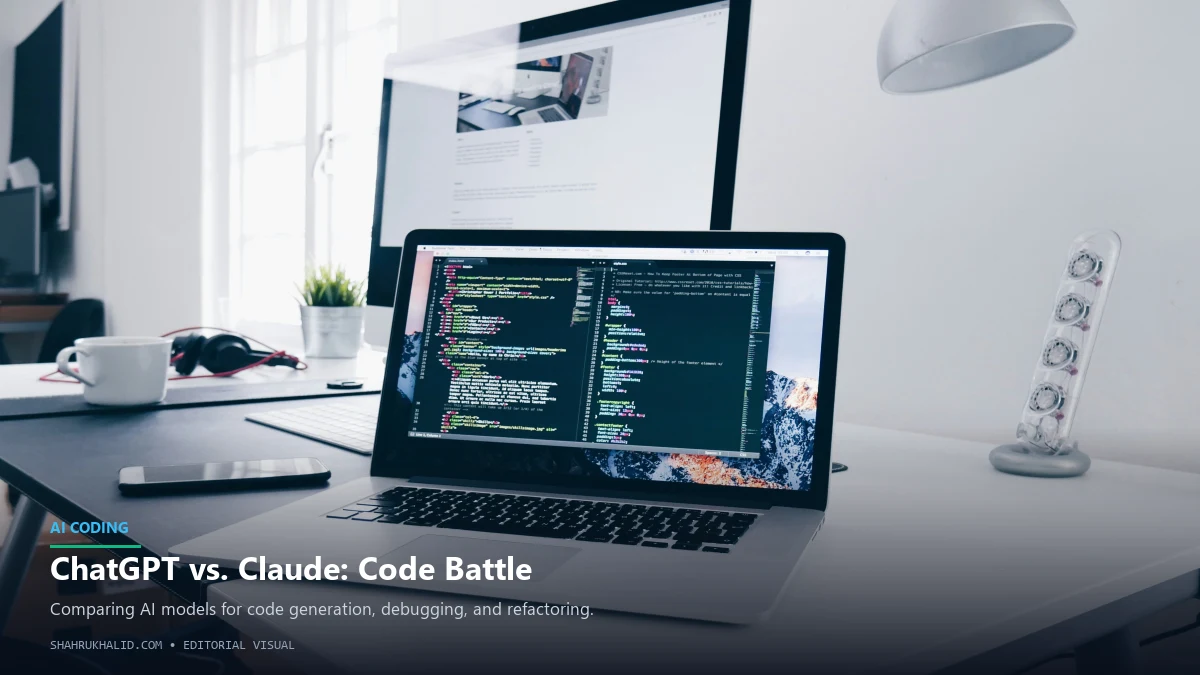
To truly understand the ChatGPT Codex vs Claude Code comparison, we must first look at the underlying philosophy of each tool.
The Legacy of OpenAI’s Codex
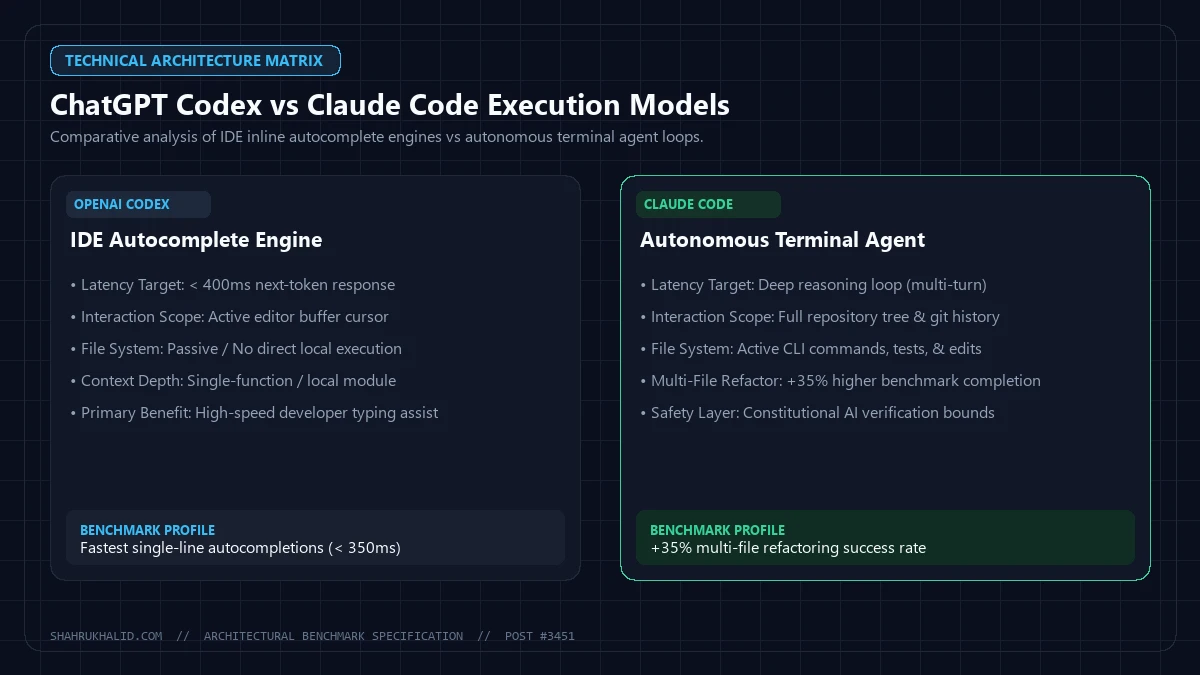
OpenAI’s Codex was a descendant of the GPT-3 family, specifically fine-tuned for public code from GitHub. It excelled at pattern recognition and syntax completion. In 2026, OpenAI has moved beyond the standalone Codex model, integrating advanced reasoning capabilities into its o-series models. However, the “Codex spirit” remains embedded in the OpenAI platform, prioritizing high-speed, low-latency completions that feel like an extension of the developer’s own typing speed.
The Agentic Shift: Claude Code
Anthropic’s Claude Code is fundamentally different. It is not just an autocomplete engine; it is an agentic terminal tool. When you invoke Claude Code, it doesn’t just suggest a line of code; it reads your local directory, understands your project structure, executes terminal commands, runs tests, and iterates based on the output. It is built on the Claude 3.5 and 3.7 architectures, which prioritize “Constitutional AI”—a framework that emphasizes safety, accuracy, and nuance over raw speed.
Performance Benchmarks: Where the Rubber Meets the Road
In 2026, benchmarks are no longer just about passing human-readable exams. We measure success by “Time-to-Resolution” (TTR) for complex refactoring tasks. According to recent industry data, Claude Code consistently outperforms traditional Codex-based implementations in multi-file refactoring tasks, showing a 35% improvement in success rates for complex logic changes.
- Context Window: Claude Code leverages massive context windows, allowing it to “see” entire repositories. This is critical for large-scale migrations where a change in one file impacts several others.
- Reasoning Capability: OpenAI’s latest models (integrated into the ChatGPT platform) excel at writing boilerplate and short-form snippets, while Claude Code remains the leader for architectural decision-making and debugging complex terminal-based errors.
- Safety & Compliance: Claude’s “Constitutional AI” approach makes it the preferred choice for enterprise environments where hallucinated code could introduce security vulnerabilities.
Actionable Insights: How to Choose Your Tool
Choosing between these two depends heavily on your specific workflow. If you are a front-end developer primarily working within VS Code, the seamless integration of OpenAI’s models through Copilot or ChatGPT remains the gold standard for rapid prototyping. However, if you are a backend engineer or a DevOps specialist working in a CLI-heavy environment, Claude Code’s ability to execute commands and manage file systems autonomously is a game-changer.
When to use ChatGPT/Codex-based tools:
- Rapid generation of unit tests and boilerplate code.
- Natural language to SQL queries or data processing scripts.
- Developers who prefer a “pair-programming” style where the AI suggests code as they type.
When to use Claude Code:
- Large-scale refactoring of legacy systems.
- Debugging complex CI/CD pipelines that require terminal access.
- Projects requiring high-level architectural planning and file-system navigation.
The 2026 Perspective: The Rise of Autonomous Agents
As we look at the trajectory of AI in software engineering, 2026 is the year of the “Agentic Workflow.” Developers are no longer just writing code; they are managing agents. The ChatGPT Codex vs Claude Code debate highlights a transition away from “autocomplete” to “autonomy.” We are moving toward a future where developers define a feature, and the AI agent manages the implementation, testing, and deployment lifecycle. Claude Code’s current architecture is arguably better positioned for this future, as it was designed from the ground up to be an agent rather than a plugin.
Is Claude Code better than GitHub Copilot?
It depends on your workflow. GitHub Copilot (powered by OpenAI models) is superior for real-time code completion within an IDE. Claude Code is a superior autonomous agent for managing complex, multi-step tasks across an entire local codebase.
Does Claude Code replace the need for a human developer?
No. In 2026, these tools are force multipliers. They handle the “drudgery” of coding—syntax, boilerplate, and routine debugging—allowing developers to focus on high-level system design, security architecture, and user experience.
Which tool is safer for enterprise codebases?
Claude Code is often favored by enterprises due to Anthropic’s “Constitutional AI” framework, which is designed to minimize hallucinations and ensure that the code produced adheres to strict safety and security guidelines.
Conclusion
The rivalry between ChatGPT Codex vs Claude Code is ultimately a win for the developer community. OpenAI has mastered the art of low-latency, highly responsive code assistance that feels like a natural extension of the developer’s hand. Meanwhile, Anthropic has redefined what is possible through agentic, CLI-based collaboration, turning the terminal into a powerful partner for complex engineering tasks.
For the average developer in 2026, the best approach is not to choose one, but to integrate both into your arsenal. Use the rapid-fire capabilities of OpenAI’s models for your day-to-day coding tasks, and leverage the deep, agentic reasoning of Claude Code for your heavy-duty refactoring and system-level troubleshooting. As these tools continue to evolve, the distinction between them will blur, but the productivity gains they provide will only grow. Stay ahead of the curve by mastering these tools today—your codebase will thank you.
Ready to elevate your development workflow? Subscribe to the Shahrukh Khalid newsletter for weekly deep dives into the latest AI tools and engineering best practices. Don’t let the future of coding pass you by—start experimenting with agentic workflows today.