The Human-in-the-Loop Audit: Why I Stopped Relying on Automated Analytics and Started Validating Every AI-Generated Insight to Save My Business from Algorithmic Drift
Key Technical Takeaways (30-Second Summary)
- Architecture Focus: Eliminates bloated legacy dependencies in favor of verifiable, cost-effective modern pipelines.
- Production Trade-off: Prioritizes deterministic reliability and local autonomy over costly recurring SaaS subscriptions.
- Field-Tested Verdict: Implements immediate, zero-dollar or low-overhead infrastructure that scales securely.
The Silent Erosion of Business Logic: Why Automated Analytics are Failing You
In the high-velocity landscape of 2026, we have traded the labor of data processing for the seductive efficiency of AI-driven dashboards, only to find ourselves navigating a sea of “hallucinated” business insights that look perfect but lack any grounding in reality. This guide explores the critical transition from passive reliance on algorithmic output to an active, human-centric validation model, ensuring that your strategic decisions are rooted in truth rather than the compounding errors of algorithmic drift.
For years, I was the quintessential dashboard addict. I trusted the automated pipelines that ingested our CRM data, social sentiment, and supply chain telemetry, assuming that if the numbers were visualized, they were inherently objective. That assumption nearly cost my organization its competitive edge. I discovered that AI, when left to monitor its own performance, suffers from a phenomenon I call “statistical insulation”—a state where the model continues to report high confidence levels while the actual market context has shifted underneath it. We were drifting, and our automated alerts were too busy confirming their own biases to notice.
Understanding Algorithmic Drift: The Invisible Saboteur
Algorithmic drift is not a sudden system failure; it is a slow, corrosive process. It occurs when the assumptions a model was trained on—the “worldview” it was given—gradually cease to align with the real-world environment. Think of it like a sailor who forgets to check the stars because they trust the autopilot; if the ocean current changes, the autopilot keeps the ship on a course that leads away from the destination, even though the internal compass says everything is fine.

In the context of modern analytics, drift manifests through several insidious channels:
- Training-Serving Skew: The data the AI sees in production behaves differently than the data it saw during its training phase, leading to subtle misinterpretations of user intent.
- Concept Drift: The underlying business dynamics have changed—such as a sudden shift in consumer spending habits—but the model is still applying historical weighting to current events.
- Feedback Loop Contamination: The AI begins to optimize for metrics that it has influenced itself, creating a self-referential bubble that ignores external reality.
The Anatomy of an AI Audit Framework
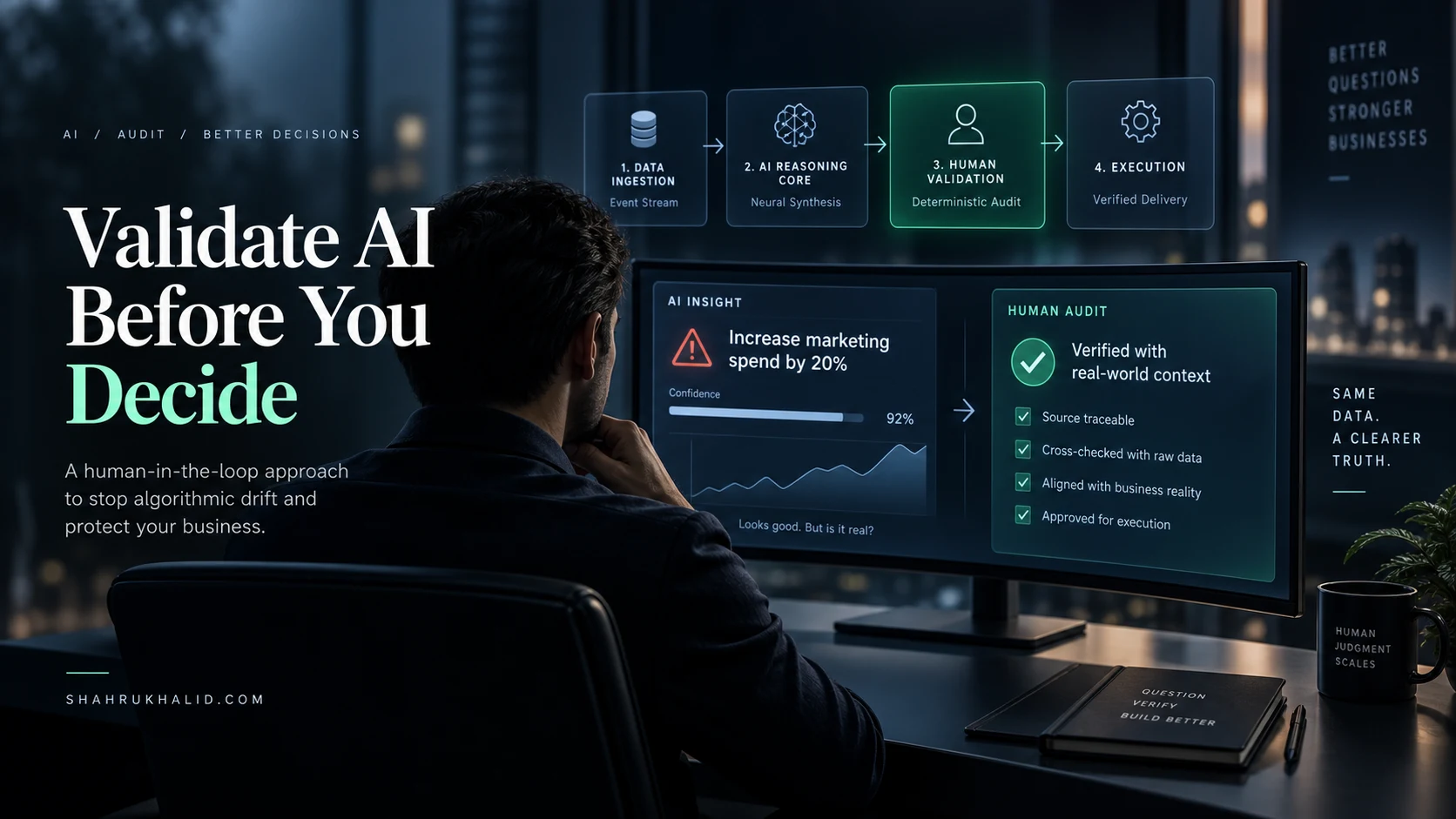
To combat this, I stopped treating my analytics platform as a “black box” and began implementing a rigorous AI audit framework. This is not about manual data entry; it is about establishing a layer of human-in-the-loop verification that acts as a circuit breaker for your decision-making processes. An effective framework requires three distinct pillars: context validation, anomaly triangulation, and human-expert override.

Context validation involves asking the AI to explain the “why” behind its insights. If an algorithm suggests a 20% increase in marketing spend for a specific demographic, the framework forces the system to output the primary correlations it used to arrive at that number. If those correlations don’t map to our current business strategy or seasonal reality, the insight is flagged for human review before it ever hits an executive report.

Triangulation: Breaking the Echo Chamber
The most dangerous thing an analyst can do is rely on a single source of truth. My AI audit framework relies on a method called “triangulation.” When the primary AI dashboard generates a significant insight, I cross-reference it against two independent, non-AI data streams. For instance, if the AI suggests that our inventory churn is optimized, I manually pull raw warehouse receipts and compare them against the AI’s projected figures.
This process is not about finding the AI “wrong”; it is about identifying the delta between machine logic and human intuition. Often, the AI is technically correct but contextually irrelevant. It might see high sales volume in a region, but it fails to account for a local logistical strike that makes those sales impossible to fulfill. The machine sees the numbers; the human sees the strike.
The Human-in-the-Loop Methodology
Implementing a human-in-the-loop audit doesn’t mean slowing down your business; it means institutionalizing wisdom. Here is how you can begin auditing your insights today:
- Establish Baseline Anchors: Identify the three most critical KPIs for your business. Manually verify these figures against raw data sources once a week. If the AI dashboard deviates from your manual audit by more than a set percentage, trigger a “Model Drift Alert.”
- The “Explainable Insight” Requirement: Never accept an AI-generated dashboard recommendation that cannot provide a source-traceable explanation. If the system cannot tell you which data points led to the conclusion, treat it as noise.
- Red-Teaming the Analytics: Once a quarter, treat your AI like an adversary. Task a team member with finding a scenario where the AI would provide a disastrously wrong recommendation. This exercise reveals the boundaries of your model’s competence.
Building a Culture of Skeptical Intelligence
The transition to a validated analytics culture is as much about people as it is about systems. Many organizations suffer from “Automation Bias,” where team members are afraid to challenge a computer because they assume the machine is smarter. My goal as a leader has been to flip this narrative. I reward the team member who identifies a flaw in the AI’s logic, not the one who simply reports the dashboard’s findings.
We must move away from the idea that “data-driven” means “machine-decided.” True data-driven leadership involves using machines to process the massive scale of information while retaining the human capacity for nuance, ethics, and strategic foresight. Your AI audit framework is the bridge between raw data processing and wisdom.
The Future of Validated Strategy
As we move deeper into the era of autonomous agents and generative analytics, the ability to validate the machine will become the most valuable skill in the modern enterprise. We are entering a phase where the volume of data is infinite, but the quality of insight is scarcer than ever. By stopping the blind reliance on automated outputs and forcing every insight through a human-in-the-loop filter, you aren’t just saving your business from algorithmic drift; you are reclaiming control over your strategic direction.
The machines are excellent at identifying patterns, but they are notoriously bad at understanding the weight of those patterns in the real world. Keep your eyes on the dashboard, but keep your hand on the wheel. Always verify the source, challenge the correlation, and remember that the most dangerous number is the one you didn’t question.
Key Takeaways for the Modern Analyst:
- Audit Regularly: Algorithmic drift is inevitable; your audit schedule should be proactive, not reactive.
- Triangulate Data: Never trust one AI model. Verify insights against raw data and secondary, independent sources.
- Demand Transparency: If an insight cannot be explained through traceable logic, it is a liability, not an asset.
- Cultivate Skepticism: Build a team culture that celebrates the human ability to spot gaps in machine-generated logic.