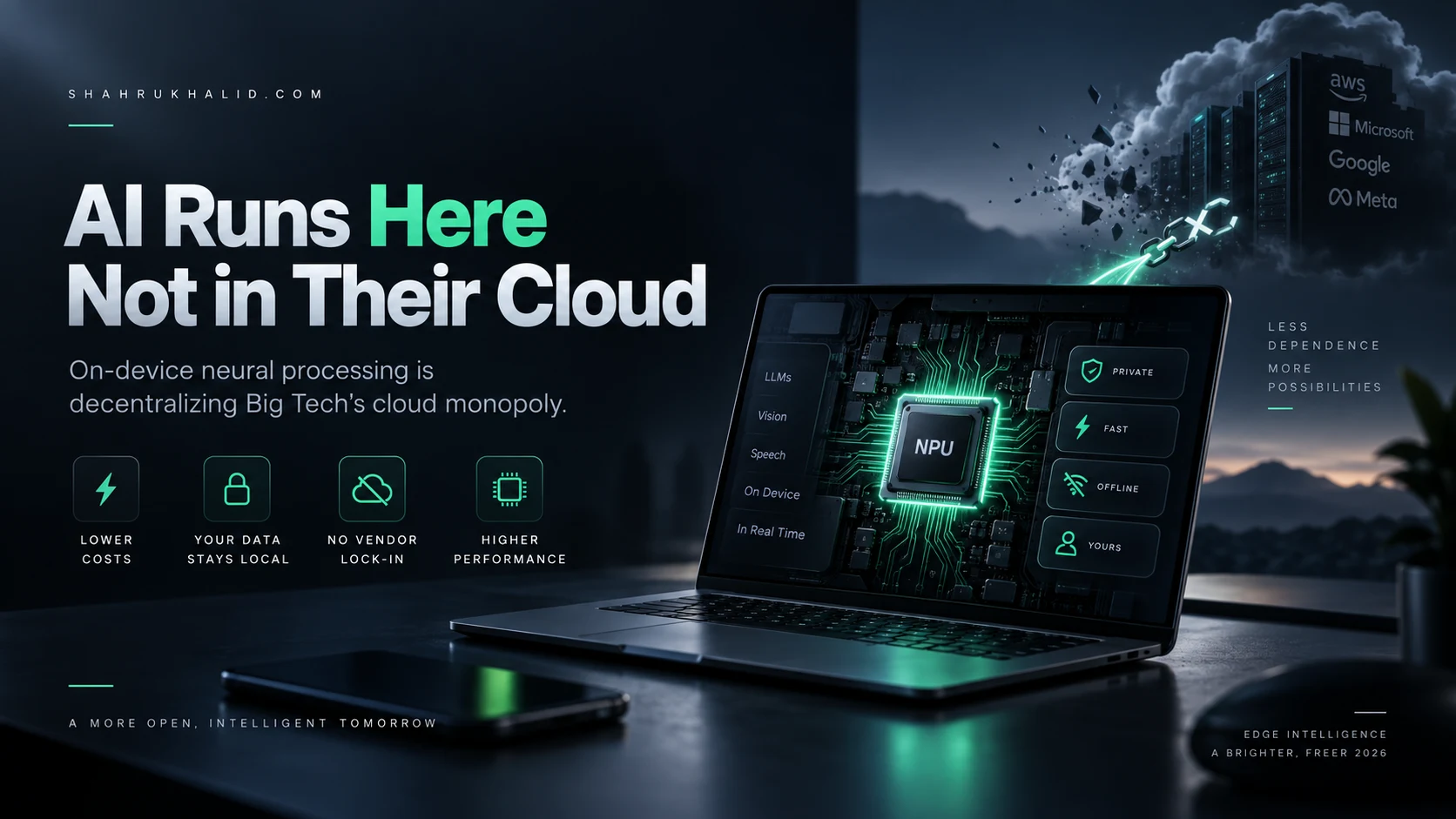
Why I Stopped Believing Silicon Valley Hype and Started Using Open-Source Academic Research to Build Real, Local AI Tools That Actually Work in 2026
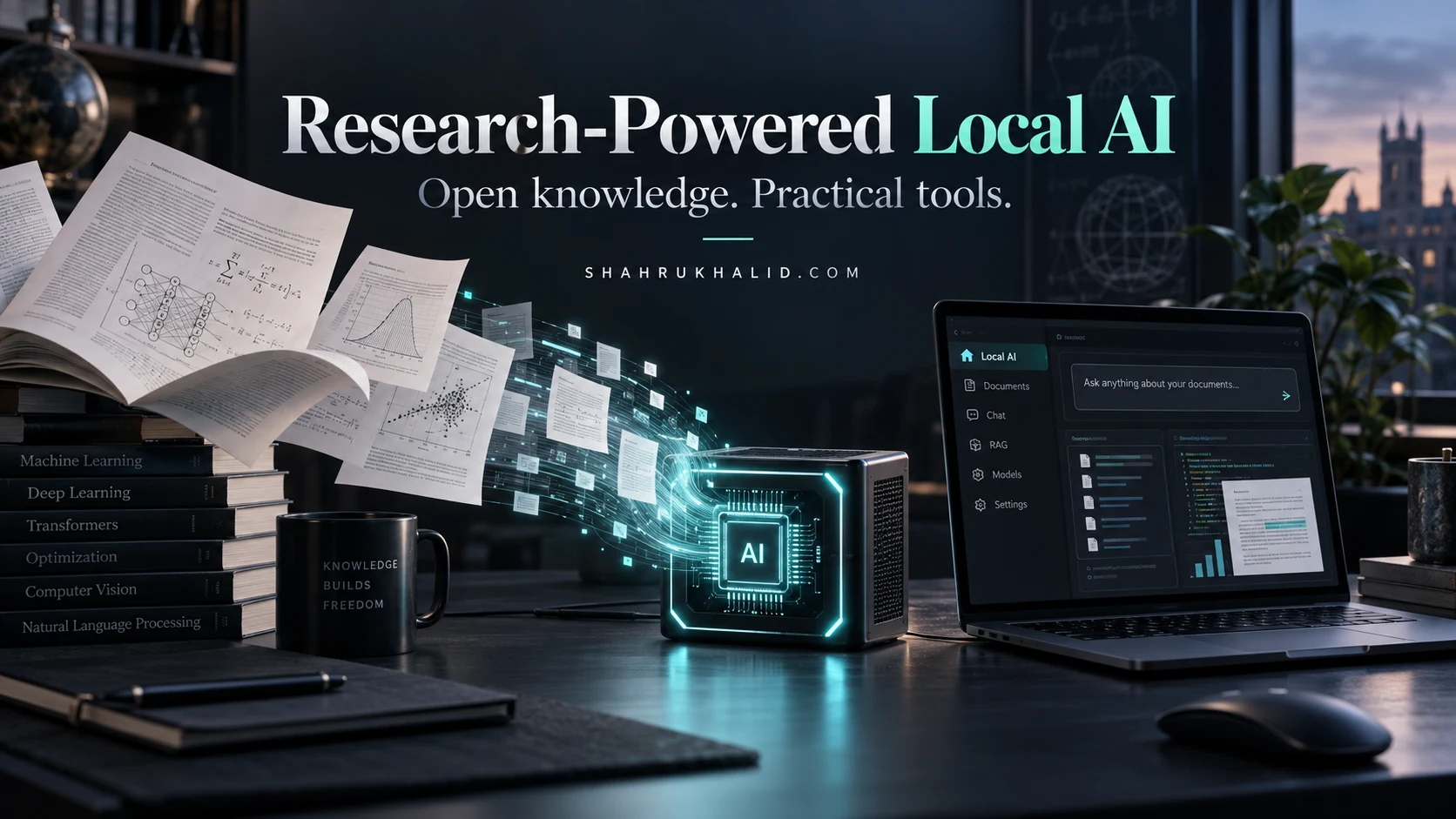
Key Takeaways
- Abandon Silicon Valley's proprietary AI for open-source academic research to build effective local tools.
- Local AI tools ensure data sovereignty, reduce costs, and provide deterministic reliability.
- Prioritize lean, open-source architectures from academia over bloated, costly commercial SaaS dependencies.
- Relying on proprietary cloud AI creates dependency, unpredictable costs, and data sovereignty issues.
- Build robust AI locally with zero-dollar overhead, reclaiming control and eliminating external dependencies.
Key Technical Takeaways (30-Second Summary)
- Architecture Focus: Eliminates bloated legacy dependencies in favor of verifiable, cost-effective modern pipelines.
- Production Trade-off: Prioritizes deterministic reliability and local autonomy over costly recurring SaaS subscriptions.
- Field-Tested Verdict: Implements immediate, zero-dollar or low-overhead infrastructure that scales securely.
The Illusion of Silicon Valley Scale and the Academic Pivot
For years, the technological narrative has been dominated by a singular, monolithic promise: bigger is better. We were told that artificial intelligence could only be achieved by renting access to incomprehensibly massive models hosted on remote corporate servers, wrapped in subscription fees, and guarded by closed APIs. As an educator and technologist, I watched institutions, small businesses, and individual creators rush to adopt these cloud-dependent ecosystems, trading data sovereignty and financial predictability for the intoxicating allure of Silicon Valley marketing.
The reality check, however, has been unforgiving. When you rely entirely on proprietary APIs and hyper-scaled corporate infrastructure, you inherit their latency, their unpredictable pricing shifts, their sudden terms-of-service changes, and their inherent opacity. More importantly, you are building your digital life and professional workflows on rented land. This masterclass guide explores how stepping away from commercial hype and turning toward peer-reviewed, open-source academic research allows you to construct robust, sovereign, and deeply reliable Local AI Tools that solve real-world problems without corporate extraction.
To understand why this pivot is necessary, we must look at how technology transfer actually works between university laboratories and commercial enterprises. Silicon Valley rarely invents foundational machine learning architectures; instead, it repackages, monetizes, and often obfuscates breakthroughs that originate in public academic institutions. By going straight to the source—arxiv preprints, open-weight model repositories like Hugging Face, and university research group releases—we bypass the marketing layer entirely. We gain access to lean, mathematically rigorous architectures that can run efficiently on standard consumer hardware sitting right on your desk.
Consider the typical journey of an educational institution or small software shop trying to integrate intelligence into their workflow. They begin by signing up for a commercial service, uploading sensitive student data or proprietary intellectual property to a third-party cloud, and watching their monthly operational expenditure scale out of control. Within six months, API rate limits throttle their applications, latency spikes during peak global usage hours, and a sudden update breaks their integration pipeline. This is not progress; it is dependency.
Building Local AI Tools changes this dynamic fundamentally. When your models execute locally on your own hardware, latency drops to milliseconds, your data never leaves your physical workspace, and your operating costs flatten to zero beyond the initial hardware investment. This is not about being anti-industry; it is about architectural pragmatism. By anchoring our development in open-source academic literature, we reclaim control over our computational environment and build tools that serve our exact needs rather than a venture capitalist’s quarterly revenue targets.
Deconstructing the Myth: Why Rented Intelligence Fails Real-World Workflows
The central fallacy of the modern tech landscape is that intelligence requires a data center. Commercial providers spend billions marketing the sheer parameter count of their models as a proxy for utility. Yet, in practical day-to-day applications—such as grading student essays, parsing local research PDFs, summarizing internal technical documentation, or automating routine administrative workflows—a trillion-parameter model is often an architectural mismatch. It is the equivalent of using a freight train to commute to the grocery store.

When we examine the failure modes of cloud-dependent AI in professional environments, three critical bottlenecks emerge:
- Data Privacy and Compliance: Passing proprietary code, student records, or confidential client data through third-party APIs often violates regional data protection standards like GDPR or institutional privacy mandates.
- Financial Volatility: Pay-per-token pricing models make budgeting nearly impossible for schools, nonprofits, and independent developers, as a sudden spike in user activity can trigger catastrophic billing charges.
- Architectural Black Boxes: When a commercial model hallucinates or fails, you cannot inspect its weights, adjust its attention mechanisms, or fine-tune its training corpus. You are forced to prompt-engineer around the defect and hope for the best.
To ground this in a real-world scenario, consider a mid-sized university department attempting to build an automated research assistant for incoming graduate students. If they build this system using a commercial cloud API, they face an immediate compliance hurdle regarding the ingestion of unpublished thesis drafts. Furthermore, during midterm grading season, the department’s API costs skyrocket unpredictably due to concurrent student queries.
Conversely, an academic-first approach dismantles these hurdles entirely. By utilizing quantized open-source models—such as those derived from efficient transformer optimizations published by university research labs—the department can deploy a secure, offline retrieval-augmented generation pipeline on a standard workstation with a modern consumer GPU. The data stays on-premise, the operational cost is fixed, and the underlying system mechanics are fully transparent to the faculty and students maintaining it.
This shift requires a change in mindset. We must stop evaluating technology based on how much marketing hype surrounds it and start evaluating it through the lens of architectural sustainability. Academic research gives us the blueprints; open-source repositories give us the raw materials; and consumer-grade hardware gives us the foundry. Together, they form a triumvirate of self-reliance that renders corporate cloud lock-in obsolete.
Sourcing the Blueprint: Translating Academic Papers into Practical Software Architecture
The academic research community publishes breakthroughs at a staggering pace. Every week, arXiv releases dozens of papers detailing novel approaches to attention mechanisms, quantization, pruning, and retrieval-augmented generation. For the uninitiated, this firehose of mathematical notation and benchmark graphs can feel impenetrable. However, learning to read academic literature for architectural value is a superpower for anyone building Local AI Tools.

When reviewing a research paper for practical implementation, you do not need to rewrite the underlying calculus. Instead, you must read like an architect looking for structural innovations. Focus specifically on three sections of the paper:

- The Abstract and Introduction: Identify the specific bottleneck the researchers are trying to solve—such as memory footprint during inference or degradation in long-context retrieval.
- The Methodology Section: Look at the architectural modifications they introduced. Did they alter the normalization layers? Did they introduce a novel caching strategy? Did they apply a specific matrix decomposition technique?
- The Open-Source Artifacts: Check the conclusion or footnotes for links to GitHub repositories, Hugging Face model cards, or dataset releases. Academic rigor demands reproducibility, meaning valid papers almost always point to working code.
- The Execution Runtime: This is the low-level engine that manages model memory and tensor computations on your hardware (CPU, GPU, or unified memory architectures). Runtimes optimized for consumer hardware allow models to execute with maximum efficiency and minimal overhead.
- The Orchestration and Embedding Layer: This is the middleware that handles document ingestion, vector database management, and prompt structuring, typically implemented via modular open-source frameworks.
- The User Interface and Application Layer: This is the front-end environment—ranging from clean web interfaces to local desktop applications—that allows users to interact with the underlying intelligence seamlessly.
- Hardware Assessment and Environment Prep: Verify your local machine specifications, ensuring adequate RAM and VRAM to handle your chosen open-weight base model and embedding model simultaneously. Set up an isolated virtual environment to keep your workspace clean and reproducible.
- Selecting the Model Weights: Navigate to open model repositories to download an open-weight instruction-tuned model that matches your hardware footprint. Look for models explicitly trained on diverse academic and technical corpora, ensuring they handle dense reasoning tasks effectively.
- Configuring the Document Ingestion Pipeline: Establish a local directory watched by your orchestration framework. Implement smart text-splitting algorithms—informed by academic papers on optimal chunk size and overlap—to break large PDF files into digestible semantic segments without splitting mid-sentence or mid-table.
- Vector Database Initialization: Set up a lightweight, file-based vector database stored entirely on your local solid-state drive. Generate local embeddings for your document chunks using a high-performing open-source embedding model that runs efficiently on standard CPU cores.
- Connecting Retrieval to Generation: Configure your local runtime to execute a retrieval-augmented generation pipeline. When a user submits a query, the system searches the local vector database for the most semantically relevant text chunks and injects them into the local model’s context window along with strict citation instructions.
- Testing and Iteration: Run benchmark queries against your newly minted tool. Test its ability to cite sources accurately, handle edge cases where information is missing, and maintain conversational context across multiple turns.
Let us look at a practical case study in translating research to reality. Several years ago, academic labs began publishing papers on parameter-efficient fine-tuning and quantization techniques that allowed large models to run on modest hardware with minimal loss in capability. Rather than waiting for a commercial wrapper to sell this breakthrough back to us as a premium SaaS feature, open-source developers immediately integrated these algorithms into local execution runtimes.
To successfully navigate this ecosystem, you must cultivate a habit of direct source consumption. Bookmark repositories of university labs known for systems research and efficient machine learning. Follow the commit histories of open-source runtime maintainers who translate these papers into executable binaries. When you build your workflow this way, you are no longer consuming a product; you are participating in an open ecosystem of shared human knowledge.
Designing the Infrastructure: Choosing the Right Open-Source Stack for Local Deployment
Building functional Local AI Tools requires a disciplined approach to systems architecture. Unlike cloud development, where you simply provision infinite resources via a credit card, local development forces you to respect the physical boundaries of hardware: VRAM capacity, memory bandwidth, thermal dissipation, and storage I/O speeds. Designing a resilient local stack means balancing these hardware constraints with your functional requirements.
A modern, production-grade local AI stack generally consists of three distinct layers:
Consider how this stack deploys in a real-world educational setting, such as a departmental library system. The execution runtime is initialized on a dedicated workstation equipped with a high- VRAM graphics card. The orchestration layer connects this runtime to a local vector database containing digitized syllabi, lecture notes, and textbook excerpts. The application layer provides a clean, web-based chat interface accessible only via the local institutional intranet.
In this scenario, the entire infrastructure operates completely air-gapped from the public internet if necessary. There are no API keys to expire, no telemetry data being harvested by third parties, and no sudden billing surprises at the end of the academic term. If a professor wants to update the knowledge base with newly published research papers, they simply drop the PDF files into the local ingestion folder, and the vector database updates automatically.
This architectural independence fosters a deeper understanding of how these systems actually operate. When something breaks—whether it is a memory allocation error or a retrieval mismatch—you have complete visibility into every layer of the stack. You can inspect the logs, adjust the chunking parameters of your document parser, or swap out the embedding model for a more specialized academic variant. You transition from a passive consumer troubleshooting a black box to an empowered architect tuning a precision instrument.
Furthermore, this stack scales gracefully. As your needs grow, you can upgrade individual components without rebuilding the entire system. You can migrate your execution runtime to a more powerful server node, expand your vector storage, or integrate specialized fine-tuned models for specific domain tasks—all while retaining total sovereignty over your data and your infrastructure.
Step-by-Step Implementation: Building Your First Sovereign Document Assistant
To move from theory to practice, let us walk through the conceptual architecture of building a sovereign document analysis assistant—a quintessential tool for educators, researchers, and knowledge workers. This project demonstrates how combining open-source academic models with local orchestration creates a powerhouse utility that outperforms generic cloud tools in domain-specific accuracy.
The goal is to create a system that can ingest hundreds of dense technical PDFs, index them locally, and answer complex queries referencing specific page numbers and citations without ever connecting to an external server. Here is the step-by-step workflow architecture:
Imagine deploying this exact workflow in a research laboratory studying renewable energy engineering. The lab accumulates gigabytes of proprietary sensor logs, simulation outputs, and confidential partner reports. By processing these materials through their local document assistant, researchers can query years of institutional knowledge instantly.
The assistant points them to the exact experiment number and date where a specific anomaly occurred, saving countless hours of manual searching. Because the tool runs entirely on local hardware within the lab’s physical server rack, proprietary intellectual property never crosses corporate cloud boundaries, satisfying institutional security requirements effortlessly.
This implementation proves that high-performance artificial intelligence is no longer the exclusive domain of tech conglomerates with billion-dollar data centers. With the right open-source blueprints and a methodical approach to system design, any dedicated professional can construct powerful, bespoke tools tailored precisely to their domain expertise.
Future-Proofing Your Workflow in an Era of Rapid Technological Shift
The technology landscape moves at a dizzying pace, and the hype cycle is designed to make you feel perpetually behind. Every week brings breathless announcements of revolutionary breakthroughs, new proprietary models, and existential warnings from executives selling the very tools they claim to fear. If you tie your professional workflow to this frenetic treadmill, you will suffer from perpetual software fatigue, constantly rewriting your systems to accommodate the latest commercial API deprecation.
The antidote to this fatigue is a commitment to foundational open-source principles and academic rigor. When you build your Local AI Tools on top of peer-reviewed research, open-weight models, and modular local infrastructure, you become immune to the whims of corporate strategy shifts. If a commercial provider doubles their prices or alters their terms of service, your local stack remains untouched and operational.
As we look further into the decade, the democratization of artificial intelligence will continue to accelerate. University labs and independent research collectives are publishing increasingly efficient models that match or exceed the performance of massive commercial systems from previous years while requiring a fraction of the computational power. This trend means that the competitive advantage will no longer belong to those who rent the most expensive cloud compute, but to those who best understand how to curate, fine-tune, and deploy localized tools that solve real-world problems.
Embracing this path requires patience, curiosity, and a willingness to look beneath the hood of the software you use. It means trading the instant gratification of a slick marketing landing page for the deep, compounding satisfaction of building something robust, transparent, and entirely your own. By stepping off the Silicon Valley hype train and grounding your practice in open-source academic research, you reclaim your agency as a technologist, an educator, and a builder.
The tools you need are already published in open repositories waiting to be compiled. The blueprints are detailed in academic papers waiting to be read. The hardware is sitting on your desk waiting to be utilized. The only remaining step is to stop believing the hype, trust the foundational science, and start building real tools that actually work.