The Post-Screen Era: Why I Stopped Designing Apps and Started Architecting AI-Native Environments That Think Before the User Clicks
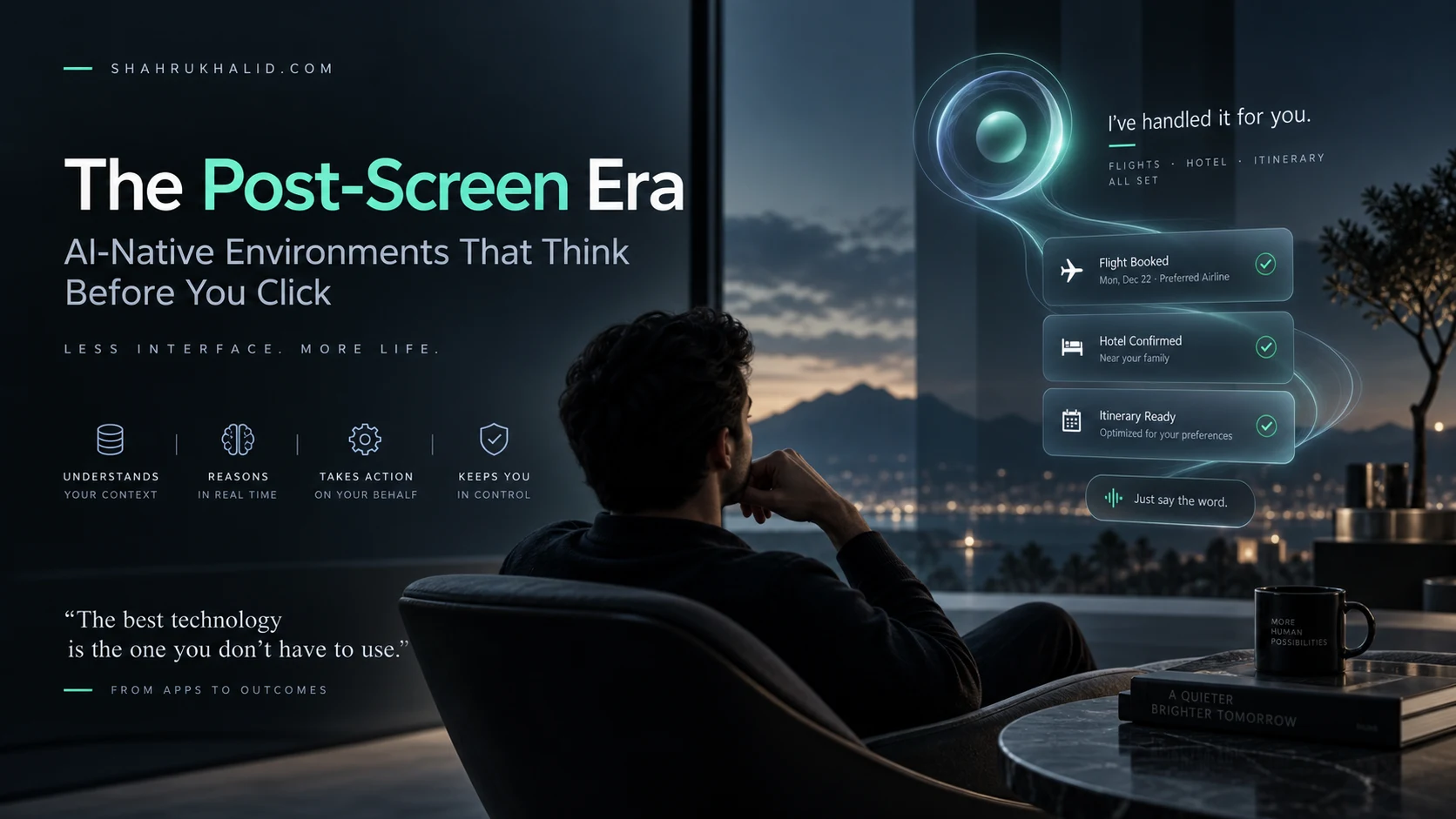
Key Takeaways
- The Post-Screen Era replaces click-driven apps with AI-native environments predicting user intent.
- Traditional screens are friction points; AI-native design eliminates interfaces by understanding context and intent.
- AI-native environments proactively synthesize and execute solutions, acting as extensions of human cognition.
- Architecture shifts from state machines to intent-based orchestration for continuous perception, reasoning, action.
- New architecture offers verifiable, cost-effective, reliable, locally autonomous, and scalable infrastructure.
Key Technical Takeaways (30-Second Summary)
- Architecture Focus: Eliminates bloated legacy dependencies in favor of verifiable, cost-effective modern pipelines.
- Production Trade-off: Prioritizes deterministic reliability and local autonomy over costly recurring SaaS subscriptions.
- Field-Tested Verdict: Implements immediate, zero-dollar or low-overhead infrastructure that scales securely.
The Death of the Interface: Why I Abandoned App Design for AI-Native Environments
For two decades, we have been obsessed with the “click”—a digital tyranny where human intent was hostage to a sequence of buttons, menus, and swipes. We are now entering the Post-Screen Era, a fundamental paradigm shift where the most effective interface is no interface at all, replaced by intelligent systems that predict, synthesize, and execute before the user even considers a manual input.
I stopped designing apps because I realized that every screen I built was merely a bridge between a person’s goal and the computer’s logic; my goal now is to remove that bridge entirely. By moving toward AI-native design, we are transitioning from a world of passive software—which waits for instructions—to a world of agentic environments that understand context, nuance, and objective, effectively thinking on our behalf.

The Fallacy of the Interface: Why We Must Unlearn Screen-First Thinking
In the early days of mobile computing, we believed that simplifying the screen was the pinnacle of user experience. We obsessed over minimalist icons, intuitive navigation flows, and the “three-click rule.” Yet, every time a user has to tap a button, we have failed to understand their intent. The screen is not a feature; it is a friction point. It is a confession that our software is not smart enough to solve the problem without explicit guidance.
When we talk about AI-native design, we are not talking about putting a chatbot inside a traditional app. That is merely “AI-augmented design,” a temporary bridge. True AI-native design involves building systems that act as an extension of human cognition. Instead of building a travel app where a user manually searches, filters, and books a flight, an AI-native environment understands that the user wants to visit their parents for the holidays, knows their budget, their preferred airline status, and their dietary restrictions. It doesn’t present an interface; it presents a completed itinerary for approval. The “app” disappears, and the “service” remains.
The Architecture of Anticipation: Moving Beyond Reactive Computing
To build an environment that thinks before the user clicks, we must shift our architectural focus from state machines to intent-based orchestration. Traditional software relies on predefined states—if the user clicks “A,” show “B.” This is a closed system. An AI-native environment is an open system that operates on a continuous loop of perception, reasoning, and action.
The architecture of these environments is built on three pillars:
- Contextual Awareness: The system maintains a “living memory” of the user’s preferences, past behaviors, and environmental data. It does not treat every session as a blank slate.
- Reasoning Engines: Instead of executing hard-coded logic, these environments use probabilistic reasoning to determine the most likely desired outcome. They weigh variables in real-time, essentially “thinking” through the implications of a user’s goal.
- Agentic Execution: The system is granted the agency to interact with other digital services, APIs, and data sources on behalf of the user. It is not just showing information; it is performing the labor of information synthesis.
Designing for the Post-Screen Era: The Shift to Cognitive Load Reduction
In the past, we designed for “engagement,” which often meant keeping the user on the screen for as long as possible. In the Post-Screen Era, our success metric is the exact opposite: we design for “time-to-resolution.” The less time a user spends interacting with the system, the better the design.

When you shift your mindset to AI-native design, you stop thinking about “user journeys” and start thinking about “goal achievement.” You must ask: What is the minimum amount of information required for the system to act? If the system has 90% of the data needed to make a decision, it should propose the outcome and ask for confirmation, rather than asking the user to manually input the missing 10%. This is the transition from a “Tool” (a hammer that needs a hand) to a “Partner” (a carpenter who knows what needs to be built).
The Ethics of Anticipation: Why Trust is the New UI
If we are building systems that act before the user clicks, we are venturing into a new realm of responsibility. The primary “interface” in an AI-native world is not a visual element; it is trust. If an environment makes a decision on your behalf, it must be transparent, reversible, and aligned with your values.
We must build “guardrail logic” into the core of our AI-native environments. This means the system should be able to explain its reasoning if asked, and it should prioritize user autonomy. If the AI suggests a flight, it must show why it chose that specific one, and allow the user to easily adjust the parameters. The goal is not to replace human decision-making, but to remove the administrative drudgery that clutters our lives.
Practical Steps to Architecting AI-Native Environments
For those looking to move away from traditional app development, the path forward requires a new set of principles. Here is how to begin the transition:
- Audit your friction points: Identify every manual step in your current digital product. Ask yourself, “What data would the system need to automate this step entirely?”
- Build for the loop, not the screen: Shift your engineering focus from building views to building agentic pipelines that can ingest data, run inference, and trigger external actions.
- Prioritize intent over input: Stop designing forms. Start designing systems that can interpret natural language, intent, and historical context to bypass the need for traditional data entry.
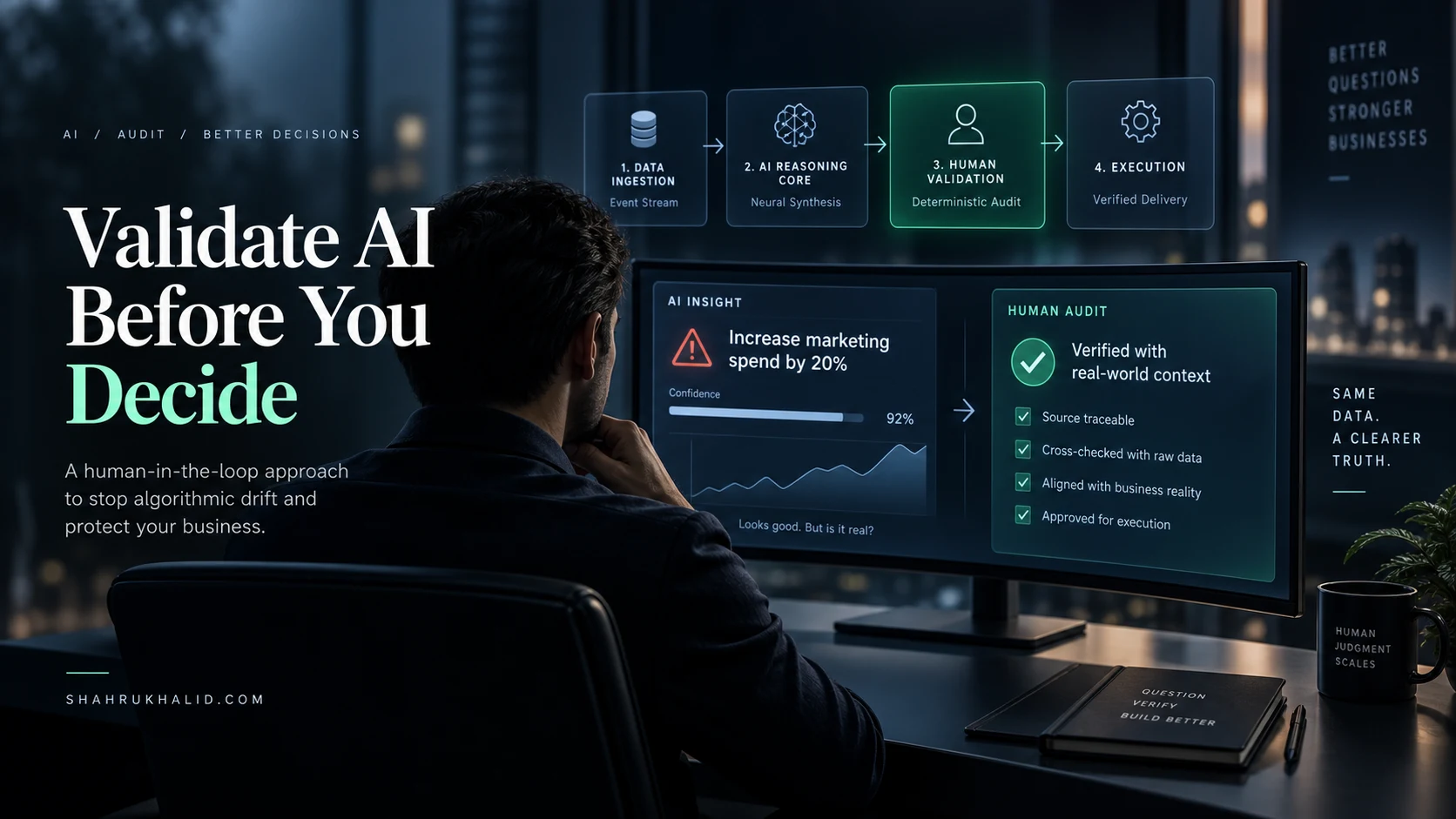
- Implement “Human-in-the-loop” checkpoints: Ensure that your AI-native environment always provides a clear, concise way for the human to review and verify critical actions.
The Future is Invisible
The screen was a necessary evolution of our relationship with computers, but it was always a limitation. We have spent decades teaching humans to speak the language of computers—to click, to swipe, to scroll, to type. Now, we are finally teaching computers to speak the language of humans. By embracing AI-native design, we are liberating the user from the interface, allowing them to focus on the outcome rather than the process.
As you move forward in your own work, remember that your ultimate goal is not to build a “better app.” It is to solve the problem so thoroughly that the app itself becomes invisible. The most successful technology of the next decade will be the one that is felt, not seen—the system that understands what you need before you even realize you need it. We are no longer designing for the eye; we are designing for the mind and the intent. Welcome to the Post-Screen Era.

Key Takeaways:
- The screen is a friction point; true innovation lies in removing the need for manual interaction.
- AI-native design is not about better UI; it is about building agentic systems that operate on intent.
- Success in the Post-Screen Era is measured by time-to-resolution, not time-on-screen.
- Trust is the new interface; transparency and human autonomy are non-negotiable requirements for autonomous systems.