Why I Stopped Writing Code and Started Orchestrating Intent: A Beginner’s Guide to Programming in 2026
Key Takeaways
- Developers now orchestrate intent and design architecture, as AI handles mechanical coding tasks.
- The bottleneck shifted from coding to requirements clarity, edge-case anticipation, and system security.
- AI acts as a junior assistant; humans are principal engineers validating logic and defining constraints.
- New architecture prioritizes verifiable, cost-effective pipelines, deterministic reliability, and local autonomy.
- Value as a creator is defined by precise instructions and governing AI agent behaviors.
Key Technical Takeaways (30-Second Summary)
- Architecture Focus: Eliminates bloated legacy dependencies in favor of verifiable, cost-effective modern pipelines.
- Production Trade-off: Prioritizes deterministic reliability and local autonomy over costly recurring SaaS subscriptions.
- Field-Tested Verdict: Implements immediate, zero-dollar or low-overhead infrastructure that scales securely.
The Paradigm Shift: From Syntax Mechanics to Architectural Intent
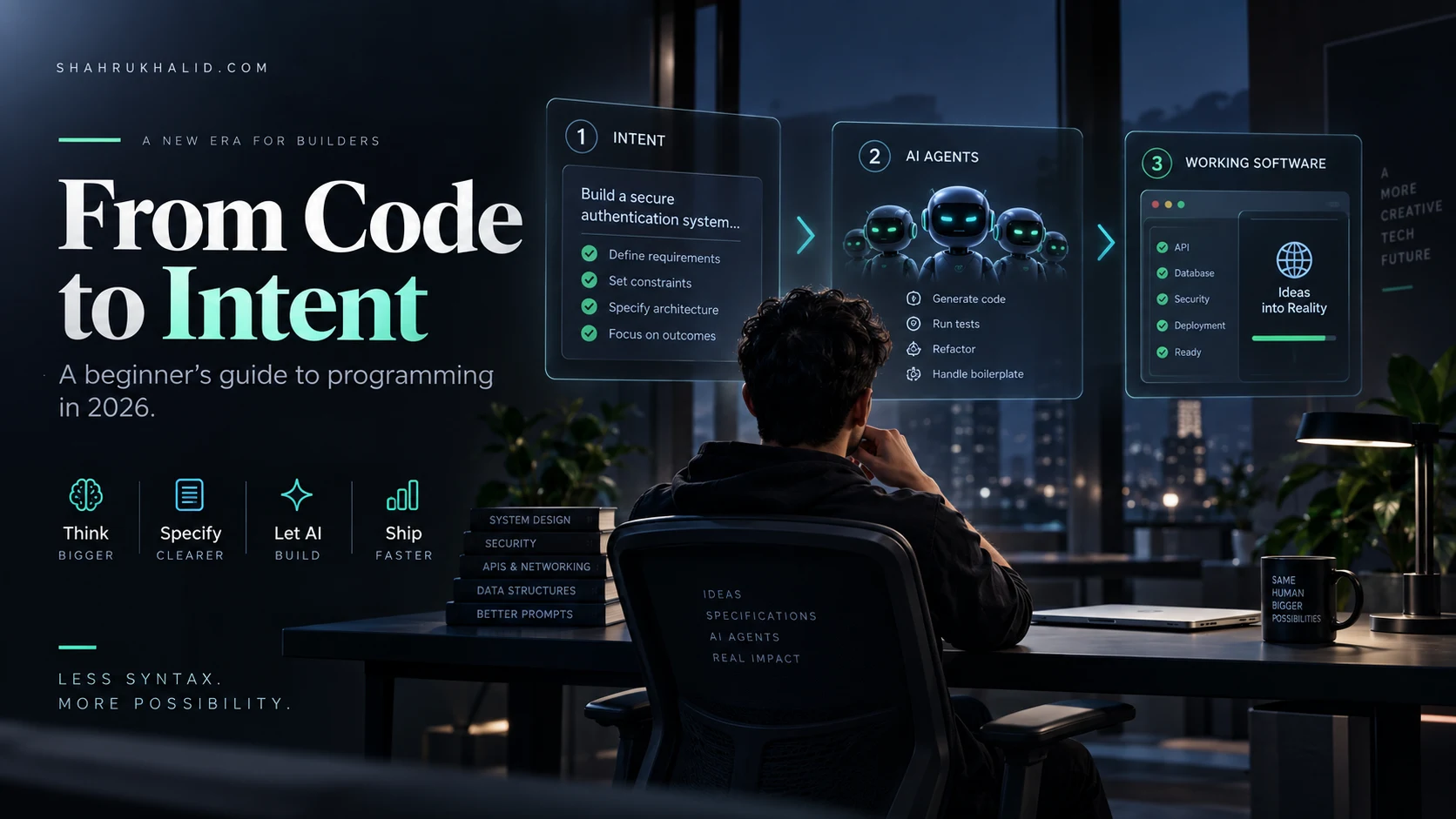
The role of the developer has fundamentally shifted. For decades, learning how to build software meant memorizing syntax, managing memory allocations, wrestling with arcane compiler errors, and manually writing boilerplate loops. Today, advanced artificial intelligence handles these mechanical operations with near-instantaneous speed. This evolution does not mean developers are obsolete; rather, it means our focus has elevated from writing code to orchestrating intent. When building software via programming in 2026, human operators act as systems architects, design directors, and logic validators, directing autonomous agents to execute the underlying syntax.
This masterclass guide explores this structural transformation. We will examine why traditional coding is giving way to high-level system orchestration, how beginners can enter the tech landscape without getting bogged down in semicolon placement, and what skills actually matter when AI writes the code. By treating AI as a junior assistant and yourself as the principal engineer, you unlock a fundamentally different way of building digital products. You no longer translate your thoughts into machine-readable syntax character by character; instead, you define constraints, validate outputs, and govern system behaviors.
Understanding this transition requires looking at software development not as an exercise in typing, but as an exercise in logical problem-solving and domain modeling. As syntax becomes a solved problem, the bottleneck in software engineering shifts entirely to requirements clarity, edge-case anticipation, and system security. Let us deconstruct how beginners can navigate this brave new world, turning the complexity of modern architecture into a distinct competitive advantage.
Understanding the Shift: Why Writing Code is No Longer the Bottleneck
For a long time, the primary friction in software development was translation latency—the time it took for a human to translate a business requirement into working, syntax-error-free programming code. If you wanted to build a user authentication service, you had to write database migration scripts, configure routing handlers, implement hashing algorithms, and wire up error-handling mechanisms line by line. Each of these steps required specialized knowledge of language-specific frameworks and ecosystem quirks.

Today, foundation models and specialized coding agents can generate entire modules, write automated test suites, and refactor legacy codebases in seconds. The bottleneck has officially migrated from implementation to specification. If your instructions to an AI agent are vague, incomplete, or logically flawed, the resulting software will be equally flawed, regardless of how fast the machine types. This is the core premise of programming in 2026: your value as a creator is defined by the precision of your intent, not the volume of your code output.
Consider the traditional learning curve versus the modern trajectory:
-
Traditional Coding Curve:
- Months spent learning syntax rules, variable scopes, and compiler quirks.
- Hours spent tracking down missing semicolons, unmatched brackets, and typos.
- Slow progression toward building actual functional products because the mechanics consume all available cognitive bandwidth.
- Days spent learning how to break down complex problems into clear, logical components.
- Focus on system architecture, data flow, security paradigms, and user experience.
- Rapid prototyping where AI agents handle the mechanical translation while the human guides the strategic direction.
Intent Orchestration Curve:
This shift does not eliminate the need to understand how computers work. In fact, it raises the baseline. To successfully direct an autonomous coding agent, you must understand database normalization, API design principles, and cybersecurity fundamentals well enough to review and validate the AI’s output. If you cannot spot a security vulnerability or a memory leak in generated code, you cannot safely ship it to production.
| Development Phase | Traditional Approach (Pre-AI Era) | Orchestration Approach (Programming in 2026) |
|---|---|---|
| Syntax & Boilerplate | Manually written line by line; high time investment. | Generated instantly via natural language prompts and context windows. |
| Debugging | Stepping through logs, searching forums, manual trial and error. | Feeding error stacks back into autonomous agents with targeted constraints. |
| Architecture | Designed upfront; rigid and difficult to alter once code is written. | Fluid and iterative; easily refactored by instructing AI across the codebase. |
| Primary Human Skill | Syntax memorization, framework fluency, typing speed. | System design, logic validation, prompt engineering, security auditing. |
The Anatomy of Intent: Moving from Syntax to Specification
When you stop writing code and start orchestrating intent, your primary tool is no longer a text editor configured with complex linters; it is clear, unambiguous specification. Writing a good specification requires a shift in mindset. You must learn to think like a product manager, a security auditor, and a systems architect simultaneously. When you give instructions to an AI agent, every ambiguity you leave open becomes a gamble the AI has to take on your behalf.

To master this, you must learn how to structure your intent into discrete, verifiable layers. Let us look at how an intent-driven specification differs from a casual prompt. A casual prompt says: “Build me a login page.” An intent-driven specification defines the data schema, the security requirements, the failure states, and the user experience constraints in explicit detail.
# System Specification: Secure Authentication Module
## Objective
Implement a token-based authentication service using JSON Web Tokens (JWT) with secure HTTP-only cookie storage.
## Functional Requirements
1. User registration with email validation and Argon2 password hashing.
2. Login endpoint issuing a short-lived access token (15 minutes) and a long-lived refresh token (7 days).
3. Rate limiting on the login route: maximum 5 attempts per IP address per 15-minute window.
## Security Constraints
- Passwords must never be stored in plain text or logged to standard output.
- All incoming requests must sanitize input payloads to prevent SQL injection and cross-site scripting (XSS).
- CORS policies must restrict API access to approved frontend domains.
## Acceptance Criteria
- Automated test suite must pass with 90% code coverage.
- Invalid token attempts must return a standardized 401 Unauthorized JSON response.
By providing this level of granular intent, you give the AI coding agent a concrete boundary within which to operate. You are no longer crossing your fingers and hoping the machine guesses what you want; you are engineering the constraints of the solution before a single line of code is materialized.
This approach transforms debugging as well. When an error occurs, you do not look at the syntax to find a missing comma; you examine the specification to see where your constraints were violated or where an edge case was missed. You then update the specification, feed it back into your development environment, and let the agent refactor the implementation accordingly.
Foundational Knowledge Still Matters: What Beginners Must Actually Learn
A common misconception among absolute beginners is that because AI writes the code, you do not need to understand computer science fundamentals. This is dangerously false. If you do not understand how data structures work, how networks communicate via TCP/IP, or how relational databases enforce foreign key constraints, you will be entirely incapable of evaluating whether an AI-generated system is robust, scalable, or secure.
When approaching programming in 2026, your educational roadmap shifts away from memorizing language syntax and toward mastering core architectural concepts. You must learn how to read code fluently, even if you rarely write it from scratch. Reading code is an analytical skill; writing code is a generative skill. In the age of orchestration, reading and validation are vastly more important.
Here are the foundational pillars every beginner must prioritize:
-
1. Systems Logic and Data Structures: You need to know when to use an array, a hash map, a queue, or a tree. Even if an AI generates the implementation, you must specify the correct data structure to ensure optimal time and space complexity for your application.
2. Networking and API Design: Modern software is distributed. You must understand HTTP methods, status codes, RESTful conventions, WebSockets, and asynchronous event-driven architectures to orchestrate microservices effectively.
3. Security Fundamentals: Understanding the OWASP Top Ten, authentication flows, authorization boundaries, and encryption at rest/in transit ensures you do not inadvertently deploy vulnerable systems generated by compliant AI agents.
4. Version Control (Git): You must be a master of Git. When AI agents are modifying files across a large repository, you need to know how to inspect diffs, manage branches, resolve merge conflicts, and roll back broken changes instantly.
By mastering these foundational layers, you transition from a passive passenger to an active director. You understand the “why” and the “what,” allowing you to delegate the “how” to your machine assistants.
Building Your First Intent-Driven Project: A Step-by-Step Walkthrough
Let us walk through a practical exercise to demonstrate how intent orchestration works in a real-world scenario. Suppose we want to build a simple, high-performance Markdown-to-HTML publishing tool. Instead of opening an IDE and manually configuring a project, installing dependencies, and writing boilerplate file-system loops, we will orchestrate the development process.
Step one is setting up the project workspace and defining the environment constraints. We establish a clean directory structure and initialize our configuration files.
# Initialize a new directory and setup a Python virtual environment
mkdir md-publisher
cd md-publisher
python3 -m venv venv
source venv/bin/activate
Step two is writing our master specification file, often named PROJECT_SPEC.md. This file serves as the single source of truth for our AI coding assistant. It outlines the libraries we want to use (such as Python’s built-in pathlib and the markdown library), the expected input directory, and the output compilation rules.
# Project Specification: Static Markdown Publisher
## Overview
A lightweight command-line script that monitors a local directory for Markdown files, compiles them into styled HTML documents, and outputs them to a public directory.
## Technical Stack
- Language: Python 3.10+
- Dependencies: `markdown`, `jinja2` for HTML templating.
## Core Behaviors
1. Scan the `./content` directory for all `.md` files.
2. Read each file, parse frontmatter for metadata (title, date), and convert body content to HTML.
3. Inject the compiled HTML into a base Jinja2 template located at `./templates/base.html`.
4. Write the final output to `./public/` maintaining the relative folder structure.
Step three involves passing this specification to your AI development environment with a precise execution prompt:
Read PROJECT_SPEC.md carefully. Implement the complete Python script in a file named `publisher.py`. Include comprehensive error handling for missing directories and malformed Markdown frontmatter. Do not write placeholder comments; provide fully working code.
Once the AI generates publisher.py, step four begins: validation and testing. You inspect the generated code to ensure it adheres to best practices, check that paths are handled securely without vulnerability to directory traversal attacks, and run test inputs through the script. If a bug is found—say, an unhandled encoding error when reading non-UTF-8 files—you do not fix the Python code by hand. You update your specification or provide a targeted correction prompt:
The script fails when encountering files with ISO-8859-1 encoding. Update the file reading logic to attempt UTF-8 first and gracefully fallback to ISO-8859-1 with a logged warning.
This iterative loop—Specification, Generation, Validation, Refinement—is the heartbeat of modern software engineering.
The New Developer Workflow: Managing AI Agents as Team Members
Adopting an intent-driven workflow requires changing how you manage your daily development habits. When working with AI coding agents, treating the tool like a junior developer or pair programmer yields the best results. A junior developer needs clear context, well-defined constraints, modular tasks, and rigorous code reviews before their work is merged into production.
Failing to provide clear context leads to hallucinations, bloated code, and architectural drift. To avoid this, maintain a persistent documentation workspace within your project. Use architecture decision records (ADRs) and clear README files that the AI can read at the start of every session. This context injection ensures that the agent understands the history and constraints of your codebase rather than guessing blindly.
Furthermore, breaking large tasks into atomic units is essential. Never ask an AI to “build a complete e-commerce platform with Stripe integration, user dashboards, and inventory management” in a single prompt. Instead, break the project down into sequential milestones:
- Database schema design and migration scripts for products and users.
- Secure user authentication and role-based access control middleware.
- Product catalog API endpoints with pagination and filtering.
- Stripe webhook integration for secure payment processing.
- Frontend UI components communicating with the backend APIs.
By compartmentalizing your intent, you maintain complete control over the system architecture. If something breaks, you know exactly which milestone introduced the regression, allowing you to audit the specific prompt and generated output.
Overcoming the Pitfalls: Common Traps in Intent Orchestration
While orchestrating intent is vastly more efficient than writing syntax by hand, it introduces a new class of engineering challenges. Beginners must be vigilant against these common pitfalls to ensure their software remains maintainable, secure, and performant.
1. The Illusion of Competence: Because AI-generated code often looks clean, well-formatted, and syntactically correct, it is easy to assume it is functionally correct and secure. This leads to rubber-stamping code reviews. Always run automated test suites, perform manual edge-case testing, and inspect security boundaries critically.
2. Architectural Drift: When you prompt an AI across multiple disconnected sessions without maintaining a centralized design document, the codebase can quickly become a patchwork of inconsistent patterns. One module might use asynchronous patterns while another uses synchronous blocking calls, leading to unpredictable runtime behavior.
3. Prompt Ambiguity: Vague instructions lead to bloated codebases filled with unnecessary dependencies, unused utility functions, and overly complex logic. Practice ruthless conciseness in your specifications. If a feature is not explicitly requested, ensure the AI is constrained from inventing speculative functionality.
4. Loss of Deep Mental Models: If you never engage with the underlying mechanics, your ability to troubleshoot catastrophic production failures diminishes over time. Balance your reliance on AI orchestration by periodically reading low-level documentation, studying system internals, and debugging complex stack traces manually.
Conclusion: The Future Belongs to System Orchestrators
The evolution from syntax writer to intent orchestrator represents one of the most empowering shifts in the history of technology. By removing the mechanical friction of coding, we open the doors of software creation to a broader, more diverse group of problem solvers. You no longer need to spend years memorizing obscure library functions to bring a transformative digital product to life; you need clarity of thought, rigorous architectural discipline, and a deep understanding of human needs.
As you embark on your journey in programming in 2026, remember that your ultimate value lies not in the speed of your typing, but in the quality of your vision. Master the art of specification, respect the foundational principles of computer science, and treat AI not as a magic oracle, but as a tireless, brilliant assistant awaiting your precise direction. The architecture of the future is yours to design.