
The End of the Academic Echo Chamber: Why I Stopped Grading Final Papers and Started Scoring Student Ability to Detect AI Hallucinations

Key Takeaways
- Traditional final papers are obsolete; AI generates prose, undermining critical thinking assessment.
- Grading shifted from final papers to student ability to detect AI hallucinations.
- This fosters forensic information analysis, a crucial skill for the modern workforce.
- AI hallucinations are probabilistic 'features,' not bugs; LLMs confidently 'bullshit' when wrong.
- Treat AI output as a 'draft zero,' requiring human verification, fact-checking, and contextualization.
Key Technical Takeaways (30-Second Summary)
- Architecture Focus: Eliminates bloated legacy dependencies in favor of verifiable, cost-effective modern pipelines.
- Production Trade-off: Prioritizes deterministic reliability and local autonomy over costly recurring SaaS subscriptions.
- Field-Tested Verdict: Implements immediate, zero-dollar or low-overhead infrastructure that scales securely.
The Academic Mirage: Why Traditional Grading Died in My Classroom
The final paper, once the gold standard of academic assessment, has become a hollow ritual where students chase word counts and AI generates the prose, leaving behind a profound deficit in critical thinking. By shifting my pedagogy from evaluating static outputs to scoring a student’s ability to detect AI hallucinations, I have transformed my classroom into a laboratory of skepticism and high-level synthesis.
For years, I sat behind my desk at the end of every semester, grading stacks of papers that felt increasingly sterile. They were technically proficient, grammatically flawless, and entirely devoid of the messy, human spark of genuine discovery. I realized that by assigning traditional essays, I was merely asking students to compete with the very Large Language Models that were already doing the work for them. As an EdTech coordinator, I saw the writing on the wall: if a machine can write a perfect B-grade essay in three seconds, the essay is no longer a measure of student ability; it is a measure of the student’s ability to prompt a machine.
I decided to stop grading the paper and start grading the process of verification. My curriculum now centers on AI literacy education, forcing students to engage with AI as a fallible partner rather than an oracle of truth. This shift has not only eliminated the plague of plagiarism—it has turned my students into forensic analysts of information, a skill that is far more valuable in the modern workforce than the ability to write a five-paragraph persuasive essay.
The Anatomy of an AI Hallucination
To teach students how to detect errors, we must first understand why machines lie. AI hallucinations are not bugs; they are features of a probabilistic system. LLMs are designed to predict the next token in a sequence based on statistical likelihood, not on a grounded database of objective truth. When a model lacks sufficient training data on a specific, niche topic, it does not say “I don’t know.” Instead, it fills the gap with the most statistically probable—but factually incorrect—information it can synthesize.

I teach my students that an AI is a “confident bullshitter.” It writes with the tone of an expert even when it is completely wrong. This is the core of AI literacy education: shifting the student’s mindset from “Is this information useful?” to “How is this information potentially distorted?” We treat every AI-generated response as a “draft zero,” a rough collection of ideas that requires a human to verify, fact-check, and contextualize before it has any academic value.
Designing the “Verification-First” Curriculum
My classroom workflow has undergone a complete architectural redesign. Instead of assigning a prompt and asking for a 2,000-word submission, I provide students with a complex, multi-layered research question. The assignment is structured in three distinct phases that force the student to act as the primary researcher, while the AI acts as a flawed assistant.


- Phase One: The Adversarial Prompt. Students are tasked with prompting an AI to generate an argument on a topic. They are required to document the prompts used and the specific “hallucinations” or logical fallacies the AI introduces.
- Phase Two: The Forensic Audit. Students must treat the AI output as a crime scene. They are required to cross-reference every claim, statistic, and historical reference against primary source documents, peer-reviewed journals, and reputable digital archives.
- Phase Three: The Synthesis Report. Instead of a paper, students submit a “Verification Log.” This document details where the AI succeeded, where it invented citations, where it hallucinated historical events, and how the student corrected the record to arrive at a grounded conclusion.
By shifting the focus to the Verification Log, I am no longer grading the prose—I am grading the rigor of the student’s investigative process. This is the essence of AI literacy education: the ability to discern truth from the noise of generative algorithms.
The Death of the Echo Chamber
The academic echo chamber thrives on the assumption that the student is the sole creator of content. When we force students to interact with AI, we break the seal of that chamber. We introduce an external, unpredictable, and often incorrect voice into the academic environment. This is uncomfortable for many students who have been taught to trust the “authority” of the textbook or the search result.
However, this discomfort is where learning happens. When a student discovers that their AI assistant has invented a non-existent Supreme Court case or misattributed a quote to a historical figure, they experience a cognitive “aha!” moment. They realize that they are the final arbiter of truth. They learn that technology is not a neutral arbiter of facts, but a tool that requires human oversight. By moving away from grading the final paper, I have effectively neutralized the “cheating” conversation. You cannot cheat if the assignment is to find the errors in the machine’s output.
Equipping Students for a Post-Truth Workforce
The professional world of 2026 and beyond will not reward students who can write like an AI; it will reward those who can manage AI. If a student becomes a software engineer, a journalist, or a policy analyst, their value will be defined by their ability to audit the outputs of automated systems. If they accept AI output at face value, they become a liability. If they possess the skills derived from a robust AI literacy education, they become an essential filter for organizational truth.
We are currently training a generation to be “prompt engineers,” but we are failing to train them to be “truth engineers.” My classroom is a rehearsal for the latter. We spend time discussing the nuance of source bias, the limitations of training data, and the psychological tendency for humans to defer to the authority of a digital screen. This is not just education; it is a survival skill for the digital age.





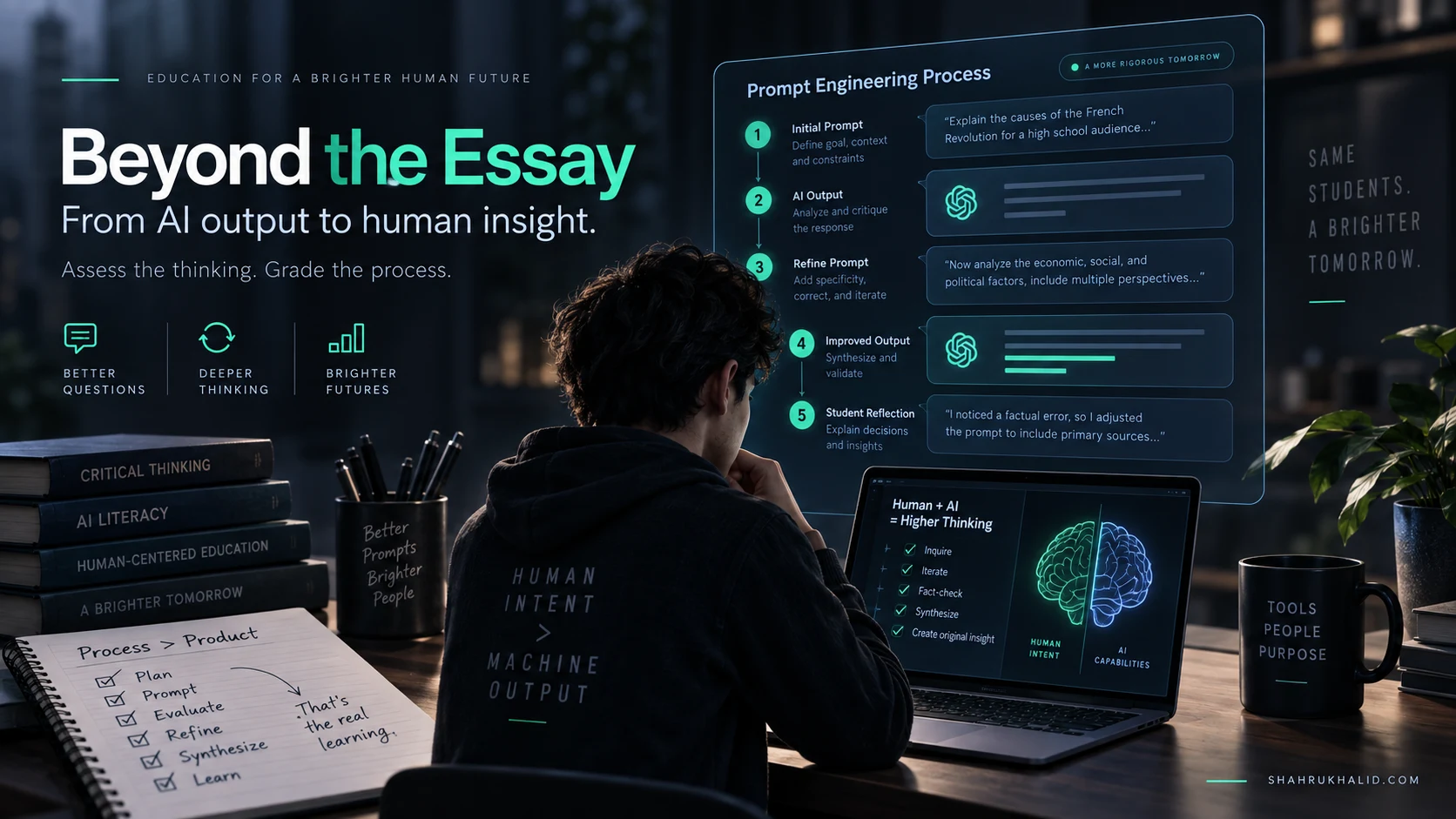




Compelling perspective on “The End of the Academic Echo Chamber: Why I Stopped Grading Final Papers and Started Scoring Student Ability to Detect AI Hallucinations”. Structuring rigorous evaluation frameworks around these learning processes is essential to ensure long-term pedagogical validity.