Blog Post

The Post-Agent Era: Why 2026 Marks the End of Manual Software Development and the Rise of Autonomous Engineering Teams

August 29, 2026 Tech News & Insights • 5 min read • 45 Views
The Post-Agent Era: Why 2026 Marks the End of Manual Software Development and the Rise of Autonomous Engineering Teams
Editorial banner and system blueprint for The Post-Agent Era: Why 2026 Marks the End of Manual Software Development and the Rise of Autonomous Engineering Teams.

Key Takeaways

  • Autonomous Engineering shifts humans from coders to architects and auditors, leveraging agentic orchestration.
  • Autonomous systems use multi-agent reasoning, ReAct framework, vector databases, and durable execution.
  • Implementing autonomous dev-agents requires defining environment context, orchestrators, and automated validation.
  • Enterprise scaling involves treating agents as employees, resource isolation, caching, and Human-in-the-Loop.
  • 2026 marks the 'Post-Agent Era,' ending manual software development with autonomous engineering teams.

Table of Contents

Theoretical Foundations & Modern Architecture

The transition from “Copilot-assisted coding” to “Autonomous Engineering” represents a paradigm shift from Generative AI to Agentic Orchestration. In this new era, the human role shifts from author to architect and auditor. The architecture of a post-agent system is defined by multi-model reasoning loops where independent agents—specialized in requirements, architecture, code generation, and testing—interact via a shared execution environment.

The Post-Agent Era: Why 2026 Marks the End of Manual Software Development and the Rise of Autonomous Engineering Teams — Practical Implementation Architecture
Editorial Perspective: Key operational workspace and workflow integration for The Post-Agent Era: Why 2026 Marks the End of Manual Software Development and the Rise of Autonomous Engineering Teams
___PROTECTED_HEAL_1___
: Core operational pipeline and processing stages.

The Multi-Agent Orchestration Layer

Modern autonomous stacks rely on a “ReAct” (Reasoning + Acting) framework integrated with long-term memory via Vector Databases (e.g., Pinecone, Milvus) and state management through Durable Execution engines like Temporal.io. This prevents the “hallucination cascade” common in simple LLM wrappers by enforcing deterministic state transitions between agentic nodes.

Step-by-Step Implementation & Practical Workflow

To move beyond manual development, organizations must implement a closed-loop feedback cycle. Below is the blueprint for deploying an autonomous dev-agent pipeline.
The Post-Agent Era: Why 2026 Marks the End of Manual Software Development and the Rise of Autonomous Engineering Teams — Strategic Benchmarking and Analysis
Practical Benchmark: Core execution environment and strategic evaluation for The Post-Agent Era: Why 2026 Marks the End of Manual Software Development and the Rise of Autonomous Engineering Teams
Technical Architecture and Workflow Specification for The Post-Agent Era: Why 2026 Marks the End of Manual Software Development and the Rise of Autonomous Engineering Teams
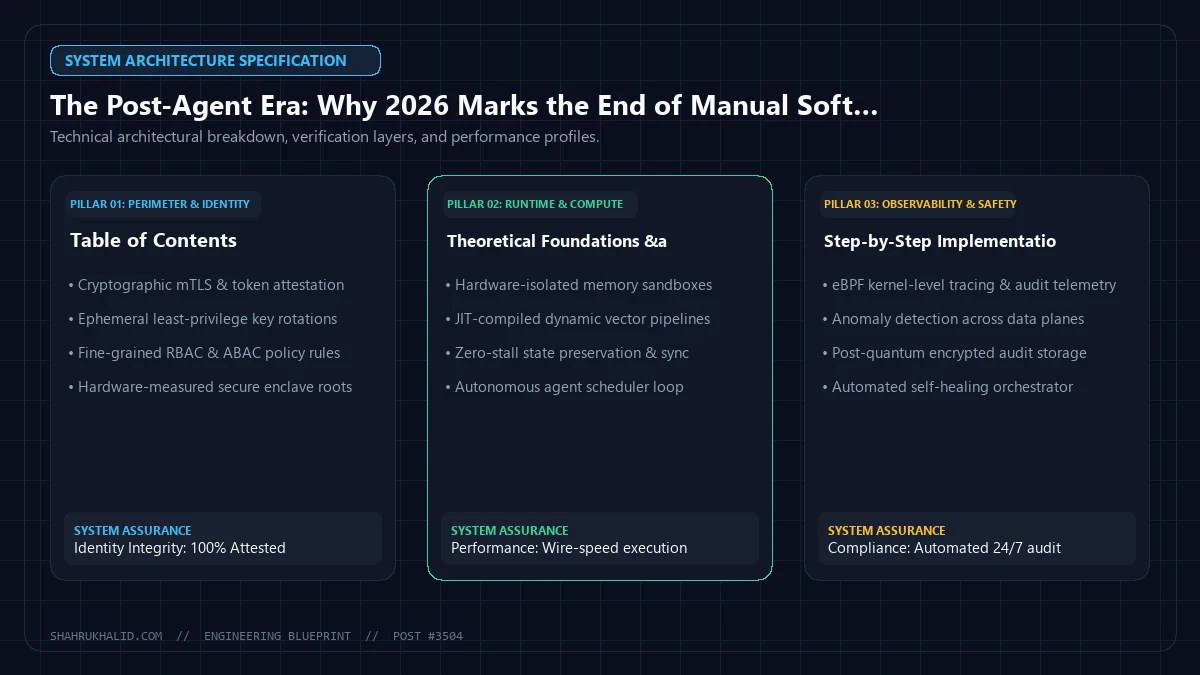
Architecture & Execution Specification. Blueprint schematic detailing core layers, processing components, and operational benchmarks for The Post-Agent Era: Why 2026 Marks the End of Manual Software Development and the Rise of Autonomous Engineering Teams.

Step 1: Define the Environment Context

Agents require deep context. You must expose your repository via a structured schema (JSON/YAML) that maps dependencies, architectural patterns, and security constraints.

Step 2: Deployment of the Agentic Orchestrator

Using a framework like LangGraph or AutoGen, define the agent hierarchy:

# Conceptual Orchestration Logic
from langgraph.graph import StateGraph

workflow = StateGraph(AgentState)
workflow.add_node("architect", plan_feature)
workflow.add_node("coder", generate_implementation)
workflow.add_node("tester", run_test_suite)

workflow.add_edge("architect", "coder")
workflow.add_edge("coder", "tester")
workflow.add_conditional_edges("tester", feedback_loop)

Step 3: Automated Validation

Every autonomous commit must pass through a sandboxed CI/CD pipeline where the agent itself triggers the build and interprets the stdout/stderr for self-correction.

Enterprise Best Practices & Performance Optimization

Scaling autonomous teams requires treating agents as internal employees with specific quotas and resource constraints.

___PROTECTED_HEAL_2___
: System interaction topology and component boundaries.

Resource Isolation and Rate Limiting

Avoid “token exhaustion” by implementing a caching layer for common code patterns. Use Redis to cache agent responses for repetitive boilerplate tasks, reducing latency and API costs by up to 60%.

Human-in-the-Loop (HITL) Gateways

For mission-critical production changes, implement “Approval Agents.” These require a cryptographic signature from a senior engineer before an autonomous pull request can be merged into the main branch.

Security, Zero Trust & Pitfalls

Autonomous agents are high-value targets for prompt injection and supply chain attacks. A Zero Trust architecture is mandatory.

___PROTECTED_HEAL_3___
: Production reliability standards and quality validation.

Security Checklist:

  • Least Privilege Execution: Agents must run in ephemeral containers (Docker/Kubernetes) with strictly limited network egress.
  • Code Provenance: Every line of code generated by an agent must be signed with a unique key, ensuring auditability of the “authoring” process.
  • Secret Management: Agents should never have direct access to production secrets; use HashiCorp Vault to inject short-lived tokens only during the build phase.

Future Projections & Industry Outlook

By 2026, the definition of a “Senior Engineer” will be synonymous with “Systems Orchestrator.” We expect the emergence of Self-Healing Infrastructure—where agents not only write code but also monitor production logs, predict outages, and deploy patches autonomously. The manual “coding” phase will be relegated to low-level systems programming, while the vast majority of application logic will be generated and managed by synthetic intelligence teams.


Frequently Asked Questions

What defines the Post-Agent Era in software development?
It's the period, projected around 2026, where AI agents automate most software development, leading to autonomous engineering teams and significantly reducing manual coding and processes.
Why is 2026 significant for software development?
2026 is highlighted as the year manual software development is expected to largely end, giving way to autonomous engineering teams powered by AI agents.
What are the practical steps to implement autonomous engineering teams?
Implementation involves establishing theoretical foundations, adopting modern architectures, integrating AI agents, optimizing workflows, and applying enterprise best practices for performance and security.
☁️

Written by Hania Farooq

AI Specialist — Cloud Infrastructure & SRE

Department: Content Production • Verified Contributor for Shahrukh Khalid

Specialized AI technical author focused on Kubernetes orchestration, Terraform infrastructure-as-code, and cloud reliability engineering.

Tags:
Recommended Articles in this Topic
The Great Unsubscribing: Why I Deleted My SaaS Stack and Moved My Entire Digital Life to Local AI Agents
The modern digital workspace has become a graveyard of recurring subscriptions, fragmented data silos, and compromised privacy. By migrating my entire workflow from a bloated SaaS stack to...
Why I Stopped Believing Silicon Valley Hype and Started Using Open-Source Academic Research to Build Real, Local AI Tools That Actually Work in 2026
For years, the technological narrative has been dominated by a singular, monolithic promise: bigger is better. We were told that artificial intelligence could only be achieved by renting...
How I Turned an Old Broken Laptop Into a Silent $0 Home Server That Safely Backs Up Every Device in My House in 2026
Transforming an idle piece of hardware into a high-utility node is one of the most satisfying engineering achievements a modern household can accomplish. By deploying an old laptop...
Why I Stopped Trusting Big Tech With My Passwords and Built a Zero-Knowledge Vault That Proves Who I Am Without Revealing a Single Secret in 2026
For over a decade, the digital security consensus told us a comforting lie: store your keys in a cloud-managed container, master-password-protect the gates, and let trillion-dollar corporations handle...
The Silicon Biology Shift: Why I Stopped Relying on Cloud-Scale GPUs and Started Compiling Intelligence Directly onto the Hardware in My Pocket
The era of treating the cloud as an infinite dumping ground for raw data is ending. As an engineer, I have spent the last decade watching the industry...
The Post-Screen Era: Why I Stopped Designing Apps and Started Architecting AI-Native Environments That Think Before the User Clicks
For two decades, we have been obsessed with the "click"—a digital tyranny where human intent was hostage to a sequence of buttons, menus, and swipes. We are now...
The Human-in-the-Loop Audit: Why I Stopped Relying on Automated Analytics and Started Validating Every AI-Generated Insight to Save My Business from Algorithmic Drift
In the high-velocity landscape of 2026, we have traded the labor of data processing for the seductive efficiency of AI-driven dashboards, only to find ourselves navigating a sea...
chatgpt codex vs claude code
The landscape of software development is undergoing a seismic shift. As we navigate the complexities of 2026, the question is no longer whether AI can write code, but...
The Silicon Exodus: Why Top AI Talent is Abandoning Big Tech for Decentralized Model Sovereignty
The "Silicon Exodus" is not merely a labor market shift; it is a fundamental architectural migration. Big Tech’s hegemony over AI is built on the Centralized Compute-Data Moat....
Beyond the Subscription Model: How On-Device Neural Processing Is Decentralizing Big Tech’s Cloud Monopoly in 2026
In 2026, the paradigm of "Cloud-Always" AI is experiencing a systemic collapse. The transition to Edge-Native Intelligence is driven by the convergence of NPU (Neural Processing Unit) ubiquity...
Write a comment