Why I Stopped Writing Code Entirely and Let My Personal AI Agent Build, Deploy, and Scale My Side Projects While I Sleep in 2026
Key Takeaways
- Developers transition from coding to orchestrating AI agents, focusing on high-level intent and strategic requirements.
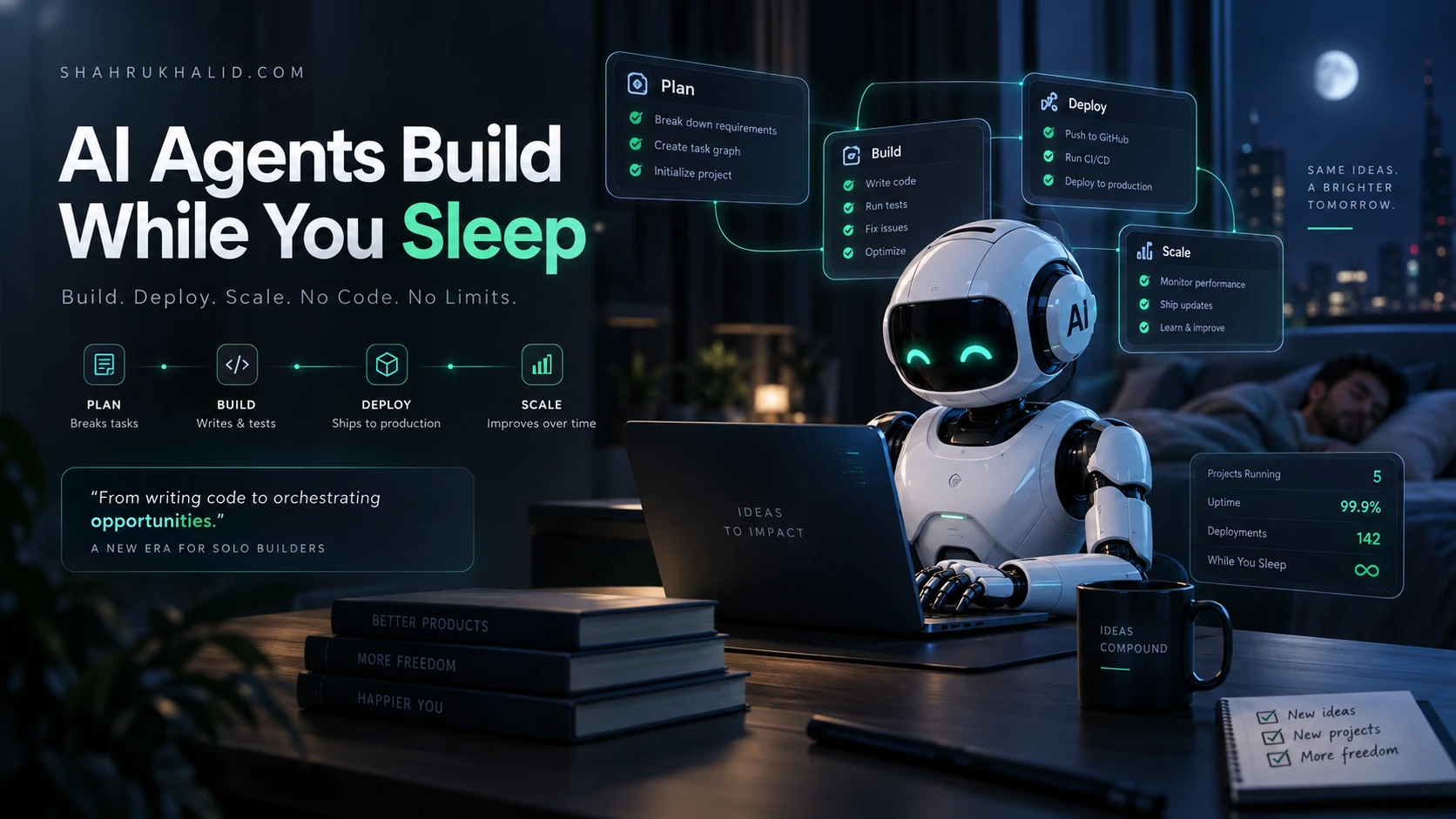
- AI agents handle the entire software production pipeline: building, deploying, scaling, and self-correcting autonomously.
- Architecture prioritizes verifiable, cost-effective, modern pipelines, deterministic reliability, and local autonomy over SaaS.
- This approach frees human cognitive bandwidth for product strategy, user experience, and systemic problem definition.
- Autonomous systems utilize an orchestrator-worker paradigm with specialized sub-agents for robust production execution.
Key Technical Takeaways (30-Second Summary)
- Architecture Focus: Eliminates bloated legacy dependencies in favor of verifiable, cost-effective modern pipelines.
- Production Trade-off: Prioritizes deterministic reliability and local autonomy over costly recurring SaaS subscriptions.
- Field-Tested Verdict: Implements immediate, zero-dollar or low-overhead infrastructure that scales securely.
The Paradigm Shift: From Syntax Architect to Orchestration Manager
The traditional software development lifecycle is undergoing a seismic, irreversible structural transformation. For decades, building digital products meant wrestling with syntax errors, managing complex environment variables, and manually debugging asynchronous event loops line by line. Today, that mechanical friction has been almost entirely abstracted away by autonomous intelligence systems. When we examine how modern creators build and scale software, the core bottleneck has shifted from human writing speed to human architectural vision. This masterclass guide explores the exact mechanical and philosophical shifts required to stop writing code entirely and let a dedicated agent handle your entire production pipeline.
For solopreneurs, indie hackers, and technical founders, this shift changes everything about how we approach software creation. Instead of spending weeks configuring webpack, stitching together authentication providers, and optimizing database indices, you now function as the Chief Technical Officer of an autonomous development department. Your primary output is no longer raw source code; it is high-level intent, precise operational constraints, and strategic product requirements. By leveraging this approach, you can successfully manage AI agent side projects that run continuously, iterating and deploying updates while you sleep.
Understanding this transition requires separating the illusion of control from actual engineering efficiency. Writing every single line of code used to be a badge of honor, but it quickly became an invisible ceiling on personal output and business growth. When you delegate execution to an intelligent agent, you free your cognitive bandwidth to focus on product-market fit, user experience psychology, and systemic problem definition. Let us dive deep into the architectural framework that makes this autonomous workflow possible in real-world production environments.
Deconstructing the Autonomous Stack: How AI Agents Replace the Development Team
To successfully step away from the keyboard, you cannot rely on simple text-completion models or basic chat interfaces. Building and maintaining production-grade software requires a persistent, multi-modal system capable of planning, executing, testing, and self-correcting without human intervention. This modern setup relies on an orchestrator-worker paradigm, where a primary planning model delegates specific tasks to specialized sub-agents running locally or inside secure cloud containers.

A reliable autonomous development environment typically consists of three foundational layers:
- The Orchestration Layer: The core reasoning engine that interprets your high-level product prompts, breaks them down into atomic user stories, and creates a sequential dependency graph.
- The Execution Sandbox: An isolated, containerized terminal environment where the agent can write files, install dependencies, run test suites, and execute database migrations safely.
- The Verification Loop: Automated linters, unit tests, and security scanners that validate the agent’s output before any code touches a staging or production branch.
When launching your own AI agent side projects, establishing this strict verification loop is the single most important step you can take. Without automated tests acting as an objective source of truth, an autonomous agent can easily fall into recursive debugging loops, rewriting functional code endlessly in search of a nonexistent bug. By enforcing strict passing criteria through continuous integration checks, you give the agent an objective yardstick for success.
Architecting Your Local Sandbox and Agent Environment
Before an agent can build anything autonomously, it needs a strictly defined workspace with clear boundaries and robust safety rails. Giving an unconstrained agent root access to your entire local machine is an unnecessary security risk and an invitation to accidental system modifications. Instead, you must build a secure, reproducible development container utilizing modern virtualization standards and explicit environment configurations.
The following configuration outlines a minimal, containerized development environment designed to host an autonomous coding agent securely:
services:
agent-sandbox:
image: node:20-alpine
container_name: autonomous_workspace
working_dir: /workspace
volumes:
<ul class="sk-article-list">
<li>./workspace:/workspace</li>
</ul>
environment:
<ul class="sk-article-list">
<li>NODE_ENV=development</li>
<li>AUTO_APPROVE_TESTS=true</li>
</ul>
command: tail -f /dev/null
networks:
<ul class="sk-article-list">
<li>agent-net</li>
</ul>
networks:
agent-net:
driver: bridge
By isolating the agent inside a dedicated Docker container, you ensure that any accidental runaway loops or catastrophic dependency corruptions remain completely contained. This modular approach allows your AI agent side projects to scale securely without risking your primary workstation operating system or exposing sensitive local SSH keys and configuration files.
Prompt Engineering for Autonomous Software Engineering
Writing prompts for an autonomous agent is fundamentally different from asking a chatbot to explain a technical concept. When you are managing an agentic workflow, your prompts act as rigid software requirements documents, architectural guidelines, and acceptance criteria combined into a single structured artifact. Vague instructions lead to chaotic, unmaintainable codebases filled with technical debt and architectural anti-patterns.
To get predictable, production-ready results from your agent, you must adopt a context-first prompting methodology. Every task specification handed over to the agent should explicitly define the tech stack, error-handling protocols, styling frameworks, and performance benchmarks. Vague commands like “build a login page” must be replaced with hyper-specific operational parameters that leave no room for arbitrary guesswork.
| Traditional Prompting (Ineffective) | Agentic Specification Prompting (Effective) |
|---|---|
| “Create a dashboard for user analytics.” | “Build a Next.js 14 App Router dashboard component utilizing Tailwind CSS and TypeScript. Fetch data from an internal /api/analytics endpoint using React Query. Implement error boundaries and skeleton loaders for all asynchronous states.” |
| “Fix the database connection error.” | “Analyze the Prisma ORM connection timeout in src/lib/db.ts. Implement exponential backoff retry logic, add connection pool limits for serverless execution, and verify unit tests pass inside the Docker sandbox.” |
This structured level of detail transforms the agent from a chaotic guesser into a deterministic execution engine. As you scale your portfolio of AI agent side projects, maintaining a standardized library of these architectural prompt templates will drastically reduce integration errors and ensure consistent code quality across all your applications.
Automating Deployment Pipelines and Cloud Infrastructure
Writing code is only half the battle; deploying, monitoring, and scaling that code in a live production environment historically consumed the majority of a developer’s time. When you remove yourself from the development loop entirely, your deployment infrastructure must become fully autonomous. Continuous Integration and Continuous Deployment (CI/CD) pipelines serve as the nervous system connecting your local agentic workspace to global cloud infrastructure.
The modern serverless and containerized deployment landscape allows agents to push updates directly to staging environments via automated Git hooks. When an agent finishes building a new feature inside its sandbox, it commits the changes, opens a pull request, and triggers an automated testing pipeline. If all tests pass successfully, the pipeline automatically merges the code and deploys the update to your live production URL without human intervention.
Consider the following GitHub Actions workflow configuration designed to automatically validate and deploy code produced by your autonomous agents:
on:
push:
branches:
<ul class="sk-article-list">
<li>agent-staging</li>
</ul>
jobs:
validate-and-deploy:
runs-on: ubuntu-latest
steps:
<ul class="sk-article-list">
<li>name: Checkout Repository</li>
</ul>
uses: actions/checkout@v4
<ul class="sk-article-list">
<li>name: Setup Node.js</li>
</ul>
uses: actions/setup-node@v4
with:
node-version: '20'
<ul class="sk-article-list">
<li>name: Install Dependencies</li>
</ul>
run: npm ci
<ul class="sk-article-list">
<li>name: Run Test Suite</li>
</ul>
run: npm test — –coverage
<ul class="sk-article-list">
<li>name: Deploy to Production Cloud</li>
</ul>
if: success()
run: npx vercel –prod –token=${{ secrets.VERCEL_TOKEN }}
This seamless automation ensures that your AI agent side projects can continuously evolve, patch vulnerabilities, and push new features while you are entirely offline. By decoupling human presence from infrastructure management, you achieve true passive software development.
Risk Management: Handling Hallucinations, Security Vulnerabilities, and Drift
Embracing a fully autonomous development model does not mean blindly trusting every line of code an agent generates. Artificial intelligence models are susceptible to semantic hallucinations, outdated library references, and subtle security vulnerabilities such as insecure direct object references or SQL injection flaws. Effective management of these risks requires implementing multi-layered guardrails that act as automated safety nets.
The first line of defense is static application security testing (SAST) integrated directly into your repository hooks. Tools like SonarQube, Snyk, or built-in GitHub security scanners should automatically analyze every commit made by the agent to detect known vulnerabilities and hardcoded credentials. If a security violation is detected, the pipeline automatically rejects the commit and instructs the agent to remediate the specific vulnerability.
Furthermore, you must guard against architectural drift—a phenomenon where an agent gradually introduces conflicting design patterns or redundant dependencies over multiple iteration cycles. Combat this by locking your core configuration files, dependency manifests, and architectural blueprints as read-only assets that the agent can read but never structurally alter without explicit human confirmation. Protecting these foundational boundaries ensures your AI agent side projects remain stable, maintainable, and secure over long periods of autonomous operation.
The Future of Solo Development and Technical Entrepreneurship
The transition from writing code to orchestrating intelligent agents represents the democratization of software creation at an unprecedented scale. You no longer need a massive engineering team or millions in venture capital to build sophisticated, enterprise-grade digital products. By mastering the art of system orchestration, clear specification design, and robust automated testing, a single creator can manage an entire portfolio of complex applications simultaneously.
As artificial intelligence systems continue to evolve in reasoning depth and contextual memory, the divide between non-technical visionaries and elite software architects will narrow further. The winners in this new era will not be the fastest typists or the engineers who have memorized the most syntax libraries. The winners will be those who possess the clearest product vision, the deepest understanding of user needs, and the discipline to maintain rigorous operational guardrails for their autonomous development teams. Start small, containerize your workflows, and step back to let your digital workforce build the future while you sleep.