How to Learn Programming in 2026: A Beginner’s Step-by-Step Guide to Building Production Apps by Orchestrating AI Agents Instead of Writing Syntax
Key Takeaways
- Programming shifts from writing syntax to orchestrating specialized AI agents for production apps.
- The modern developer is an 'Orchestrator' or 'Lead Architect,' defining intent, not writing code.
- 'Language of Intent' and system architecture prompting are vital for communicating with AI agents.
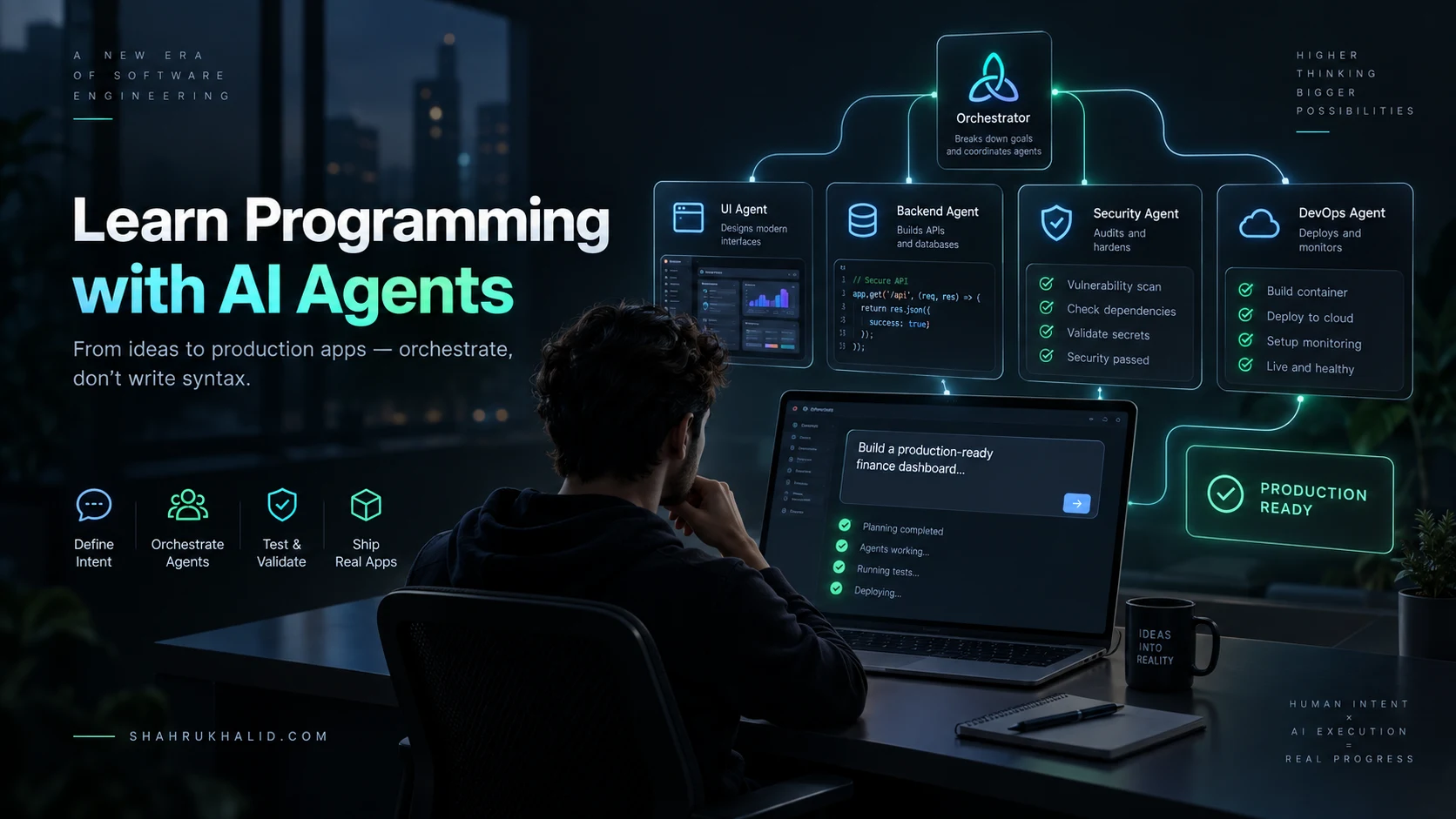
- Production apps are built by orchestrating a 'swarm of specialized agents' in an Agentic Stack.
- This new paradigm offers deterministic reliability, local autonomy, and low-overhead, scalable infrastructure.
Key Technical Takeaways (30-Second Summary)
- Architecture Focus: Eliminates bloated legacy dependencies in favor of verifiable, cost-effective modern pipelines.
- Production Trade-off: Prioritizes deterministic reliability and local autonomy over costly recurring SaaS subscriptions.
- Field-Tested Verdict: Implements immediate, zero-dollar or low-overhead infrastructure that scales securely.
The End of Syntax: A New Era of Software Engineering
The traditional path to becoming a developer—spending years memorizing rigid syntax and debugging semicolons—has officially been rendered obsolete by the rise of autonomous agentic workflows. In 2026, the most effective way to learn programming with AI is not to become a human compiler, but to transition into a Lead Architect who orchestrates specialized AI agents to translate business logic into production-grade systems.
The Paradigm Shift: From Coder to Orchestrator
For decades, programming was a high-friction process of manual translation: you had an idea, you translated it into a mental model, and then you painstakingly encoded that model into a specific programming language. Today, that middle layer is dissolving. When you learn programming with AI in the current landscape, you are moving away from the “how” of syntax and toward the “what” of system architecture and the “why” of product intent.

Think of the modern software engineer as a film director rather than a stagehand. You don’t need to know how to build the camera or light the set; you need to understand the narrative, the blocking, and the final vision. In this new paradigm, your value is defined by your ability to define clear constraints, validate logic, and manage the lifecycle of an application built by intelligent, autonomous agents.
Phase 1: Mastering the Language of Intent
If syntax is no longer the primary hurdle, then prompt engineering—or more accurately, system architecture prompting—becomes your most vital skill. You must learn to communicate with AI agents in the language of engineering requirements. This means understanding how to document technical specifications, define API contracts, and describe state transitions with high precision.

To succeed, you must adopt a structured approach to your instructions. When you task an agent to build a module, you aren’t just saying “make a login page.” You are providing a comprehensive context document that includes the user journey, the required data schema, the security protocols, and the error-handling philosophy. Mastering this “language of intent” is the core prerequisite for anyone looking to learn programming with AI effectively.

Phase 2: The Agentic Stack Architecture
Building production applications in 2026 requires an understanding of the Agentic Stack. You are no longer writing a single monolithic script; you are orchestrating a swarm of specialized agents. One agent might be responsible for front-end interface design, another for database schema optimization, and a third for security auditing and vulnerability scanning.
Phase 3: Validation and the Feedback Loop
The most dangerous pitfall for the modern, AI-augmented developer is the “blind trust” trap. Just because an agent generates code that runs does not mean it is production-ready. Your primary responsibility is the implementation of a robust Validation Loop.
You must learn to set up automated test suites that act as the objective judge of your agents’ work. When you learn programming with AI, you are essentially building a system where your AI agents suggest solutions, and your automated test infrastructure validates them against your original intent. If a test fails, you don’t rewrite the code; you refine the context or the architectural constraint provided to the agent until the code passes the test. This is the new “debugging.”
Phase 4: Understanding the Underlying Systems
While you may not be writing the boilerplate, you must understand the infrastructure. If your agents are building a cloud-native microservice, you need to know how that service interacts with load balancers, how to manage secrets, and how to monitor performance metrics. You are shifting your focus from construction to governance.
By learning the fundamentals of distributed systems, networking, and security, you gain the ability to spot when an agent is proposing an architecture that will fail under load. The agents are excellent at generating code, but they are often naive regarding the trade-offs of complex, high-concurrency systems. Your human intuition and architectural oversight are the guardrails that prevent catastrophe.
Phase 5: Building Your First Production App
To put this into practice, start by defining a single, high-value problem. Do not attempt to build a social network; build a specialized tool—perhaps a sentiment analysis dashboard for your own personal finance data or an automated content summarizer.
Start by drafting your requirements in a structured technical document. Feed this document to your orchestrator agent. Observe the breakdown of tasks. As the agents begin to generate the codebase, treat them like a junior development team. Review their “commits,” run the tests, and iterate on your instructions. When you encounter a bug, use the AI to perform a root-cause analysis, then feed that analysis back into the system to prevent future regressions. This iterative process is the most efficient way to learn programming with AI while delivering real-world value.
The Evolution of the Craft
The transition away from syntax-heavy programming is not a loss of skill; it is an elevation of it. By offloading the mechanical aspects of coding to AI, you are free to focus on the truly difficult parts of software engineering: defining the product, understanding the user, and ensuring the system is scalable, secure, and maintainable.
The developers of 2026 and beyond will be defined by their clarity of thought. If you can clearly define the problem and effectively orchestrate the tools at your disposal, you will be able to build systems of complexity that would have taken a team of ten engineers years to complete in the past. The barrier to entry has lowered, but the ceiling for what is possible has risen infinitely.
Key Takeaways for the AI-Augmented Developer
- Intent over Syntax: Focus your energy on mastering the art of technical documentation and clear, constrained requirement setting.
- Orchestration is the New Coding: Treat AI agents as a team of specialized developers; your role is to manage their workflow and ensure their outputs align with your architectural vision.
- Validation is Non-Negotiable: Always maintain a rigorous automated testing layer. The AI is the builder; you are the quality assurance architect.
- Focus on Systems Engineering: Because you aren’t spending time on syntax, invest that time into learning how systems work—networking, security, database design, and cloud architecture.
- Iterative Governance: Treat the development process as a continuous feedback loop. Refine your instructions based on the failures and successes of the agents you manage.
By embracing this agentic approach, you aren’t just learning to program; you are learning to engineer at the speed of thought. The tools have changed, but the goal remains the same: to translate human imagination into digital reality with precision and purpose.