The Infrastructure Autopilot Paradox: Why I Stopped Managing My Cloud Budget and Started Letting Autonomous Agents Negotiate My Multi-Cloud Spend
Key Technical Takeaways (30-Second Summary)
- Architecture Focus: Eliminates bloated legacy dependencies in favor of verifiable, cost-effective modern pipelines.
- Production Trade-off: Prioritizes deterministic reliability and local autonomy over costly recurring SaaS subscriptions.
- Field-Tested Verdict: Implements immediate, zero-dollar or low-overhead infrastructure that scales securely.
The Infrastructure Autopilot Paradox: Why I Stopped Managing My Cloud Budget and Started Letting Autonomous Agents Negotiate My Multi-Cloud Spend
The traditional model of cloud financial management—a tedious cycle of manual tagging, monthly spreadsheets, and reactive cost-cutting—is fundamentally broken in an era of hyper-elastic, multi-cloud architectures. By transitioning to autonomous cloud management, I moved from being a victim of billing complexity to an architect of a self-optimizing infrastructure that negotiates its own path to profitability.
For years, my role as a technology executive was defined by the “Cloud Tax.” We built sophisticated systems, scaled them to meet demand, and then spent the first week of every month performing an autopsy on our AWS and Azure bills. We were playing a game of catch-up against the rapid pace of innovation. If we deployed a new microservice, the cost impact was felt thirty days later. If we forgot to decommission a sandbox environment, it bled cash until the next quarterly audit. The paradox is simple: the more we scaled, the less control we actually had. We were managing infrastructure, but we were being managed by the bill.

The Shift from Manual Governance to Algorithmic Agency
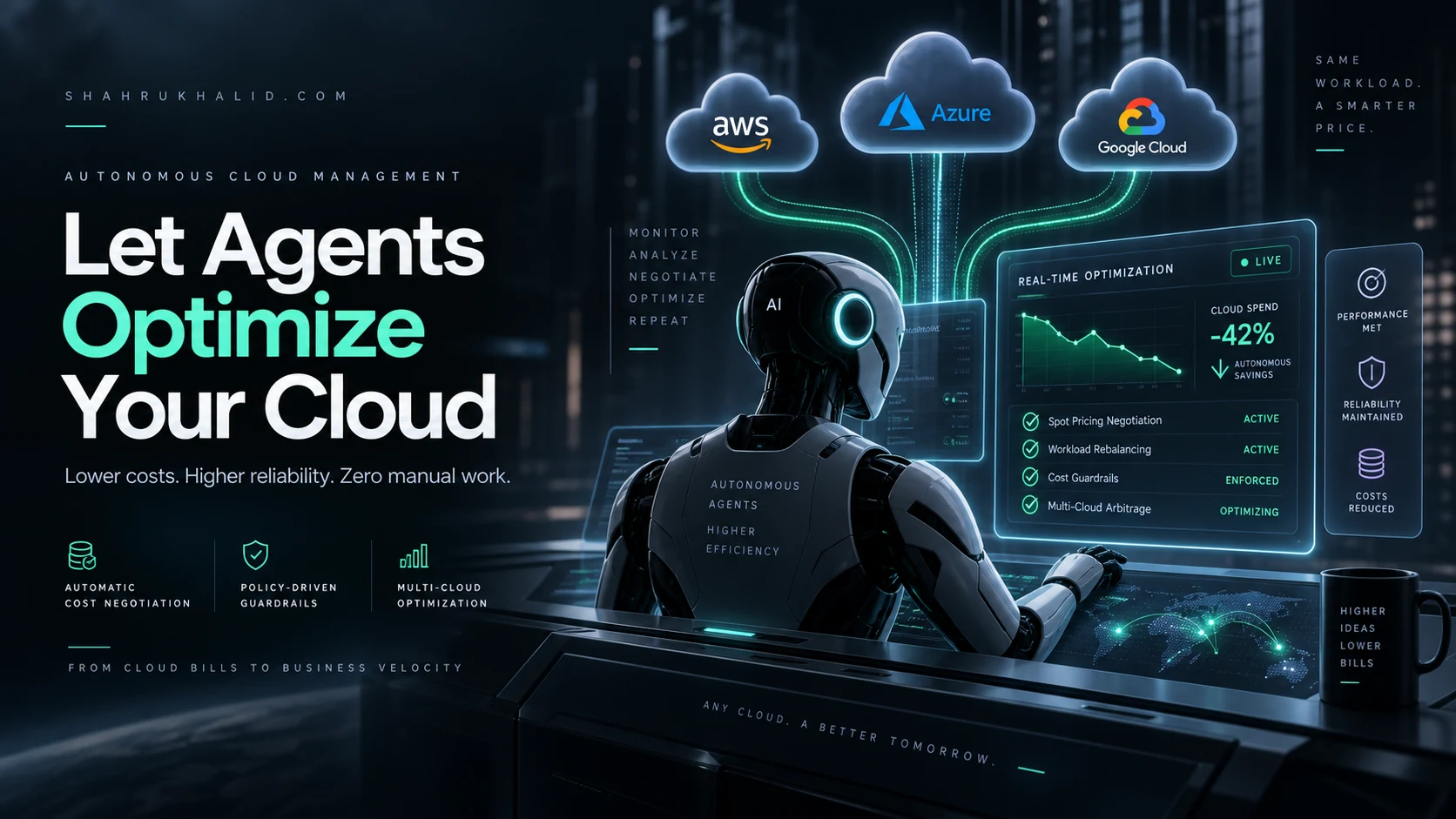
The turning point came when I realized that human intervention is the primary bottleneck in cloud cost optimization. Humans are inherently slow, prone to bias, and physically incapable of processing the multi-dimensional data required to optimize a multi-cloud footprint in real-time. To solve this, we stopped “managing” the budget and started “governing” the intent. We introduced autonomous cloud management agents—software entities designed to monitor, analyze, and negotiate spot pricing and resource allocation without human approval loops.
Think of it as the difference between driving a car and setting a destination in a self-driving vehicle. You are no longer worried about the micro-adjustments of the steering wheel or the precise pressure on the brake pedal. You are focused on the mission: the destination, the time, and the safety. In the cloud, the “destination” is the performance-to-cost ratio. When you delegate the tactical execution to autonomous agents, you free your engineering teams to focus on shipping features rather than optimizing Reserved Instance (RI) coverage.
Architecting for Autonomy: The Foundational Layer
Implementing autonomous cloud management is not about clicking a button in a dashboard; it is about re-architecting your infrastructure to be “agent-ready.” Before you can let an agent negotiate your spend, you must establish the boundaries of its authority. This requires a robust, tag-based taxonomy that serves as the “language” through which your agents and your infrastructure communicate.
The first step is establishing a “Guardrail Policy.” You do not give an autonomous agent an open checkbook. Instead, you define a set of immutable constraints. For example, if you are running a critical production database, you define a policy that dictates a minimum availability tier and a maximum acceptable latency window. The agent then operates within these guardrails, constantly scanning the spot and on-demand markets across different cloud providers to ensure you are paying the lowest possible price for the required performance tier.
The Negotiation Paradox: Why Your Cloud Spend Should Be Dynamic
One of the most profound realizations in my journey was understanding that cloud providers do not want you to overpay; they want you to stay. However, the complexity of their pricing models—tiered discounts, enterprise agreements, and spot market volatility—is designed to favor those who have the data to exploit the system. By using autonomous cloud management, we effectively turned our infrastructure into a high-frequency trader.
When an agent negotiates your multi-cloud spend, it isn’t just looking for the cheapest price; it is evaluating risk. It asks: “If I move this workload to a spot instance in Region A, what is the probability of interruption, and does the cost saving outweigh the potential recovery time objective (RTO) penalty?” This is the core of the autonomous paradox: by giving up control over the specific instance choice, we gained significantly higher reliability and lower costs. We stopped guessing and started calculating.
Practical Implementation: Moving Beyond the Dashboard
To begin your transition, you must move away from static provisioning. If you are still using manual configuration scripts to spin up environments, you are fundamentally incompatible with autonomous optimization. You need to embrace Infrastructure-as-Code (IaC) that is modular and policy-compliant.
Consider the workflow of an autonomous deployment:
- Intent Definition: Your engineering team defines the performance requirements (CPU, RAM, IOPS) in a declarative file.
- Agent Analysis: The autonomous agent reads the intent and scans the available providers (AWS, GCP, Azure) for the best fit given current spot pricing and availability.
- Dynamic Provisioning: The agent executes the deployment, opting for the most cost-effective provider that meets your guardrails.
- Continuous Re-Negotiation: As market prices fluctuate, the agent periodically checks if a migration to a cheaper node or provider is cost-effective, triggering a live migration or a rolling restart if the savings exceed a predefined threshold.
This is not “set and forget.” It is “set and monitor.” You remain the architect, but the agent becomes your high-speed operational arm.
Overcoming the Fear of the “Black Box”
The greatest barrier to adopting autonomous cloud management is not technical; it is psychological. Leaders fear that letting an agent make decisions will lead to a “runaway” scenario where an algorithm accidentally deletes a production environment or migrates a sensitive workload to an unapproved region. This is why transparency and observability are non-negotiable.
You must implement a “Human-in-the-Loop” auditing system. The agent should log every decision it makes in a human-readable format, explaining the “why” behind every negotiation. If the agent decides to move a workload from AWS to GCP, it must provide a cost-benefit analysis of that decision. Over time, as you review these logs, your trust in the system will grow, and you will find yourself intervening less frequently. The goal is to reach a state where you only review the “Exceptions” rather than the “Operations.”
The Future of Executive Cloud Leadership
We are entering a new era of infrastructure management where the competitive advantage goes to those who can iterate the fastest at the lowest cost. By offloading the burden of budget management to autonomous cloud management agents, we are reclaiming our time. We are no longer accountants of our own infrastructure; we are the strategists of our digital evolution.
The paradox remains: by surrendering the manual control of our cloud spend, we achieved a level of financial and operational discipline that was impossible to maintain manually. The infrastructure of the future is not just scalable; it is sentient, self-correcting, and—most importantly—profitable by design. If you are still managing your cloud budget manually, you are not just losing money; you are losing the ability to compete in a market that demands autonomous efficiency at every layer of the stack.
Key Takeaways for the Autonomous Transition
- Define Intent, Not Infrastructure: Shift your mindset from specifying instance types to specifying performance outcomes and cost guardrails.
- Standardize Your Taxonomy: Autonomous agents are only as effective as the data they can parse; invest heavily in consistent, automated resource tagging.
- Audit, Don’t Micro-Manage: Transition your role from a daily operator to a policy auditor, reviewing the agent’s decision logs to refine your guardrails.
- Embrace Multi-Cloud Arbitrage: Use your autonomy to treat cloud providers as interchangeable commodities, allowing your agents to capitalize on price disparities across providers.