Autonomous AI Agent Swarms in 2026: Multi-Agent Architecture and Enterprise Implementation
The Architecture of Autonomy: Mastering AI Agent Swarms in 2026
In 2026, the paradigm of enterprise artificial intelligence has shifted decisively from monolithic, single-model interactions to the dynamic orchestration of autonomous AI agent swarms. By distributing complex cognitive workloads across specialized, interoperable nodes, organizations are transcending the limitations of individual large language models to achieve autonomous execution of multi-step business processes that were previously considered impossible to automate.

The Evolution of Multi-Agent Orchestration
The transition to agentic workflows is defined by the move from passive prompt-response systems to proactive, goal-oriented autonomous AI agents 2026. Unlike early-stage chatbots, a swarm architecture functions as a decentralized ecosystem where distinct agents—each optimized for specific reasoning, data retrieval, or execution tasks—collaborate through a shared communication protocol. This shift mirrors the transition from mainframe computing to microservices, but with the added layer of emergent intelligence.

According to research into multi-agent orchestration and autonomous execution benchmarks (arxiv.org/abs/2402.01030), the effectiveness of these systems is not measured by the capability of a single model, but by the efficiency of the “hand-off” between agents. When agents operate in a swarm, they can perform self-correction, peer-review their own outputs, and dynamically re-allocate resources based on the specific constraints of the enterprise environment.
Core Components of an Agentic Swarm
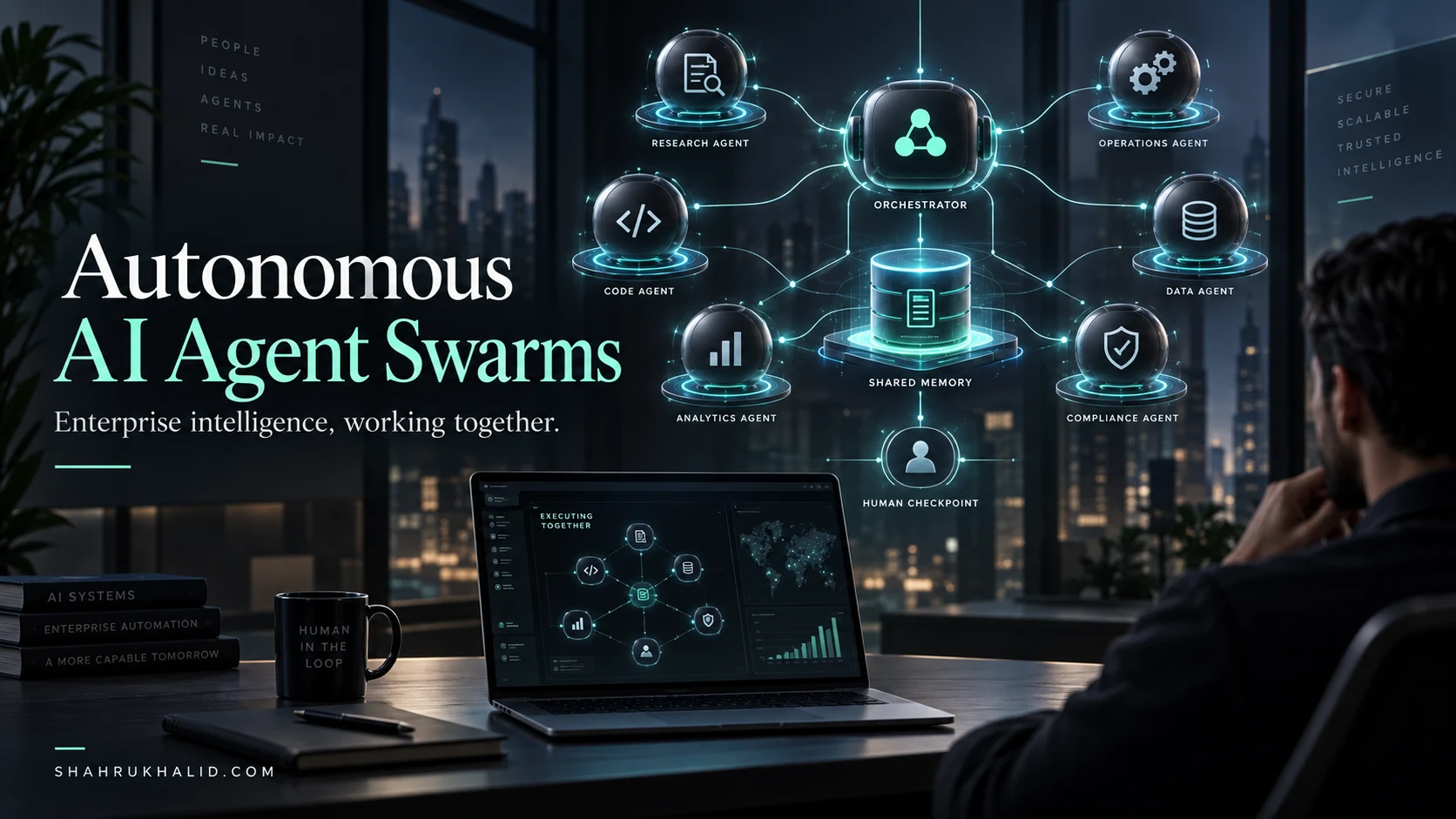
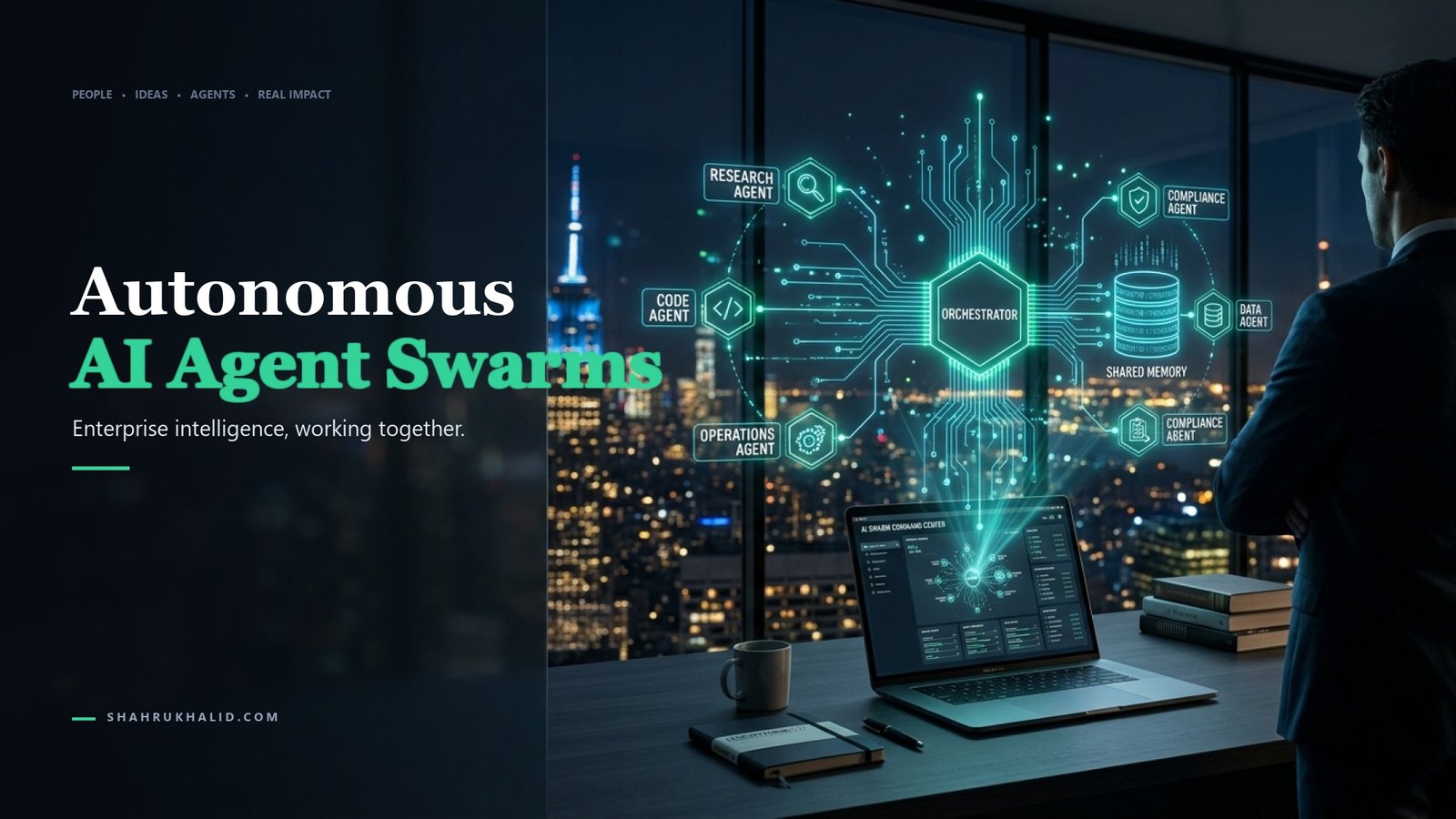
- The Orchestrator (Controller): The high-level reasoning engine that decomposes a user’s high-level objective into a structured directed acyclic graph (DAG) of sub-tasks.
- Specialized Worker Agents: Discrete models fine-tuned or prompted to excel in narrow domains, such as code generation, financial analysis, or supply chain logistics.
- Shared Memory Layer (The Blackboard): A centralized, secure state-store where agents post their progress, findings, and logs, allowing other agents to pick up tasks without redundant processing.
- Tool Grounding Infrastructure: The secure bridge between the agent and enterprise-grade software, utilizing multimodal integration protocols to interact with APIs, databases, and legacy CRMs (ai.google.dev/docs).
Enterprise Implementation: A Strategic Framework
Implementing agent swarms requires a fundamental shift in infrastructure design. It is no longer about managing prompts; it is about managing “agent identity” and “governance.” Enterprises must treat agents as digital employees, complete with defined roles, access permissions, and accountability metrics.
The Four-Phase Deployment Lifecycle
- Task Decomposition Analysis: Before deployment, map out the workflow. Identify which segments require deterministic execution (fixed rules) and which require probabilistic reasoning (agentic decision-making).
- Agent Persona Engineering: Define the “System Prompt” and operational boundaries for each agent. An agent tasked with financial forecasting must be restricted by different guardrails than an agent tasked with customer sentiment analysis.
- Orchestration Layer Integration: Deploy a middleware layer that manages agent communication. This layer must ensure that loops are closed, deadlocks are identified, and human-in-the-loop (HITL) checkpoints are triggered when confidence scores drop below a predetermined threshold.
- Observability and Feedback Loops: Monitor not just the output, but the “reasoning path.” By analyzing the logs generated by the swarm, teams can identify where agents are failing to collaborate effectively or where they are hallucinating due to poor tool grounding.
Comparison: Monolithic AI vs. Agent Swarm Architectures
| Feature | Monolithic AI (2023-2024) | Agent Swarm (2026) |
|---|---|---|
| Decision Making | Single-step, linear inference | Multi-step, recursive reasoning |
| Task Scope | Restricted to immediate prompts | End-to-end process automation |
| Fault Tolerance | Low (failure at any step halts output) | High (agents can re-attempt or re-route) |
| Resource Usage | High latency for complex tasks | Optimized by specialized agent allocation |
Real-World Case Studies in Autonomous Execution
The true value of autonomous AI agents 2026 is best understood through practical applications. Consider a global logistics firm seeking to automate its procurement process. In a traditional setup, an analyst would manually pull data from a database, check inventory levels, compare supplier pricing, and then draft a purchase order. In an agent swarm architecture, the process is transformed into a continuous loop.

The “Inventory Agent” monitors real-time stock levels. When a threshold is hit, it triggers the “Market Analysis Agent,” which queries external API endpoints for current supplier pricing. Once a choice is made, the “Procurement Agent” drafts the order, which is then reviewed by a “Compliance Agent” that checks the document against internal legal requirements. Finally, a human manager receives a single notification to approve the final package. This entire workflow operates autonomously, with the orchestration layer ensuring that if the Market Analysis Agent fails to retrieve data, it automatically notifies the Inventory Agent to retry after a specific interval.
Overcoming Challenges in Tool Grounding
The most significant hurdle to enterprise adoption remains tool grounding. If an agent cannot reliably interact with an ERP system, the swarm collapses. The latest enterprise multimodal agent integration protocols (ai.google.dev/docs) emphasize the importance of “Semantic Grounding.” This means the agent must not only understand the syntax of an API call but also the semantic context of the underlying business process.
Enterprises are increasingly moving away from raw API access and toward “Agentic Interfaces.” These are standardized API wrappers that provide the agent with a clear description of the tool’s capabilities, expected input formats, and potential error codes. By providing agents with structured documentation, the reliability of autonomous execution increases exponentially. It is the difference between asking an agent to “send an email” and providing it with a specific tool called send_email_v2 that includes built-in verification for recipient authentication.
Governance and Security in Multi-Agent Ecosystems
As autonomous AI agents 2026 become more pervasive, security becomes the paramount concern. The threat of an “agent loop” where two agents trigger each other into an infinite, resource-draining cycle is a real technical risk. Furthermore, the risk of prompt injection is amplified when agents have the authority to execute actions in a production environment.
To mitigate these risks, architects are implementing the following strategies:
- The “Circuit Breaker” Pattern: Similar to electrical engineering, if an agent exceeds a specific budget of compute tokens or time, the orchestration layer physically cuts the connection to the external tools.
- Least Privilege Agent Architecture: Just as humans are granted specific roles, agents are assigned the minimum set of API permissions required for their specific function. A researcher agent should never have write-access to the payment gateway.
- Immutable Audit Trails: Every action taken by an agent must be logged in an immutable ledger. In 2026, this is becoming a standard requirement for compliance in regulated industries, allowing teams to “replay” an agent’s reasoning path in the event of an error.
The Future of Enterprise Cognitive Labor
Looking toward the next horizon, we are moving toward “Self-Organizing Swarms.” In these systems, the Orchestrator does not explicitly define every step. Instead, it defines the outcome, and the agents negotiate among themselves to determine who is best equipped to handle each sub-task based on current availability and expertise. This level of abstraction will redefine the role of the technology leader from a “systems architect” to an “ecosystem designer.”
The maturity of autonomous AI agents 2026 is evidenced by the shift in focus from “can we build this?” to “how do we scale this safely?” The integration of multi-agent architectures is not merely a trend; it is the fundamental building block of the next generation of enterprise operations. By embracing the swarm model, organizations are not just adding intelligence to their workflows; they are creating the digital infrastructure necessary to operate at the speed and scale of the next decade.
For those looking to transition, the path forward is clear: start with small, well-defined workflows, prioritize robust tool grounding, and maintain a rigorous, human-centric governance model. The era of the single, all-knowing AI is over. The era of the collaborative, autonomous agent swarm has begun.