Blog Post

Beyond the Full-Stack: Why Component-Based Architecture Is Dead and Autonomous Code Synthesis Is the New Standard
August 29, 2026 Programming • 5 min read • 47 Views
Beyond the Full-Stack: Why Component-Based Architecture Is Dead and Autonomous Code Synthesis Is the New Standard
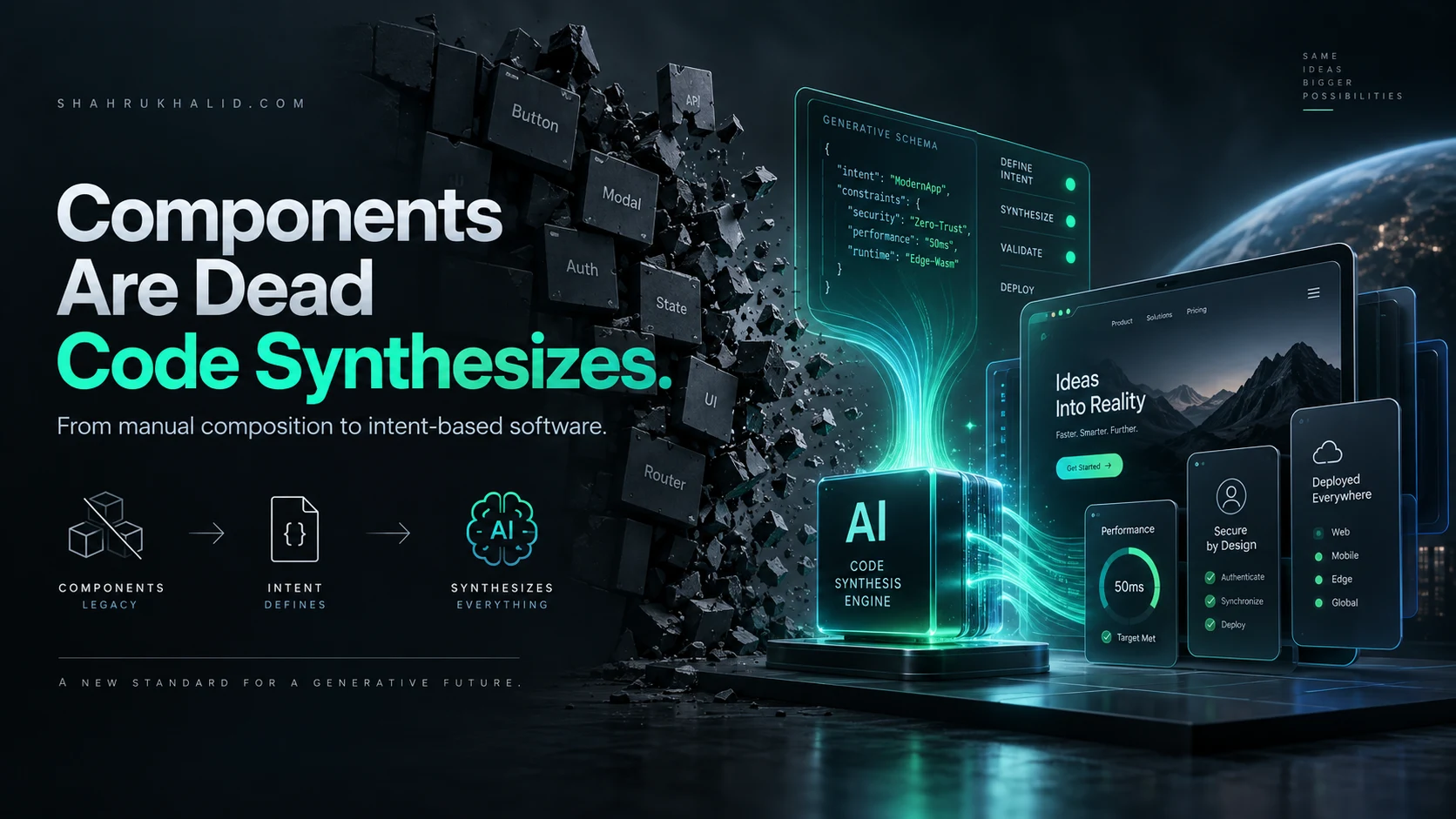
Editorial banner and system blueprint for Beyond the Full-Stack: Why Component-Based Architecture Is Dead and Autonomous Code Synthesis Is the New Standard.

Key Takeaways

  • Autonomous Code Synthesis (ACS) replaces component architecture, moving from manual composition to intent-based generation.
  • The 'source of truth' shifts from human-written code to high-level Generative Schemas defining requirements.
  • The 'Full-Stack' role is obsolete; developers become System Architects defining constraints for synthesis engines.
  • Constraint-Driven Development (CDD) defines system intent and guardrails, bypassing manual component creation.
  • ACS output is a compiled binary or optimized bundle, verified by formal methods, not individual components.

Table of Contents

Theoretical Foundations & Modern Architecture

For two decades, the software industry has been trapped in the tyranny of component-based architecture. We have spent countless hours composing UIs from atomic units—atoms, molecules, organisms—only to find ourselves managing massive dependency graphs and brittle state synchronization logic. The paradigm shift toward Autonomous Code Synthesis (ACS) represents a departure from manual composition toward intent-based generation.

Beyond the Full-Stack: Why Component-Based Architecture Is Dead and Autonomous Code Synthesis Is the New Standard — Practical Implementation Architecture
Editorial Perspective: Key operational workspace and workflow integration for Beyond the Full-Stack: Why Component-Based Architecture Is Dead and Autonomous Code Synthesis Is the New Standard
___PROTECTED_HEAL_1___
: Core operational pipeline and processing stages.

From Composition to Intent

Component-based architecture relies on the developer acting as an orchestrator of pre-defined blocks. ACS, conversely, treats the codebase as a transient artifact. The “source of truth” migrates from the human-written code to the Generative Schema—a high-level representation of business requirements and domain constraints. When the underlying model or requirements shift, the system does not need a refactor; it requires a re-synthesis.

The Death of the “Full-Stack” Developer

In the ACS era, the term “Full-Stack” becomes obsolete. The abstraction layer is no longer the browser or the server; it is the synthesis engine. Developers transition into System Architects who define the constraints, guardrails, and validation logic, while the synthesis engine handles the mechanical implementation of endpoints, state machines, and view layers.

Step-by-Step Implementation & Practical Code

To move beyond components, we adopt a Constraint-Driven Development (CDD) workflow. Instead of writing Button.jsx, we define the interaction lifecycle in a machine-readable format.
Beyond the Full-Stack: Why Component-Based Architecture Is Dead and Autonomous Code Synthesis Is the New Standard — Strategic Benchmarking and Analysis
Practical Benchmark: Core execution environment and strategic evaluation for Beyond the Full-Stack: Why Component-Based Architecture Is Dead and Autonomous Code Synthesis Is the New Standard
Technical Architecture and Workflow Specification for Beyond the Full-Stack: Why Component-Based Architecture Is Dead and Autonomous Code Synthesis Is the New Standard
Architecture & Execution Specification. Blueprint schematic detailing core layers, processing components, and operational benchmarks for Beyond the Full-Stack: Why Component-Based Architecture Is Dead and Autonomous Code Synthesis Is the New Standard.

Step 1: Defining the Synthesis Schema

{
  "intent": "UserAuthenticationFlow",
  "constraints": {
    "security": "OAuth2-OIDC",
    "storage": "Encrypted-Local",
    "latency_budget": "50ms"
  },
  "runtime": "Edge-Wasm"
}

Step 2: Invoking the Synthesis Engine

Using a CLI-based synthesis tool, we trigger the generation of the entire domain module, bypassing manual boilerplate.


npx synthesize --schema ./auth-flow.json --target=production --validate=strict

Step 3: Post-Synthesis Verification

The output is not a set of components, but a compiled binary or optimized bundle that adheres to the schema. We verify the integrity of the generated code using formal methods rather than unit tests for every UI element.

Enterprise Best Practices & Performance Optimization

Scaling ACS requires a shift in how we manage technical debt. In a component-based system, debt is code. In an ACS system, debt is schema drift.

___PROTECTED_HEAL_2___
: System interaction topology and component boundaries.

Continuous Synthesis Pipelines

Integrate synthesis into your CI/CD pipeline. Every commit to the business schema triggers a full re-synthesis of the application. This ensures that performance optimizations—such as tree-shaking and runtime code-splitting—are applied globally rather than per-component.

Performance Metrics in Synthesis

Set performance budgets at the schema level. The synthesis engine should fail the build if the generated code violates the Cumulative Layout Shift (CLS) or Time to Interactive (TTI) thresholds defined in the constraints.

Security, Zero Trust & Common Pitfalls Checklist

Security in ACS is fundamentally different. Since humans no longer write the implementation, the attack surface shifts to the Synthesis Engine and the Prompt/Schema Injection layer.

___PROTECTED_HEAL_3___
: Production reliability standards and quality validation.

Zero Trust Checklist

  • Schema Validation: Never accept raw input into the synthesis engine. Use strict JSON-Schema validation.
  • Deterministic Synthesis: Ensure the engine uses fixed seeds or pinned versions of models to prevent non-deterministic code injection.
  • Runtime Guardrails: Implement a WebAssembly-based sandbox to execute generated code, preventing unauthorized API access.

Common Pitfalls

The most dangerous pitfall is “Manual Patching.” Developers tempted to edit the generated code directly will break the reconciliation loop. If a change is needed, it must be performed at the schema level, never in the generated artifacts.

Future Projections & Industry Outlook

We are entering an era of “Software as a Service” (SaaS) where the software itself is generated on-demand. Within five years, static repositories will be considered legacy storage. Applications will be synthesized at the edge, tailored to the specific device and network conditions of the end-user in real-time.
Frequently Asked Questions

Why is component-based architecture considered obsolete?
Component-based architecture is superseded by autonomous code synthesis, which offers automated development, superior scalability, and reduced manual integration, making it more efficient for modern software demands.
What is autonomous code synthesis?
Autonomous code synthesis is an advanced paradigm where AI systems automatically generate, optimize, and integrate software components, accelerating development and enhancing system robustness beyond traditional manual coding.
How does autonomous code synthesis change full-stack development?
Autonomous code synthesis shifts full-stack development from manual integration to AI-driven generation, significantly accelerating project timelines, minimizing human error, and enabling dynamic system evolution beyond traditional component limitations.
☁️

Written by Hania Farooq

AI Specialist — Cloud Infrastructure & SRE

Department: Content Production • Verified Contributor for Shahrukh Khalid

Specialized AI technical author focused on Kubernetes orchestration, Terraform infrastructure-as-code, and cloud reliability engineering.

Tags:
Recommended Articles in this Topic
JWT vs Sessions: Complete Comparison
JWT vs Sessions: Complete Comparison In the ever-evolving landscape of web development, robust and secure authentication mechanisms are paramount. Choosing the right approach can significantly...
TypeScript vs JavaScript: Complete Comparison
Software Architecture & System Design Series Flagship Architectural Guide in-memory caching and system design comparison → Architectural deep dive comparing Redis vs Memcached for high-throughput...
Redis vs Memcached: Complete Comparison
Redis vs Memcached: Complete Comparison In the high-stakes world of modern application development, performance and scalability are paramount. Developers and architects constantly seek robust solutions...
GraphQL vs REST API: Complete Comparison
GraphQL vs REST API: Complete Comparison 1. Introduction In the dynamic landscape of modern web development, Application Programming Interfaces (APIs) serve as the backbone, enabling...
PostgreSQL vs MongoDB: Complete Comparison
PostgreSQL vs MongoDB: Complete Comparison In the vast and ever-evolving landscape of database technologies, choosing the right solution is a critical decision that can significantly...
React vs Vue: Complete Comparison
React vs Vue: Complete Comparison In the rapidly evolving landscape of frontend web development, choosing the right JavaScript framework or library is a pivotal decision...
gRPC vs REST: Complete Comparison
gRPC vs REST: Complete Comparison A Deep Dive into API Communication Styles for Modern Architectures Software Architecture & System Design Series Flagship Architectural Guide in-memory...
Architecting Zero-Trust Systems Programming Runtimes in 2026: Hardware CHERI Capability Domains, Formally Verified Rust Concurrency Primitives, and Sub-Microsecond Kernel-Bypass IPC
Modern zero-trust systems programming demands the complete elimination of ambient authority within the runtime, moving beyond software-defined sandbox boundaries to hardware-enforced spatial and temporal memory...
Architecting Adaptive Just-In-Time Compilers in 2026: Real-Time eBPF Instruction Tracing, Polyhedral Loop Vectorization via MLIR, and Zero-Stall On-Stack Replacement Pipelines
Modern Just-In-Time (JIT) compilation architectures are undergoing a fundamental paradigm shift away from intrusive, counter-based software profiling toward out-of-band hardware telemetry and multi-level polyhedral intermediate...
Architecting Ultra-Low-Latency Actor Runtimes in 2026: Lock-Free Work-Stealing Schedulers, One-Sided RDMA Remote Mailboxes, and Generational Arena Allocators
To achieve sub-microsecond P99 latencies in modern distributed systems, infrastructure engineers must bypass the operating system kernel, eliminate non-deterministic garbage collection pauses, and avoid global...
Write a comment