GraphQL vs REST API: Complete Comparison
Key Takeaways
- GraphQL excels in data fetching efficiency by avoiding over/under-fetching via client-driven queries.
- REST leverages HTTP caching for scalability but can suffer from over/under-fetching.
- GraphQL has a steeper learning curve due to new concepts like schemas and resolvers.
- REST is a mature technology with extensive tooling and a vast community.
- GraphQL suits complex UIs and microservices, while REST is ideal for resource-centric APIs.
GraphQL vs REST API: Complete Comparison
1. Introduction
In the dynamic landscape of modern web development, Application Programming Interfaces (APIs) serve as the backbone, enabling communication between disparate software systems. For decades, REST (Representational State Transfer) has been the dominant architectural style for building web services, celebrated for its simplicity and statelessness. However, with the advent of complex client applications, particularly mobile and single-page applications, new challenges emerged around data fetching efficiency and flexibility. This led to the rise of GraphQL, a query language for APIs and a runtime for fulfilling those queries with your existing data.
This comprehensive comparison article aims to dissect the fundamental differences, strengths, and weaknesses of GraphQL and REST API. We will delve into their core principles, explore their respective advantages and disadvantages, and provide clear guidance on when to choose one over the other. Whether you are a software engineer grappling with API design, an architect evaluating technology stacks, or a project manager seeking to understand the implications of these choices, this guide will equip you with the knowledge to make informed decisions for your next project. By the end, you will have a clear understanding of which API paradigm best suits your specific needs and constraints, ensuring optimal performance, scalability, and developer experience.
2. Quick comparison overview table
| Feature | GraphQL | REST API |
|---|---|---|
| Performance | Highly efficient data fetching (client-driven, no over/under-fetching). Can reduce network requests. | Can suffer from over-fetching (too much data) or under-fetching (multiple requests needed). Excellent HTTP caching. |
| Scalability | Excellent for complex, evolving data structures and microservices orchestration. Can be challenging with caching. | Scales well horizontally. Simpler to cache, which aids scalability. Can lead to many endpoints. |
| Learning Curve | Steeper learning curve due to new concepts (schema, queries, mutations, resolvers). | Relatively lower learning curve, leveraging existing HTTP knowledge and conventions. |
| Community & Maturity | Growing rapidly, strong tooling, but younger than REST. | Mature, vast community, extensive tooling, and established best practices. |
| Cost (Development & Maintenance) | Potentially higher initial development cost due to schema design and resolver implementation. Can reduce client-side complexity. | Generally lower initial development cost. Can lead to higher client-side complexity for varied data needs. |
| Use Cases | Complex UIs, mobile apps, microservices aggregation, real-time data, public APIs requiring flexibility. | Resource-centric APIs, simple CRUD operations, traditional web services, public APIs where caching is critical. |
3. What is GraphQL?
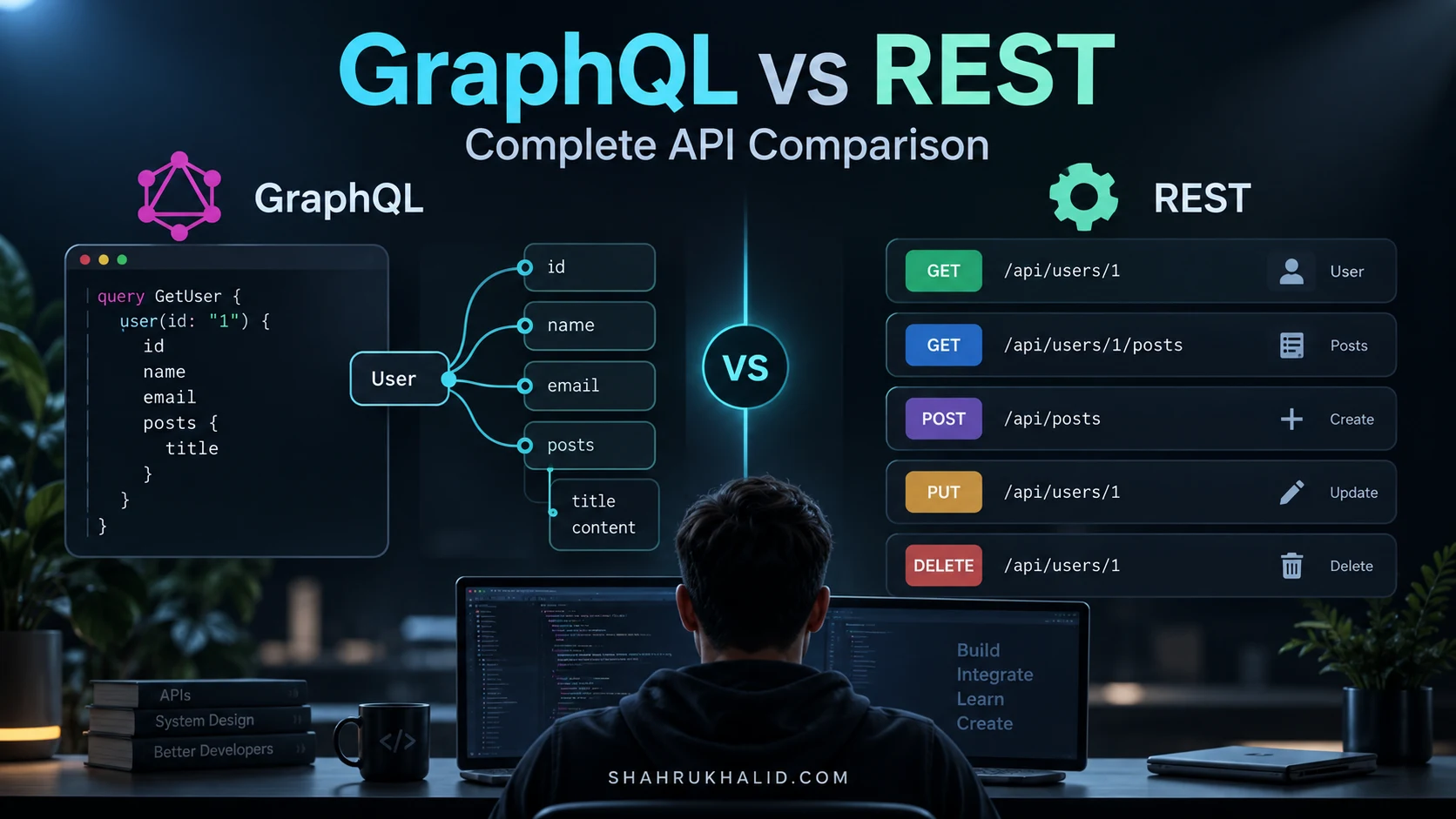
GraphQL is an open-source data query and manipulation language for APIs, and a runtime for fulfilling queries with existing data. Developed by Facebook in 2012 and publicly released in 2015, it was designed to address the inefficiencies and inflexibilities encountered with traditional REST APIs in mobile environments. At its core, GraphQL allows clients to precisely define the data structure they need, and the server responds with exactly that data, no more and no less. This eliminates the problems of over-fetching (receiving more data than required) and under-fetching (needing to make multiple requests to gather all necessary data).
A GraphQL API is typically exposed via a single endpoint, unlike REST which relies on multiple resource-specific endpoints. It is built around a strong type system, defined by a schema that describes all possible data and operations (queries for reading, mutations for writing, and subscriptions for real-time updates). Clients interact with this schema using a declarative query language, requesting specific fields and relationships. This client-driven data fetching paradigm empowers frontend developers with greater control and flexibility, leading to more efficient data transfer and a streamlined development experience, especially for applications with diverse and evolving data requirements.
4. What is REST API?
REST, or Representational State Transfer, is an architectural style for designing networked applications. Coined by Roy Fielding in 2000, it emphasizes a stateless client-server communication model where resources are identified by unique URIs (Uniform Resource Identifiers). REST APIs typically leverage standard HTTP methods (GET, POST, PUT, DELETE, PATCH) to perform CRUD (Create, Read, Update, Delete) operations on these resources. Each request from a client to a server contains all the information needed to understand the request, making the server stateless and improving scalability.
The core principles of REST include a uniform interface, statelessness, cacheability, client-server separation, and a layered system. Resources are typically represented in formats like JSON or XML. REST’s widespread adoption stems from its simplicity, ease of understanding, and its direct mapping to the underlying HTTP protocol, making it highly compatible with existing web infrastructure. It’s particularly well-suited for resource-centric applications where operations primarily involve manipulating distinct entities. While highly effective for many scenarios, its fixed resource structures can sometimes lead to inefficiencies when clients require highly specific or aggregated data, prompting the need for more flexible alternatives.
5. GraphQL — Pros and Cons
Pros of GraphQL:
- Efficient Data Fetching: Eliminates over-fetching and under-fetching. Clients request exactly what they need, reducing payload sizes and network requests, especially beneficial for mobile applications.
- Single Endpoint: A single endpoint simplifies API management and interaction. All data can be accessed through one URL, making client-side development more straightforward.
- Strong Typing and Schema: The GraphQL schema defines all available data and operations, providing a clear contract between client and server. This enables powerful tooling, validation, and auto-completion.
- Improved Developer Experience: Introspection capabilities allow clients to query the schema itself, facilitating automatic documentation, code generation, and powerful IDE integrations.
- Versionless API Design: Adding new fields to the schema doesn’t require versioning the API, as existing clients will only fetch the data they explicitly request. This reduces breaking changes.
- Real-time Capabilities (Subscriptions): GraphQL natively supports subscriptions, enabling real-time data updates from the server to the client, ideal for chat applications, live dashboards, or notifications.
- Microservices Aggregation: Excellent for orchestrating data from multiple backend services, presenting a unified API to the client without exposing the underlying microservice architecture.
Cons of GraphQL:
- Steeper Learning Curve: Requires understanding new concepts like schemas, types, resolvers, queries, mutations, and subscriptions, which can be a hurdle for teams accustomed to REST.
- Complex Caching: Unlike REST, which leverages native HTTP caching mechanisms (ETags, Last-Modified), GraphQL’s single endpoint and dynamic queries make caching more complex to implement effectively at the network level.
- File Uploads: Handling file uploads can be more cumbersome in GraphQL compared to REST, often requiring multipart form data and custom solutions.
- N+1 Problem: If not implemented carefully (e.g., using data loaders), fetching nested data can lead to the “N+1 problem,” where N additional database queries are made for each item in a list.
- Operational Overhead: Monitoring and logging can be more challenging due to the single endpoint and dynamic nature of queries. Rate limiting also requires more sophisticated implementation.
- Complexity for Simple APIs: For straightforward CRUD operations on well-defined resources, GraphQL can introduce unnecessary overhead and complexity compared to a simple REST API.
- Security Considerations: The flexibility of GraphQL queries can expose a larger attack surface if not properly secured, requiring careful validation and authorization at the field level.
6. REST API — Pros and Cons
Pros of REST API:
- Simplicity and Ease of Use: REST is relatively easy to understand and implement, leveraging familiar HTTP methods and concepts.
- Widespread Adoption and Maturity: REST has been around for a long time, leading to a vast community, extensive tooling, established best practices, and abundant resources.
- Excellent Caching Mechanisms: Leverages standard HTTP caching (e.g., ETags, Last-Modified headers), making it highly efficient for static or frequently accessed data.
- Statelessness: Each request from the client to the server contains all the necessary information, making the server stateless. This simplifies server design and improves scalability.
- Clear Separation of Concerns: The client and server are decoupled, allowing independent development and evolution.
- Resource-Oriented: Naturally maps to resources and their operations, making it intuitive for managing distinct entities.
- Tooling and Ecosystem: A wealth of tools for testing (Postman, Insomnia), documentation (Swagger/OpenAPI), and client libraries are readily available.
Cons of REST API:
- Over-fetching and Under-fetching: Clients often receive more data than they need (over-fetching) or have to make multiple requests to get all required data (under-fetching), leading to inefficient network usage.
- Multiple Endpoints: Complex applications might require interacting with many different endpoints, making client-side data orchestration challenging.
- Less Flexible Data Fetching: The server dictates the structure of the response, limiting client flexibility in data retrieval.
- Versioning Challenges: Evolving APIs often necessitate versioning (e.g.,
/v1/users,/v2/users), which can lead to maintenance overhead and client compatibility issues. - Many Round Trips: For complex UIs requiring data from multiple resources, clients might need to make several requests, increasing latency and network overhead.
- Less Efficient for Nested Data: Retrieving deeply nested or interconnected data often requires multiple API calls or complex server-side joins, which can be inefficient.
- Lack of Strong Typing: While tools like OpenAPI can add schema definition, REST itself doesn’t enforce a strong type system by default, which can lead to runtime errors or inconsistencies.
7. When to choose GraphQL
Choosing GraphQL can significantly benefit projects facing specific challenges or having particular requirements. Here are scenarios where GraphQL shines:
- Complex and Evolving UIs: For applications with highly dynamic user interfaces (e.g., dashboards, social media feeds) that require varied data shapes and frequent changes, GraphQL provides unparalleled flexibility. Clients can adapt to UI changes without requiring backend modifications.
- Mobile Applications: Bandwidth and latency are critical for mobile. GraphQL’s ability to fetch only the necessary data minimizes payload size and network requests, leading to faster load times and a better user experience.
- Microservices Architecture: When you have a backend composed of many microservices, GraphQL can act as an API Gateway, aggregating data from various services into a single, unified API for the frontend. This simplifies client-side development and shields clients from backend complexity.
- Rapid Prototyping and Iteration: The flexibility of GraphQL allows frontend teams to iterate quickly on UI features without constant coordination with backend teams for new endpoints or data structures.
- Public APIs Requiring Flexibility: If you’re building a public API where consumers have diverse and unpredictable data needs, GraphQL offers a powerful and flexible interface, empowering developers to build custom integrations.
- Real-time Functionality: With built-in support for subscriptions, GraphQL is an excellent choice for applications requiring real-time data updates, such as live chat, notifications, or collaborative editing tools.
- Developer Experience Focus: If providing a superior developer experience with strong typing, introspection, and auto-generated documentation is a priority, GraphQL’s ecosystem is highly advantageous.
8. When to choose REST API
Despite the rise of GraphQL, REST remains an incredibly powerful and suitable choice for a vast array of projects. Here are the scenarios where REST API is often the preferred option:
- Simple CRUD Operations: For APIs that primarily involve creating, reading, updating, and deleting well-defined resources (e.g., a simple blog, user management system), REST’s resource-oriented approach is straightforward and highly effective.
- Resource-Centric APIs: If your application naturally maps to distinct, independent resources, and clients typically need to fetch entire resources or perform standard operations on them, REST is a perfect fit.
- Traditional Web Applications: For server-rendered applications or those with less dynamic client-side data needs, REST’s simplicity and direct mapping to HTTP verbs are often sufficient and easier to implement.
- Leveraging HTTP Caching: When caching at the network level is a critical performance requirement for static or frequently accessed data, REST’s natural compatibility with HTTP caching mechanisms provides a significant advantage.
- Existing Infrastructure and Expertise: If your team already has extensive experience with REST, and your existing infrastructure is built around it, continuing with REST can be more efficient and cost-effective than migrating to a new paradigm.
- Public APIs Where Simplicity is Key: For public APIs where ease of adoption and a low learning curve for consumers are paramount, REST’s familiarity can be a strong selling point.
- Small to Medium-Sized Projects: For projects with limited complexity and a clear scope, the overhead of setting up a GraphQL server (schema, resolvers) might outweigh the benefits, making REST a quicker and simpler choice.
- When Specific HTTP Status Codes are Important: REST naturally uses HTTP status codes (e.g., 200 OK, 404 Not Found, 500 Internal Server Error) to convey the outcome of a request, which can be useful for debugging and error handling.
9. Real-world use cases for each
GraphQL Real-world Use Cases:
- Facebook: The creator of GraphQL, Facebook uses it extensively for its mobile applications and internal systems to efficiently fetch and aggregate data from various backend services. The Facebook Graph API, while not purely GraphQL, shares conceptual similarities.
- GitHub API v4: GitHub adopted GraphQL for its public API to provide developers with more control over the data they retrieve. This allows users to craft precise queries for repositories, issues, pull requests, and more, significantly reducing over-fetching.
- Shopify: Shopify uses GraphQL for its Admin API, allowing merchants and developers to build powerful custom applications and integrations that interact with their store data in a highly flexible manner.
- Yelp: Yelp leverages GraphQL to power its mobile applications, enabling efficient data fetching for complex UIs that display business information, reviews, photos, and more, all from a single request.
- Twitter: While not their primary public API, Twitter has used GraphQL internally for some of its frontend applications to optimize data loading.
REST API Real-world Use Cases:
- Twitter API: Twitter’s public API is a classic example of a RESTful API, providing developers access to tweets, users, and other data through resource-based endpoints.
- Google APIs: Many of Google’s widely used APIs, such as Google Maps API, Google Drive API, and YouTube Data API, are built on REST principles, offering access to their services via standard HTTP requests.
- Amazon S3 (Simple Storage Service): S3 provides a RESTful interface for storing and retrieving objects, allowing developers to interact with cloud storage using standard HTTP methods.
- Stripe API: Stripe, a leading online payment processing platform, offers a robust REST API for managing payments, customers, and subscriptions. Its clear, resource-oriented design makes it easy for developers to integrate payment functionality.
- OpenWeatherMap API: This popular service provides weather data through a simple REST API, where users can query weather information for specific locations using distinct endpoints.
10. Verdict
The choice between GraphQL and REST API is not about one being inherently superior to the other; rather, it’s about selecting the right tool for the job. Both architectural styles have distinct strengths and weaknesses, making them suitable for different contexts and project requirements. There is no one-size-fits-all solution, and the “best” choice is always situational.
Choose GraphQL if: your application has a complex, evolving UI with diverse data needs, especially for mobile clients where bandwidth is a concern. It excels in microservices environments where data aggregation is crucial, and when providing a highly flexible and self-documenting API for third-party developers is a priority. GraphQL empowers frontend teams with greater autonomy and can significantly reduce client-side development complexity for intricate data flows.
Choose REST API if: your application primarily deals with simple CRUD operations on well-defined, resource-centric data. It’s ideal when leveraging existing HTTP infrastructure and caching mechanisms is a priority, and for projects where simplicity, widespread adoption, and a lower learning curve for the development team are key. REST remains a robust and highly scalable solution for many traditional web services and public APIs where the data structure is relatively stable.
Ultimately, the decision should be driven by a thorough analysis of your project’s specific needs, the complexity of your data models, the capabilities and preferences of your development team, and your long-term scalability and maintenance goals. In some advanced scenarios, a hybrid approach, using REST for simpler, cacheable resources and GraphQL for complex, dynamic data, might even be the most pragmatic solution.