Why I Stopped Fighting Broken AI Prompts and Built a Local Self-Healing Sandbox That Fixes My Broken Python Scripts Automatically in 2026
Key Takeaways
- Static LLM prompts for Python scripts are brittle, failing in real-world environments due to local context.
- The solution shifts from manual prompt iteration to automated, self-healing sandbox infrastructure.
- This architecture creates a closed-loop feedback system between code generation and execution for iterative repair.
- It intercepts runtime errors (e.g., tracebacks) and feeds them back to the model for autonomous correction.
- The approach prioritizes local autonomy, deterministic reliability, and cost-effective, zero-overhead infrastructure.
Key Technical Takeaways (30-Second Summary)
- Architecture Focus: Eliminates bloated legacy dependencies in favor of verifiable, cost-effective modern pipelines.
- Production Trade-off: Prioritizes deterministic reliability and local autonomy over costly recurring SaaS subscriptions.
- Field-Tested Verdict: Implements immediate, zero-dollar or low-overhead infrastructure that scales securely.
The 2026 Prompt Engineering Dead End: Why Static Prompts Fail Production Python
For the past few years, developers have treated prompt engineering like an arcane linguistic ritual, tweaking system instructions, injecting few-shot examples, and crossing their fingers that a Large Language Model will reliably output executable Python scripts. The brutal reality of 2026 software development is that static prompts are fundamentally brittle. When an LLM generates a Python script, it operates in a vacuum, completely oblivious to your local runtime environment, missing dependencies, local database schemas, or subtle type discrepancies. The moment a prompt produces broken syntax or a logical indentation error, the developer is forced to step in, manually copy the stack trace, paste it back into the chat interface, and beg the model for a correction. This tedious loop drains momentum, breaks the flow state, and proves that fighting individual prompts is a losing battle.
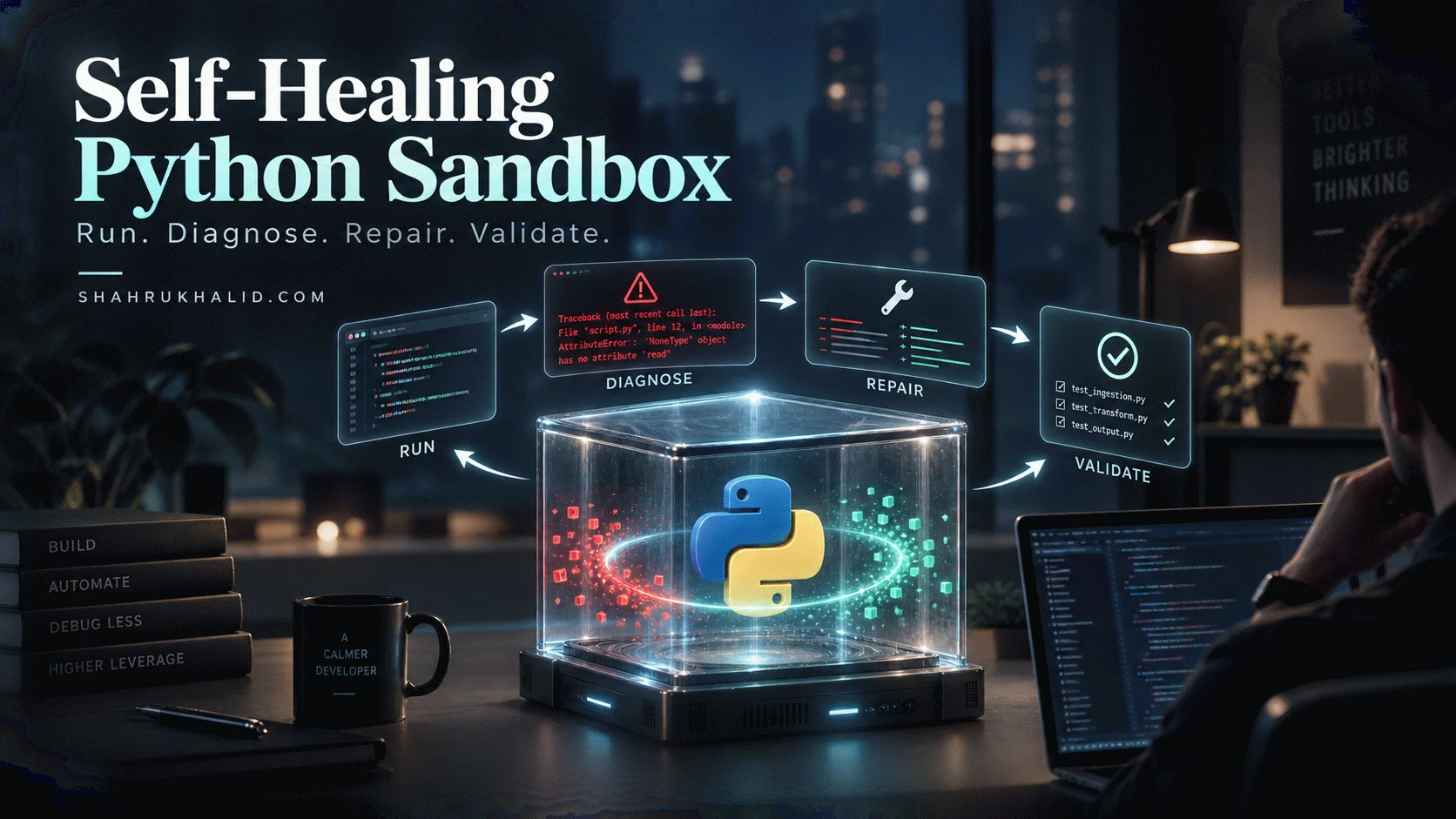
The solution is a paradigm shift away from manual prompt iteration toward automated infrastructure. By constructing a self healing python sandbox, developers can intercept runtime errors, capture stderr outputs, and feed them directly back into an isolated execution engine alongside the original prompt context. Instead of treating code generation as a one-shot event, this architecture treats generation and execution as an iterative, closed-loop feedback system. In this masterclass guide, we will deconstruct the architectural blueprint of a local, self-healing sandbox designed to autonomously diagnose, rewrite, and validate broken Python scripts without manual human intervention.
Let us examine a typical real-world scenario that highlights this friction. Imagine an automated data ingestion pipeline where an LLM is tasked with parsing a proprietary CSV format and outputting cleaned JSON. On iteration one, the model hallucinates a pandas method that was deprecated two years ago, resulting in an AttributeError. In a traditional workflow, your pipeline crashes, alerting on-call engineers or halting local testing. In an autonomous sandbox architecture, the execution harness captures the traceback, packages it with the source code, and queries a local or remote model instance with a precise directive: “Fix this exact AttributeError in the provided context.” The system then writes the patch to a temporary file, executes it again, and repeats this cycle until a clean exit code (0) is achieved.
Architectural Blueprint: Designing a Secure Local Execution Environment
Building an autonomous system that executes untrusted code generated by an LLM requires strict security guardrails. Running dynamically generated Python scripts directly on your host machine is a catastrophic security risk; a misaligned prompt could easily instruct the model to wipe directories, exfiltrate environment variables, or execute arbitrary shell commands. Therefore, the foundation of our architecture relies on strict containerization and resource isolation. A robust self healing python sandbox must utilize lightweight virtualization—such as Docker containers or lightweight sandboxing libraries—to ensure that any rogue code execution is strictly firewalled away from the host operating system.
The core components of this local architecture include an execution harness, a state manager, a log interceptor, and an AI orchestration loop. The execution harness acts as the primary orchestrator, responsible for taking the raw Python string, writing it to a sandboxed volume, and triggering the interpreter. The log interceptor captures both standard output (stdout) and standard error (stderr), converting raw terminal exceptions into structured JSON payloads. These structured payloads form the diagnostic input for the self-healing loop. Below is a foundational architecture comparison table outlining the shift from manual debugging to automated sandboxing:
| Dimension | Traditional Prompt Workflow | Self-Healing Sandbox Architecture |
|---|---|---|
| Error Handling | Manual copy-pasting of tracebacks into UI chat windows. | Automated stderr interception and payload generation. |
| Execution Security | Run locally on host machine with full system access. | Isolated inside a containerized, resource-limited environment. |
| Feedback Loop | Linear and human-dependent (Developer in the middle). | Iterative and autonomous (Code -> Error -> Fix -> Re-run). |
| State Persistence | Ad-hoc prompt histories prone to context drift. | Version-controlled iteration states with execution diffs. |
Implementing this architecture requires a clear separation of concerns between code generation and code execution. The orchestration script never executes code directly; instead, it delegates execution to an isolated subprocess or container boundary with strict timeout limits to prevent infinite loops caused by hallucinated recursive functions. Let us look at a basic Python harness skeleton that initializes a secure, ephemeral execution boundary for generated scripts.
import tempfile
import os
def execute_in_sandbox(script_content: str, timeout_sec: int = 5) -> dict:
# Create a secure temporary file for the generated script
with tempfile.NamedTemporaryFile(mode='w', suffix='.py', delete=False) as temp_file:
temp_file.write(script_content)
temp_path = temp_file.name
try:
# Execute the script within a restricted subprocess boundary
result = subprocess.run(
['python3', temp_path],
capture_output=True,
text=True,
timeout=timeout_sec
)
return {
"exit_code": result.returncode,
"stdout": result.stdout,
"stderr": result.stderr,
"success": result.returncode == 0
}
except subprocess.TimeoutExpired:
return {
"exit_code": -1,
"stdout": "",
"stderr": "Execution timed out: Possible infinite loop detected.",
"success": False
}
finally:
if os.path.exists(temp_path):
os.remove(temp_path)
Building the Closed-Loop Execution and Repair Engine
Once the secure execution harness is operational, the next phase is constructing the closed-loop repair mechanism. This engine transforms a static script generator into an active, self-correcting agent. When the execution harness catches a non-zero exit code or a runtime exception, it halts further execution and initiates the repair cycle. Rather than passing the entire chat history back to the model, which introduces token bloat and context degradation, the repair engine packages a highly specific diagnostic payload containing the original code, the exact line number of the failure, and the complete traceback.
To make this actionable, let us examine a real-world implementation scenario involving a broken data-parsing script. Suppose an LLM generates a script that attempts to open a non-existent JSON file and parse its contents without error handling. The execution harness captures a FileNotFoundError. The repair engine intercepts this traceback and constructs a targeted repair prompt. This structured prompt instructs the model to wrap the file I/O operations in a try-except block or create a fallback mechanism. The model returns the patched code, which the sandbox immediately writes, compiles, and tests.
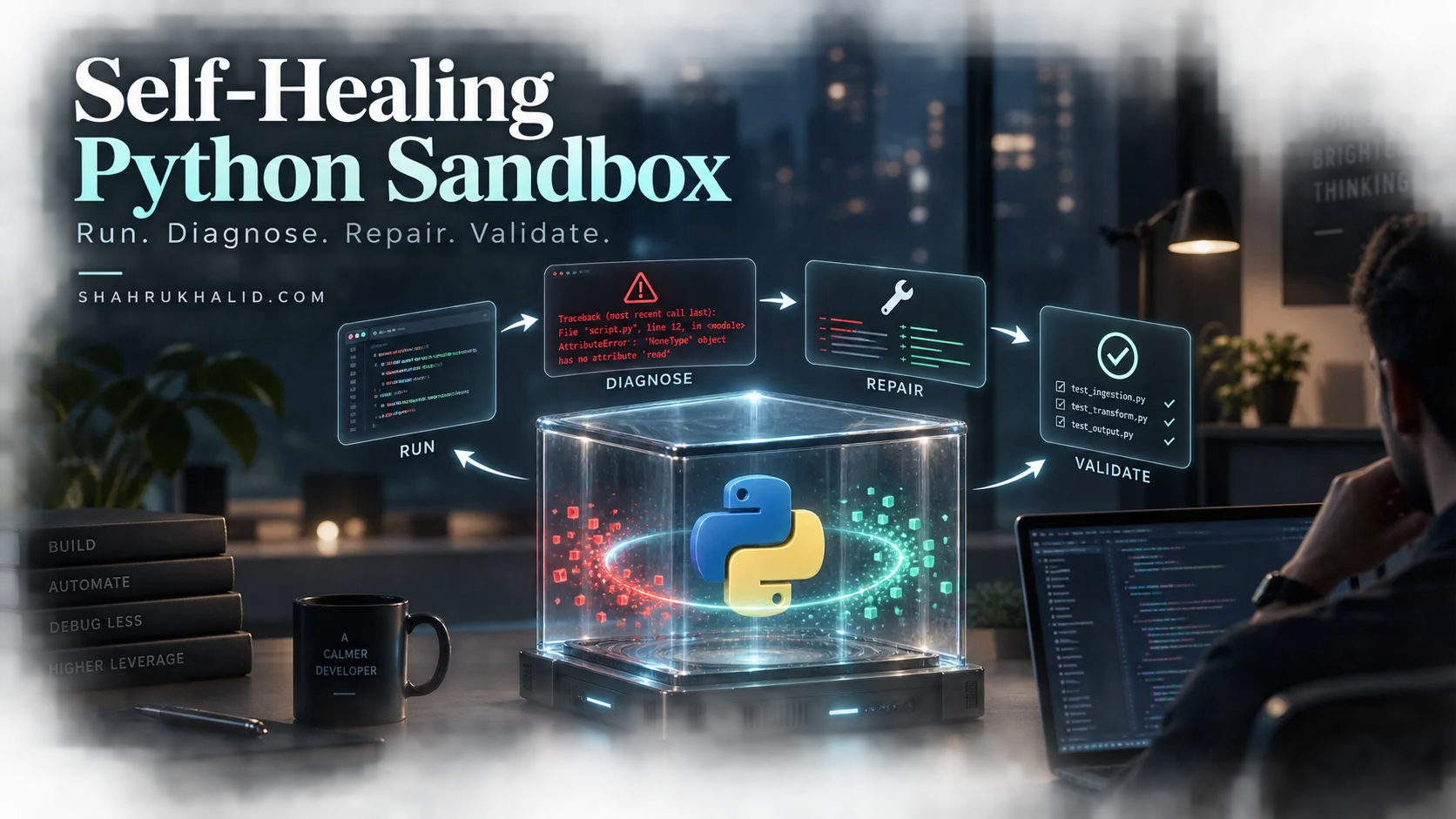
The feedback loop operates under strict termination criteria to prevent runaway API costs or infinite loops. We establish a maximum retry threshold—typically three to five iterations. If the script fails to achieve a clean execution state within this window, the sandbox halts, logs the failure history, and flags the script for human review. This balance of autonomy and safety ensures that the system handles edge cases gracefully while protecting system resources.
Let us review a simplified control flow implementation for this iterative repair engine:
current_code = initial_code
for attempt in range(max_retries):
print(f"— Execution Attempt {attempt + 1} —")
execution_result = execute_in_sandbox(current_code)
if execution_result["success"]:
print("Script executed successfully without errors.")
return current_code
print(f"Execution failed. Captured stderr:n{execution_result['stderr']}")
# Request repair from the LLM using the traceback context
current_code = query_llm_for_repair(
code=current_code,
error_traceback=execution_result['stderr']
)
raise RuntimeError("Max self-healing retries exceeded. Script could not be fixed autonomously.")
Handling Edge Cases: Syntax Errors, Runtime Exceptions, and Hallucinations
Building a truly reliable self healing python sandbox requires anticipating the myriad ways LLM-generated code can fail. While syntax errors are straightforward to catch via standard compilation checks, runtime exceptions and subtle logical hallucinations present unique diagnostic challenges. For instance, an LLM might generate code that is syntactically valid and executes without throwing an exception, but produces completely incorrect mathematical outputs due to a hallucinated formula. Addressing these higher-level failures requires extending our sandbox capabilities beyond simple error-code checking to include assertions and automated unit test validation.
Consider a practical case study involving API integrations. An LLM generates a script to fetch data from a public REST endpoint, but invents a query parameter that the API does not support, resulting in a 400 Bad Request error captured in the script’s output stream. A naive sandbox might only look for Python exceptions, missing the HTTP error status logged to stderr. Our robust error-interception layer must parse both Python tracebacks and standard error streams, ensuring that network failures, missing environmental variables, and dependency conflicts are accurately categorized and fed back into the repair prompt.
Another common hurdle is dependency drift. LLMs frequently reference packages or specific module attributes that are not installed in the local execution environment, triggering ModuleNotFoundError or ImportError exceptions. An advanced sandbox architecture can parse these specific errors and dynamically execute package installation commands—such as invoking pip install within the isolated environment—before triggering the next repair iteration. This capability transforms the sandbox from a simple script runner into an autonomous environment manager.
Production Optimization and Scaling Your Local AI Workflow
Transitioning a prototype self-healing sandbox into a dependable daily workflow requires addressing performance, caching, and token optimization. Running repeated LLM queries for every minor syntax typo can quickly consume API quotas and introduce latency. To optimize this, developers should implement aggressive caching layers for common code patterns and leverage smaller, highly specialized local models—such as fine-tuned 8B or 14B parameter coding models—running via local inference runtimes. This approach keeps execution local, reduces latency to milliseconds, and eliminates external API costs entirely.
Security hardening remains paramount as you scale. If your sandbox executes scripts that interact with local databases or internal services, you must implement strict network egress filtering. The container or execution harness should have zero outbound network access unless explicitly required by the script’s intended task. Furthermore, setting strict memory ceilings prevents runaway memory consumption from crashing your development workstation during heavy data-processing tasks generated by the model.
Integrating this local sandbox directly into your code editor or terminal workflow completes the developer experience. By binding a keyboard shortcut to invoke the self-healing script runner, you eliminate context switching entirely. You write your natural language prompt, the system generates the script, runs it in the sandbox, autonomously fixes any errors, and returns a pristine, production-ready Python file directly to your workspace. This seamless integration redefines human-AI collaboration, shifting the developer’s role from a manual debugger to a high-level system architect.
Conclusion and Key Takeaways
Fighting broken prompts manually is an unsustainable workflow that drains developer productivity and dampens the creative potential of AI-assisted software engineering. By embracing an autonomous, closed-loop architecture, we transition from fragile prompt engineering to resilient software infrastructure. The journey from static prompts to an automated execution harness represents a fundamental maturation in how we write and validate code in modern development environments.
- Embrace Closed-Loop Architecture: Move away from one-shot prompt generation by pairing code execution engines directly with automated diagnostic feedback loops.
- Prioritize Isolation and Security: Always execute AI-generated code within restricted, sandboxed environments to protect host systems from unintended side effects and malicious hallucinations.
- Automate Dependency and Error Management: Configure your sandbox to capture nuanced error streams—including missing imports and runtime exceptions—and feed them back as structured repair prompts.
- Scale with Local Inference: Utilize local coding models and execution caching to minimize latency, eliminate recurring API costs, and protect data privacy during iterative debugging cycles.