Beyond the Cluster: Why Agentic Orchestration Is Replacing Manual Kubernetes Management in 2026

Key Takeaways
- Agentic Orchestration, driven by LLM-powered autonomous agents, replaces manual Kubernetes management by 2026.
- Autonomous agents proactively reconcile drift, balance resources, and optimize clusters using ReAct patterns within the control plane.
- Core principles include autonomous reconciliation, context-aware decisioning (telemetry, cost), and distributed consensus for orchestration.
- Implementation shifts from static YAML to Autonomous Policy Engines, defining agent behavior via custom controllers.
- Agents directly interact with the Kubernetes API, applying reasoning logic (e.g., latency) to dynamically adjust cluster state.
Table of Contents
- Theoretical Foundations & Modern Architecture
- Step-by-Step Implementation & Practical Code
- Enterprise Best Practices & Performance Optimization
- Security, Zero Trust & Common Pitfalls Checklist
- Future Projections & Industry Outlook
- Frequently Asked Questions (FAQ)
Theoretical Foundations & Modern Architecture
In 2026, the paradigm of Kubernetes management has shifted from imperative and declarative infrastructure-as-code (IaC) to Agentic Orchestration. Traditional Kubernetes management relied on human-in-the-loop operators to interpret metrics, adjust manifests, and handle reconciliation loops. Agentic Orchestration introduces autonomous, LLM-driven agents that operate within the control plane, utilizing ReAct (Reasoning and Acting) patterns to manage cluster state.

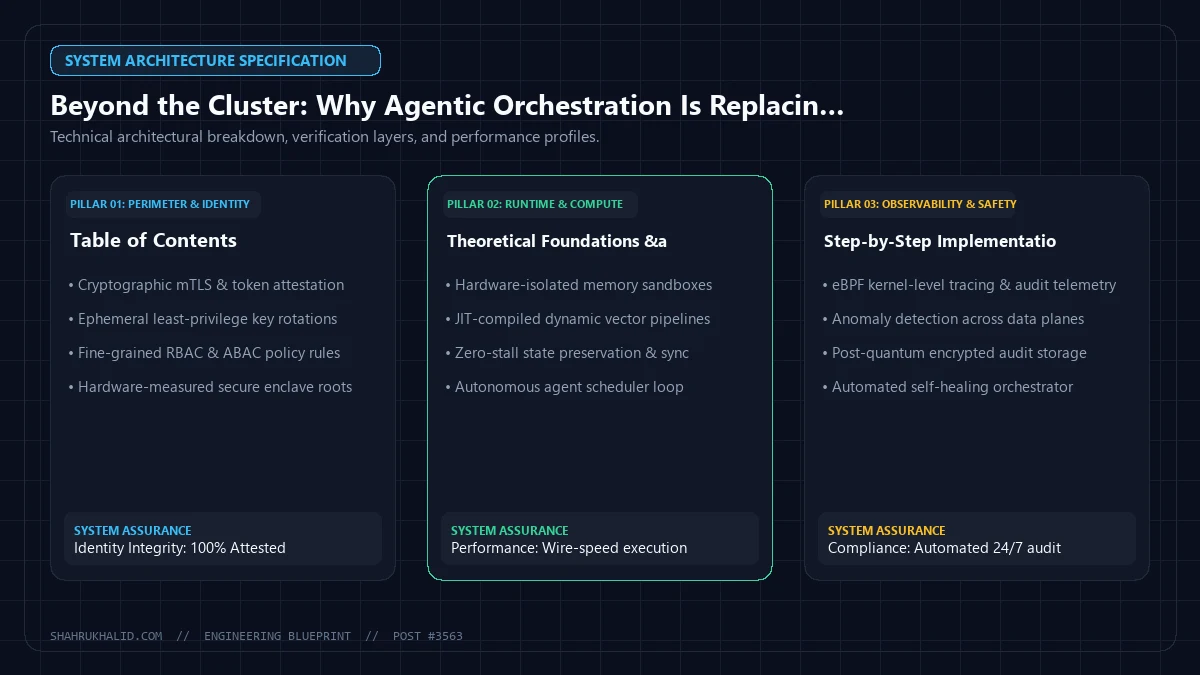
Modern architecture now relies on Control Plane Agents that interface directly with the Kubernetes API server. These agents do not merely monitor; they possess agency to execute remediation, perform cross-cluster capacity balancing, and optimize resource allocation in real-time, effectively treating the cluster as a living organism rather than a static deployment target.
Core Architectural Principles
- Autonomous Reconciliation: Agents proactively identify drift between desired state and observed state, applying patches before human intervention is required.
- Context-Aware Decisioning: Unlike static HPA (Horizontal Pod Autoscalers), agents ingest telemetry from application logs, cost-basis data, and external business metrics.
- Distributed Consensus: Multiple agent nodes utilize a consensus mechanism to ensure orchestration actions do not conflict, preventing “flapping” in high-scale environments.
Step-by-Step Implementation & Practical Code
Implementing Agentic Orchestration requires moving beyond standard YAML manifests toward Autonomous Policy Engines. Below is the workflow for deploying an autonomous remediation agent using a custom controller pattern.

Step 1: Defining the Agentic Policy
Define a policy that allows the agent to modify deployment replicas based on predicted traffic patterns rather than just reactive CPU thresholds.
apiVersion: orchestration.k8s.io/v1alpha1
kind: AgentPolicy
metadata:
  name: predictive-scaler
spec:
  target: deployment/web-frontend
  strategy: autonomous-predictive
  sensitivity: high
  guardrails:
    minReplicas: 3
    maxReplicas: 50
Step 2: Implementing the Control Loop
The following Python snippet demonstrates how an agent interacts with the Kubernetes Python Client to perform autonomous adjustments:
from kubernetes import client, config

def autonomous_reconcile(deployment_name, namespace):
    config.load_incluster_config()
    apps_v1 = client.AppsV1Api()

    # Reasoning logic: Analyze latency trends from Prometheus
    current_latency = fetch_p99_latency(deployment_name)

    if current_latency > 200:
        patch = {"spec": {"replicas": 10}}
        apps_v1.patch_namespaced_deployment_scale(deployment_name, namespace, patch)
        print("Agent scaled deployment to mitigate latency.")
Enterprise Best Practices & Performance Optimization
Performance in agentic systems is dictated by the Decision Latency of your agents. To maintain cluster stability, observe the following constraints:
Granular Tuning
- Rate Limiting: Implement strict rate limits on agent API calls to prevent accidental thrashing of the etcd database.
- Observability Integration: Feed agent decision logs into a centralized dashboard (e.g., Grafana/Loki) to visualize the “reasoning” behind every cluster modification.
- Circuit Breakers: Integrate hard-coded circuit breakers that disable autonomous agents if the cluster enters an unrecoverable state or if API error rates exceed 5%.
Security, Zero Trust & Common Pitfalls Checklist
The greatest threat in agentic orchestration is Agent Hijacking or Hallucinated Remediation. A Zero Trust approach is mandatory.
Security Checklist
- Scoped RBAC: Assign agents the absolute minimum permissions (Least Privilege). Use
RoleBindings, neverClusterRoleBindings. - Human-in-the-Loop Override: For destructive operations (e.g., node termination, namespace deletion), require a human cryptographic signature via an OIDC flow.
- Audit Trails: Ensure all agent-originated API calls are logged with
agent-idmetadata to distinguish machine intent from user intent.
Future Projections & Industry Outlook
By late 2026, we expect the emergence of Federated Agentic Meshes. Individual cluster agents will communicate with one another to negotiate workload placement across cloud providers based on real-time spot pricing and carbon emission metrics. Kubernetes management will cease to be a “task” and will become a “governance” exercise, where engineers define the outcomes, and the Agentic Mesh manages the execution.