gRPC vs REST: Complete Comparison
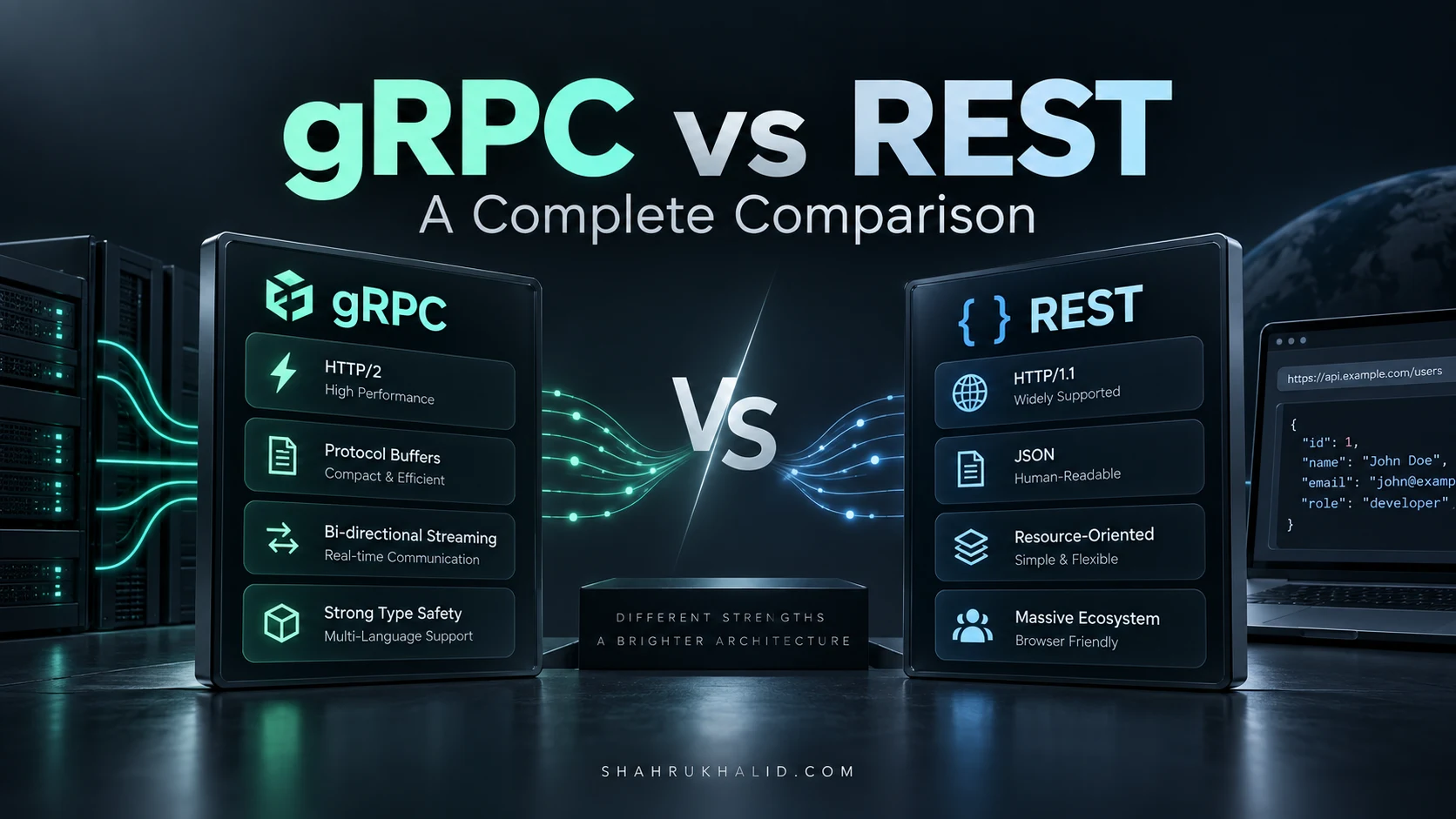
Key Takeaways
- gRPC leverages HTTP/2 and binary Protobuf for high performance and excellent scalability.
- REST is resource-oriented, uses human-readable JSON/XML, offering a gentler learning curve.
- gRPC's binary serialization and HTTP/2 make it more efficient than REST for high throughput.
- Choosing between gRPC and REST impacts performance, scalability, and development speed.
- gRPC has a steeper learning curve due to Protobuf IDL; REST is more familiar.
gRPC vs REST: Complete Comparison
A Deep Dive into API Communication Styles for Modern Architectures
1. Introduction
In the rapidly evolving landscape of software development, choosing the right communication protocol for your Application Programming Interfaces (APIs) is a critical decision that impacts performance, scalability, development speed, and maintainability. Two prominent architectural styles dominate this discussion: gRPC and REST. Both have carved out significant niches, offering distinct advantages and disadvantages depending on the specific requirements of a project.
This comprehensive article aims to provide a detailed, unbiased comparison of gRPC vs REST, delving into their underlying principles, technical characteristics, and practical implications. We will explore what makes each unique, their respective strengths and weaknesses, and most importantly, guide you through the decision-making process of when to choose one over the other. Whether you’re a seasoned software architect grappling with microservices design, a backend developer evaluating API strategies, or a curious engineer seeking to understand modern web communication, this guide is crafted to equip you with the knowledge needed to make informed choices for your next project.
By the end of this comparison, you will have a clear understanding of:
- The fundamental differences between gRPC and REST.
- The performance, scalability, and development considerations for each.
- Specific use cases where gRPC excels and where REST remains the preferred choice.
- Practical advice on integrating these technologies into your systems.
2. Quick Comparison Overview Table
Before diving into the intricate details, here’s a high-level comparison table highlighting key features of gRPC and REST.
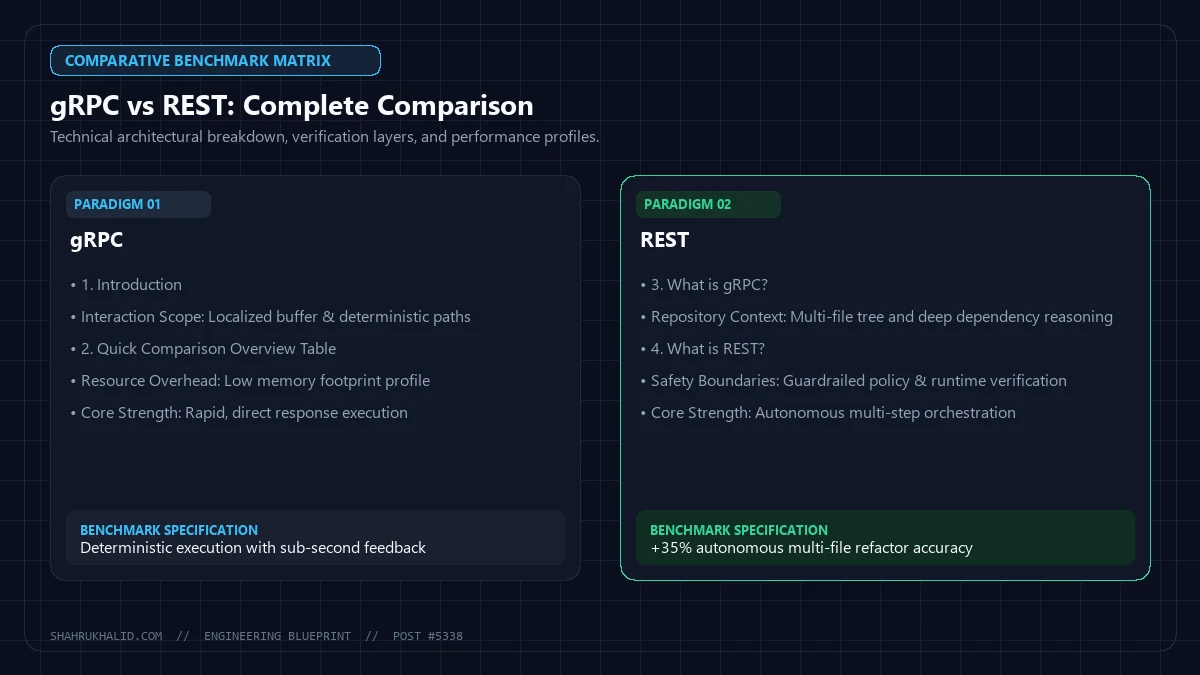
| Feature | gRPC | REST |
|---|---|---|
| Communication Style | RPC (Remote Procedure Call) | Resource-oriented |
| Transport Protocol | HTTP/2 (mandatory) | HTTP/1.1 (common), HTTP/2 (possible) |
| Data Format | Protocol Buffers (Protobuf) – binary | JSON, XML, plain text – human-readable |
| Serialization | Efficient binary serialization | Text-based (JSON/XML), more verbose |
| Performance | High (due to HTTP/2, Protobuf, binary) | Good (but generally lower than gRPC for high-throughput) |
| Scalability | Excellent (lower overhead, efficient for microservices) | Good (but can incur higher overhead with large payloads) |
| Learning Curve | Steeper (Protobuf IDL, code generation) | Gentler (familiar HTTP verbs, JSON) |
| Community & Ecosystem | Growing, strong Google backing, specific tooling | Mature, vast, industry standard, extensive tooling |
| Cost (Bandwidth/CPU) | Lower (due to compact binary format, HTTP/2 features) | Higher (due to verbose text format, HTTP/1.1 overhead) |
| Browser Support | Limited (requires gRPC-Web proxy) | Native and excellent |
| Streaming | Built-in bi-directional streaming | Limited (requires WebSockets for true streaming) |
| Type Safety | Strong (Protobuf schema, code generation) | Weak (schema often external or inferred) |
| Use Cases | Microservices, IoT, mobile, high-performance APIs, polyglot systems | Web applications, public APIs, simple integrations, browser-based clients |
3. What is gRPC?
gRPC, an acronym for Google Remote Procedure Call, is an open-source, high-performance RPC framework developed by Google. It enables client and server applications to communicate transparently and build connected systems. At its core, gRPC allows you to define a service using Protocol Buffers (Protobuf), a language-agnostic, platform-neutral, extensible mechanism for serializing structured data. This definition, written in a .proto file, specifies the methods that can be called remotely with their parameters and return types.
A distinctive feature of gRPC is its reliance on HTTP/2 for its transport protocol. HTTP/2 offers significant advantages over HTTP/1.1, including multiplexing (sending multiple requests over a single connection), header compression, and server push capabilities. These features, combined with Protobuf’s efficient binary serialization, contribute to gRPC’s superior performance and reduced network usage, making it ideal for high-throughput, low-latency communication scenarios. gRPC automatically generates client and server code in various programming languages based on the Protobuf service definition, abstracting away the complexities of network communication and data serialization, and ensuring strong type safety across different services.
4. What is REST?
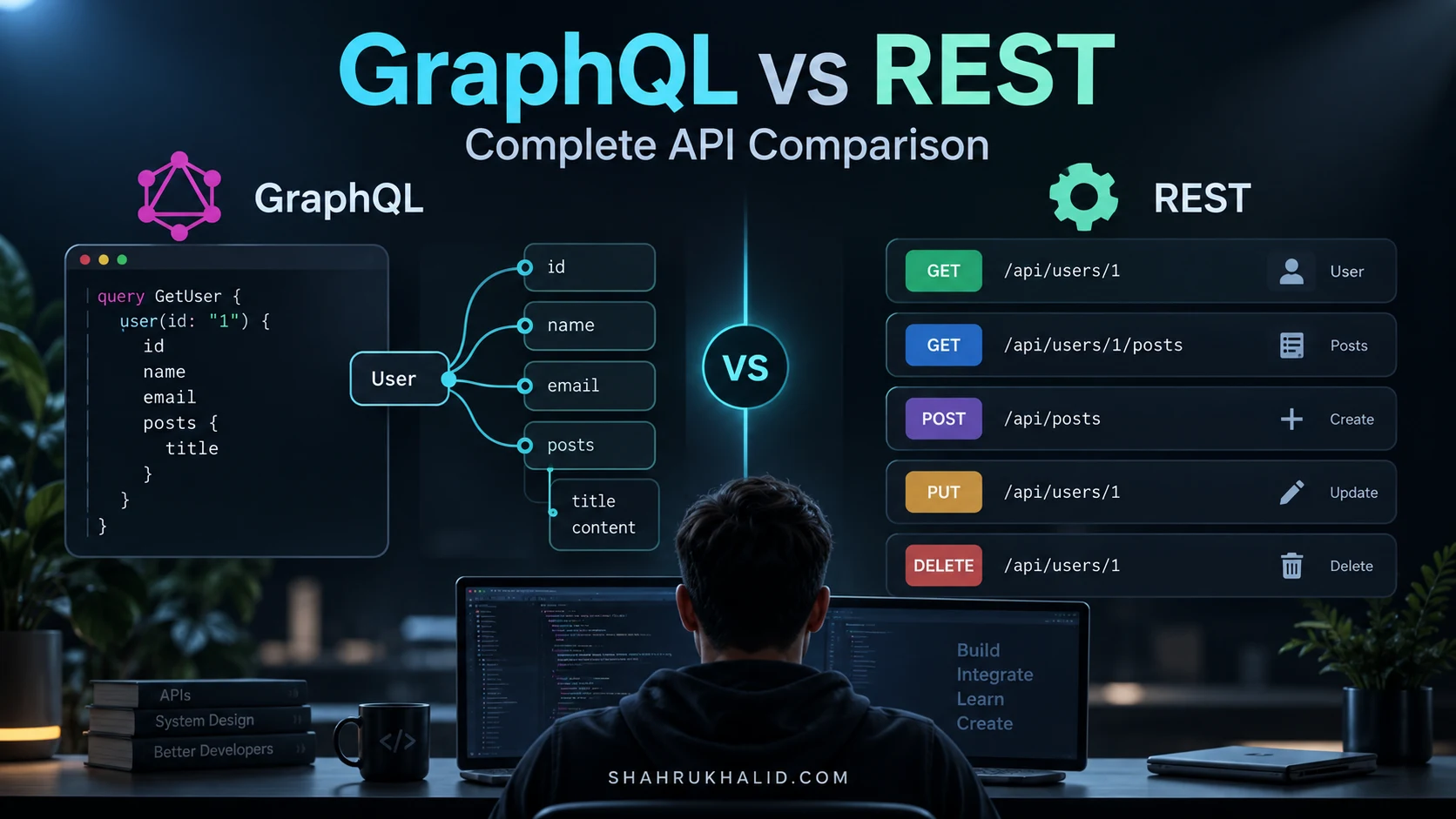
REST, which stands for Representational State Transfer, is an architectural style, not a protocol, that defines a set of constraints for designing networked applications. It was introduced by Roy Fielding in his doctoral dissertation in 2000. RESTful APIs are built around resources, which are identified by unique Uniform Resource Identifiers (URIs). Clients interact with these resources using a uniform interface, typically a subset of standard HTTP methods: GET (retrieve), POST (create), PUT (update/replace), PATCH (partial update), and DELETE (remove).
A key principle of REST is statelessness, meaning each request from a client to a server must contain all the information needed to understand the request, and the server should not store any client context between requests. This simplifies server design and improves scalability. Data is commonly exchanged in human-readable formats like JSON (JavaScript Object Notation) or XML (Extensible Markup Language), with JSON being the predominant choice due to its lightweight nature and ease of parsing in web browsers. REST’s simplicity, widespread adoption, and excellent browser compatibility have made it the de facto standard for building public APIs and web services, offering a flexible and easily consumable interface for a broad range of clients.
5. gRPC — Pros and Cons
Pros of gRPC:
- High Performance and Efficiency:
- HTTP/2: Leverages HTTP/2’s features like multiplexing (multiple concurrent requests over a single TCP connection), header compression (HPACK), and binary framing, which significantly reduces latency and improves throughput compared to HTTP/1.1.
- Protocol Buffers: Uses a compact binary serialization format, which is much smaller and faster to serialize/deserialize than text-based formats like JSON or XML. This leads to lower bandwidth consumption and faster processing.
- Strong Type Safety and Code Generation:
- IDL (Interface Definition Language): Services are defined using Protobuf’s IDL, which strictly defines message structures and service methods.
- Automated Code Generation: Compilers automatically generate client and server boilerplate code in various languages (Go, Java, C++, Python, Node.js, etc.). This ensures type safety, reduces manual coding errors, and speeds up development.
- Bi-directional Streaming:
- gRPC inherently supports four types of service methods: unary (single request/response), server streaming, client streaming, and bi-directional streaming. This makes it ideal for real-time communication, chat applications, IoT device communication, and long-lived connections.
- Polyglot Environment Support:
- Due to code generation, gRPC works seamlessly across diverse programming languages, making it an excellent choice for microservices architectures where different services might be written in different languages.
- Built-in Features:
- Includes built-in support for authentication, load balancing, health checking, and error handling, simplifying the implementation of robust distributed systems.
Cons of gRPC:
- Steeper Learning Curve:
- Developers need to learn Protobuf syntax, the gRPC paradigm, and the code generation process, which can be more complex than the familiar HTTP/JSON model of REST.
- Less Human-Readable:
- The binary nature of Protobuf messages makes them difficult to inspect and debug directly using standard browser developer tools or command-line utilities like
curl. Specialized tools are often required.
- The binary nature of Protobuf messages makes them difficult to inspect and debug directly using standard browser developer tools or command-line utilities like
- Limited Browser Support:
- Browsers do not natively support HTTP/2’s full features or Protobuf directly. To use gRPC from a web browser, a proxy layer (like gRPC-Web) is required to translate gRPC calls into HTTP/1.1 and Protobuf to base64-encoded Protobuf or JSON.
- Ecosystem and Tooling Maturity:
- While growing rapidly, the gRPC ecosystem, including testing tools, monitoring, and gateways, is generally less mature and extensive than that of REST.
- No Built-in Caching Mechanism:
- Unlike HTTP/1.1, which has well-defined caching semantics, gRPC does not provide intrinsic caching mechanisms. Caching must be implemented at the application layer.
- Can Be Overkill:
- For simple APIs or applications with low performance requirements, the added complexity of gRPC might not be justified, and REST could be a simpler, faster choice for initial development.
6. REST — Pros and Cons
Pros of REST:
- Simplicity and Familiarity:
- REST is built upon well-understood HTTP principles and verbs (GET, POST, PUT, DELETE), making it intuitive for developers familiar with web technologies.
- Data formats like JSON are human-readable and easy to parse, which simplifies debugging and integration.
- Widespread Adoption and Vast Ecosystem:
- REST is the most widely adopted API architectural style. This means a huge community, extensive documentation, countless libraries, frameworks, and tools (e.g., Postman, Swagger/OpenAPI) are available across all programming languages.
- Excellent Browser Support:
- REST APIs are natively supported by all web browsers, making them the default choice for client-side web applications (SPAs, traditional web apps).
- Statelessness:
- Each request from the client to the server contains all the necessary information, making the server stateless. This simplifies server-side implementation, improves scalability, and makes it easier to distribute requests across multiple servers.
- Caching Mechanisms:
- REST leverages standard HTTP caching mechanisms (e.g., ETag, Last-Modified, Cache-Control headers), which can significantly improve performance and reduce server load for frequently accessed resources.
- Flexibility in Data Format:
- While JSON is dominant, REST can support various data formats like XML, HTML, or plain text, offering flexibility depending on client requirements.
Cons of REST:
- Less Efficient for High-Performance Scenarios:
- HTTP/1.1 Overhead: Often relies on HTTP/1.1, which can be less efficient due to connection overhead for each request and lack of multiplexing.
- Text-based Data: JSON/XML are text-based and more verbose than binary formats, leading to larger message sizes and higher bandwidth consumption.
- Over-fetching and Under-fetching: Clients often receive more data than needed (over-fetching) or need to make multiple requests to get all required data (under-fetching) because resources are fixed.
- Lack of Strong Type Safety:
- REST APIs typically don’t have a built-in mechanism for strong type checking at compile time. While tools like OpenAPI/Swagger can define schemas, type validation usually happens at runtime, potentially leading to errors.
- Limited Streaming Capabilities:
- REST is primarily request-response based. While techniques like long polling or server-sent events (SSE) can simulate streaming, true bi-directional streaming typically requires an upgrade to WebSockets, introducing another protocol.
- Verbosity:
- HTTP headers and JSON/XML payloads can be quite verbose, especially for small data transfers, leading to increased network traffic.
- Complexity in Large Systems:
- As the number of resources and relationships grows, designing and managing a truly RESTful API that adheres to all principles (e.g., HATEOAS) can become challenging.
7. When to Choose gRPC
The decision to adopt gRPC often hinges on specific technical requirements and architectural goals. Here are scenarios where gRPC is typically the superior choice:
- Microservices Communication: For internal communication between services in a distributed microservices architecture, gRPC’s efficiency, strong typing, and multi-language support make it an excellent fit. It helps ensure consistent interfaces and high-speed data exchange within the system.
- High-Performance, Low-Latency APIs: If your application demands minimal latency and maximum throughput, such as real-time analytics, gaming backends, or financial trading systems, gRPC’s HTTP/2 foundation and binary serialization offer significant performance advantages.
- Real-time Streaming Services: Applications requiring continuous data streams, like IoT device communication, live chat, video conferencing, or push notifications, benefit immensely from gRPC’s native support for bi-directional streaming.
- Polyglot Environments: In organizations where different teams use different programming languages for various services, gRPC’s code generation across multiple languages simplifies integration and ensures interoperability.
- Mobile Backends: For mobile applications, where network bandwidth and battery life are critical, gRPC’s compact message format and efficient communication reduce data usage and improve responsiveness.
- API Evolution and Versioning: Protocol Buffers provide robust mechanisms for evolving APIs without breaking existing clients, which is crucial for long-lived services.
8. When to Choose REST
Despite gRPC’s technical prowess, REST remains the dominant choice for many applications, particularly those exposed to the public internet or requiring broad accessibility. Consider REST for the following use cases:
- Public-Facing APIs: When you need to expose an API to external developers, partners, or the general public, REST’s simplicity, familiarity, and widespread tooling make it the most accessible option. Almost every developer understands how to interact with a REST API.
- Web Applications and Browser-Based Clients: For clients running in web browsers, REST APIs are the natural choice due to native browser support for HTTP and JSON. gRPC requires a proxy layer (gRPC-Web) for browser compatibility, adding complexity.
- Simple CRUD Operations: If your API primarily involves standard Create, Read, Update, and Delete (CRUD) operations on resources, REST’s resource-oriented approach and HTTP verbs align perfectly with these requirements.
- When Human Readability and Debugging are Crucial: The text-based nature of JSON payloads in REST makes them easy to read, inspect, and debug using standard tools like
curl, browser developer consoles, or API clients like Postman. - Leveraging HTTP Caching: For resources that are frequently accessed but change infrequently, REST’s ability to utilize standard HTTP caching mechanisms can significantly reduce server load and improve client-side performance.
- Existing Infrastructure and Expertise: If your team and existing systems are heavily invested in RESTful principles, tooling, and expertise, sticking with REST might be more pragmatic to avoid a steep learning curve and migration costs.
9. Real-world Use Cases for Each
gRPC Real-world Use Cases:
- Google: As the creator of gRPC, Google uses it extensively for internal microservices communication across its vast infrastructure, including services powering products like Google Stadia, YouTube, and Google Cloud.
- Netflix: While known for its RESTful public APIs, Netflix employs gRPC for various internal data plane services, leveraging its performance for high-volume, low-latency communication between backend components.
- Square: The payment processing company utilizes gRPC for inter-service communication within its microservices architecture, benefiting from strong type safety and efficiency.
- Lyft: The ride-sharing company uses gRPC for its inter-service communication, citing performance improvements and simplified API development for its polyglot environment.
- IoT Devices: For constrained environments like IoT devices, gRPC’s efficient binary protocol minimizes bandwidth and power consumption, making it suitable for communication with cloud services.
- Financial Trading Platforms: High-frequency trading systems often use gRPC for real-time data feeds and transaction processing due to its low latency and high throughput capabilities.
REST Real-world Use Cases:
- Social Media APIs (Twitter, Facebook, Instagram): These platforms expose RESTful APIs to allow third-party developers to integrate with their services, retrieve data, and post content.
- Payment Gateways (Stripe, PayPal): Financial service providers offer REST APIs for processing payments, managing subscriptions, and handling transactions, making it easy for businesses to integrate payment functionalities.
- E-commerce Platforms (Shopify, Amazon MWS): These platforms provide RESTful APIs for managing products, orders, customers, and inventory, enabling businesses to build custom storefronts or integrate with other systems.
- Content Management Systems (WordPress REST API): Modern CMS platforms expose REST APIs to provide a headless content delivery mechanism, allowing developers to build custom frontends using various technologies.
- Cloud Provider APIs (AWS, Azure, Google Cloud): The APIs for managing cloud resources (compute, storage, networking) are predominantly RESTful, offering a universally accessible way to programmatically interact with cloud services.
- Single Page Applications (SPAs): Most modern web applications built with frameworks like React, Angular, or Vue.js communicate with their backend services using REST APIs to fetch and send data.
10. Verdict
The choice between gRPC and REST is not about one being definitively “better” than the other; rather, it’s about selecting the right tool for the job. Both architectural styles have their unique strengths and are optimized for different communication patterns and environments. REST, with its simplicity, human-readability, and vast ecosystem, remains the undisputed champion for public-facing APIs, web applications, and scenarios where broad accessibility and ease of integration are paramount. Its statelessness and resource-oriented nature align perfectly with the traditional web model.
Conversely, gRPC shines in high-performance, internal, and real-time communication scenarios. Its efficiency, strong type safety, and native streaming capabilities make it an ideal fit for microservices architectures, IoT devices, mobile backends, and polyglot systems where speed, efficiency, and strict interface contracts are critical. Many modern systems successfully employ a hybrid approach, using gRPC for internal service-to-service communication and exposing a RESTful API gateway for external clients, thereby leveraging the best of both worlds. Ultimately, the decision should be driven by a careful evaluation of your project’s specific requirements, performance needs, team expertise, and the long-term maintainability of your system.