Beyond Syntax: Why I Stopped Teaching My Students to Write Code and Started Teaching Them to Debug AI Logic

Key Takeaways
- Software education shifts from syntax mastery to debugging and verifying AI-generated logic.
- Engineers transition from code authors to architects verifying AI-generated structural integrity.
- AI generates well-formatted but potentially flawed, insecure, or inefficient code, demanding human validation.
- Debugging AI logic and rigorous verification are the new core competencies for technologists.
- Traditional syntax-focused teaching is obsolete; industry requires structural engineers, not mere code bricklayers.
Key Technical Takeaways (30-Second Summary)
- Architecture Focus: Eliminates bloated legacy dependencies in favor of verifiable, cost-effective modern pipelines.
- Production Trade-off: Prioritizes deterministic reliability and local autonomy over costly recurring SaaS subscriptions.
- Field-Tested Verdict: Implements immediate, zero-dollar or low-overhead infrastructure that scales securely.
The Great Shift: Why Syntax No Longer Defines the Software Engineer
For decades, the gatekeeper of computer science education was syntax—a brutal, unforgiving trial by fire where students were judged by their ability to place semicolons and match curly braces. Today, that gate has been blown wide open by Large Language Models, forcing us to realize that teaching students how to write code is no longer the primary objective; instead, the new frontier is teaching AI programming through the lens of rigorous, logical debugging.
In my classroom, I have stopped grading on the ability to memorize the syntax of a Python dictionary or the boilerplate of a React component. Why? Because the machine does that better, faster, and more accurately than any student ever could. If a student can prompt an AI to generate a functioning web scraper in ten seconds, the value of the education is no longer in the typing; it is in the verification. We are moving from an era of “authorship” to an era of “editorial oversight,” where the engineer is the architect who must validate the structural integrity of a machine-generated blueprint. This shift is not just a pedagogical convenience; it is a fundamental restructuring of what it means to be a technologist in the 2026 landscape.
The Fallacy of the Blank Screen
The traditional “blank screen” method of teaching programming—where a student stares at a cursor and struggles to recall the correct method signature—is fundamentally broken. It mirrors a world where software was built by hand-crafting every brick. Today, we live in the world of pre-fabricated, high-performance modular construction. When we focus on syntax, we are teaching students to be bricklayers, but the industry is demanding structural engineers who understand the physics of the buildings they oversee.
When I look at the modern classroom, the most successful students are not the ones who can recite the documentation of a library from memory. They are the ones who can look at a block of AI-generated logic and ask, “Does this actually solve the problem, or does it just look like it does?” This is the essence of debugging AI logic. The AI is a brilliant, tireless intern that suffers from a severe case of overconfidence. It will generate perfectly formatted code that is logically bankrupt, subtly insecure, or inefficiently architected. If the student cannot debug that logic, they are not a programmer; they are merely a conduit for technical debt.
The Pedagogy of Verification: Debugging as the New Core Competency
Teaching AI programming is not about mastering prompt engineering; it is about mastering the art of the audit. My curriculum now centers on the “Verify-Before-Execute” methodology. Every time an AI provides a solution, the student must undergo a three-stage audit:

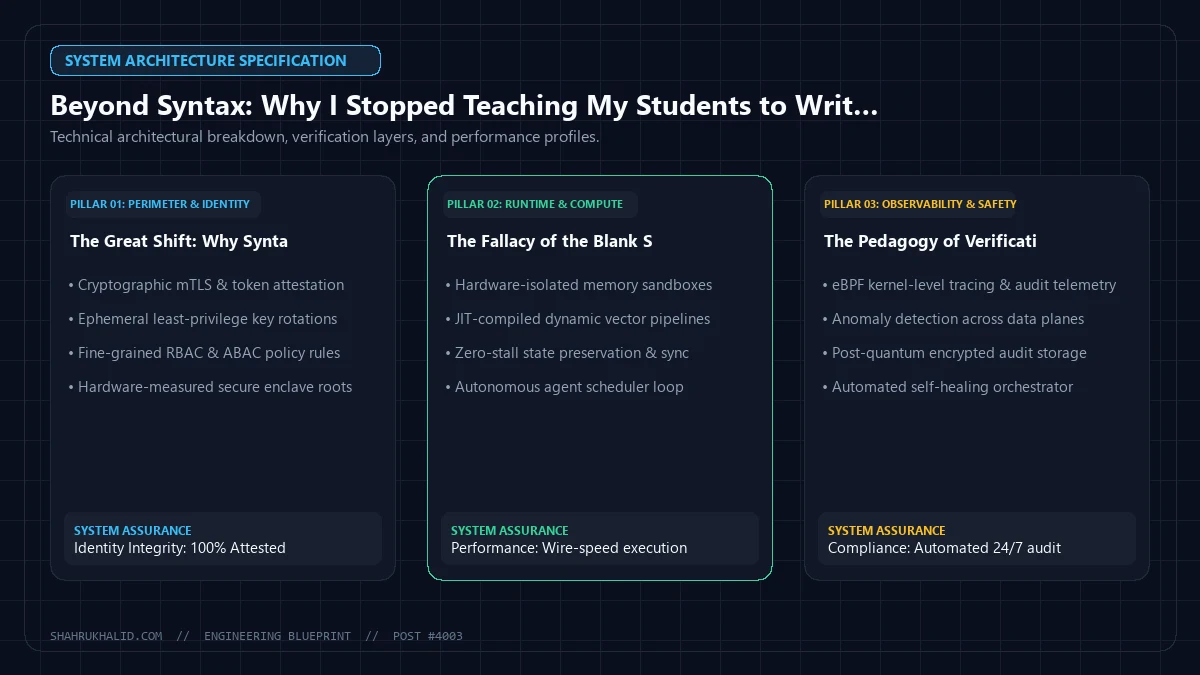
- The Logical Trace: Before running the code, can the student walk through the execution flow on paper? If they cannot explain the state changes, they cannot own the code.
- The Edge-Case Stress Test: How does this logic behave under extreme conditions? The AI is an optimist; it assumes the happy path. The engineer must be a pessimist, identifying the boundary conditions where the logic inevitably collapses.
- The Security Heuristic: What are the implicit assumptions the AI made about the data? Does it assume the input is sanitized? Does it ignore potential race conditions?
By forcing students to defend the AI’s logic, we move them from a passive role to an active, authoritative one. They stop being “users” of AI and start being “supervisors” of an autonomous development engine.
Mental Models Over Method Signatures
To succeed in this new paradigm, students must possess deep, conceptual mental models of how systems interact. Syntax is transient—frameworks rise and fall, and languages evolve. But the fundamental logic of data structures, algorithmic complexity, and system architecture remains constant. When I teach my students, I emphasize the “Why” over the “How.”
For instance, instead of teaching the syntax of a specific database query, I teach the concept of relational integrity and query optimization. If the AI generates a query that creates an N+1 problem, the student must have the mental model to recognize that the execution plan will be inefficient. They don’t need to write the query from scratch, but they must be able to spot the architectural bottleneck that the AI ignored. This is the difference between an amateur and a professional.
Modern teaching must prioritize high-level system design. We should be asking students to diagram the lifecycle of data, the handshake protocols between services, and the error-handling strategies for distributed systems. When they understand the “What” and the “Why,” the “How” becomes a simple matter of asking an AI to implement the pattern they have already validated in their minds.
The Ethics of AI-Assisted Development
A critical component of teaching AI programming is the development of a professional conscience. When a student relies on an AI, they are inheriting the biases, the shortcuts, and the potential hallucinations of the model. I teach my students that they are legally and ethically responsible for the code that bears their name, regardless of its origin.
This means teaching them how to read code with a “skeptical eye.” We spend hours in class reviewing “hallucinated” code—snippets that look syntactically perfect but reference non-existent libraries or rely on deprecated methods that create security vulnerabilities. This is the most practical training they can receive. They learn that the machine is a tool, not an authority. By cultivating this skepticism, we are building a generation of engineers who are more vigilant than their predecessors, precisely because they know how easily the machine can be wrong.
Building a Culture of “Human-in-the-Loop”
The transition toward AI-augmented development is not a threat; it is an evolution of our creative capacity. By automating the mundane, we free ourselves to tackle the truly difficult problems: complex systems design, user-centric product architecture, and long-term maintainability. My classroom is no longer a place of rote memorization; it is a laboratory for system verification.
When students realize that their value lies in their ability to reason, to debug, and to architect, their confidence skyrockets. They stop fearing the AI and start commanding it. They learn that the most powerful tool in the shed is not the code generator itself, but the human brain that decides whether that code is worth deploying. As we look toward the future of software engineering, we must accept that the era of syntax-first programming is over. The era of logic-first debugging has arrived, and it is here to stay.
Practical Takeaways for the Future-Ready Engineer
To thrive in this new landscape, adopt these three core principles:
- Never Execute Unaudited Code: Treat all AI output as a draft that requires a peer review. Even if the code runs, ask yourself if it meets your standards for security, scalability, and clarity.
- Invest in First Principles: Focus your learning on algorithms, data structures, and system design. These are the foundations that allow you to judge the quality of AI-generated logic.
- Master the Language of Intent: Your new skill is not writing syntax; it is writing requirements. The better you can articulate the “why” and the “what” of a problem, the better the AI will perform as your assistant.
The classroom of the future is not filled with students typing furiously to catch up with a compiler. It is filled with thoughtful, critical thinkers who are orchestrating complex systems, debugging logic that spans thousands of lines, and ensuring that the software of tomorrow is built on a foundation of human wisdom, not just machine speed.