The 2026 K-12 International School Playbook: Your Beginners Step-by-Step Guide to Thriving

Key Takeaways
- Module 1: Comprehensive Foundations & Concept Primer
- The 'Why': Your School's Mission as its Core API
- Curriculum as a Framework: Choosing Your Tech Stack
- Pedagogy as Implementation Logic: Writing Your Business Logic
- Module 2: Prerequisites & Complete Environment Setup

You might be thinking, “Maryam, what does a developer advocate know about schools?” And that’s a fair question! But over the years, I’ve realized that building a successful, future-ready school from the ground up shares a surprising amount of DNA with building a large-scale, resilient software platform. Both require a solid architectural blueprint, a clear understanding of the end-user (the student), a robust framework (the curriculum), and a dedicated team to build, maintain, and debug it.
I’m writing this for my colleague Shahrukh Khalid’s platform because he and I share a core belief: the principles of good design, scalability, and user-centricity are universal. Whether you’re architecting a cloud service or an educational institution, the fundamentals of creating something that is built to last and designed to serve are the same.
So, if you’re a student of education, an aspiring school founder, or a passionate educator dreaming of creating your own institution, this guide is for you. We’re going to treat this journey like the ultimate development project. We’ll start with the foundational concepts, set up our “environment,” design our “architecture,” write some “code” (in the form of policies and plans), and deploy a thriving educational ecosystem. This is your beginner’s step-by-step guide to not just launching, but thriving. Welcome to The 2026 K-12 International School Playbook.
Comprehensive Foundations & Concept Primer

Before we write a single line of our “code” or lay the first brick of our “infrastructure,” we need to understand the fundamental principles. In software development, we call this “getting the lay of theland.” We wouldn’t start building an application without understanding what a server, a database, or an API is. Similarly, we can’t build a school without grasping the core concepts that form its very soul. Let’s demystify the jargon and build our foundational knowledge.
The ‘Why’: Your School’s Mission as its Core API
Every great software project starts with a “why.” Why are we building this? What problem does it solve? Who is it for? This “why” becomes the project’s mission, its north star. In the world of schools, this is your Mission and Vision. Think of your school’s mission statement not as a fluffy marketing slogan, but as its core API (Application Programming Interface).
An API, in simple terms, is a contract. It defines how other systems can interact with your application, what they can request, and what they can expect in return. Your school’s mission is the same. It’s a public promise that tells parents, students, and teachers: “If you connect with our system, here is the value you will receive. Here is the transformation we promise to deliver.”
For example, a mission like “To empower students with critical thinking skills and a passion for lifelong learning to solve global challenges” is a powerful API endpoint. It tells you that every decision—from the curriculum you choose to the teachers you hire—must serve this contract. If a proposed activity doesn’t help build critical thinking or a passion for learning, it’s a “bad request” and should be rejected. Your mission is your ultimate validation layer. In 2026, a weak, undefined mission is like an undocumented, unstable API—no one will want to build on it.
Curriculum as a Framework: Choosing Your Tech Stack
Once you have your “why,” you need to decide on the “how.” In web development, we choose a framework—like React, Angular, or Vue—to provide the structure and tools for building our application. You don’t have to reinvent the wheel for every button and form. The framework gives you a solid, tested foundation.
In a K-12 international school, your curriculum is your framework. It’s the foundational structure upon which you build your entire educational experience. Choosing an international school curriculum is one of the most critical architectural decisions you’ll make. The most common “frameworks” you’ll encounter are:
- The International Baccalaureate (IB) Framework: This is like a comprehensive, full-stack framework. It comes in four programs (PYP, MYP, DP, CP) that cover the entire K-12 journey. It’s known for its inquiry-based approach and focus on developing the whole student (the “IB Learner Profile”). It’s highly respected by universities worldwide, but it can be rigid and requires significant teacher training—think of it as having a steep learning curve but powerful, built-in features.
- The Cambridge International Framework: This is a more modular and flexible framework, like a library-based approach (think using individual libraries like Express.js instead of a full framework). You can pick and choose different components (IGCSEs, A-Levels). It’s famous for its academic rigor, especially in high school, and offers a clear pathway to university. It’s often seen as more traditional and content-focused than the IB.
- American Curriculum (with Advanced Placement – AP): This framework is based on U.S. standards. It’s highly flexible in the K-8 years, but becomes more standardized in high school with the option of AP courses. APs are like specialized modules you can plug in to provide college-level rigor in specific subjects. This is a very popular choice for schools catering to American expats or students aiming for U.S. universities.
Just as there’s no single “best” programming language, there’s no single “best” curriculum. The right choice depends entirely on your school’s API—your mission, your target student population (your “end-users”), and the region you’re operating in.
Pedagogy as Implementation Logic: Writing Your Business Logic
If the curriculum is the framework, then pedagogy is your unique implementation logic. It’s how you bring the curriculum to life in the classroom. You and a competing school could both use the IB framework, but your pedagogical approach is what will differentiate your “product.”
Think of it this way: the curriculum tells you what to teach (the learning objectives, the content). Pedagogy is how you teach it. Is your school’s logic based on:
- Project-Based Learning (PBL)? Students work on extended projects to solve real-world problems. This is like an agile, iterative development cycle.
- Inquiry-Based Learning? Students’ questions drive the learning process. The teacher acts as a facilitator, or a “senior dev” guiding a “junior dev,” rather than a lecturer.
- Direct Instruction? A more traditional, teacher-led approach. This can be efficient for foundational knowledge, like learning basic syntax.
- Blended Learning? A mix of online and in-person instruction. This is like a hybrid cloud architecture, leveraging the best of both worlds.
Your pedagogical approach is your secret sauce. It’s the collection of functions, algorithms, and methods your teachers will use every day to execute the curriculum and deliver on the promise of your mission API. A key part of global K-12 education today is moving beyond rote memorization and towards pedagogies that build skills for the future.
Prerequisites & Complete Environment Setup

Alright, we’ve got our conceptual blueprint. We know our “why” and have thought about our core “tech stack.” Now it’s time to set up our development environment. In software, this means installing the right tools, configuring our machine, and creating the project directory. In the world of international school setup, this phase is about laying the legal, financial, and physical groundwork. It’s less glamorous than designing the curriculum, but without it, your project will never even compile.
Step 1: ‘Installing’ Your Legal & Financial Dependencies
Before you can write a single line of “code” (policy), you need to install the necessary dependencies. These are the non-negotiable legal and financial structures that allow your school to exist.
- Legal Incorporation (
sudo apt-get install legal-entity): Your first step is to establish a legal entity for the school. This could be a for-profit company, a non-profit foundation, or another structure depending on your country’s laws. This is like creating your main project folder. It’s the container for everything else. You will absolutely need legal counsel for this. Don’t try to “code” this part yourself. A lawyer specializing in education or business law is your essential “package manager.” - Securing Seed Funding (
git clone --depth=1 seed_funding.git): Schools are capital-intensive. You’ll need a detailed business plan that outlines your projected costs for the first 3-5 years. This includes construction/renovation, technology, furniture, salaries, marketing, and a healthy contingency fund. Presenting this to investors, banks, or donors is your “git clone” command—you’re pulling in the initial resources needed to build. Your business plan is yourREADME.mdfile for this repository; it must be clear, comprehensive, and convincing. - Opening a Bank Account & Financial Systems (
./conwith-finance-tools): Once you have a legal entity and initial funding, you need a dedicated bank account. You’ll also need to choose your financial management software (like QuickBooks, Xero, or a more specialized school ERP). This is your core financial configuration. It’s how you’ll track every transaction, manage payroll, and generate financial reports.
Verification Command: At the end of this step, you should be able to “run” a simple check:
ls -l /legal && cat /bank/account_status.txt
In plain English: Do you have your official incorporation documents in hand? Is your business bank account active and funded? If the answer to both is yes, your basic dependencies are installed.
Step 2: Configuring Your Physical & Digital Infrastructure
Now that the core legal and financial packages are in place, it’s time to set up the “hardware” and “networking”—your physical campus and digital backbone.
- Location, Location, Location (Choosing Your Server Region): Selecting a site for your school is like choosing a server region in the cloud. You need to consider accessibility for your target audience (expat K-12 schooling is a huge factor here), local zoning regulations (your “firewall rules”), safety, and room for future expansion (your “scalability plan”). The physical building is your server hardware. Does it have enough “RAM” (classroom space), “CPU” (specialist rooms like labs and art studios), and “storage” (libraries and administrative offices)?
- Architectural & Renovation Plan (Your Infrastructure as Code): You will work with architects and contractors to design or renovate the space. This plan is your “Infrastructure as Code” (IaC) script. It’s a declarative file that specifies exactly how your physical environment should be configured. Every classroom, every hallway, every safety feature must be meticulously planned.
- Setting Up the Network (Your VPC and Subnets): This is both literal and metaphorical. You will literally need to set up a robust Wi-Fi network, ethernet ports, and servers. But you also need to design your school’s digital architecture. This includes:
- Student Information System (SIS): This is your central database. It holds all student data, grades, attendance, and contact information. Popular “databases” include PowerSchool, Veracross, and iSAMS.
- Learning Management System (LMS): This is your content delivery network (CDN). It’s where teachers post assignments, students submit work, and learning resources are stored. Think Canvas, Google Classroom, or Schoology.
- Communication Platform: This is your messaging queue. How will you communicate with parents, students, and staff? This could be a dedicated app like Seesaw, ClassDojo, or integrated features within your SIS.
Directory Layout: A well-structured project is easy to navigate. Think of your school’s operational plan like a project directory:
|– /legal_and_finance/
| |– incorporation_docs.pdf
| |– business_plan_v3.xlsx
| `– bank_statements/
|– /physical_campus/
| |– architectural_blueprints.dwg
| |– safety_compliance_report.pdf
| `– renovation_project_plan.mpp
|– /digital_infrastructure/
| |– sis_config.yaml
| |– lms_selection_matrix.docx
| `– network_diagram.png
`– /accreditation_and_curriculum/
|– curriculum_framework_choice.md
`– accreditation_application_draft.docx
Step 3: The Accreditation ‘Compiler’
Accreditation is the process by which your school is officially recognized by an external agency. Think of it as a strict code compiler or a continuous integration (CI) pipeline. It checks your entire project for quality, standards, and completeness. You can’t “deploy” your school without it.
Major accreditation bodies for international schools include CIS (Council of International Schools), WASC (Western Association of Schools and Colleges), and NEASC (New England Association of Schools and Colleges). The process is long and arduous. You submit a massive amount of documentation (your “source code”) covering every aspect of your school’s plan. They review it, send a team to visit your “environment” (the campus), and then either “pass the build” (grant accreditation) or “fail the build” with a list of errors you need to fix.
CLI Verification: Starting this process early is critical. Your verification command is simple:
./request-accreditation-candidacy --agency=CIS
In plain English: Have you contacted your target accreditation agency and formally started the application process for candidacy? This step alone can take years, so it must run in parallel with your environment setup.
Core Implementation Architecture
With our environment set up, we can now move to the most exciting part of the design phase: architecting the core implementation. This is where we design the systems, workflows, and human structures that will make the school run. If Module 2 was about setting up the physical servers and network, this module is about designing the microservices, databases, and APIs that will run on that infrastructure. We’re moving from the hardware to the software architecture.
Designing Your ‘Microservices’: The Departmental Structure
A modern, scalable application is often built using a microservices architecture. Instead of one giant, monolithic program, the application is broken down into smaller, independent services (e.g., a user service, a payment service, an inventory service). Each service is responsible for one thing, does it well, and communicates with other services through well-defined APIs.
A thriving K-12 international school should be structured in the same way. A monolithic, top-down structure where every decision goes through one person creates bottlenecks and fails to scale. A microservices approach empowers departments to own their domain while ensuring seamless collaboration.
Let’s visualize this with a card structure:
Visual Card Grid: School Department Microservices
Each “service” (department) has a clear owner (a Head of Department or Director). They have the autonomy to manage their own “codebase” (their team and processes) but must adhere to the school-wide “API contracts” for communication. For example, when the Admissions Service “onboards” a new student, it makes an API call (
POST /new_student_record) to the Academics Service and the Finance Service, which then triggers their own internal workflows (assigning a class, generating an invoice). This modular design is a cornerstone of international school best practices.
The Student Journey: Your Primary User Flow
In user experience (UX) design, we meticulously map out the “user journey.” What are the steps a user takes from discovering our product to becoming a loyal customer? What are their pain points and moments of delight?
The most important user in our system is the student. Architecting the student journey is paramount. How can K-12 international schools ensure student success? It starts by designing a journey that is seamless, supportive, and centered on their growth.
Let’s map a simplified end-to-end student journey:
Diagram: Student Journey Flow
[Inquiry/Discovery] -> [Application] -> [Assessment] -> [Acceptance & Onboarding] -> [First Day Experience] -> [Academic Year Cycle] -> [Progress Monitoring & Support] -> [Transition to Next Grade] -> [Graduation & Alumni]
[Application](The Signup Form): Is your application process simple and clear? Is it mobile-friendly? This is the first interaction a family has with your “product.” A clunky process is like a signup form with 20 required fields—it creates friction and lowers conversion.[Onboarding](The Welcome Wizard): Once a student is accepted, what is their onboarding experience? Do they get a welcome kit? Is there a clear orientation program for both students and parents? A good onboarding process reduces “user churn” (students leaving after the first year).[Academic Year Cycle](The Main Application Loop): This is the core of your program. It’s a continuous loop of[Learning -> Assessment -> Feedback -> Iteration]. Your architecture must support this loop. Does your SIS/LMS make it easy for teachers to give timely feedback? Can parents easily see their child’s progress?[Progress Monitoring & Support](The Debugger & Error Handling): What happens when a student starts to struggle? This is an “error” in the system that needs to be handled gracefully. Your architecture must have a robust support system. This includes learning support specialists, counselors, and a clear process for intervention. It’s your system’stry-catchblock for academic and personal challenges.
Data Architecture: The Single Source of Truth
A major challenge in any large system is data integrity. If the Sales team has one set of customer data and the Support team has another, chaos ensues. The solution is a “Single Source of Truth” (SSoT).
For a school, the Student Information System (SIS) must be your SSoT for all student-related data.
Diagram: Data Flow Architecture
^ |
| |
(Grade/Attendance Data)——————– | –(Student Roster)–> [LMS]
| |
(Billing Info)—————————– | –(Family Contact Info)–> [Communications App]
| |
(Demographic Data)————————- | –(Reporting Queries)–> [Analytics Dashboard]
This diagram shows that the SIS is the central hub. The Admissions system writes to it, but the LMS, communication apps, and financial systems read from it. This prevents data duplication and ensures everyone is working from the same, up-to-date information. When designing your processes, always ask: “Where is the single source of truth for this piece of information?” Enforcing this discipline from day one will save you from countless “data corruption” headaches down the line. This is a critical, yet often overlooked, part of strategic planning for K-12 international schools.
Hands-on Code & Practical Implementation

Theory and architecture diagrams are fantastic, but the magic happens when you start implementing. In our school-building project, our “code” isn’t Python or JavaScript; it’s the policies, handbooks, curriculum maps, and hiring rubrics that bring our architecture to life. This module is about writing that “code.” We’ll provide heavily “commented,” production-ready templates and configurations that you can adapt for your own institution.
‘Coding’ Your Academic Engine: The Curriculum Map
A curriculum map is the detailed, step-by-step implementation of your chosen curriculum framework (IB, Cambridge, etc.). It breaks down the entire year, unit by unit, week by week. It’s the core application logic for your ‘Academics Service’. It’s not just a list of topics; it’s a detailed spec.
Here’s a “heavily commented” template for a single unit in a Grade 7 Science curriculum map.
File: G7_Science_Unit3_Ecosystems.yaml
# CURRICULUM MAP: GRADE 7 SCIENCE – UNIT 3
# FRAMEWORK: IB Middle Years Programme (MYP)
# AUTHOR: Head of Science
# VERSION: 1.0
# ===================================================================
unit_title: "Interconnected Ecosystems"
# — The 'Why' of the Unit —
# This connects to the school's mission API. It explains the purpose.
statement_of_inquiry: "Understanding the delicate balance and interconnected systems within local and global environments helps us appreciate our role as responsible stewards."
# — Core Learning Objectives (The 'Function' definitions) —
# These are the specific, measurable skills and knowledge students will acquire.
key_concepts:
- "Systems"
- "Relationships"
related_concepts:
- "Balance"
- "Environment"
global_context: "Globalization and Sustainability"
# — Assessment Tasks (The 'Unit Tests') —
# How we will measure if the learning objectives were met.
# Must include both formative (in-progress checks) and summative (final) assessments.
summative_assessments:
- type: "Investigation Report"
task_description: "Students will design and conduct an experiment to test the effect of a variable (e.g., pollution, light) on a small-scale model ecosystem."
criteria: ["Criterion B: Inquiring and Designing", "Criterion C: Processing and Evaluating"]
- type: "Multimedia Presentation"
task_description: "Students will research a threatened ecosystem and present a call-to-action plan to a panel of 'community leaders' (teachers/parents)."
criteria: ["Criterion D: Reflecting on the Impacts of Science"]
# — Learning Process (The 'Implementation Logic') —
# A week-by-week sequence of activities and resources.
learning_experiences:
- week: 1
topic: "Introduction to Systems & Ecosystems"
activities: "Brainstorming session, local nature walk to identify system components, introductory reading on food webs."
resources: "Video: 'The Web of Life', Online Simulation: 'Ecosystem Builder'"
- week: 2-3
topic: "Energy Flow and Nutrient Cycles"
activities: "Lab: Owl pellet dissection, diagramming the carbon and water cycles, group research on producers/consumers/decomposers."
resources: "Textbook Ch. 4, Interactive Website: 'Cycles of the Earth'"
# … and so on for the entire 6-8 week unit …
# — Differentiation (Handling 'Edge Cases') —
# How we will support students who are struggling or need an extra challenge.
differentiation_strategies:
- support: "Provide sentence starters and graphical organizers for the investigation report. Use of small, teacher-led focus groups."
- extension: "Challenge students to model their ecosystem's data using a spreadsheet to make future predictions. Research the economic impact of ecosystem collapse."
This “code” is clear, structured, and actionable. A new teacher could pick this up and understand exactly what to do, just like a new developer could understand a well-documented function. Your entire K-12 academic program should be built from these detailed, interconnected files.
Configuring Your ‘HR Service’: The Teacher Hiring Rubric
Your teachers are the most important part of your system. They are the “processors” that execute your pedagogical logic. Hiring the right teachers is therefore a mission-critical task. You can’t just rely on “gut feeling.” You need a structured, data-driven process. A hiring rubric is your configuration file for this process.
File: config/hiring_rubric_math_teacher.json
"position": "High School Mathematics Teacher",
"version": "2.1",
"stages": {
"resume_screen": {
"criteria": [
{"name": "Relevant_Degree", "weight": 1, "required": true},
{"name": "Teaching_Certification", "weight": 1, "required": true},
{"name": "Experience_with_IB_DP_Math", "weight": 2, "required": true},
{"name": "International_Experience", "weight": 1, "required": false}
]
},
"demo_lesson": {
"description": "Candidate will teach a 30-minute lesson on 'Introduction to Derivatives' to a panel acting as Grade 11 students.",
"criteria": [
{"name": "Conceptual_Clarity", "weight": 3, "scale": [1, 2, 3, 4, 5]},
{"name": "Student_Engagement", "weight": 3, "scale": [1, 2, 3, 4, 5]},
{"name": "Inquiry-Based_Techniques", "weight": 2, "scale": [1, 2, 3, 4, 5]},
{"name": "Assessment_of_Understanding", "weight": 2, "scale": [1, 2, 3, 4, 5]}
]
},
"panel_interview": {
"description": "Interview with Head of Department, Principal, and a peer teacher.",
"criteria": [
{"name": "Pedagogical_Alignment", "prompt": "Describe how you would handle a mixed-ability classroom.", "weight": 3},
{"name": "Collaborative_Mindset", "prompt": "Tell us about a time you co-planned a unit with a colleague.", "weight": 2},
{"name": "Contribution_to_Community", "prompt": "What extracurricular activities would you be interested in leading?", "weight": 1}
]
}
},
"scoring_guide": {
"1": "Does not meet expectations",
"2": "Partially meets expectations",
"3": "Meets expectations",
"4": "Exceeds expectations",
"5": "Strongly exceeds expectations"
}
}
Using this rubric, every candidate is evaluated against the same objective criteria. It removes bias and ensures you are hiring for the skills and mindset that align with your school’s “architecture.” It turns a subjective process into a more predictable and reliable one, which is essential for building a high-quality team.
The Parent Handbook: Your Public-Facing Documentation
If the curriculum map is your internal code, the Parent & Student Handbook is your public-facing API documentation. It tells your “users” (families) how to interact with your system, what the rules are, and what to expect. It must be clear, comprehensive, and written in plain English, not “internal jargon.”
A good handbook is not just a list of rules. It’s an opportunity to reinforce your mission.
Optimizing Digital Infrastructure for 2026 K-12 International Schools: An Architectural Blueprint
As we approach 2026, K-12 international schools face an imperative to evolve their digital infrastructure beyond mere connectivity. The demand for seamless hybrid learning, robust data security, and AI-driven personalization necessitates a sophisticated architectural blueprint. A cloud-first strategy is paramount, leveraging Infrastructure as a Service (IaaS) for flexible compute, Platform as a Service (PaaS) for development agility, and Software as a Service (SaaS) for specialized educational tools like Learning Management Systems (LMS) and Student Information Systems (SIS). This distributed model enhances scalability, reduces on-premise overhead, and ensures business continuity, crucial for a global educational network.
Data governance and cybersecurity are non-negotiable pillars. Implementing a Zero Trust architecture, coupled with multi-factor authentication (MFA) and single sign-on (SSO) solutions, protects sensitive student and faculty data against evolving cyber threats. Compliance with international data privacy regulations such as GDPR and FERPA must be embedded into the system’s design, not as an afterthought. Furthermore, advanced learning analytics platforms, often powered by machine learning, require secure data pipelines to extract, transform, and load educational data, offering insights into student performance and pedagogical effectiveness while preserving privacy.
The integration of AI and automation will redefine administrative efficiency and personalized learning experiences. Chatbots can handle routine inquiries, freeing up staff, while AI-driven adaptive learning paths can tailor content to individual student needs. This requires an API-first approach, enabling interoperability between diverse educational technologies and fostering a truly connected digital ecosystem. Schools must prioritize vendor solutions that offer open APIs and adhere to industry standards for seamless data exchange and future-proofing their investments.
Below is a simplified comparison of cloud service models, illustrating their strategic fit within a modern K-12 international school’s IT architecture for 2026:
| Cloud Service Model | Description | Typical Use Cases for 2026 K-12 International | Key Benefit |
|---|---|---|---|
| IaaS (Infrastructure as a Service) | Virtualized computing resources (servers, storage, networks) | Hosting legacy applications, custom development environments, secure data storage | Maximum flexibility and control over infrastructure |
| PaaS (Platform as a Service) | Platform for developing, running, and managing applications | Developing custom educational apps, hosting school websites, learning analytics dashboards | Faster development and deployment, reduced operational complexity |
| SaaS (Software as a Service) | Software applications delivered over the internet | LMS (e.g., Canvas, Moodle), SIS (e.g., Blackbaud), video conferencing (e.g., Zoom), productivity suites (e.g., Microsoft 365, Google Workspace) | Ease of use, minimal IT management, immediate access to advanced features |
By Shahrukh Khalid
Strategic Curriculum Evolution and Assessment for 2026 K-12 International Learning
The landscape of 2026 K-12 international education demands a radical re-evaluation of curriculum and assessment strategies to prepare students for an unpredictable global future. Traditional content-heavy models are giving way to frameworks emphasizing future-ready skills: critical thinking, creativity, collaboration, communication (the 4Cs), digital literacy, and global citizenship. Curricula must be designed to be interdisciplinary, connecting subjects to real-world problems and fostering deeper understanding rather than rote memorization. Project-Based Learning (PBL) and inquiry-based approaches become central, empowering students to take ownership of their learning journeys and develop practical problem-solving capabilities.
Personalized learning pathways, facilitated by adaptive technologies and AI, are no longer aspirational but essential. These systems can identify individual student strengths and weaknesses, recommending tailored resources and activities to optimize engagement and mastery. This shift requires educators to transition from content deliverers to facilitators and mentors, guiding students through complex challenges and fostering intrinsic motivation. The curriculum must also explicitly integrate ethical considerations of technology, sustainability, and cultural diversity to cultivate responsible global citizens.
Assessment in 2026 for K-12 international schools will move decisively towards competency-based models. This paradigm prioritizes demonstrated mastery of skills and knowledge over time-bound grades, providing a more authentic and holistic view of student progress. Authentic assessments, such as portfolios, presentations, simulations, and real-world projects, will gain prominence, reflecting students’ ability to apply learning in meaningful contexts. AI-powered analytics can support educators in tracking competency acquisition, offering granular feedback, and identifying areas for targeted intervention, ensuring equitable outcomes for diverse learners.
Consider the following conceptual framework for integrating competency-based assessment within a 2026 K-12 international curriculum:
// Conceptual Framework: Competency-Based Assessment Rubric Structure

{
  "Competency_ID": "GC001",
  "Competency_Name": "Global Collaboration & Digital Citizenship",
  "Description": "Ability to effectively collaborate across diverse cultures using digital tools, adhering to ethical online practices.",
  "Grade_Level_Band": "9-12",
  "Learning_Objectives": [
    "LO_GC001.1: Analyze global issues from multiple perspectives.",
    "LO_GC001.2: Utilize digital platforms for cross-cultural project work.",
    "LO_GC001.3: Demonstrate ethical digital communication and data privacy awareness."
  ],
  "Performance_Indicators": [
    {
      "Level": "Beginning",
      "Criteria": "Participates minimally in group discussions; identifies basic cultural differences; limited use of digital tools for collaboration."
    },
    {
      "Level": "Developing",
      "Criteria": "Contributes to group discussions; recognizes diverse perspectives; uses digital tools for communication; understands basic digital ethics."
    },
    {
      "Level": "Proficient",
      "Criteria": "Actively engages in collaborative projects; articulates and respects diverse viewpoints; effectively leverages digital tools for project management and communication; consistently applies digital citizenship principles."
    },
    {
      "Level": "Exemplary",
      "Criteria": "Leads cross-cultural collaborations; synthesizes diverse perspectives into innovative solutions; designs and implements advanced digital strategies; advocates for ethical digital practices and global equity."
    }
  ],
  "Assessment_Methods": [
    "Collaborative Project Portfolio",
    "Peer & Self-Assessment Rubrics",
    "Digital Presentation of Global Issue Analysis",
    "Reflective Journal on Digital Citizenship"
  ]
}
This framework allows for continuous feedback, personalized learning paths, and a clear understanding of student mastery, moving beyond traditional summative grades to foster lifelong learning and adaptive expertise. The focus shifts to what students can do with their knowledge, preparing them to thrive in complex global environments.
By Shahrukh Khalid
Designing Scalable and Secure Digital Infrastructures for the 2026 K-12 International Environment
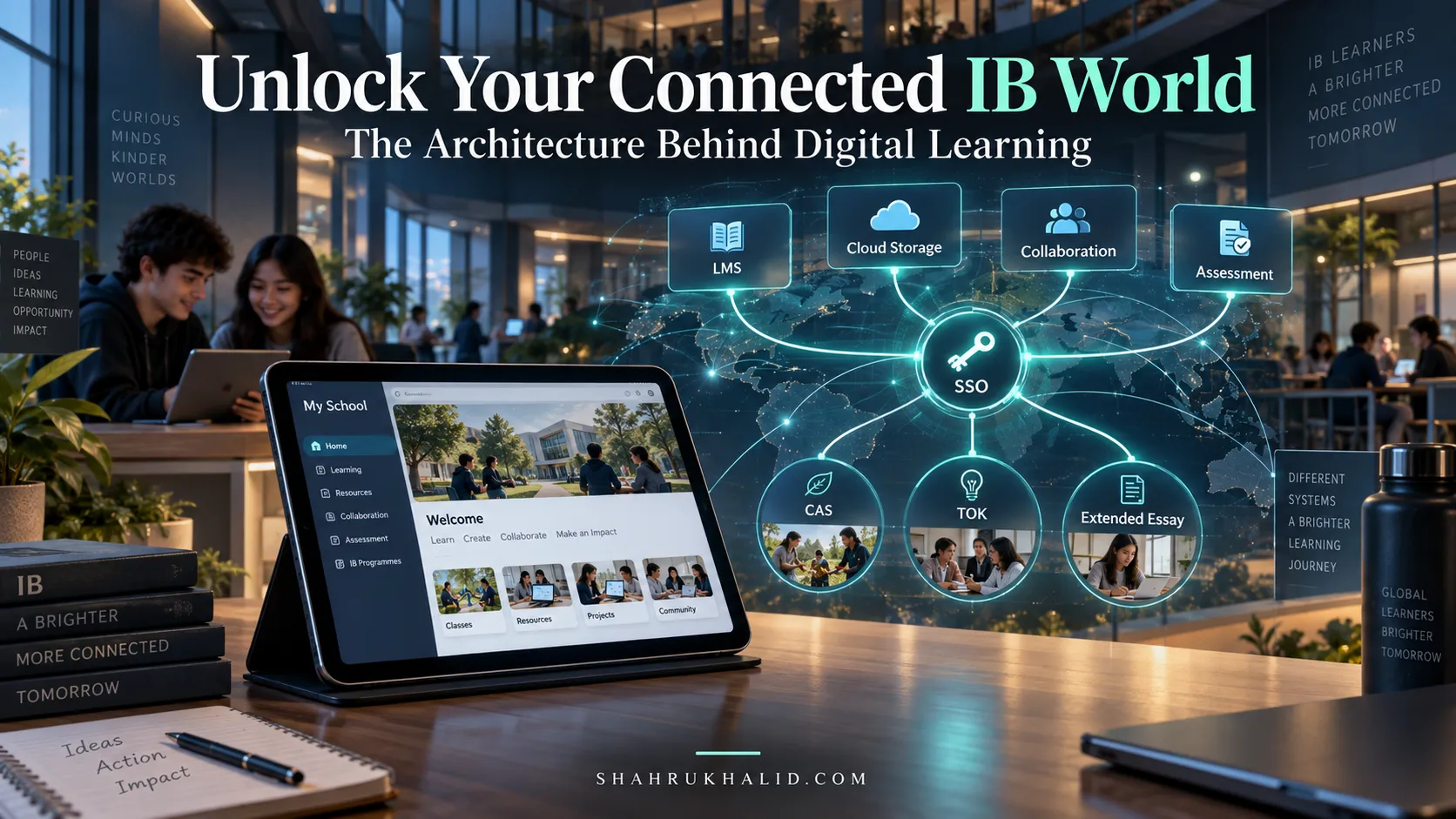
The landscape of K-12 international education is undergoing a profound digital transformation, necessitating robust, scalable, and secure technological foundations. For the 2026 K-12 international school, a fragmented approach to IT is no longer viable. Instead, an integrated digital ecosystem, leveraging cloud-native principles and advanced security protocols, is paramount. This involves not just adopting new tools, but architecting a cohesive environment where learning management systems (LMS), student information systems (SIS), communication platforms, and data analytics engines seamlessly interoperate.
A critical architectural pattern emerging for this era is the microservices-based approach, allowing for greater flexibility, resilience, and independent scaling of components. Consider a simplified representation of a modern K-12 international digital stack:
// Simplified Cloud-Native K-12 International Architecture Blueprint

// 1. Identity & Access Management (IAM) - Centralized Authentication
Service: Auth0/Okta (SSO for all platforms)
  - User Roles: Student, Teacher, Admin, Parent
  - MFA Enforcement: Required

// 2. Learning Management System (LMS) - Modular & Extensible
Platform: Moodle/Canvas (API-driven)
  - Modules: Course Content, Assignments, Grading, Forums
  - Integration: SCORM, LTI standards

// 3. Student Information System (SIS) - Data Hub
Platform: PowerSchool/Veracross (API-first)
  - Data Models: Student Profiles, Attendance, Grades, Schedules
  - Integration: Real-time sync with LMS, Parent Portals

// 4. Communication & Collaboration - Integrated Suite
Platform: Google Workspace/Microsoft 365
  - Components: Email, Video Conferencing, Document Collaboration
  - Security: Data Loss Prevention (DLP) policies

// 5. Data Analytics & AI for Personalized Learning
Platform: AWS Redshift/Azure Synapse + Custom ML Models
  - Data Sources: LMS, SIS, Assessment Platforms
  - Use Cases: Learning Path Recommendation, Early Intervention Alerts
  - Privacy: Anonymization & Differential Privacy techniques

// 6. Security & Compliance - Layered Defense
Framework: NIST Cybersecurity Framework
  - Components: Endpoint Protection, Network Segmentation, Threat Detection
  - Data Governance: GDPR, CCPA, Local Regulations (e.g., FERPA for US-aligned schools)
Beyond architecture, data sovereignty and privacy compliance are non-negotiable for the 2026 K-12 international institution. Implementing zero-trust network access, robust encryption for data at rest and in transit, and regular security audits are foundational. The engineering challenge lies in building systems that are not only powerful and user-friendly but also inherently secure and compliant across diverse international regulatory landscapes. This demands a proactive security-by-design philosophy, ensuring that every component, from student data to virtual classroom interactions, is protected against evolving cyber threats.
Attribution: Shahrukh Khalid
Strategic Curriculum Engineering for the 2026 K-12 International Learner: Beyond Traditional Frameworks
The imperative for the 2026 K-12 international school is to cultivate global citizens equipped with adaptive skills, critical thinking, and a profound understanding of interconnectedness. Traditional, siloed curricula are giving way to integrated, interdisciplinary approaches that prioritize conceptual understanding over rote memorization. Curriculum engineering for this new era involves designing learning experiences that foster global competencies, ethical AI literacy, sustainability mindsets, and cross-cultural communication. This demands a shift from content delivery to skill development and authentic problem-solving.
Consider a benchmark comparison of pedagogical models, highlighting their suitability for the evolving demands of the 2026 K-12 international student:
| Pedagogical Model | Key Characteristics | Global Competency Development | Tech Integration Potential | Suitability for 2026 K-12 International |
|---|---|---|---|---|
| Traditional/Didactic | Teacher-centered, lecture-based, standardized assessment. | Low (focus on national/local content). | Low to Moderate (digital textbooks, basic tools). | Limited (lacks adaptability, global perspective). |
| Project-Based Learning (PBL) | Student-centered, real-world problems, collaboration, inquiry. | High (problem-solving, collaboration, cultural context). | High (research, digital creation tools, virtual collaboration). | Excellent (fosters 21st-century skills, interdisciplinary). |
| Inquiry-Based Learning | Student-driven questions, investigation, critical thinking, discovery. | High (curiosity, research skills, diverse perspectives). | High (data analysis, simulation, virtual labs). | Excellent (develops autonomy, deep understanding). |
| Blended Learning | Combines online digital media with traditional classroom methods. | Moderate to High (access to diverse resources, global collaboration). | Very High (personalized pacing, adaptive learning platforms). | Very Good (flexible, leverages technology for differentiation). |
| Competency-Based Learning | Focus on mastering specific skills/competencies, personalized pace. | High (explicit skill development, transferable skills). | High (adaptive assessment, personalized learning paths). | Excellent (ensures mastery, prepares for future challenges). |
The engineering of future-proof curricula also involves integrating ethical considerations for emerging technologies like Artificial Intelligence. Students must not only understand how AI works but also its societal impact, biases, and ethical implications. This requires designing modules that prompt critical reflection, data ethics discussions, and responsible innovation. Furthermore, curriculum designers must embed principles of sustainable development, encouraging students to become active agents in addressing global challenges. The goal is to move beyond mere content coverage to fostering a dynamic learning ecosystem that prepares students not just for exams, but for a complex, interconnected, and rapidly evolving world.
Attribution: Shahrukh Khalid