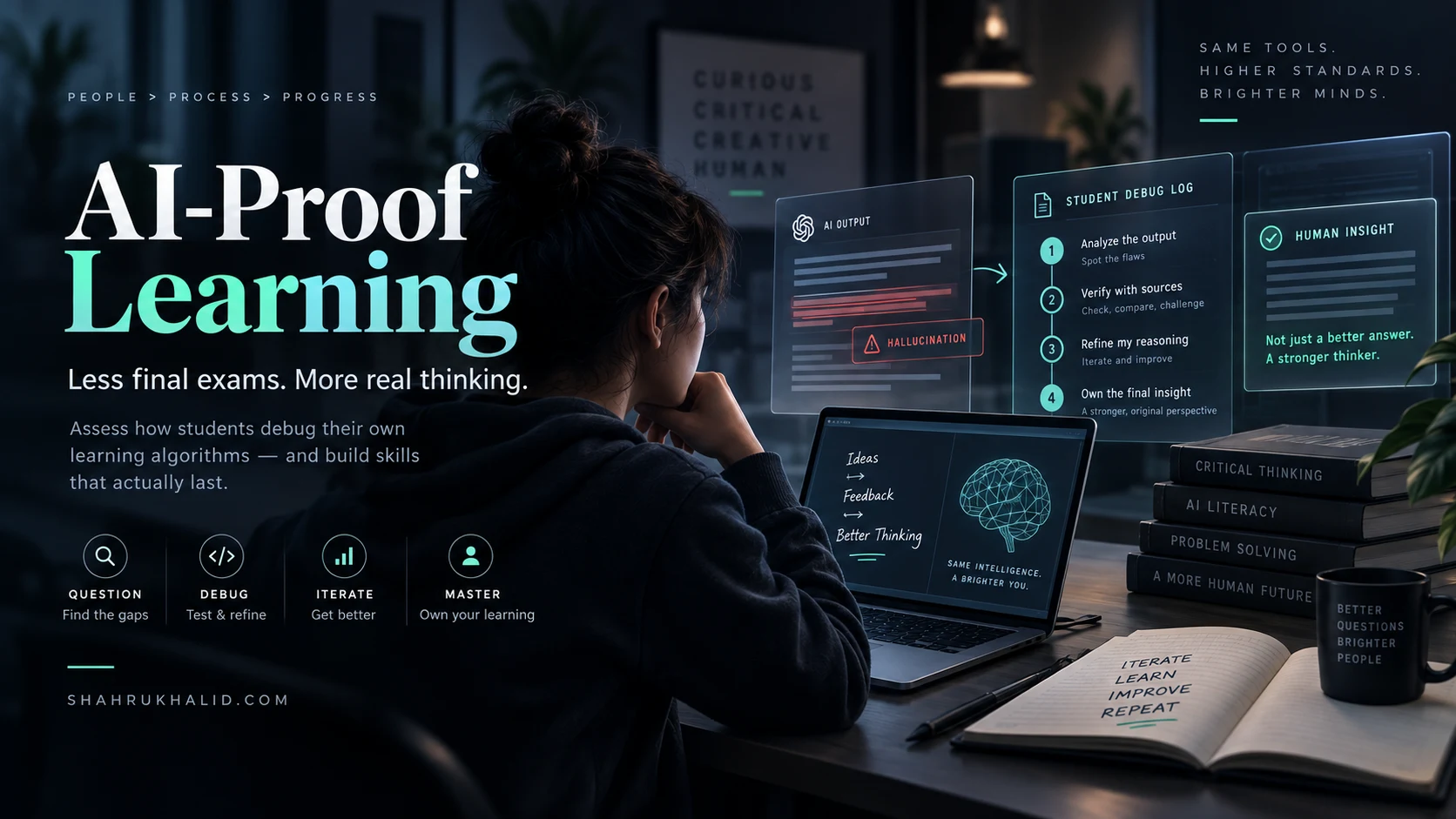
The Death of the Essay: Why I Replaced Writing Assignments with AI-Guided Socratic Debates to Finally Teach Critical Thinking
Key Takeaways
- AI renders traditional essays obsolete by decoupling writing from critical thinking.
- Essays fail as critical thinking assessments, measuring retrieval/polish, not adaptive friction.
- AI-guided Socratic debates replace static essays to foster dynamic critical thinking.
- The Socratic method interrogates assumptions, forcing students to defend ideas under pressure.
- Education must shift from static assessment artifacts to dynamic, adaptive processes.
For decades, the standard take-home essay has served as the undisputed gold standard of academic assessment, yet the widespread arrival of conversational models has rendered this traditional artifact structurally obsolete. In this comprehensive masterclass guide for Shahrukh Khalid | Technology News & Insights, we examine how replacing passive text generation with dynamic, AI-guided Socratic debates breathes new life into cognitive development and truly teaches critical thinking.
The Anatomy of a Broken Paradigm: Why the Traditional Essay Failed
Walk into any high school or university faculty lounge today, and you will hear a shared, exhausted consensus: the traditional essay is on life support. For centuries, educators relied on the multi-paragraph essay as the primary proxy for student understanding. The logic was simple: if a student could research a topic, outline an argument, and synthesize their thoughts into a coherent two-thousand-word paper, they had mastered the subject matter. But this pedagogical model rested on a fragile assumption—that the act of writing was inextricably bound to the act of thinking.
When generative artificial intelligence entered the mainstream educational landscape, it exposed the hidden flaw in our assessment architecture. We discovered, almost overnight, that writing a text-based output and thinking critically were no longer the same thing. Students quickly realized that they could prompt an automated system to generate a brilliantly structured, impeccably cited essay in under ten seconds. They could receive an ‘A’ for a product they never mentally processed. The medium had decoupled from the cognition.
As an EdTech coordinator, I watched this crisis unfold across our district in real time. Plagiarism checkers became useless arms races against rapidly evolving paraphrasing tools. Faculty members responded by reverting to the pedagogical dark ages: in-class blue-book writing, handwritten journals, and draconian surveillance software that monitored keystrokes and locked browser windows. But policing students into intellectual compliance does not teach them how to think; it simply teaches them how to evade detection. We were treating the symptoms of a broken evaluation system while ignoring the disease.
The core issue is that essays measure retrieval and polish rather than friction and adaptation. A static document does not push back when a student makes a logical fallacy. It does not ask for clarification when an argument relies on a weak premise. It sits passively on a screen, accepting whatever words are fed into it. To fix modern education, we needed to abandon the static artifact and replace it with a dynamic process. We needed an environment where students could not just report information, but defend it under pressure.
Enter the Socratic Method: The Ancient Antidote to Modern Apathy
Long before Silicon Valley started building neural networks, the ancient Greek philosopher Socrates was pioneering the ultimate educational technology: the conversation. The Socratic method is not about imparting knowledge; it is about relentlessly interrogating assumptions. It is a collaborative, argumentative dialogue that uses disciplined questioning to stimulate critical thinking and illuminate ideas. In a true Socratic dialogue, you cannot fake your way through with surface-level jargon or downloaded summaries, because the next question will always target the exact gap in your logic.

For generations, scaling the Socratic method was an impossible dream for classroom teachers. Imagine an educator with one hundred and fifty students. Even in an idealized block schedule, finding the time to engage in a ten-minute, individualized, exploratory debate with every single student on a weekly basis is mathematically impossible. Class sizes, administrative burdens, and standardized testing mandates forced us into scalable, mass-production assessments like multiple-choice tests and take-home essays.
This is where the true promise of AI in education finally materializes. We are no longer constrained by human bandwidth. By configuring large language models to act as patient, relentless, and adaptive Socratic interlocutors, we can give every single student their own personal philosopher-coach. This is not about using technology to write papers for students; it is about using technology to force students to do the heavy cognitive lifting themselves.
When an artificial intelligence is primed to run a Socratic debate, it abandons its default posture of being a helpful assistant that gives direct answers. Instead, its primary system prompt is inverted: Never give the student the answer. Never write their arguments for them. When they make a claim, ask for their evidence. When they commit a logical fallacy, gently point out the contradiction and ask them to reconcile it. Suddenly, the machine transforms from a cheating enabler into an inescapable intellectual sparring partner.
Designing the AI-Guided Socratic Debate: A Step-by-Step Blueprint
Transitioning away from essays requires a complete redesign of your learning management system (LMS) workflows and assignment prompts. You cannot simply tell students to go chat with a chatbot and hand in a screenshot. To make AI-guided Socratic debates rigorous, fair, and pedagogically sound, you must engineer the interaction with precision. Here is the operational framework we developed and tested across humanities and science classrooms.
First, establish the foundational topic and the student’s initial stance. Before a student ever opens the debate interface, they must submit a single thesis sentence and a brief outline of their core premise. This ensures they have a baseline mental model. If they walk into the debate completely blind, the session devolves into random guesswork. The initial premise acts as the anchor line for the conversation.
Second, define the persona of the AI interlocutor. Through customized prompt engineering, you must configure the AI’s behavior, tone, and boundaries. For a beginner-level implementation, instructors should provide students with a pre-tested prompt template. The configuration must instruct the AI to:
- Maintain a curious, respectful, but uncompromisingly analytical tone.
- Limit each response to a single, direct challenge or probing question to avoid overwhelming the student with cognitive load.
- Track the depth of the student’s reasoning across a simulated multi-turn conversation.
- Provide a concluding summary report at the end of the session that outlines the student’s strengths and the logical gaps that remained unaddressed.
Third, set clear structural parameters for the debate session. A successful Socratic assignment should operate within defined boundaries—typically running for five to ten conversational turns. This prevents infinite loops of circular reasoning while ensuring the student has to defend their position through at least two or three layers of counter-arguments. Students learn that their initial assertion is merely the entry fee to a deeper intellectual exploration.
Overcoming Classroom Friction: Change Management for Teachers and Students
Any time you disrupt a centuries-old academic tradition, you will encounter immediate friction. When I first announced to our faculty that we were phasing out essays in favor of AI-guided debates, the pushback was fierce and immediate. Traditionalists worried that we were abandoning literacy. Tech-skeptics worried that we were handing the keys of the classroom entirely over to automated systems. And students, surprisingly, were terrified because they realized they could no longer coast through assignments on the night before they were due.
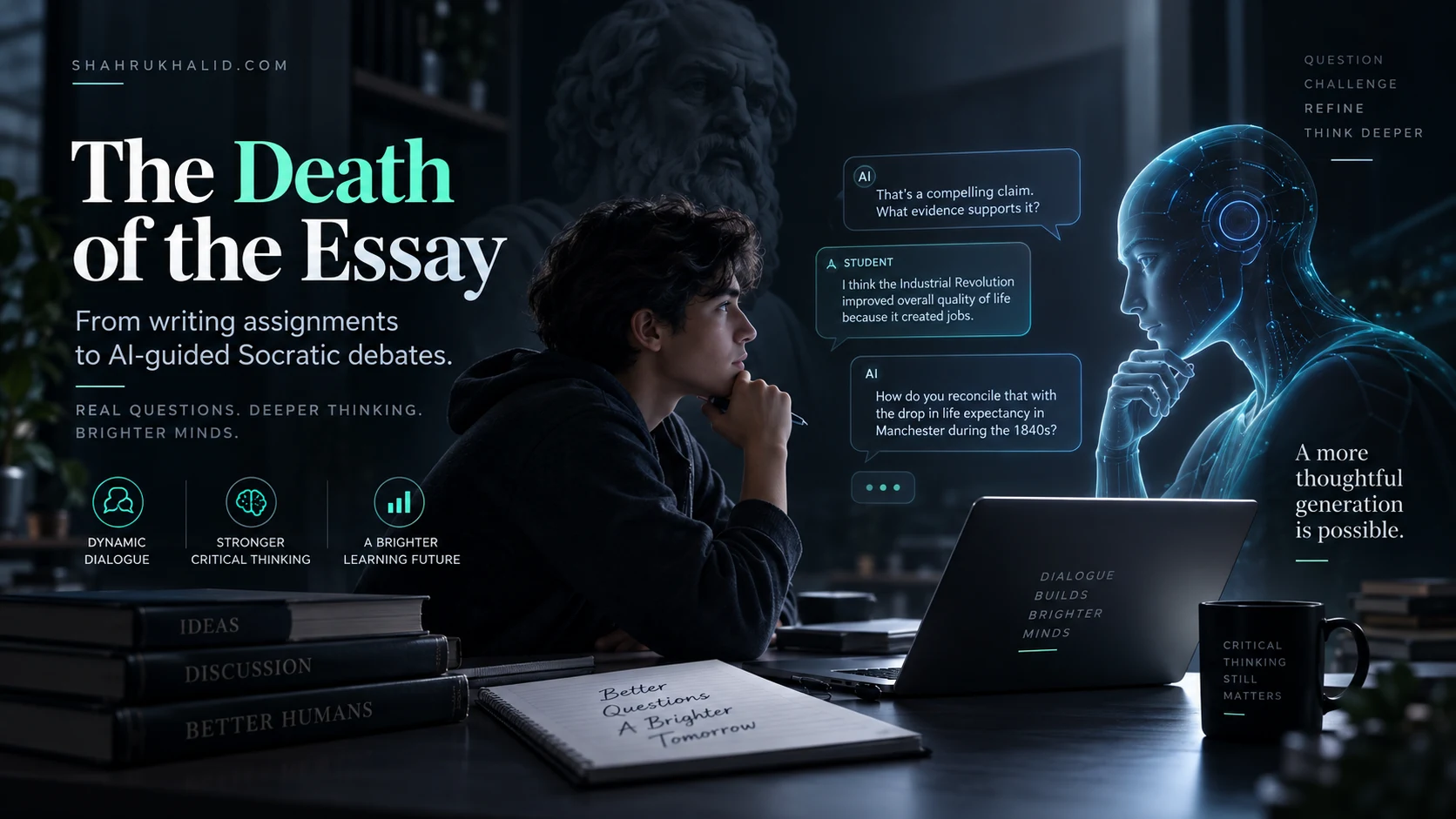
The student resistance was particularly fascinating. For years, students had been trained to view assignments as a game of compliance: figure out what the teacher wants to hear, package it in academic-sounding prose, and collect the grade. The Socratic debate broke this game completely. When the AI responded to a superficial generalization with, “That is a compelling claim, but what empirical evidence supports the causal link between those two events?” the student suddenly realized they actually had to understand the material.
To ease this transition, we implemented a scaffolding strategy:
- Demystification Workshops: We spent the first week of the semester walking students through how large language models process arguments, explicitly teaching them that chatbots do not “know” things, but rather predict logical sequences of thought.
- Low-Stakes Practice Rounds: Before grading any debates, students participated in mandatory, ungraded trial runs debating trivial, playful topics—such as whether a hot dog constitutes a sandwich—to get comfortable with the conversational flow and pacing of an AI interlocutor.
- Teacher as Facilitator, Not Grader: Educators stopped spending their weekends reading stale, formulaic essays. Instead, they spent class time circulating the room while students engaged in their debates, stepping in only when a student hit an insurmountable conceptual roadblock.
This shift fundamentally altered the emotional temperature of the classroom. Grading became a collaborative review of the debate transcripts rather than a lonely, adversarial battle of red pen against student prose. Teachers rediscovered why they entered the profession: not to proofread grammar, but to watch lightbulbs go off in real time.
Evaluating the Unquantifiable: How to Grade a Conversation
One of the most frequent objections raised by educators hesitant to adopt this model is the question of assessment. “How on earth do you grade a dynamic conversation?” they ask. “An essay gives me a clean, static document with a word count and a bibliography. A debate is messy, unpredictable, and ephemeral.”
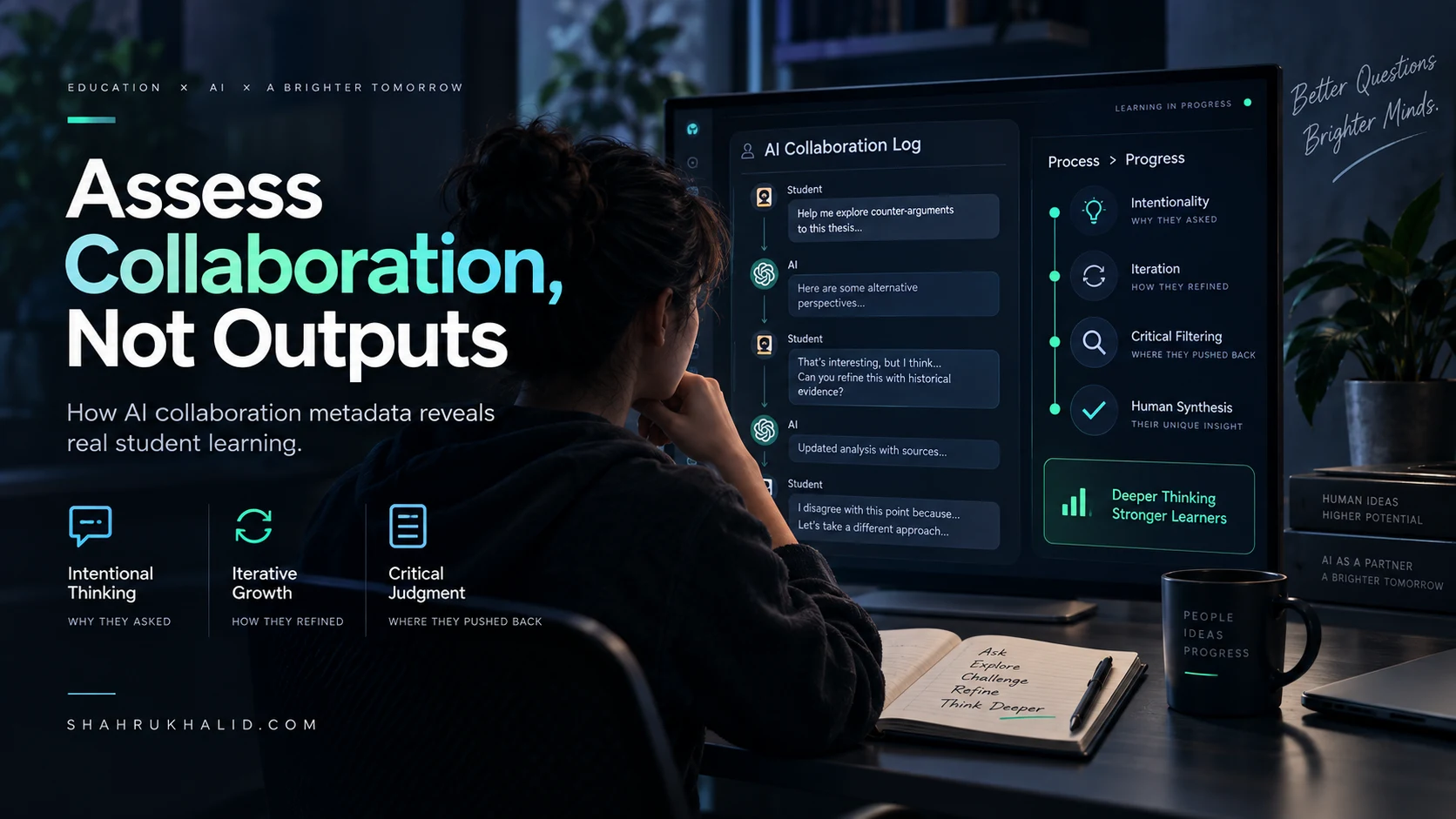
The beauty of modern AI in education frameworks is that the messiness of human dialogue can be captured, structured, and evaluated without losing its nuance. Because the entire Socratic debate takes place within a digital interface, the complete transcript is preserved. But we do not grade the transcript by reading every word manually. Instead, we use a rubric-driven evaluation pipeline.
When designing your grading rubric, shift your criteria away from traditional metrics like vocabulary richness, transitional phrases, and paragraph length. Those are traits of essay writing, not of critical thinking. Instead, evaluate students on four core dimensions:
- Intellectual Resilience: How well did the student maintain their composure and adapt their argument when confronted with a difficult counter-example or probing question?
- Evidence Integration: Did the student rely on credible facts, historical contexts, or scientific principles when defending their assertions, or did they resort to circular reasoning and emotional appeals?
- Nuance and Concession: Did the student demonstrate intellectual maturity by acknowledging the limits of their own argument or conceding valid points raised by the AI interlocutor?
- Pivoting and Synthesis: How effectively did the student incorporate the AI’s feedback to refine and strengthen their thesis over the course of the multi-turn exchange?
At the conclusion of the session, the AI generates a diagnostic evaluation report based on these precise rubric parameters, complete with direct quotes from the transcript highlighting moments of brilliant synthesis alongside moments of logical collapse. The teacher reviews this diagnostic report alongside the raw transcript, making the final grading decision faster, more objective, and far more comprehensive than grading a traditional essay.
Real-World Case Study: Transforming a History Unit
To see how this works in practice, let us look at a real-world deployment from last semester in an eleventh-grade global history course. Historically, the culminating assessment for the unit on the Industrial Revolution was a traditional, fifteen-hundred-word argumentative essay answering the prompt: “Did the Industrial Revolution improve or diminish the overall quality of life for the working class?”
In previous years, the grading results were depressingly predictable. Roughly twenty percent of the students produced genuinely insightful, well-researched work. Sixty percent produced competent, heavily templated essays cobbled together from Wikipedia summaries and superficial textbook skimming. And twenty percent clearly used early automated writing tools to generate generic, platitude-filled papers that checked every structural box while demonstrating zero genuine comprehension.
This year, we killed the essay. We replaced it with a twenty-minute AI-guided Socratic debate where each student had to defend a specific stance—either as an optimistic industrialist, a skeptical agrarian, or an early labor organizer—while facing an AI interlocutor programmed to challenge their economic assumptions with historical data on child labor, life expectancy, wage fluctuations, and technological displacement.
The transformation in student engagement was palpable. Because the AI adapted dynamically to each student’s chosen angle, no two debates were alike. If a student argued simplistically that factories created jobs and therefore improved life, the AI immediately countered with specific census data on urban tenement mortality rates, asking: “How do you reconcile the creation of wage labor with the dramatic drop in average life expectancy in Manchester during the 1840s?”
The student was forced to think, pivot, research on the fly, and refine their historical understanding in real time. When we reviewed the final transcripts, we found that students had engaged with counter-arguments and historical nuances they would have entirely glossed over in a standard essay. More importantly, cheating dropped to absolute zero. You cannot copy-paste your way through a real-time, adaptive intellectual interrogation. The only way to succeed was to actually learn the history.
The Future of Assessment in an AI-Saturated World
As we look toward the educational horizon, it is clear that attempting to ban, restrict, or outrun generative artificial intelligence is a losing battle. The tools will only become more ubiquitous, more intuitive, and more deeply embedded in the fabric of daily life and work. If our primary mode of assessment relies on a student sitting alone in a room producing static text on demand, we are preparing them for a world that no longer exists.
The death of the essay is not a tragedy; it is an overdue liberation. It forces us to stop treating education as a manufacturing process where students consume information and regurgitate it onto paper. Instead, it invites us to return to the root of true learning: dialogue, inquiry, friction, and the relentless pursuit of truth.
By replacing passive writing assignments with AI-guided Socratic debates, we reclaim the classroom as a space of active intellectual development. We stop policing compliance and start cultivating critical thinking. And in doing so, we prepare our students not to be outsmarted by machines, but to be empowered by them—using advanced technology not as a crutch to avoid thinking, but as a mirror to sharpen their own minds.