Blog Post

Beyond the Syllabus: Why I Stopped Grading Student Answers and Started Measuring Their Ability to Pivot When AI Gets It Wrong
September 3, 2026 Education & Learning • 7 min read • 64 Views
Beyond the Syllabus: Why I Stopped Grading Student Answers and Started Measuring Their Ability to Pivot When AI Gets It Wrong
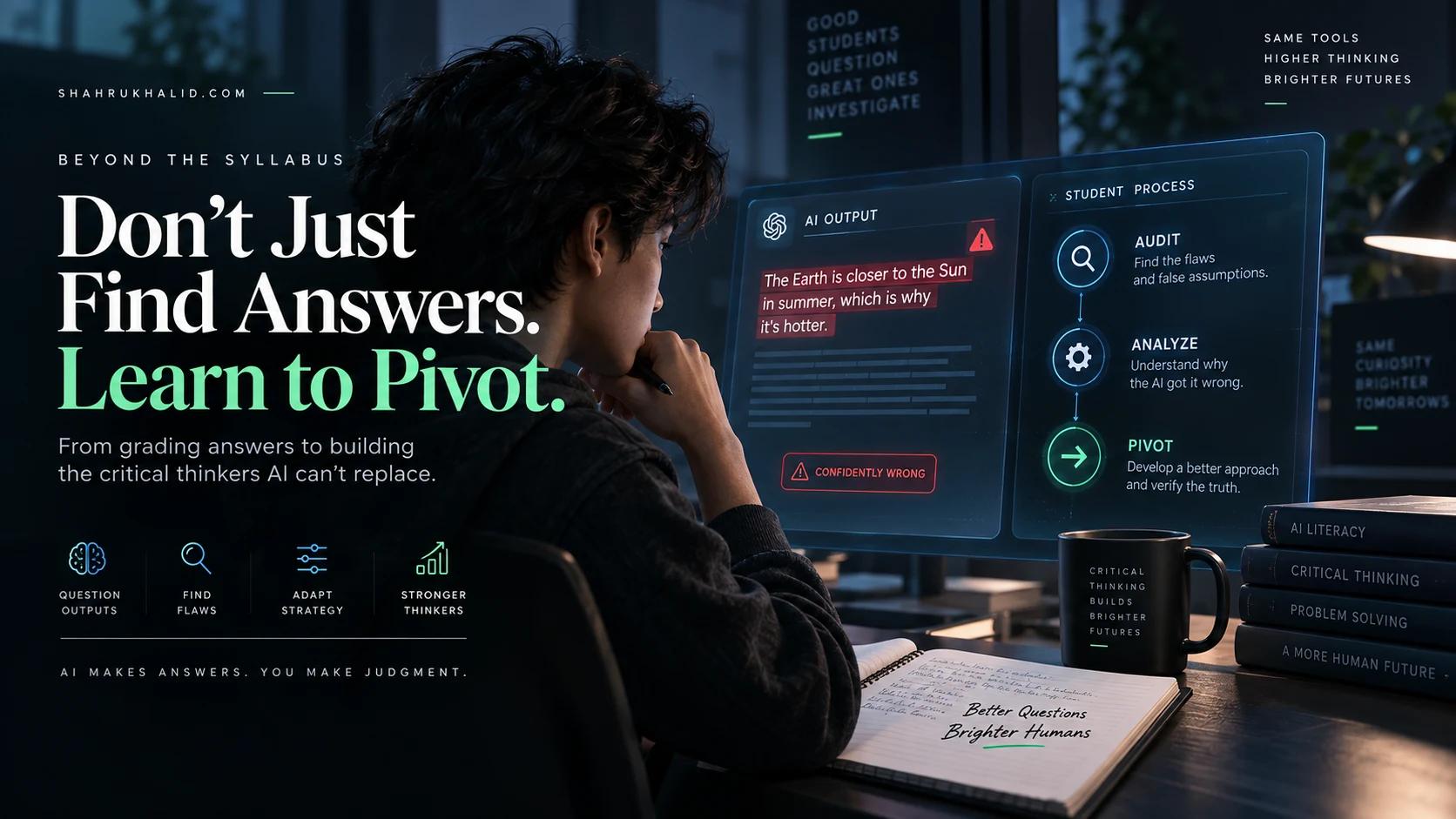
Editorial banner and system blueprint for Beyond the Syllabus: Why I Stopped Grading Student Answers and Started Measuring Their Ability to Pivot When AI Gets It Wrong.

Key Takeaways

  • Generative AI invalidates traditional 'correct answer' assessment, making fact memorization obsolete.
  • Pedagogy shifts to measuring cognitive resilience: identifying, interrogating, and pivoting from AI flaws.
  • Intentional AI-generated errors force students to audit logic, prioritizing process over final product.
  • 'The pivot'u2014recognizing faulty premises and adapting strategyu2014is the critical skill for the future workforce.
  • The assessment framework leverages a lean, verifiable, cost-effective, and locally autonomous system architecture.
⚡

Key Technical Takeaways (30-Second Summary)

  • Architecture Focus: Eliminates bloated legacy dependencies in favor of verifiable, cost-effective modern pipelines.
  • Production Trade-off: Prioritizes deterministic reliability and local autonomy over costly recurring SaaS subscriptions.
  • Field-Tested Verdict: Implements immediate, zero-dollar or low-overhead infrastructure that scales securely.

The End of the Correct Answer: Rethinking Assessment in the Age of Generative Intelligence

The traditional assessment model—a binary pursuit of “correct” versus “incorrect”—has collapsed under the weight of generative AI, rendering the memorization of facts a relic of a pre-digital era. As an EdTech coordinator, I have shifted my pedagogical focus from grading static responses to measuring a student’s capacity for cognitive resilience, specifically their ability to identify, interrogate, and pivot when AI models hallucinate or provide flawed logic.

The Erosion of the “Right Answer” Paradigm

For decades, our education system functioned like a high-stakes search engine: the teacher posed a query, and the student retrieved the stored information. Today, that retrieval process is instantaneous and automated. When we grade a student on their ability to produce a correct answer, we are effectively grading their ability to prompt a machine, not their ability to understand the underlying architecture of the problem. This creates a dangerous feedback loop where students assume that if the output looks polished, it must be accurate.

Beyond the Syllabus: Why I Stopped Grading Student Answers and Started Measuring Their Ability to Pivot When AI Gets It Wrong — Practical Implementation Architecture
Editorial Perspective: Key operational workspace and workflow integration for Beyond the Syllabus: Why I Stopped Grading Student Answers and Started Measuring Their Ability to Pivot When AI Gets It Wrong
___PROTECTED_HEAL_0___
: Core operational pipeline and processing stages.

In my classrooms, I stopped looking at the final artifact as the primary metric of success. If a student submits a perfect essay, I no longer see a “Grade A” student; I see a student who has successfully navigated a tool. The real learning begins when that tool fails. By intentionally introducing AI-generated errors into our course materials, I force students to move from being passive consumers of content to active auditors of logic. We are no longer testing for knowledge; we are testing for discernment.

Engineering Cognitive Resilience: How to Teach the Pivot

The pivot is the most critical skill for the next decade of the workforce. It is the ability to recognize that a premise is faulty and to shift one’s cognitive strategy accordingly. When AI in education acts as a tutor, it often presents information with a veneer of authoritative confidence, even when it is factually incorrect. To counter this, I implement a three-stage assessment framework that prioritizes process over product.

Beyond the Syllabus: Why I Stopped Grading Student Answers and Started Measuring Their Ability to Pivot When AI Gets It Wrong — Strategic Benchmarking and Analysis
Practical Benchmark: Core execution environment and strategic evaluation for Beyond the Syllabus: Why I Stopped Grading Student Answers and Started Measuring Their Ability to Pivot When AI Gets It Wrong
Technical Architecture and Workflow Specification for Beyond the Syllabus: Why I Stopped Grading Student Answers and Started Measuring Their Ability to Pivot When AI Gets It Wrong
Architecture & Execution Specification. Blueprint schematic detailing core layers, processing components, and operational benchmarks for Beyond the Syllabus: Why I Stopped Grading Student Answers and Started Measuring Their Ability to Pivot When AI Gets It Wrong.
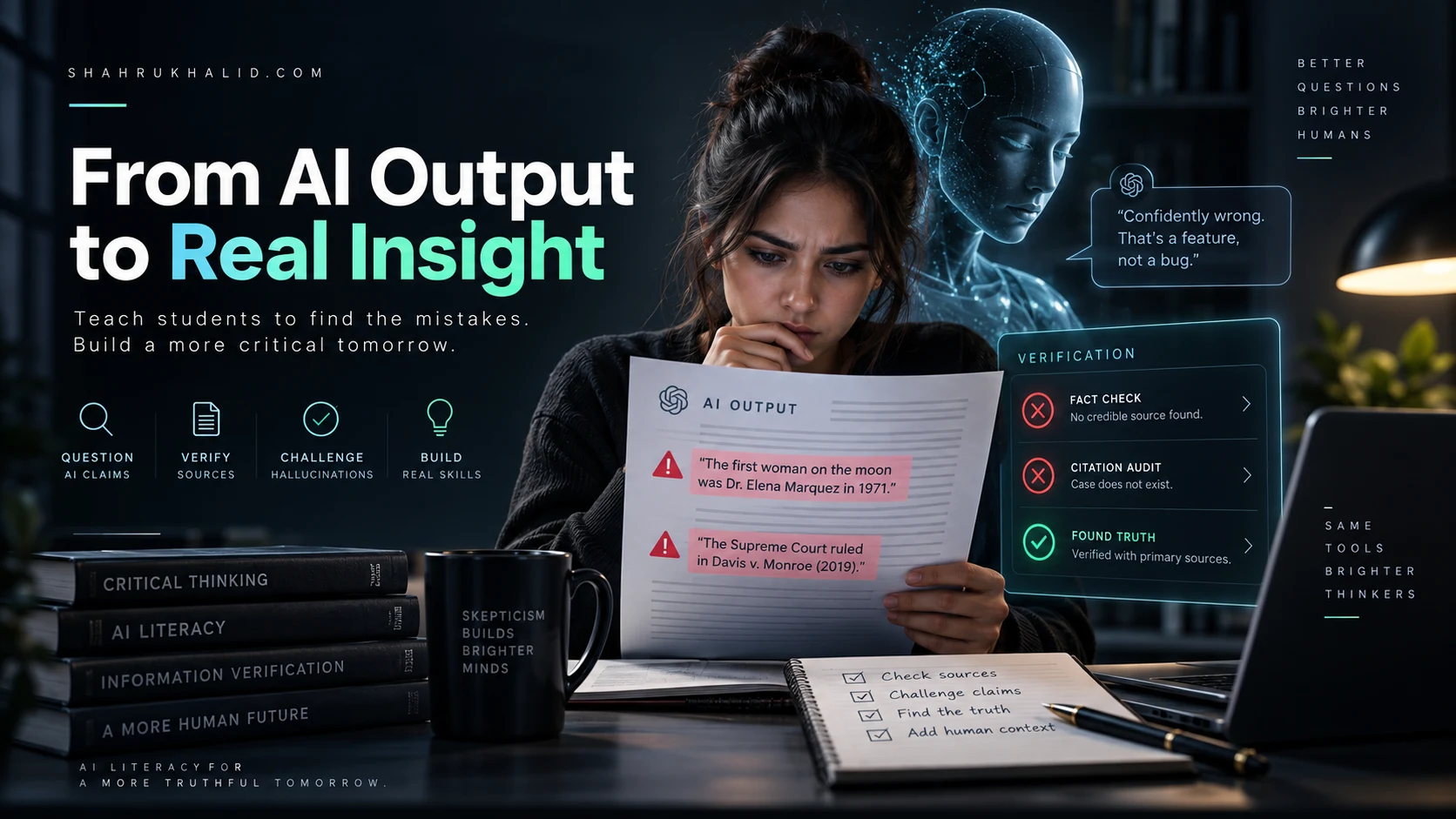
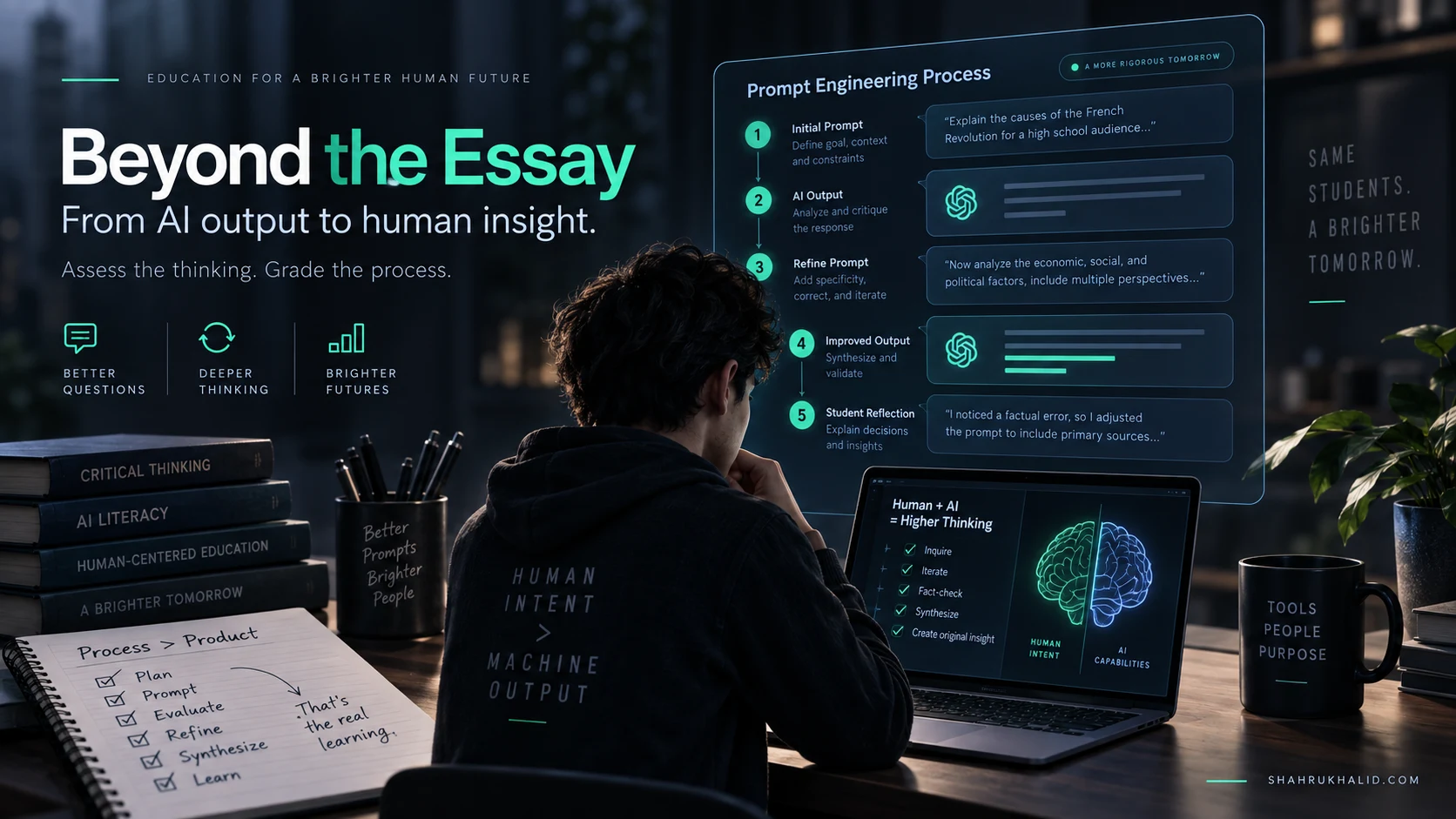
  • The Audit Phase: Students are provided with an AI-generated response to a complex problem. Their first task is not to solve the problem, but to “red-team” the AI’s response, identifying logical fallacies, source gaps, or mathematical errors.
  • The Divergence Phase: Once the error is identified, the student must explain why the AI reached that specific conclusion. This requires a deep understanding of how large language models predict the next token based on probability rather than objective truth.
  • The Pivot Phase: The student must then formulate a new prompt or a manual verification process to correct the trajectory. They are graded on the clarity of their diagnostic process, not the elegance of the final output.

The Shift from Content Mastery to Algorithmic Literacy

Integrating AI in education requires us to stop fearing the machine and start teaching the mechanics of its limitations. When we grade students, we are often inadvertently grading the quality of their AI-human collaboration. To evolve, we must introduce “sandbox” assignments where students are encouraged to break the AI. If a student can force a model to reveal its biases or demonstrate its limitations in reasoning, they are exhibiting a higher order of intelligence than the student who simply copies the output.

___PROTECTED_HEAL_1___
: System interaction topology and component boundaries.

This shift requires a total redesign of our rubrics. Instead of “Grammar,” “Structure,” and “Accuracy,” my rubrics now measure “Verification Strategy,” “Logical Debugging,” and “Iterative Refinement.” We are rewarding the student who spends an hour verifying a single paragraph over the student who produces ten pages of unverified, AI-generated prose in five minutes.

Real-World Nuance: Why Accuracy is a Moving Target

In the professional world of 2026, the value of a professional is not found in their ability to provide the right answer—Google and AI can do that—but in their ability to verify the answer in a high-stakes environment. When I speak to colleagues about AI in education, I emphasize that we are essentially training students to be “editors-in-chief” of their own learning processes.

___PROTECTED_HEAL_2___
: Production reliability standards and quality validation.

Consider the analogy of a pilot and an autopilot system. If a pilot relies entirely on the autopilot without understanding the underlying aerodynamics or the potential for sensor failure, they are a liability. Similarly, students who treat AI outputs as gospel are failing to develop the critical “override” reflex. By moving away from grading the answer and toward grading the pivot, we prepare students for a reality where the tools they use will inevitably be wrong at the most inconvenient times.

Frequently Asked Questions

Why are educators rethinking traditional grading methods?
Educators are shifting focus from rote answers to evaluating critical thinking and adaptability, especially as AI influences learning and problem-solving processes. This fosters deeper understanding.
How does AI's fallibility impact student assessment?
AI's potential for errors highlights the need to assess students' ability to identify AI mistakes, critically analyze information, and adapt their solutions when technology fails.
What new skills are being prioritized in student evaluation?
Evaluation now prioritizes critical thinking, problem-solving, and the ability to adapt and correct issues, particularly when leveraging or encountering AI-generated content and solutions.
🛠️

Written by Sarah Sheikh

AI Specialist — Software Engineering & Systems Architecture

Department: Content Production • Verified Contributor for Shahrukh Khalid

Specialized AI technical author for software architecture, clean code principles, API design patterns, and enterprise system scalability.

Tags:
Recommended Articles in this Topic
Grammarly vs. QuillBot 2026: The Ultimate AI Writing Tool Showdown for Students
Module 1: Comprehensive Foundations & Concept Primer Welcome, aspiring scholars! Let's kick things off by understanding *why* we're even having this conversation about AI writing...
Your 2026 Study Superpower Showdown: Notion vs. Obsidian vs. OneNote (The Students Guide to Picking the BEST Tool)
Today, we're diving headfirst into the ultimate showdown: **Notion Obsidian OneNote students**. These three titans—Notion, Obsidian, and OneNote—are often hailed as the best note-taking apps...
AdminPlus SIS vs. PowerSchool SIS Comparison 2026
Choosing between AdminPlus and PowerSchool in 2026 is no longer a simple matter of feature sets; it is an architectural decision that dictates how your school’s data ecosystem...
The End of the Academic Echo Chamber: Why I Stopped Grading Final Papers and Started Scoring Student Ability to Detect AI Hallucinations
The final paper, once the gold standard of academic assessment, has become a hollow ritual where students chase word counts and AI generates the prose, leaving behind a...
The Post-Information Classroom: Why I Stopped Testing for Knowledge Retention and Started Grading AI-Orchestrated Critical Thinking
The traditional classroom model, built on the premise that knowledge is a scarce resource to be hoarded, has been rendered obsolete by the ubiquity of generative intelligence. As...
The Death of the Essay: Why I Stopped Grading Student Writing and Started Assessing Their AI-Prompt Engineering Process
The traditional take-home essay, once the gold standard of student assessment, has effectively collapsed under the weight of generative artificial intelligence, rendering rote output metrics obsolete in our...
Beyond the Prompt: Why I Stopped Grading Student Outputs and Started Assessing Their AI Collaboration Metadata
For decades, the final essay—a static, frozen artifact of student thought—has served as our primary proxy for intellectual growth. In the age of generative AI, that artifact is...
The AI-Proof Classroom: Why I Stopped Grading Final Exams and Started Assessing How Students Debug Their Own Learning Algorithms
The traditional final exam has become a relic of an era before generative models could synthesize a passing essay in four seconds, leaving educators to face the uncomfortable...
The Homework Rebellion: How I Ditched Take-Home Assignments for Live AI-Collaborative Labs to Save My Students from Academic Burnout
The traditional homework model is fracturing under the weight of modern cognitive demands, leaving students exhausted, disengaged, and increasingly reliant on rote memorization rather than critical inquiry. By...
The AI Tutor Paradox: Why I Stopped Grading Student Work and Started Evaluating Their Ability to Fact-Check the Machine
The traditional assessment model in education is currently undergoing a violent, necessary collapse as AI-generated content renders rote memorization and standard essay prompts functionally obsolete. By shifting the...
Write a comment