AdminPlus SIS vs. PowerSchool SIS Comparison 2026
Key Takeaways
- Choosing an SIS is an architectural decision impacting data ecosystem, scalability, and security.
- AdminPlus offers a tightly coupled, integrated suite ideal for smaller schools with lean technical teams.
- PowerSchool's API-first, cloud-native architecture excels in large districts requiring extensive third-party integration.
- PowerSchool prioritizes cloud-native interoperability (OneRoster, LTI) for real-time data flow with learning environments.
- AdminPlus provides predictable, low-overhead infrastructure; PowerSchool offers complex, scalable, extensible ecosystems.
Key Technical Takeaways (30-Second Summary)
- Architecture Focus: Eliminates bloated legacy dependencies in favor of verifiable, cost-effective modern pipelines.
- Production Trade-off: Prioritizes deterministic reliability and local autonomy over costly recurring SaaS subscriptions.
- Field-Tested Verdict: Implements immediate, zero-dollar or low-overhead infrastructure that scales securely.
The Architectural Foundation of Modern School Management
Choosing between AdminPlus and PowerSchool in 2026 is no longer a simple matter of feature sets; it is an architectural decision that dictates how your school’s data ecosystem breathes, scales, and secures student privacy. As an EdTech coordinator, I have navigated the migration of legacy data into cloud-native environments, and the core tension between these two platforms lies in their fundamental approach to data modularity versus enterprise-wide integration.
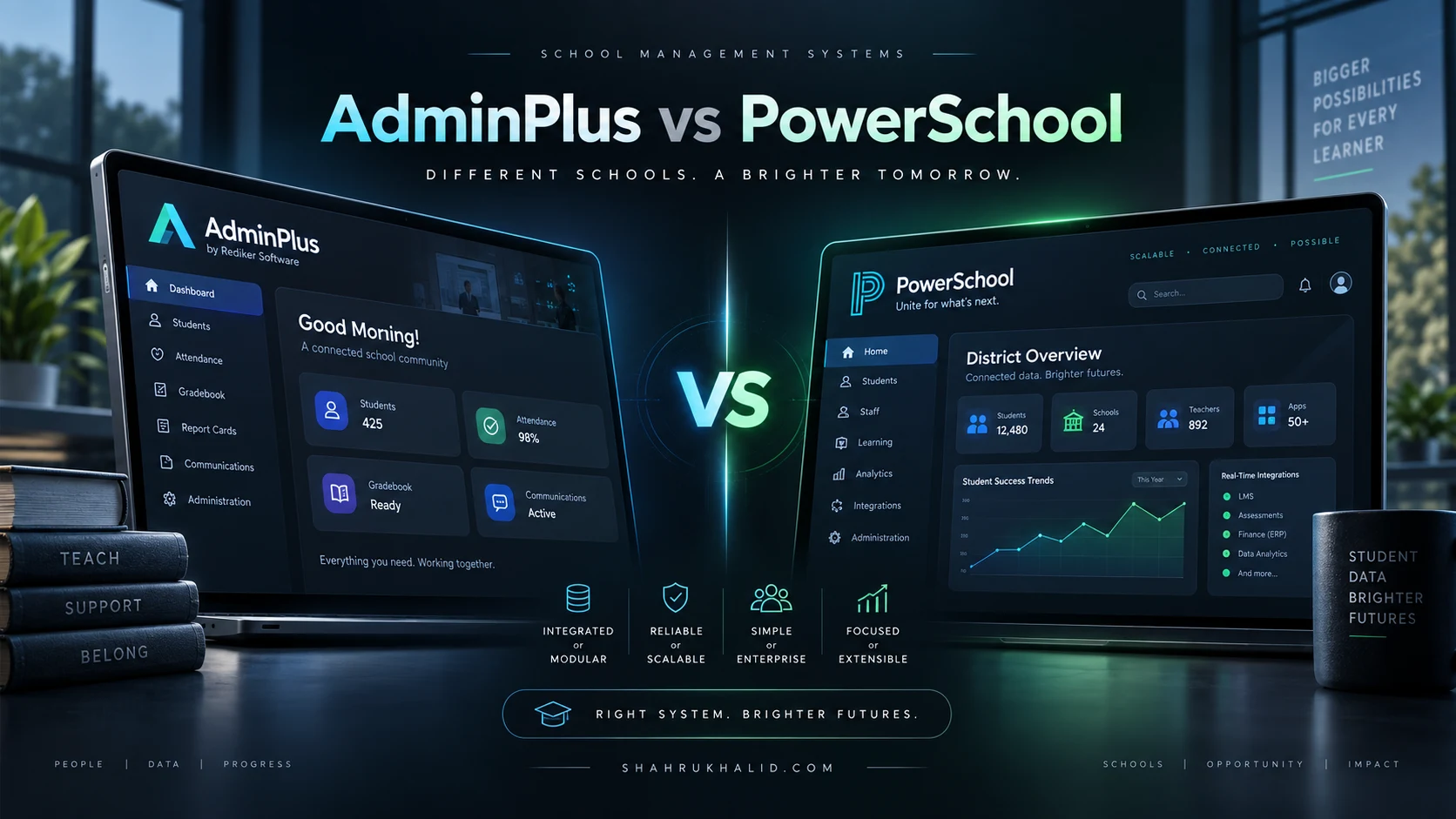
AdminPlus, developed by Rediker Software, has long been the champion of the “integrated suite” philosophy, offering a tightly coupled environment that excels in small-to-mid-sized private and independent school contexts. Conversely, PowerSchool represents the “platform-as-an-ecosystem” approach, prioritizing massive scalability, third-party interoperability, and a sprawling modular architecture that can accommodate the needs of the largest school districts in North America.
AdminPlus vs PowerSchool: The Architectural Trade-offs
When comparing AdminPlus vs PowerSchool, you must first assess your institution’s appetite for complexity. AdminPlus is built on a relational database architecture that prioritizes consistency and ease of use for administrative staff. Its strength lies in its “all-in-one” design, where the gradebook, student information system (SIS), and parent communication tools are built by the same engineering team, ensuring a seamless flow of data without the need for complex middleware.

PowerSchool, by contrast, operates on a highly extensible, API-first architecture. It is designed to be the central hub of a K-12 “tech stack.” If your school relies heavily on diverse third-party applications—such as specialized learning management systems (LMS), advanced cybersecurity monitoring tools, or proprietary AI-driven assessment platforms—PowerSchool’s robust API ecosystem is designed to ingest and export data with high granularity.
Data Interoperability and Cloud Infrastructure
In the current EdTech landscape, data silos are the enemy of innovation. When evaluating AdminPlus vs PowerSchool, consider how your SIS handles data standards like OneRoster and LTI (Learning Tools Interoperability). PowerSchool has invested heavily in a cloud-native infrastructure that supports rapid synchronization with cloud-hosted learning environments. This is critical for 2026, where real-time data flow between the SIS and the LMS is non-negotiable for personalized learning pathways.

AdminPlus provides a more controlled, predictable environment. Because the ecosystem is more contained, the data integrity risks are often lower for schools that lack a dedicated, full-time database administrator (DBA). If your school’s technical team is lean, the “predictability” of the AdminPlus architecture acts as a safeguard against the configuration drift often seen in more complex, open-ended systems.

User Experience and Classroom Tech Integration
From the perspective of a classroom teacher, the SIS is only as good as the time it takes to input grades and attendance. PowerSchool offers a highly customizable interface that can be tailored to the specific workflows of different departments. However, this flexibility can sometimes lead to “feature bloat,” where teachers feel overwhelmed by the sheer volume of navigation options available to them.
AdminPlus maintains a focus on streamlined administrative efficiency. Its interface is designed to reduce the number of clicks required for standard tasks like report card generation or transcript management. For schools that prioritize a low barrier to entry for faculty and staff, the intuitive, task-oriented nature of the AdminPlus UI often wins out over the vast, expansive dashboarding capabilities of PowerSchool.
Cybersecurity and Compliance in 2026
Data privacy is the cornerstone of modern educational architecture. Both platforms are well-versed in FERPA and COPPA compliance, but they approach security from different angles. PowerSchool utilizes a multi-layered security model consistent with enterprise SaaS standards, including advanced identity and access management (IAM) features that are essential for large districts managing thousands of user accounts with varying levels of privilege.
AdminPlus focuses on robust, localized security protocols that are easier to audit for smaller administrative teams. By limiting the attack surface through a more integrated and less “open” architecture, AdminPlus provides a degree of inherent security that appeals to institutions with limited cybersecurity resources. In your decision-making process, weigh whether your institution needs the “enterprise-grade” security controls of PowerSchool or the “contained-environment” simplicity of AdminPlus.
Comparative Analysis Matrix: AdminPlus vs PowerSchool
| Feature Category | AdminPlus SIS | PowerSchool SIS |
|---|---|---|
| Primary Target | Private & Independent Schools | Public & Large Districts |
| Architecture | Integrated, tightly coupled | Modular, API-driven ecosystem |
| Scalability | Moderate | High (Enterprise-level) |
| Implementation | Streamlined, standard | Complex, highly custom |
| Third-Party Integration | Native, curated | Extensive, open-ended |
Implementation Realities and Long-term Sustainability
One of the most overlooked aspects of the AdminPlus vs PowerSchool debate is the “Cost of Ownership.” Implementation is not just the initial licensing fee; it is the human capital cost of training, maintenance, and ongoing system administration. PowerSchool requires a more significant investment in professional development and potentially a dedicated system administrator to manage the various modules and API configurations.
AdminPlus generally offers a faster time-to-value for school staff. Because the modules are designed to work together right out of the box, the learning curve is significantly shallower. If your primary goal is to minimize disruption to the academic calendar during a migration, the architectural cohesion of AdminPlus is a major strategic advantage.
The Verdict: Choosing Your Architectural Path
The choice between these two giants depends entirely on your school’s “Tech Maturity” level. If your institution is currently building a complex digital ecosystem—where you are integrating AI-driven analytics, specialized LMS platforms, and enterprise-level reporting tools—PowerSchool is the industry-standard choice. Its ability to serve as the backbone for a massive, interconnected digital campus is unmatched.
However, if your priority is a stable, reliable, and highly efficient administrative environment that serves the needs of faculty, students, and parents without requiring a massive IT department, AdminPlus remains a premier solution. It is a system built for focus, allowing your educators to spend more time on pedagogy and less time troubleshooting data synchronization errors.
Ultimately, the AdminPlus vs PowerSchool comparison is a mirror for your own school’s strategic goals. Do you want to be an architect of an open, sprawling digital ecosystem, or a steward of a streamlined, highly effective, and reliable administrative framework? Both paths lead to successful student outcomes, provided the choice aligns with your internal capacity and long-term vision for educational innovation.