The Death of the Essay: Why I Stopped Grading Student Writing and Started Assessing Their AI-Prompt Engineering Process
Key Takeaways
- Generative AI makes traditional essay assessment obsolete, decoupling writing from student thinking.
- Assessment shifts from grading final products to evaluating the AI-prompt engineering process itself.
- Effective AI prompting requires deep subject matter understanding and critical iterative refinement skills.
- Key assessment metrics include contextual framing, iterative refinement, and logical synthesis of AI outputs.
- This pedagogical pivot fosters a new literacy, transforming classrooms into human-machine collaboration labs.
Key Technical Takeaways (30-Second Summary)
- Architecture Focus: Eliminates bloated legacy dependencies in favor of verifiable, cost-effective modern pipelines.
- Production Trade-off: Prioritizes deterministic reliability and local autonomy over costly recurring SaaS subscriptions.
- Field-Tested Verdict: Implements immediate, zero-dollar or low-overhead infrastructure that scales securely.
The End of the Traditional Essay: A Paradigm Shift in Academic Assessment
The traditional take-home essay, once the gold standard of student assessment, has effectively collapsed under the weight of generative artificial intelligence, rendering rote output metrics obsolete in our current educational landscape. As an EdTech Coordinator, I have pivoted from grading the final product to evaluating the iterative, cognitive architecture behind AI prompt engineering education, transforming the classroom into a laboratory of human-machine collaboration.
The Erosion of the Essay as a Knowledge Metric
For decades, we operated under the assumption that a five-paragraph essay was a reliable proxy for critical thinking. We measured synthesis, structural logic, and vocabulary. However, the arrival of large language models has fundamentally decoupled writing from thinking. When a student can generate a coherent, grammatically perfect, and structurally sound essay in seconds, the “product” no longer serves as an artifact of the student’s internal cognitive process. It is merely a artifact of their ability to interface with a black box.

In my district, we witnessed a massive spike in “academic integrity” cases that were ultimately futile to prosecute. You cannot police the use of a tool that is now integrated into every browser, operating system, and mobile device. The solution was not to ban the technology—a reactive and losing battle—but to shift our pedagogical focus. If the AI can write the essay, the essay is no longer the destination. The destination is now the inquiry process itself.
Defining the New Literacy: AI Prompt Engineering Education
AI prompt engineering education is not about teaching students how to “cheat” or how to “hack” a chatbot. It is the modern equivalent of teaching library science, research methodology, and rhetorical strategy. To prompt an AI effectively, a student must possess a deep, structural understanding of the subject matter. If you do not understand the nuance of the French Revolution, you cannot prompt an AI to analyze it with any degree of sophistication.
When I grade a student’s “prompt chain,” I am looking for three distinct cognitive markers:

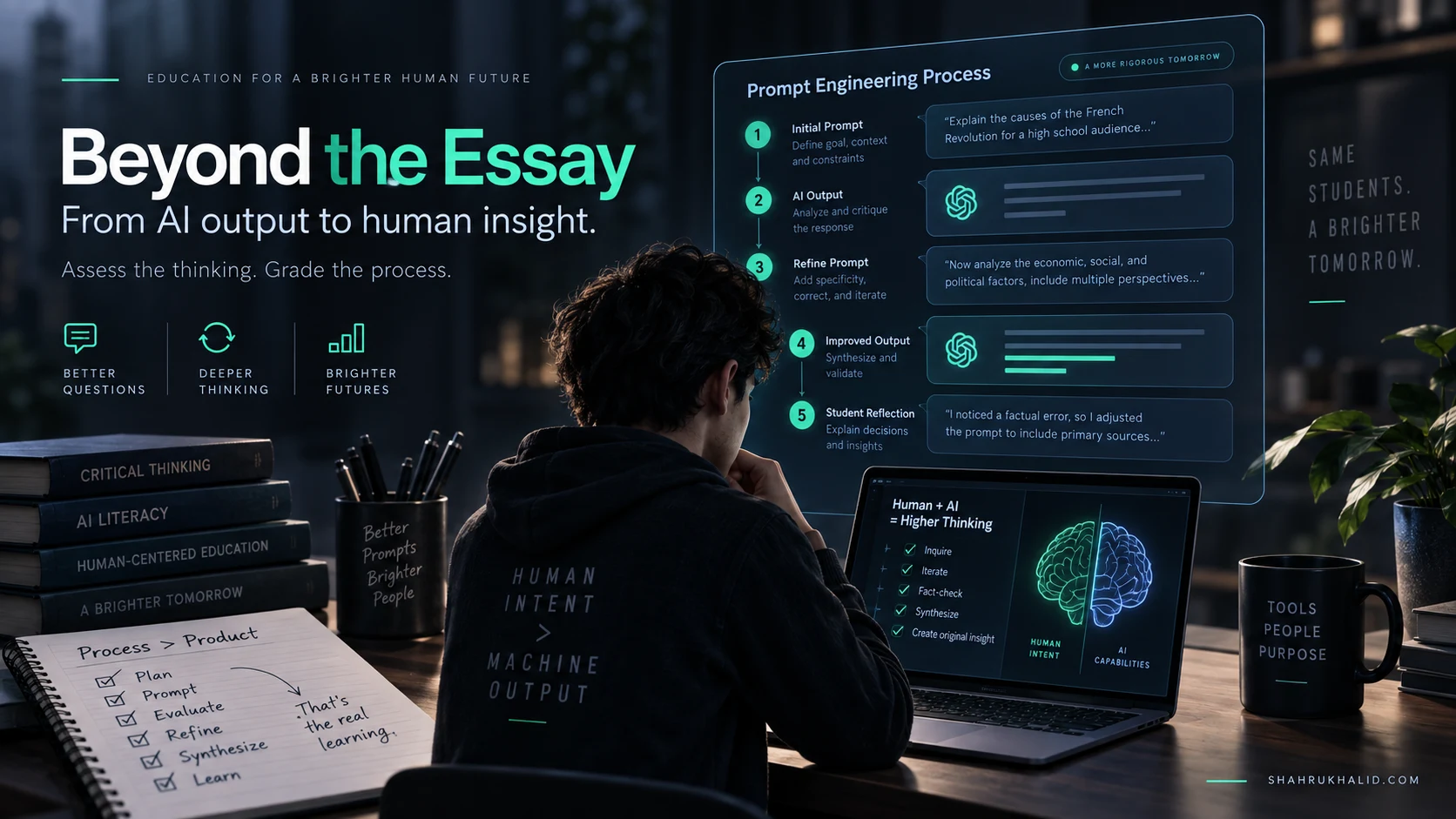
- Contextual Framing: How well does the student define the persona, the constraints, and the desired output format for the AI?
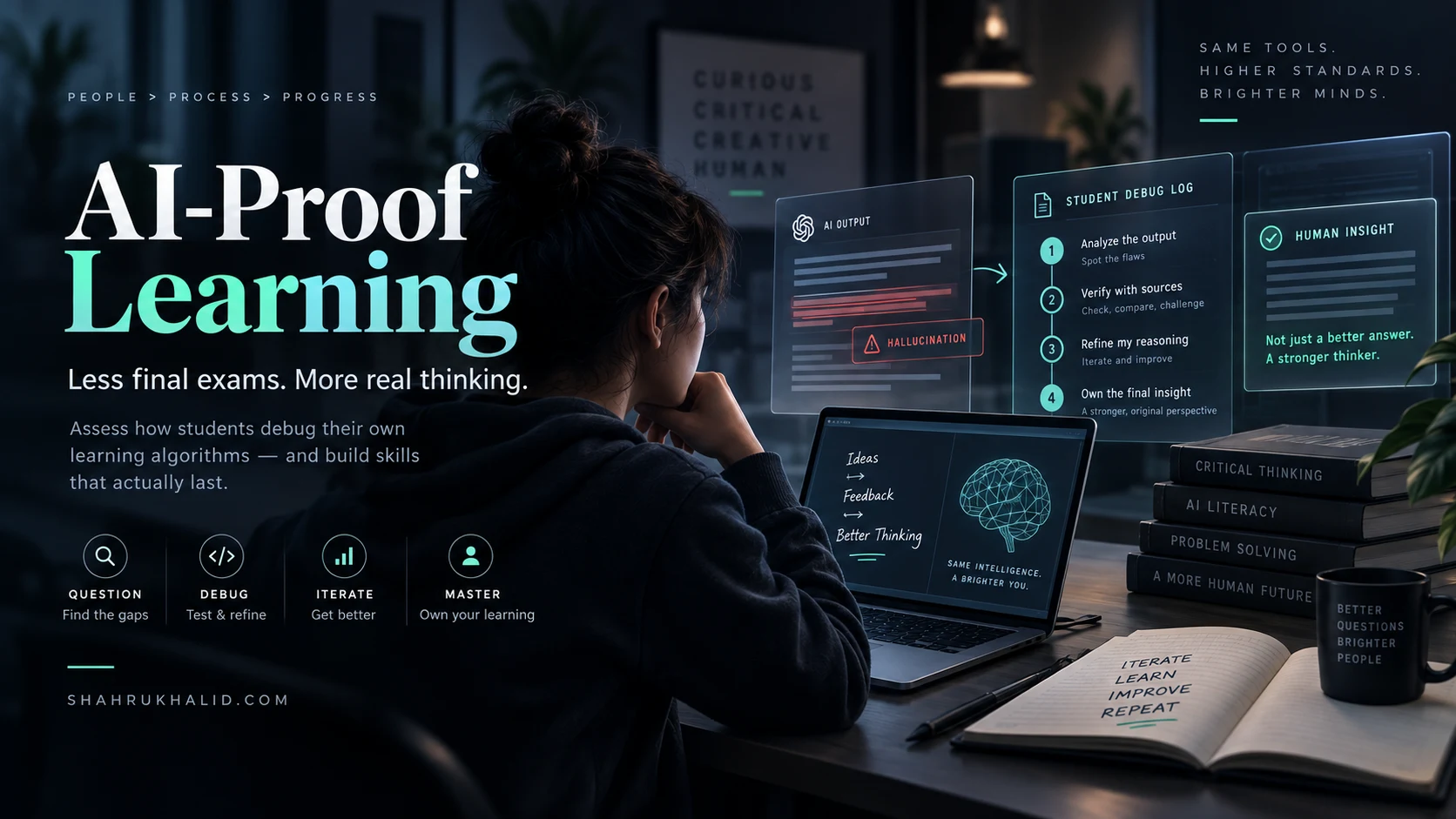
- Iterative Refinement: Does the student recognize a hallucination or a superficial answer, and do they possess the domain knowledge to course-correct the machine?
- Logical Synthesis: Can the student bridge the gap between the AI’s generated segments to form a cohesive, original argument that transcends the machine’s statistical average?
The Shift from Product to Process Documentation
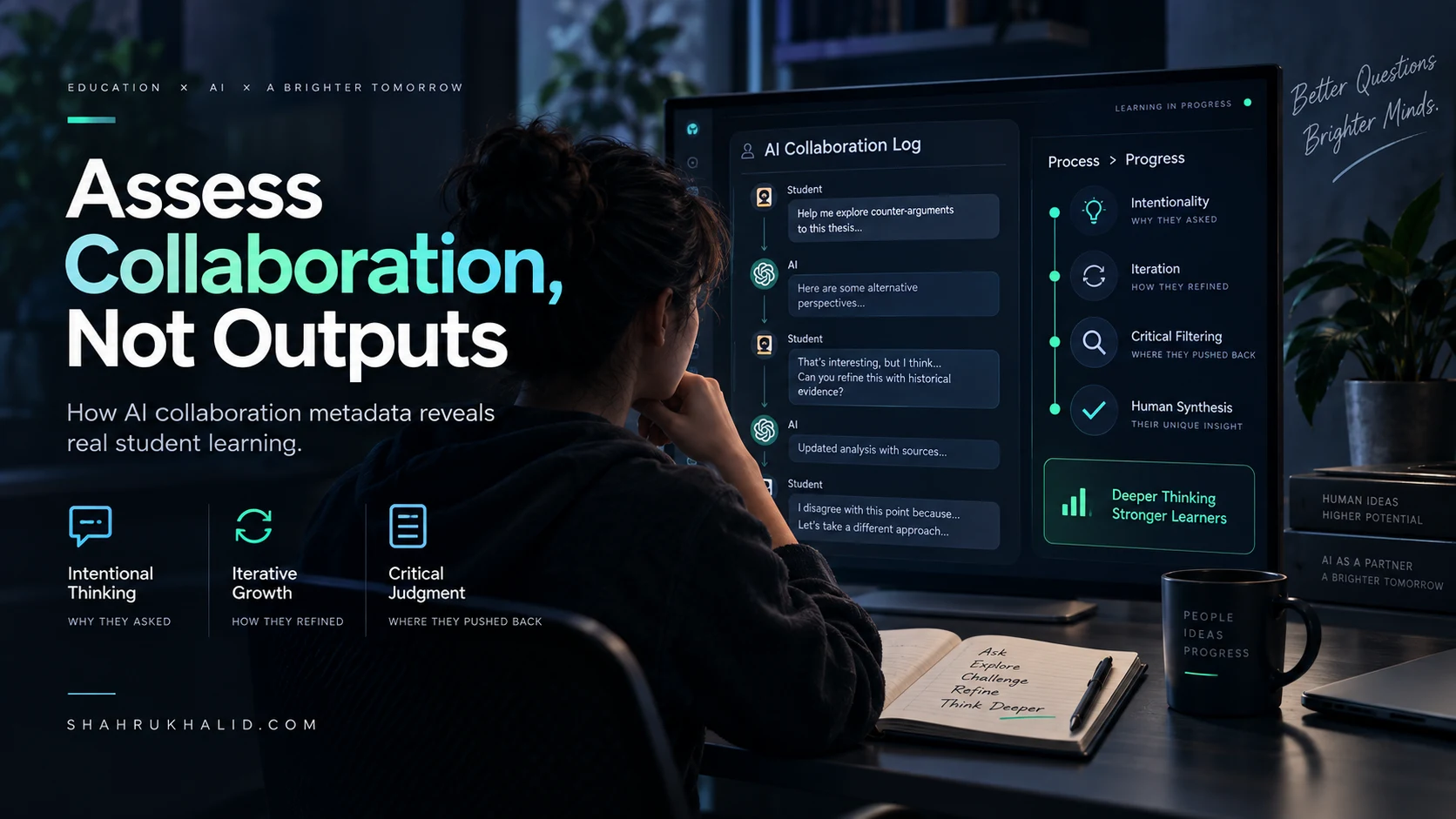
My assessment model now requires students to submit a “Process Journal” alongside every assignment. This journal is a transcript of their interaction with the AI. It records the initial prompt, the AI’s output, the student’s critique of that output, and the subsequent, more complex prompt they generated to refine the result. This is where the learning happens.
By shifting to process-based grading, I am no longer grading the “cleanliness” of the prose. I am grading the student’s ability to act as an editor, a fact-checker, and a director. This mirrors the professional world of 2026, where the most valuable employees are not those who can write the fastest, but those who can leverage AI to solve complex problems with the highest degree of accuracy and ethical alignment.
Building a Classroom of Human-Machine Collaboration
To implement this, we have redesigned our LMS workflows to prioritize transparency. Students are encouraged to use AI, but they must document the “prompt path.” This turns the classroom into a space where we discuss why certain prompts work and others fail. We explore the limitations of the model—its tendencies toward bias, its lack of real-time situational awareness, and its occasional confidence in falsehoods.
When a student realizes that the AI gave them a wrong historical date or a faulty logical premise, and they have to explain why they caught it, they are engaging in the highest level of Bloom’s Taxonomy: evaluation. They are no longer passive consumers of AI output; they are active architects of the knowledge synthesis process.
The Pedagogical Implications for 2026 and Beyond
We are moving toward a future where “writing” is a hybrid act. The human provides the intent, the ethics, and the final validation, while the machine provides the structural scaffolding and the linguistic synthesis. If we continue to grade students on their ability to mimic the machine, we are failing to prepare them for a workforce that requires them to manage the machine.
The death of the essay is actually the birth of a more rigorous, transparent, and intellectually honest form of assessment. By focusing on AI prompt engineering education, we are teaching students how to think critically about the tools they use, how to maintain human agency in an automated world, and how to verify the veracity of the information presented to them.