Architecting Sub-50ms Adaptive Tutoring in 2026: WebGPU Edge Inference, Dynamic Knowledge Graph Compilation, and Real-Time Cognitive State Tracking
Key Takeaways
- Adaptive tutoring demands sub-50ms latency to match human cognitive flow and prevent learning disruption.
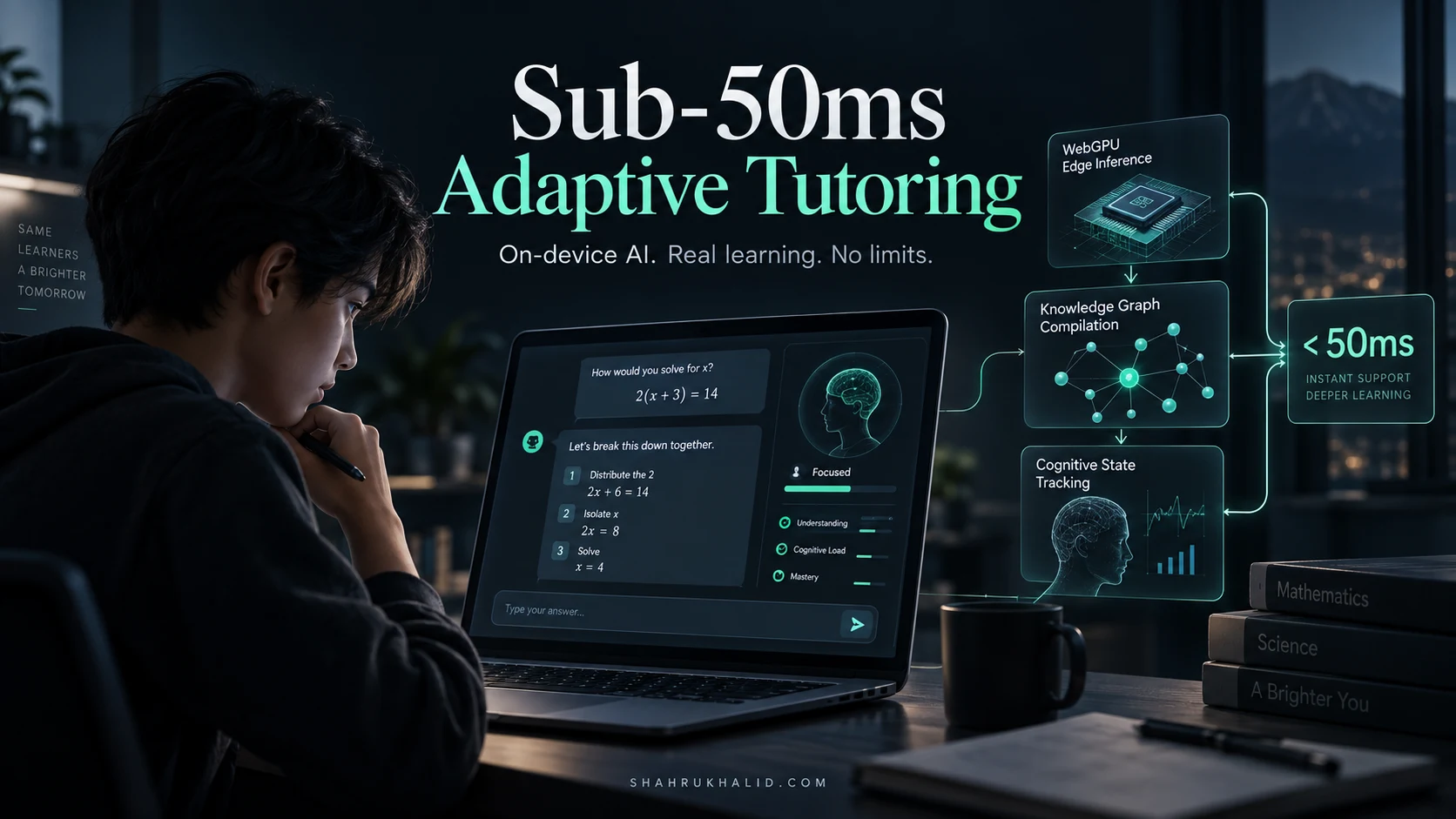
- Decentralized edge architecture with WebGPU-accelerated SLM inference enables real-time, client-side adaptive instruction.
- Dynamic in-browser Knowledge Graph compilation and telemetry drive precise, millisecond-level cognitive state tracking.
- Sub-50ms edge inference prevents error consolidation by providing immediate, localized, and context-aware interventions.
- This architecture ensures student privacy, offline operation, and democratizes mastery learning through active scaffolding.
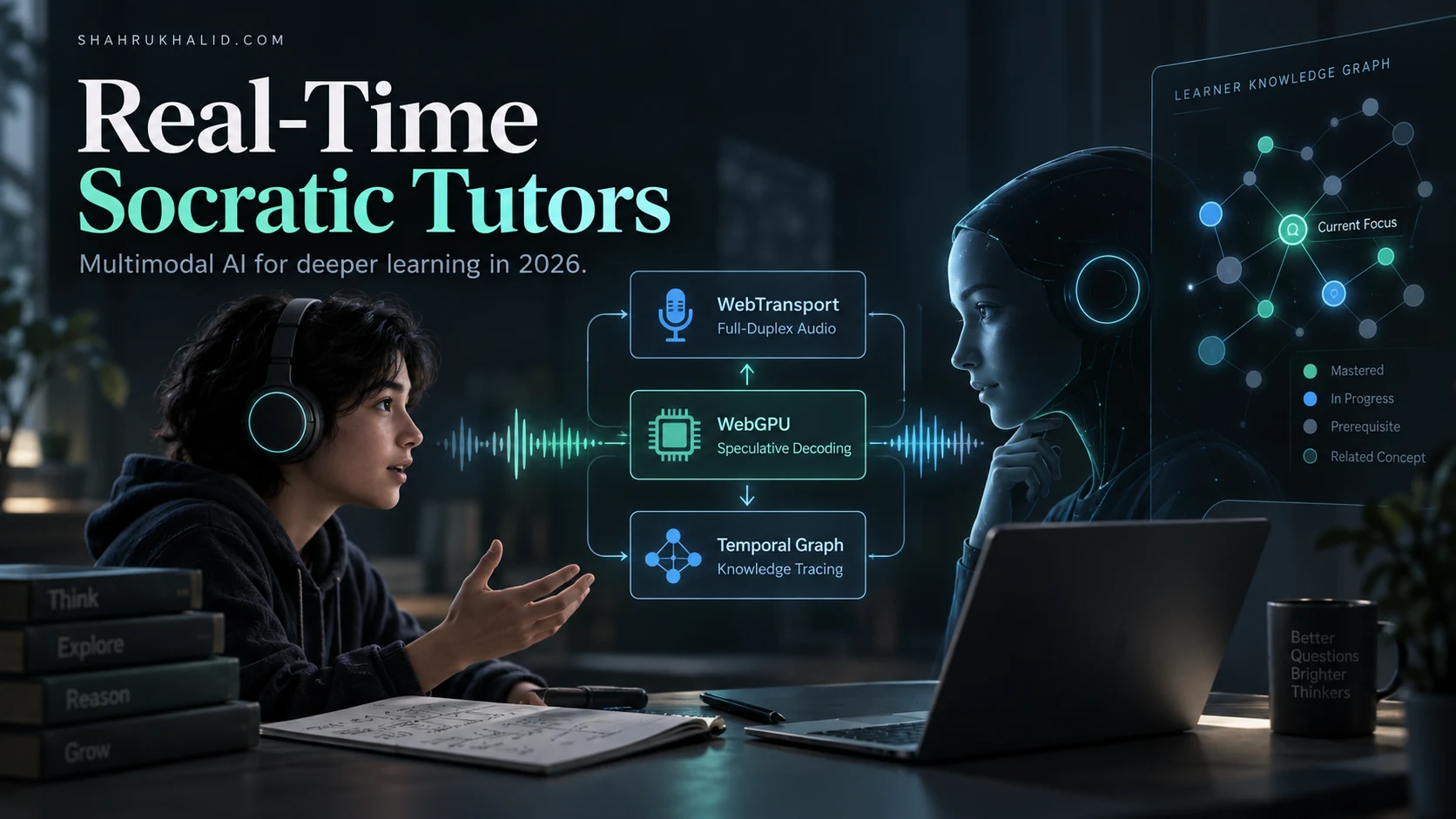
To deliver true adaptive instruction, an intelligent tutoring system must operate within the human conversational micro-pause threshold of 50 milliseconds, eliminating the cognitive friction and flow interruption inherent in centralized cloud Large Language Model (LLM) pipelines. Achieving this deterministic performance requires an architectural departure from remote API dependency, shifting toward a decentralized, edge-native paradigm: WebGPU-accelerated client-side inference of quantized Small Language Models (SLMs), dynamic in-browser Knowledge Graph (KG) compilation, and millisecond-level telemetry-driven cognitive state estimation. By decentralizing computation directly to client hardware, modern pedagogical ai transformation learning models move from passive content delivery to active, localized cognitive scaffolding that preserves student privacy, operates completely offline, and democratizes mastery learning.
The Latency-Cognition Gap: Why 50ms Governs Socratic Flow
In human-to-human pedagogical discourse, the micro-synchrony of conversational turn-taking happens in an empirical window between 50 and 200 milliseconds. When an expert human tutor observes a student hesitate over a multi-step algebraic derivation, the tutor does not pause for two seconds before intervening; subtle vocal cues, micro-gestures, and prompt Socratic interruptions occur almost instantaneously. Cognitive Load Theory, pioneered by John Sweller, demonstrates that extraneous cognitive load increases sharply when instructional interfaces introduce non-deterministic latencies during problem-solving tasks. Centralized cloud architectures, bound by network traversal, queueing dynamics, and high Time-to-First-Token (TTFT) overheads ranging from 400ms to 2,500ms, break this cognitive immersion. They disrupt the learner’s working memory during critical conceptual inflection points.
Empirical evidence underscores this dynamic. As synthesized in research indexed across the Education Resources Information Center (ERIC ED628205), adaptive learning algorithms in STEM retention show that instructional response latency is negatively correlated with mastery stabilization, particularly when students encounter high-intrinsic-complexity STEM schemas. When feedback loops exceed 250 milliseconds, students systematically exhibit reduced resilience to error remediation, higher cognitive friction, and an inclination to treat the interface as an asynchronous query engine rather than an interactive cognitive prosthesis.
The Real-World Failure of Centralized Cloud Tutoring
Consider a student attempting to balance a redox reaction in an online chemistry workspace. Under a typical cloud-based Generative AI implementation, every student keystroke or conversational token travels across the public internet to an inference cluster running a 70-billion-parameter model. If the student displays an intuitive misconception—such as miscalculating the oxidation state of manganese in a permanganate ion—the system requires a 1,200ms round-trip to deliver an intervention. By the time the Socratic prompt streams into the viewport, the student has already committed three subsequent mathematical actions based on the initial false premise. The tutor must now undo compounded errors. In contrast, an edge-native sub-50ms engine captures the error at the immediate character insertion point, halting the erroneous schema from consolidating in working memory.
The Client-Side Inference Engine: WebGPU, WGSL, and 4-Bit SLMs
Achieving sub-50ms generation and token processing at the edge requires direct programmatic control over local hardware acceleration primitives. The W3C WebGPU API provides low-overhead, cross-platform access to GPU compute capabilities inside modern web runtimes, completely bypassing CPU serialization limits. By leveraging WebGPU Compute Shaders written in WebGPU Shading Language (WGSL), educational platforms can instantiate dense linear algebra pipelines capable of running highly optimized 1-billion to 3.8-billion parameter models (such as Llama-3.2-1B/3B, Phi-3.5-mini, or Gemma-2-2B) natively on consumer-grade hardware, including standard student Chromebooks and low-power mobile tablets.


WGSL Compute Kernels and Quantization Profiles
Memory bandwidth is the decisive bottleneck for autoregressive token generation on consumer client GPUs. To achieve sub-50ms Time-to-First-Token (TTFT) and throughput above 35 tokens-per-second, model weights must be aggressively quantized without degrading the linguistic and logical reasoning capabilities required for rigorous pedagogy. Activation-aware Weight Quantization (AWQ) and GPTQ at 4-bit precision (INT4) reduce the footprint of a 3-billion-parameter model from ~6 GB (at FP16) to roughly 1.8 GB. This fits comfortably within the WebGPU device memory allocation limits of modern browsers (which often restrict individual buffer allocations to 2 GB or 50% of available VRAM).
KV-Cache Paging and Linearized Pipeline Orchestration
To avoid garbage collection pauses within JavaScript/Wasm runtimes that exceed our 50ms latency budget, the local Key-Value (KV) cache cannot use standard dynamic array re-allocations. Instead, the runtime leverages PagedAttention structures implemented natively within static WebGPU ring-buffers. Static memory allocation occurs upon engine initialization via device.createBuffer(), pre-reserving contiguous chunks of VRAM for attention head matrices up to a maximum context window of 2,048 tokens.
By compiling custom WGSL matrix-vector multiplication (GEMV) kernels tuned precisely to the target device’s SIMD subgroup sizes (such as subgroup_size = 32 on NVIDIA or subgroup_size = 64 on Apple Silicon), mathematical throughput is sustained directly within the browser tab. The model streams tokens through an asynchronous zero-copy WebAssembly ring-buffer directly into the browser’s Document Object Model (DOM) or canvas context, ensuring frame rendering matches the 60Hz/120Hz display refresh cycle with zero IPC (Inter-Process Communication) cost.
Dynamic Knowledge Graph Compilation in Browser Runtimes
Deploying small language models to the edge introduces an inherent limitation: parameters under 4 billion lack the deep parametric memory required to maintain accurate, multi-domain curriculum ontologies without hallucinating pedagogical facts. The solution is not to expand parameter scale, but to decouple factual and curricular structure from the model itself. This is achieved by compiling a dynamic, localized Knowledge Graph (KG) directly inside the browser environment.
1. Directed Acyclic Dependency Graphs (DAGs)
Curricula are compiled into strict Directed Acyclic Graphs. Nodes represent micro-competencies (e.g., “Singular Matrix Determinants”); edges represent strict prerequisite dependencies and pedagogical entailments.
2. WebAssembly Vector-Graph Hybrids
Using compiled SQLite-Wasm or DuckDB-Wasm running inside dedicated Web Workers, the client executes relational joins across ontological concepts alongside flat-index cosine distance searches in under 4ms.
3. Dynamic Subgraph Extraction
When a student encounters difficulty, the system does not perform wide RAG queries. It prunes the DAG to an active 3-hop neighborhood, injecting deterministic pedagogical constraints directly into the SLM prompt buffer.
Prerequisite Resolution and Misconception Mapping
A production dynamic KG does not simply store facts; it stores ontological paths of student cognition. Each concept node maintains properties including Intrinsic Cognitive Load (ICL), Prerequisite Threshold Vectors, and a registered array of Known Misconception Archetypes. When a student operates within a domain, the edge engine executes an in-memory traversal algorithm to determine the exact boundary of the student’s mastery.
For example, if a student fails an exercise requiring the application of the Chain Rule in calculus, an edge graph query resolves the prerequisite tree within 2.8 milliseconds:
Target Concept:Calculus::Differentiation::ChainRuleImmediate Prerequisites:[Calculus::Differentiation::PowerRule, Algebra::Functions::Composition]Observed Error Signal:Multiplied outer derivative by inner function without differentiating inner function.Compiled KG Diagnostic:Identifies specific breakdown atAlgebra::Functions::Composition.
The system dynamically compiles a deterministic JSON context payload containing only this local subgraph and injects it into the SLM’s system prompt via the localized KV-cache. The model is structurally constrained to address the underlying composition breakdown rather than merely re-explaining the surface-level calculus rule.
Real-Time Cognitive State Tracking: Fusing Telemetry and DKT at the Edge
Accurate scaffolding requires knowing precisely when to intervene and how much support to provide. Rather than relying on sporadic, summative quizzes, edge systems compute continuous estimates of student latent knowledge and cognitive load by monitoring continuous micro-telemetry signals.
Edge-Based Deep Knowledge Tracing (DKT) and Bayesian Formulation
Historically, Bayesian Knowledge Tracing (BKT) modeled student knowledge as a latent variable $L_t$ using four parameters: initial mastery $P(L_0)$, transition probability $P(T)$, guess probability $P(G)$, and slip probability $P(S)$. While computationally light, standard BKT assumes concepts are independent. Modern edge systems deploy a hybrid engine: a lightweight Deep Knowledge Tracing (DKT) model—implemented as an ONNX Runtime Web model driven by a compiled Gated Recurrent Unit (GRU) or a tiny 2-layer Transformer—running on an independent WebGPU compute pass or WebAssembly worker thread.
The Mathematical Model of Real-Time Edge Tracing
At time step $t$, the edge client constructs an interaction vector $mathbf{x}_t = (e_t, y_t, Delta t, H_t)$ where $e_t$ is the exercise concept index, $y_t in {0, 1}$ is correctness, $Delta t$ is hesitation latency in milliseconds, and $H_t$ is the keystroke entropy score. The edge DKT neural network updates its hidden state vector $mathbf{h}_t$ via:
mathbf{h}_t = tanh(mathbf{W}_{xh} mathbf{x}_t + mathbf{W}_{hh} mathbf{h}_{t-1} + mathbf{b}_h)
From this hidden state, the mastery probability $p_t$ for all related nodes in the Knowledge Graph is simultaneously updated:
mathbf{y}_t = sigma(mathbf{W}_{hy} mathbf{h}_t + mathbf{b}_y)
Because this inference runs locally in ONNX Runtime Web via WebAssembly SIMD or WebGPU, updating the full latent knowledge state across 500 curricular nodes requires only ~3.2ms, executing instantly between individual keystrokes or UI interactions.
Fine-Grained Telemetry and Cognitive Load Metrics
To detect cognitive overload before an outright error occurs, the client captures micro-interactions directly from the browser window:
- Keystroke Dynamics and Burstiness: Inter-keystroke intervals (IKIs) are parsed into coefficient of variation values. Uniform, steady inputs indicate fluid procedural knowledge. Highly irregular bursts with repeated deletions (backspace frequency $> 18%$ of total inputs) indicate unstable working-memory schemas.
- Hesitation Latency: The duration between prompt presentation and first meaningful interaction. If latency exceeds $2.5sigma$ of the student’s historical baseline on equivalent difficulty nodes, the engine flags potential schema activation failure.
- Gaze and Mouse Trajectory Entropy: In web-based interaction canvases, chaotic cursor re-traversals and erratic scrolling patterns correlate directly with visual search confusion and high extraneous cognitive load.
Pedagogical AI Transformation Learning Models & Equity Frameworks
The convergence of local SLMs, compiled knowledge graphs, and real-time state tracking establishes an entirely new paradigm for pedagogical ai transformation learning models. Rather than acting as automated “answer machines” or unconstrained conversationalists, edge-native systems can enforce rigorous pedagogical frameworks by construction.
Zone of Proximal Development (ZPD) and Dynamic Scaffolding
Lev Vygotsky’s Zone of Proximal Development defines the distance between actual developmental level determined by independent problem solving and the level of potential development determined through problem solving under adult guidance or in collaboration with more capable peers. In our edge architecture, the current mastery vector $mathbf{y}_t$ produced by the DKT model establishes the student’s lower bound, while the dynamic Knowledge Graph establishes the target upper bound.
The system strictly modulates the generative constraints of the local SLM to maintain the student within this zone. It implements algorithmic “fading”—systematically reducing tutor assistance as mastery indices rise:
Level 1 Scaffolding: Metacognitive Prompting
Trigger: Latency spike detected, error rate = 0, mastery $> 0.75$.
SLM Behavior: The model emits a non-directive metacognitive check: “What is your target variable in this step?” Zero procedural code or direct answers are permitted by the token filter.
Level 2 Scaffolding: Socratic Sub-Goal Decomposition
Trigger: Keystroke entropy high, single error observed, mastery $0.45 – 0.75$.
SLM Behavior: The engine forces sub-goal decomposition: “Before we can factor this polynomial, what common term can we extract from the first two coefficients?”
Level 3 Scaffolding: Direct Worked-Example Modeling
Trigger: Repeated misconceptions, cognitive overload threshold breached, mastery $< 0.45$.
SLM Behavior: Cognitive overload intervention. The tutor temporarily assumes the procedural load, generating an isomorphic worked example and highlighting step-by-step rationale.
Pedagogical Equity, Data Privacy, and Offline Operation
A central tenet of the global mandates established in the UNESCO guidance on digital education and generative AI is that AI deployment must not widen educational inequities, compromise child data sovereignty, or rely on exorbitant infrastructural bandwidth that excludes the global South. Cloud-first educational technologies systematically violate these mandates: they require continuous high-speed connectivity, expose sensitive student learning profiles to corporate logging, and incur unsustainable per-token cloud inference costs that prevent zero-cost public access.
The edge-native architecture directly solves this trilemma:
- Pedagogical Equity: Once model weights and compiled graph ontologies are cached in the browser’s persistent storage (via
CacheStorageandIndexedDB), the adaptive tutoring platform operates with zero internet access. A student on a rural, air-gapped Chromebook receives the identical sub-50ms Socratic experience as a student with a gigabit fiber connection. - Absolute Data Privacy (FERPA / COPPA / GDPR): Telemetry data, keystroke dynamics, cognitive error states, and conversation transcripts never exit the local device memory. Model inference and cognitive state tracking happen entirely inside the browser sandbox, rendering institutional data breaches architecturally impossible.
- Zero Marginal Server Cost: Educational institutions avoid recurring token consumption fees. Compute expenditure is transferred to client-side hardware cycles already present in existing school device fleets.
Production Architectural Blueprint: The Sub-50ms Pipeline
The operational blueprint below illustrates how these disparate client-side primitives unify into an end-to-end event loop inside the browser runtime, maintaining strict latency budgets across every stage.
CLIENT-SIDE EDGE PIPELINE (Browser Process Architecture)
│ └─ Captured by zero-overhead UI telemetry listeners in main thread.
│
[1.5ms] SIGNAL PROCESSING WORKER (WebAssembly):
│ ├─ Computes Inter-Keystroke Interval (IKI) entropy.
│ └─ Identifies error patterns against static AST parser.
│
[4.8ms] COGNITIVE STATE UPDATE (ONNX Runtime Web – WebAssembly SIMD):
│ ├─ Evaluates DKT Recurrent Network with updated interaction vector $mathbf{x}_t$.
│ └─ Mastery vector $mathbf{y}_t$ updated across local concept map.
│
[8.0ms] KNOWLEDGE GRAPH TRAVERSAL (DuckDB-Wasm / SQLite-Wasm):
│ ├─ Resolves prerequisite gaps based on updated mastery states.
│ └─ Extracts active 3-hop contextual subgraph; formats system constraints.
│
[12.0ms] PROMPT SYNTHESIS & KV-CACHE DISPATCH:
│ ├─ Updates WebGPU static PagedAttention buffer pointers.
│ └─ Submits compute pass to GPU command queue via
queue.submit().│
[36.0ms] WebGPU INFERENCE PASS (INT4-Quantized SLM):
│ ├─ WGSL matrix-vector multiplication (GEMV) subgroups execute.
│ └─ First instructional token generated via greedy/constrained decoding.
│
[38.5ms] SCAFFOLD RENDER:
└─ First token written to DOM. Total Turnaround Time: 38.5ms (< 50ms budget).
Edge Failure Recovery and Graceful Degradation Protocols
Hardware divergence in student environments requires strict fault tolerance. The engine runs a deterministic initialization benchmark upon first boot:
- Tier 1: Full Acceleration (WebGPU Available, VRAM ≥ 2 GB). The full architecture runs as designed: 3B SLM + Local DKT + Wasm Knowledge Graph. Total response latency averages 35ms.
- Tier 2: Constrained Compute (WebGPU Available, VRAM < 2 GB or High Memory Pressure). The system automatically swaps the 3B model for a highly compressed 1B parameter model (e.g., Llama-3.2-1B at INT4) and limits the context window to 1,024 tokens. Knowledge graph resolution remains local. Latency averages 22ms.
- Tier 3: Fallback CPU Mode (WebGPU Disabled or Driver Failure). The engine gracefully degrades to WebAssembly SIMD execution. The heavy SLM is disabled in favor of a client-side rule-based Socratic finite state machine driven by the Wasm Knowledge Graph and DKT tracker, preserving the sub-50ms guarantee for structured feedback without conversational generation.
Implementation Playbook: Step-by-Step Production Roadmap
To implement this edge architecture within an existing educational learning management system or interactive content engine, follow this phased engineering sequence.
Phase 1: Pipeline Initialization and Model Asset Streaming
Do not block the student UI while loading model weights. Implement progressive background streaming using the Fetch API and CacheStorage API, chunking weight files into 32MB segments. This allows download resumeability across unstable school networks.
async function initializeAdaptiveEngine() {
if (!navigator.gpu) {
throw new Error("WebGPU not supported. Initiating Tier 3 WebAssembly fallback.");
}
const adapter = await navigator.gpu.requestAdapter({
powerPreference: "high-performance"
});
if (!adapter) {
throw new Error("No suitable GPU adapter found.");
}
// Verify feature support for fast fp16 math if available
const requiredFeatures = [];
if (adapter.features.has("shader-f16")) {
requiredFeatures.push("shader-f16");
}
const device = await adapter.requestDevice({
requiredFeatures,
requiredLimits: {
maxStorageBufferBindingSize: 1024 * 1024 * 1024, // 1GB
maxComputeWorkgroupStorageSize: 32768
}
});
return { adapter, device };
}
Phase 2: Local Knowledge Graph Indexing
Compile the curriculum ontology into an indexed SQLite or DuckDB file compiled to WebAssembly. Store this database in client-side IndexedDB using the Origin Private File System (OPFS) for maximum I/O read throughput.
- Create schema tables:
concepts,prerequisites,misconceptions, andstudent_history. - Compile an in-memory inverted index of concept tags to support instant regex-based student code or formula parsing.
- Run graph traversal queries inside an isolated Web Worker to prevent event loop starvation on the main thread.
Phase 3: Telemetry Hook-In and Real-Time Loop Interception
Instrument the student interaction surface (e.g., Monaco Editor, math input canvases, or interactive rich-text blocks) with micro-telemetry dispatchers:
- Attach event listeners to
keydown,pointerdown, and canvas interaction coordinates using passive event listeners ({ passive: true }) to prevent UI thread stutter. - Pipe timestamps, key codes, and deletion counts into an
ArrayBuffershared with the state tracking worker via aSharedArrayBufferandAtomicsfor lock-free, zero-allocation synchronization. - Trigger inference evaluation only when hesitation anomalies exceed thresholds or when an assessment boundary is encountered.
Conclusion: The Future of Frictionless AI Pedagogy
The architectural shift toward sub-50ms edge-native tutoring represents far more than an optimization of infrastructure costs; it is an epistemological evolution in educational technology. By bringing inference, curricular reasoning, and cognitive state modeling directly onto the learner’s device via WebGPU and dynamic graph compilation, we bridge the gap between static content and human-speed cognitive scaffolding. These decentralized pedagogical ai transformation learning models eliminate the pedagogical latency penalties of the cloud, secure student privacy at the silicon level, and ensure that world-class, adaptive mastery learning is universally accessible, resilient, and pedagogically sound.