Architecting Real-Time Collaborative STEM Simulation Fabrics in 2026: Deterministic WebAssembly Physics Kernels, Hybrid CRDT-Driven WebTransport State Synchronization, and Headless WebGPU Frame Multiplexing
Key Takeaways
- Fixed-point WebAssembly physics kernels ensure bit-for-bit simulation determinism across diverse hardware.
- IEEE 754 inconsistencies (FMA, trig functions) cause irrecoverable state drift in multi-user physics.
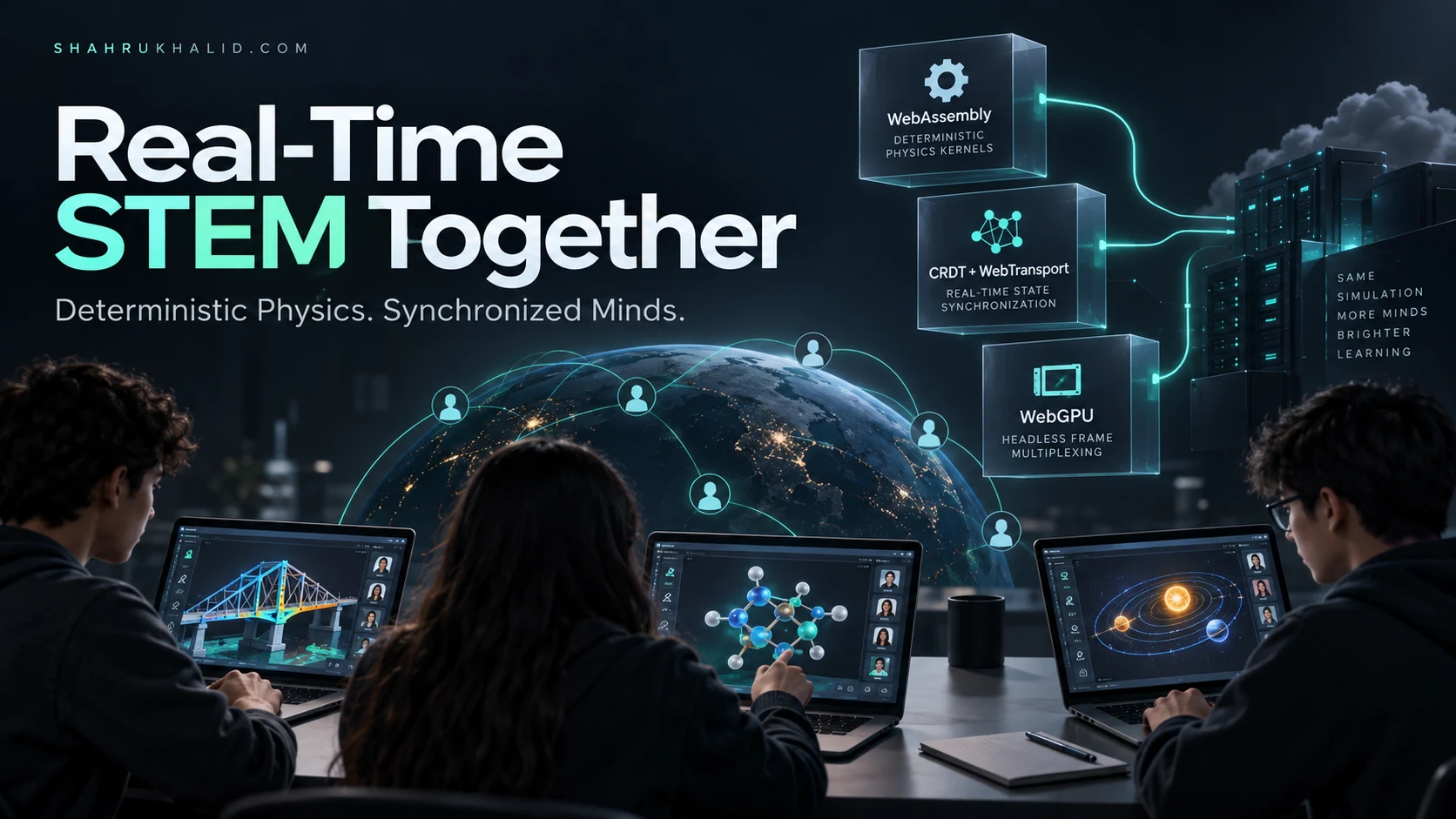
- A tri-pillar architecture combines deterministic Wasm, hybrid CRDTs, and WebGPU for collaborative STEM simulations.
- Hybrid CRDTs synchronized via WebTransport provide robust, low-latency state consistency for collaborative simulations.
- Headless WebGPU frame multiplexing, backed by WebCodecs, optimizes rendering for diverse, hardware-constrained clients.
Modern collaborative STEM simulations are fundamentally constrained by distributed state divergence: browser environments execute across radically heterogeneous hardware, where unmitigated floating-point operations desynchronize physics states, and standard client-server models introduce intolerable interactive latency. To bridge this epistemic gap in 2026, enterprise educational infrastructure must converge on a tri-pillar architectural fabric: deterministic WebAssembly (Wasm) physics kernels executing fixed-point numerical integration, hybrid Conflict-Free Replicated Data Type (CRDT) topologies synchronized over multiplexed WebTransport sessions, and headless WebGPU frame multiplexing backed by WebCodecs for hardware-constrained edge clients. This technical paradigm operationalizes empirical pedagogical frameworks, transforming passive interactive simulations into resilient, real-time shared learning environments capable of scaling to classroom cohorts without experiential degradation.
The Deterministic WebAssembly Physics Kernel
The foundational challenge of synchronous multi-user mechanical simulations lies in cross-platform arithmetic divergence. In traditional browser-based educational tools relying on vanilla JavaScript or unconstrained WebAssembly floating-point computations, slight variations in the underlying microprocessor architecture (e.g., x86_64 vs. ARM64) and JavaScript engines (V8, JavaScriptCore, SpiderMonkey) yield irrecoverable state drift within seconds.
The IEEE 754 Non-Determinism Trap
While the IEEE 754-2008 standard defines binary floating-point arithmetic formats, it explicitly leaves specific implementation behaviors undefined or target-dependent. These variations catastrophically undermine synchronous multi-client physics engines:
- Fused Multiply-Add (FMA) Inconsistencies: Hardware supporting FMA computes
(a * b) + cwith a single rounding step at the end. Architectures lacking hardware FMA compute intermediate rounded products before addition. This subtle bit-level divergence alters rigid-body contact manifolds within three to five physics frames. - Transcendental and Trigonometric Functions: Standard trigonometric routines (
sin,cos,atan2) in platform-native C/C++ runtimes or JavaScript math libraries use different polynomial approximations (e.g., minimax approximations, Remez algorithm) across hardware vendors, introducing divergent trajectories in orbital mechanics or electromagnetic simulations. - NaN Representation and Bitwise Flags: Bit patterns for Quiet vs. Signaling NaNs vary across processors. When collision-detection algorithms rely on bitwise masking or floating-point comparison bypasses, cross-client branch prediction splits irrevocably.
Engineering a Deterministic Fixed-Point Integration Engine
To guarantee bit-for-bit parity across a distributed cohort composed of high-end Apple Silicon workstations, budget x86 Chromebooks, and low-tier Android tablets, the physics kernel must decouple entirely from host hardware floating-point units (FPUs). The standard industry architecture deploys a custom fixed-point mathematics engine compiled from Rust to wasm32-unknown-unknown target specifications.
Consider a two’s complement 64-bit fixed-point representation with a 32-bit integer component and a 32-bit fractional component (Q32.32 format):
#[derive(Copy, Clone, Debug, PartialEq, Eq, PartialOrd, Ord)]
pub struct Fix64(pub i64);
impl Fix64 {
pub const FRACTIONAL_BITS: u32 = 32;
pub const ONE: Self = Fix64(1 << Self::FRACTIONAL_BITS);
#[inline(always)]
pub fn from_int(val: i32) -> Self {
Fix64((val as i64) << Self::FRACTIONAL_BITS)
}
#[inline(always)]
pub fn add(self, rhs: Self) -> Self {
Fix64(self.0.checked_add(rhs.0).expect("Fixed-point overflow on kinematic addition"))
}
#[inline(always)]
pub fn mul(self, rhs: Self) -> Self {
let product: i128 = (self.0 as i128) * (rhs.0 as i128);
Fix64((product >> Self::FRACTIONAL_BITS) as i64)
}
#[inline(always)]
pub fn div(self, rhs: Self) -> Self {
assert!(rhs.0 != 0, "Division by zero in deterministic kinematic step");
let extended = (self.0 as i128) << Self::FRACTIONAL_BITS;
Fix64((extended / (rhs.0 as i128)) as i64)
}
}
By enforcing Q32.32 math across integration routines (e.g., Symplectic Euler or 4th-Order Runge-Kutta), positions, linear velocities, angular momentums, and collision impulses resolve identically regardless of local client browser virtualization layers. Simulation inputs are captured as discrete command buffers, stamped with universal logical tick indexes, and integrated identically across all connected clients.
Rollback and Fast-Forward Lockstep (Client-Side Prediction)
Deterministic Wasm simulation relies on an adaptation of GGPO (Good Game Peace Out) rollback networking. Instead of halting local frame rates to wait for cross-network confirmation (deterministic lockstep), the client predicts the simulation forward locally.
Rollback Lifecycle in a 60Hz Wasm Runtime
- Ring Buffer Snapshotting: Every logical tick ($16.overline{6}text{ ms}$), the Wasm memory heap serializes rigid-body linear and angular state vectors into a contiguous cyclic state buffer spanning 120 ticks (2 seconds).
- Speculative Frame Execution: Local student inputs are immediately ingested and executed in the local Wasm frame without waiting for server routing.
- Desynchronization Detection: Late-arriving inputs from collaborating peers stamped at tick $T_{-k}$ arrive via WebTransport. If the state associated with $T_{-k}$ diverges from local historic predictions, the memory controller rolls back the dynamic Wasm memory pointer to $T_{-k}$.
- Microsecond Fast-Forward: The fixed-point integrator re-executes ticks from $T_{-k}$ forward to $T_{text{current}}$ sequentially. Because the Wasm linear memory snapshot requires only zero-copy page restoration and pure arithmetic execution (devoid of rendering overhead), a 30-tick rollback cycle completes in under 1.8 milliseconds on standard commodity hardware.
Hybrid CRDT State Synchronization over WebTransport
Traditional WebSocket architectures face fundamental bottlenecks in low-latency educational computing: they suffer from head-of-line (HoL) blocking on single TCP streams, while WebRTC’s peer-to-peer data channels impose complex NAT traversal (STUN/TURN) topologies that break down across strict academic network firewalls. Modern simulation fabrics standardize on WebTransport over HTTP/3, leveraging QUIC to run bidirectional, stream-multiplexed, and unreliable datagram communications over a single encrypted UDP connection via port 443.

Dual-Stream Protocol Topologies
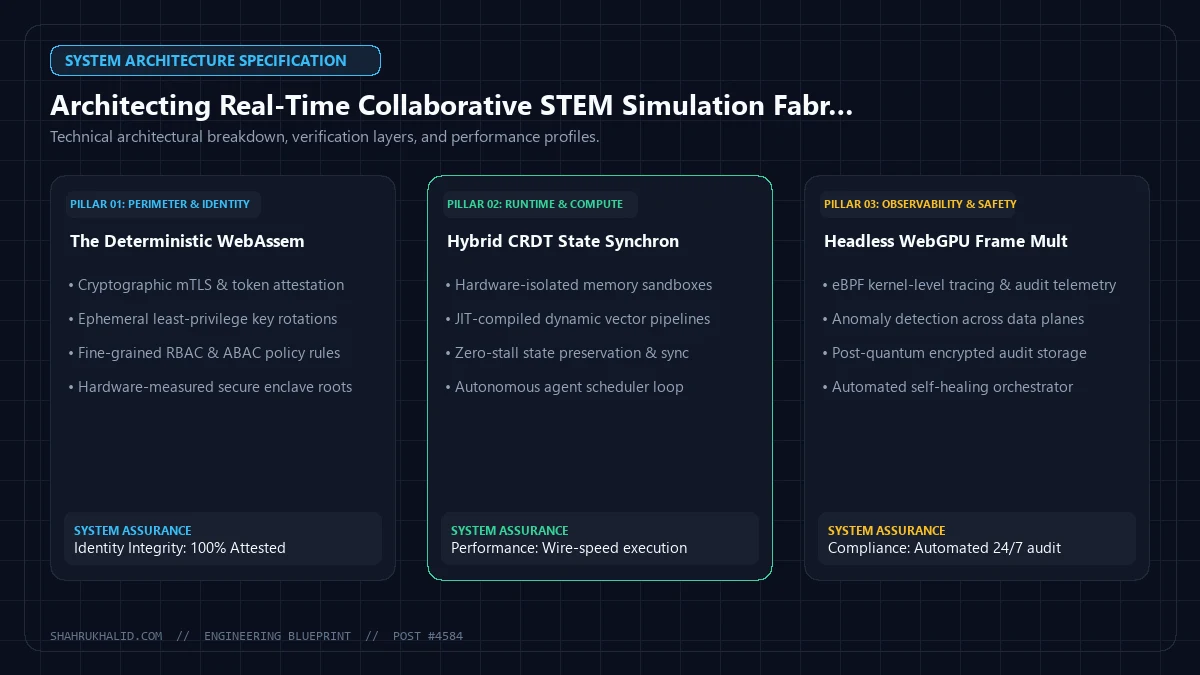
Collaborative STEM workspaces feature two fundamentally divergent state flows: high-frequency ephemeral telemetry (cursor movements, continuous force vector modifications, transient thermal gradients) and low-frequency structural topology (adding a resistor to a circuit, altering atomic bond linkages, modifying gravitational mass distributions). A hybrid state model maps these flows to distinct network primitives.
Operation-Based Conflict-Free Replicated Data Types (CRDTs)
To avoid single-point-of-failure bottlenecks and allow fully offline or partition-tolerant multi-student interactions, continuous canvas modifications rely on Conflict-Free Replicated Data Types. When simulating structural topologies (e.g., dynamic electrical grids or chemical reaction networks), state cannot be merged through crude “last-write-wins” registers without invalidating scientific validity.
Consider an operation-based JSON CRDT model mapped to simulation state changes:
class SimulationSyncFabric {
private transport: WebTransport;
private datagramWriter: WebTransportDatagramDuplexStream;
private crdtStreamWriter: WritableStreamDefaultWriter<Uint8Array>;
constructor(url: string) {
this.transport = new WebTransport(url);
}
async initialize() {
await this.transport.ready;
this.datagramWriter = this.transport.datagrams;
// Open persistent unidirectional stream for state changes
const sendStream = await this.transport.createUnidirectionalStream();
this.crdtStreamWriter = sendStream.getWriter();
this.listenIncomingDatagrams();
this.listenIncomingStreams();
}
// High-frequency telemetry: Sent via QUIC Datagrams
broadcastKinematicVector(tick: number, entityId: number, fx: number, fy: number) {
const buffer = new ArrayBuffer(20);
const view = new DataView(buffer);
view.setUint8(0, 0x01); // Opcode: Telemetry
view.setUint32(1, tick);
view.setUint32(5, entityId);
view.setInt32(9, fx); // Q32.32 Fixed-point force vector
view.setInt32(13, fy);
// Non-blocking, drop on congestion
this.datagramWriter.writable.getWriter().write(new Uint8Array(buffer));
}
// Structural modification: Sent via reliable QUIC Stream
async broadcastTopologyMutation(crdtDeltaPayload: Uint8Array) {
// Enforce causal ordering via state-based semi-lattice
await this.crdtStreamWriter.write(crdtDeltaPayload);
}
private async listenIncomingDatagrams() {
const reader = this.transport.datagrams.readable.getReader();
while (true) {
const { value, done } = await reader.read();
if (done) break;
this.routeTelemetryToWasm(value);
}
}
private async listenIncomingStreams() {
const reader = this.transport.incomingUnidirectionalStreams.getReader();
while (true) {
const { value: stream, done } = await reader.read();
if (done) break;
this.drainStreamToCRDTSubsystem(stream);
}
}
private routeTelemetryToWasm(data: Uint8Array) { /* Zero-copy buffer swap into Wasm HEAP */ }
private async drainStreamToCRDTSubsystem(stream: ReadableStream) { /* Merge operation vector */ }
}
Resolving Physics Rollback with Epistemic State Invariants
A primary architectural hurdle occurs when a deterministic physics rollback collides with a discrete CRDT structural change. For example: Student A deletes a support strut from a bridge at Tick 102. Student B applies a massive localized mechanical shear force at Tick 103. Due to network latency, the host client receives Student B’s action first, simulates structural deformation without failure, and subsequently receives the structural deletion message from Student A.
The system reconciles this divergence through an Epistemic Dependency Graph:
- Discrete topological changes instantiate unique UUIDs across a Lamport Timestamp ordering array.
- Physics entities hold weak references to their corresponding CRDT node identities in the Wasm linear heap.
- When rollback occurs, if an entity’s parent CRDT node was destroyed at tick $T_{-k}$, the physics solver truncates the fast-forward integration path for that entity and converts its accumulated kinetic energy into scalar thermodynamic or debris field states, preventing catastrophic memory exceptions or continuous solver NaN explosions.
Headless WebGPU Frame Multiplexing and Thin-Client Virtualization
A critical barrier to technical equity in educational computing is hardware fragmentation. Complex dynamic simulations—such as turbulent fluid dynamics governed by Navier-Stokes equations or molecular orbital clouds—demand compute shader hardware capabilities far beyond the integrated GPUs of low-cost Chromebooks common in public school districts.

The modern architectural solution decouples computation from display via Headless WebGPU Frame Multiplexing, creating an elastic hybrid deployment architecture.
Hybrid Compute-Render Topologies
The client fabric probes local system capabilities during initialization, evaluating GPU driver metrics, vendor strings, and compute shader dispatch limits via the WebGPU API (navigator.gpu.requestAdapter()). From these metrics, the client negotiates one of two runtime execution pipelines:
Tier 1: Native Local Client Execution
Target: Workstations, modern laptops, devices with dedicated GPUs or modern SoCs (Apple M-Series, Intel Arc, AMD RDNA).
- Local WebGPU compute passes calculate particle positions via compute shaders directly on the user’s device.
- Direct presentation via canvas swapchain (zero network rendering round-trip).
- Outbound transmission restricted to lightweight input vectors and CRDT mutation events.
Tier 2: Edge-Multiplexed Headless Execution
Target: Legacy Chromebooks, mobile thin clients, virtualized classroom lab computers.
- Cloud/Edge containerized headless nodes (Node.js/Rust + Dawn/wgpu runtime) execute the physics kernel and WebGPU compute shaders.
- Offscreen frame buffers encode directly into an AV1/H.265 stream via WebCodecs-compatible edge pipelines.
- Video frames and transform metadata stream back over WebTransport datagrams/streams for local canvas blitting.
Zero-Copy Frame Decompression with WebCodecs
For Tier 2 clients, rendering a sub-millisecond, responsive interactive stream requires avoiding the performance penalty of traditional media stack pipelines. Instead of routing through standard HTML5 <video> elements—which introduce compositor stalls, chromatic subsampling inaccuracies, and uncontrollable buffering queues—the client deploys the WebCodecs API to pipe directly from WebTransport streams into an OffscreenCanvas.
class EdgeFrameMultiplexer {
private decoder: VideoDecoder;
private canvasContext: GPUCanvasContext;
constructor(canvas: OffscreenCanvas) {
this.canvasContext = canvas.getContext('webgpu') as GPUCanvasContext;
this.initializeDecoder();
}
private initializeDecoder() {
this.decoder = new VideoDecoder({
output: (frame: VideoFrame) => {
this.renderFrameDirectToCanvas(frame);
},
error: (err) => {
console.error("WebCodecs Hardware Acceleration Error:", err);
}
});
// Configure for Ultra-Low Latency AV1 Profile
this.decoder.configure({
codec: 'av01.0.04M.08',
codedWidth: 1920,
codedHeight: 1080,
optimizeForLatency: true
});
}
public ingestEncodedChunk(packet: Uint8Array, isKeyframe: boolean, timestampMicroseconds: number) {
const chunk = new EncodedVideoChunk({
type: isKeyframe ? 'key' : 'delta',
timestamp: timestampMicroseconds,
data: packet
});
this.decoder.decode(chunk);
}
private renderFrameDirectToCanvas(frame: VideoFrame) {
// Zero-copy texture blit using WebGPU native copy operations
const externalTexture = this.canvasContext.device.importExternalTexture({
source: frame
});
// Pipeline execution binds externalTexture to full-screen Quad pipeline
this.executeBlitPass(externalTexture);
frame.close(); // Immediate release of hardware decoding frame cache
}
private executeBlitPass(texture: GPUExternalTexture) {
/* Direct WebGPU rendering pass avoiding CPU-GPU memory copy */
}
}
This edge-multiplexed configuration yields complete visual and mechanical parity across diverse classrooms, achieving frame arrival times under 12 milliseconds from edge render to client presentation on standard municipal broadband networks.
Pedagogical AI Transformation Learning Models: The Adaptive Scaffolding Fabric
Real-time collaborative simulation fabrics provide a critical pedagogical capability: continuous, fine-grained telemetry capturing raw student exploration trajectories. Integrating UNESCO guidance on digital education and generative artificial intelligence mandates that advanced instructional technologies preserve student cognitive agency, guard against algorithmic dependency, and advance pedagogical equity across global learning communities. Concurrently, empirical research indexed in the ERIC database demonstrates that adaptive scaffolding algorithms directly boost knowledge retention and dynamic problem-solving competencies in STEM environments by targeting interventions precisely within the Zone of Proximal Development (ZPD).
Modern platforms weave machine intelligence directly into the simulation loop as an active, non-intrusive epistemic observer, deploying structural pedagogical ai transformation learning models that guide exploration without preempting independent discovery.
Cognitive Trace Extraction and Misconception Detection
Unlike conventional learning management tools that evaluate static, summative answer submissions, the deterministic simulation engine exposes a rich stream of low-level kinematic operations. Every component placement, force vector modification, thermodynamic boundary adjustment, and system stabilization attempt generates a timestamped operational trace vector: $S_t = { vec{x}_t, vec{v}_t, Delta t, nabla Phi }$.
These vectors feed into an in-browser WebAssembly-compiled causal inference engine. By mapping these operational behaviors against a baseline model of correct physical principles, the system detects common student misconceptions in real time:
- Newtonian Impetus Fallacy: The student continuously applies a forward engine thrust to maintain constant velocity in a zero-gravity, frictionless orbital environment, misinterpreting velocity as an active consequence of continuous applied force.
- Thermodynamic Equilibrium Inversion: The student expects thermal transfer to proceed dynamically toward a colder gradient when ambient thermal bounds are elevated, applying cooling countermeasures to an already adiabatic subsystem.
- Direct-Current Current Dissipation Fallacy: The student assumes electrical current depletes linearly across successive series resistors, sequentially raising voltage inputs at downstream nodes rather than assessing the global loop impedance.
The Epistemic Intervention Pipeline
When the system detects a persistent mechanical misconception, it triggers a non-disruptive, multi-tiered pedagogical feedback loop. This pipeline operationalizes adaptive scaffolding principles through three distinct intervention stages:
By enforcing this tiered response, educational tools avoid using generative AI as an automatic “answer dispenser.” Instead, the system operates as an intelligent epistemic mirror that deepens conceptual inquiry while preserving mathematical and scientific validity.
Enterprise Reference Architecture: End-to-End System Blueprint
To implement this distributed simulation fabric across high-concurrency educational platforms, system architects must unify these discrete subsystems into a cohesive, high-performance operational pipeline.
+————————————————————————————————–+
| CLIENT PLATFORM RUNTIME CONTAINER |
| |
| +——————–+ +———————+ +——————————-+ |
| | Student Controls | —> | Epistemic Analytics | —> | Deterministic Wasm Kernel | |
| | & Canvas Events | | (Local Inference) | | (Fixed-Point Q32.32 Math) | |
| +——————–+ +———————+ +——————————-+ |
| | | |
| | (Raw Input Frames) (State Updates / Impulses) |
| v v |
| +——————————————————————————————–+ |
| | HYBRID SYNC FABRIC (WebTransport Session Manager) | |
| +——————————————————————————————–+ |
| | | |
| | WebTransport Datagrams (Unreliable) | Unidirectional |
| | [Input Snapshots, Cursors, Force Vectors] | Streams (CRDT) |
+————|——————————————————————|——————+
| |
v v
+————————————————————————————————–+
| EDGE-ROUTED QUIC HTTP/3 INFRASTRUCTURE |
| |
| +————————————————–+ +————————————–+ |
| | Stateful Edge Relay (Envoy / Custom QUIC Router) | | Cloud Headless WebGPU Compute Pods | |
| | – Lamport Ordering Vector Clocks | | – Headless Wasm Sim Engine | |
| | – Session-Scoped Datagram Fan-Out | | – WebGPU Render passes | |
| | – CRDT Log Compaction & Snapshot Storage | | – Hardware WebCodecs AV1 Encoders | |
| +————————————————–+ +————————————–+ |
+————————————————————————————————–+
SLA Budgets and Real-Time Execution Constraints
To sustain immersion and eliminate simulator-induced cognitive disorientation, system architects must enforce strict performance budgets across the entire hardware-network pipeline:
- Total Input-to-Photon Latency Budget: $le 33.3text{ ms}$ (within two frames at 60Hz) for Tier 1 native execution clients; $le 50text{ ms}$ for Tier 2 edge-multiplexed clients.
- Wasm Physics Step Budget: $le 4.5text{ ms}$ execution per 60Hz frame tick on low-tier x86 Celeron or ARM Cortex-A55 processor cores, leaving headroom for main-thread browser rendering tasks.
- Network Serialization Budget: $le 256text{ bytes}$ per student input tick packet over WebTransport datagrams, preventing MTU fragmentation across institutional packet-filtering firewalls.
- CRDT Compaction Thresholds: In-memory CRDT operation logs must automatically compact into static snapshot matrices every 1,800 ticks (30 seconds), preventing unbounded memory growth on long-running simulation sessions.
Failure Recovery and Partition Tolerance
If network connectivity drops—a frequent issue on oversubscribed school Wi-Fi networks—the architecture degrades gracefully:
- The client switches to an Autonomous Offline Mode. The deterministic WebAssembly kernel continues running locally on the client device, queuing student inputs into a local persistent IndexedDB ring buffer.
- The hybrid CRDT system isolates incoming mutations and suspends remote vector-clock evaluations without blocking local physics interactions.
- When network connectivity restores via WebTransport’s automatic session resumption features, the client flushes its compressed CRDT operational delta stream through a reliable unidirectional stream.
- The edge coordination server determines the lowest common causal ancestor, computes the merged state vector, and streams the canonical reconciliation state back to the client. The local Wasm engine applies this state and smoothly blends positions over three physics frames, eliminating visual snapping.
By pairing deterministic fixed-point execution in WebAssembly with low-latency WebTransport protocols, flexible WebGPU/WebCodecs rendering pipelines, and pedagogical AI scaffolding, this system blueprint provides a robust foundation for modern digital STEM education. These interconnected technologies transform the browser into a high-performance simulation platform, delivering mathematically rigorous, collaborative, and accessible laboratory experiences to students worldwide regardless of local hardware constraints.