Architecting Real-Time Multimodal Socratic Tutors in 2026: Full-Duplex WebTransport Audio Pipelines, Client-Side WebGPU Speculative Decoding, and Streaming Temporal Graph Knowledge Tracing
Key Takeaways
- Real-time Socratic tutors demand full-duplex sensory loops, abandoning traditional request-response paradigms.
- WebTransport, WebGPU, and ST-GKT enable low-latency audio, client-side verification, and cognitive mapping.
- Tutors must employ Socratic scaffolding, not direct answers, to preserve learner agency and promote struggle.
- Socratic tutors induce disequilibrium, calibrate ZPD, hint minimally, prompt metacognition, and regulate affect.
- A state-driven dialogic runtime enforces Socratic methods by diagnosing, isolating, and mapping misconceptions.
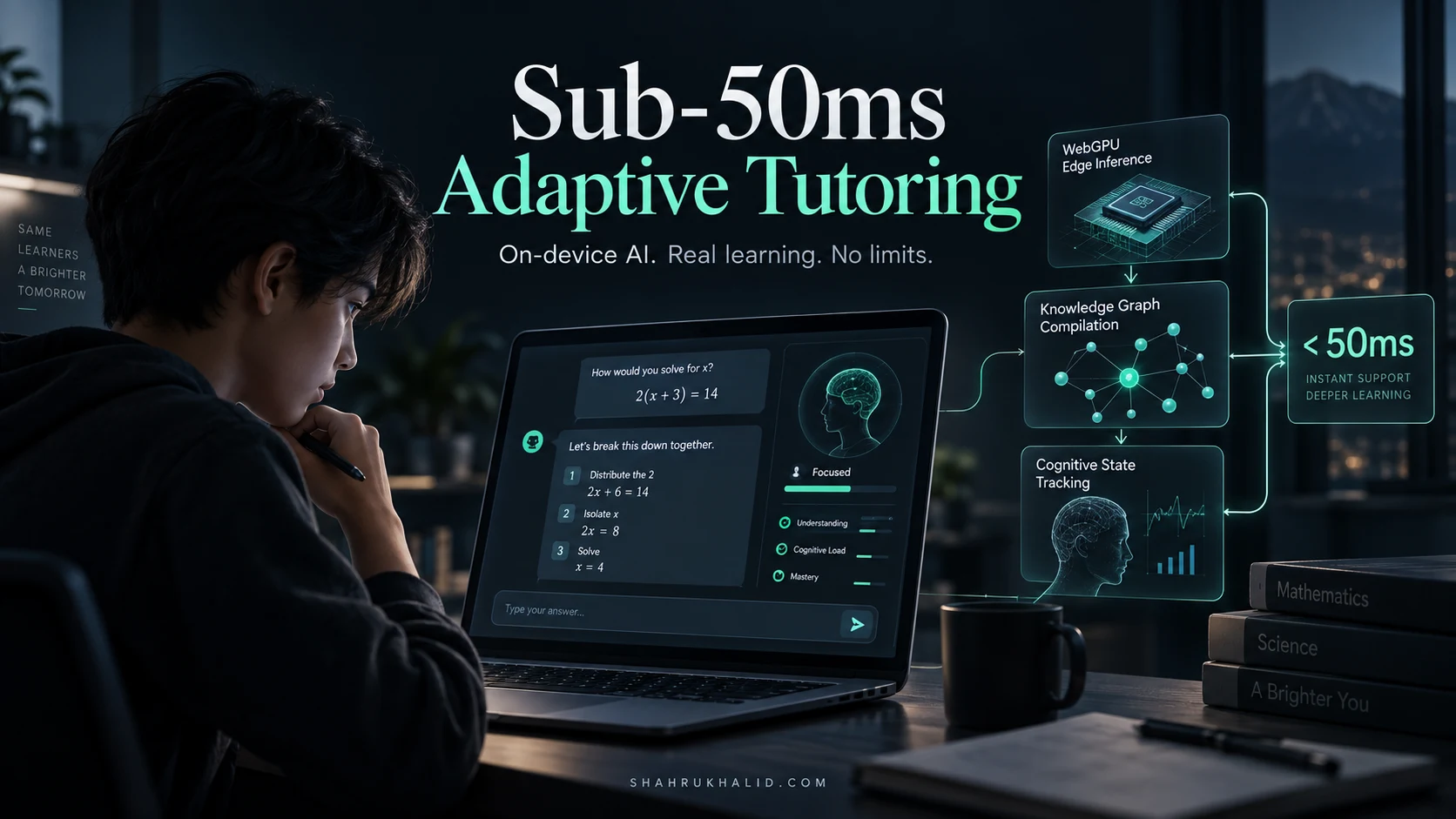
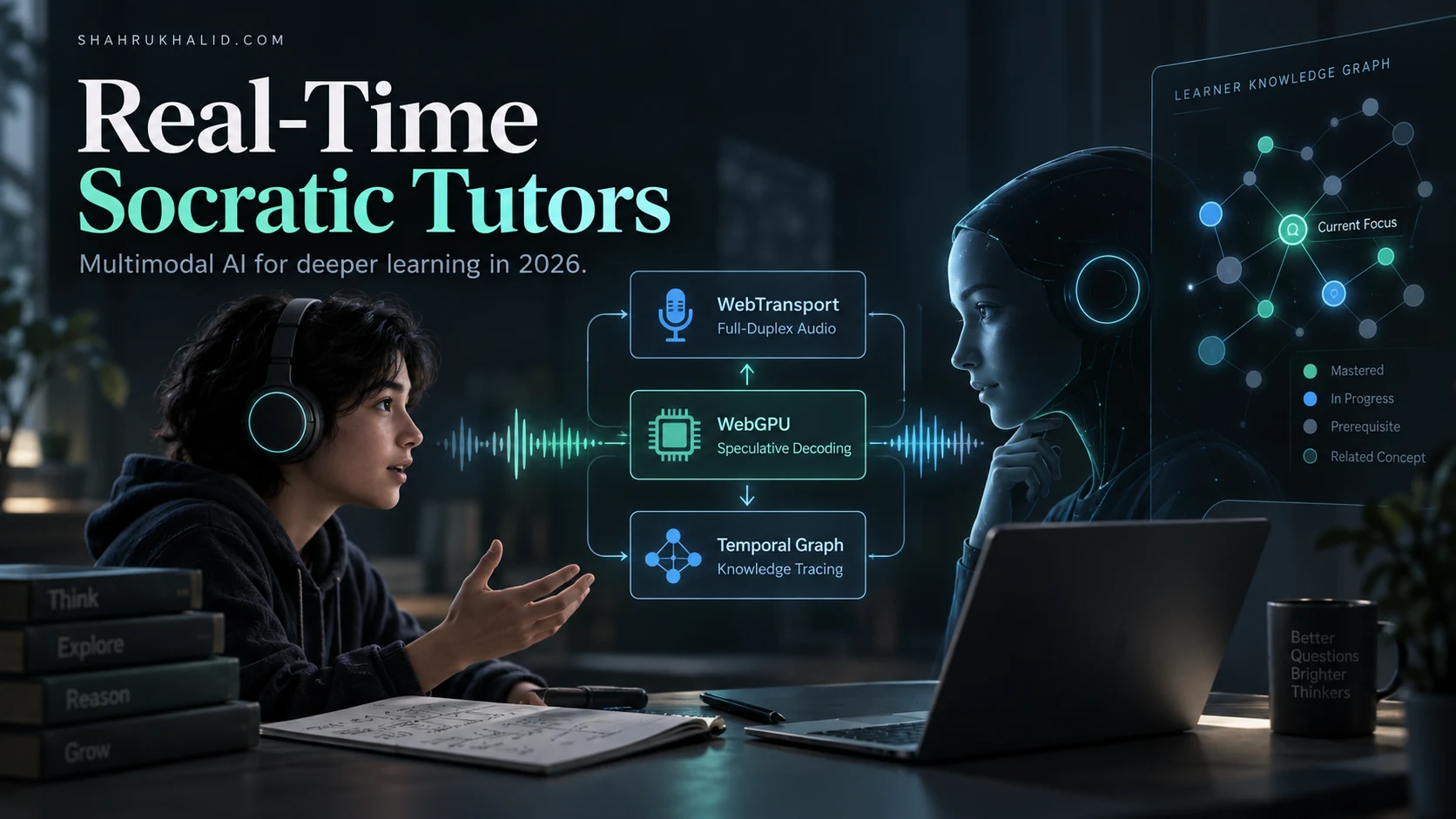
To deliver true real-time Socratic pedagogy in 2026, educational architectures must abandon the request-response paradigms of standard conversational interfaces in favor of synchronized, full-duplex sensory loops. By orchestrating WebTransport over HTTP/3 for low-latency bidirectional audio streaming, client-side WebGPU for local speculative verification, and Streaming Temporal Graph Knowledge Tracing (ST-GKT) for real-time cognitive mapping, engineering teams can build interactive tutors that maintain conversational cadence while rigorously guiding learners through structured cognitive disequilibrium. This guide details the technical and pedagogical blueprint required to implement these systems at scale.
1. The Pedagogical Paradigm Shift: Socratic Scaffolding vs. Direct Generative Answering
Mainstream Large Language Model (LLM) implementations in educational technology fail primarily because they default to direct instruction and solution generation. When a student encounters a challenging step in an advanced calculus or distributed systems problem, an unconstrained frontier model acts as an cognitive crutch, immediately providing code, derivations, and conceptual summaries. This pattern induces passive comprehension—the illusion of mastery—while fundamentally degrading the learner’s problem-solving agency.
The UNESCO guidance on generative AI and pedagogical equity in education underscores that digital learning systems must actively defend the learner’s intellectual agency, ensuring that automated interventions scaffold rather than supplant human cognitive effort. Furthermore, empirical findings documented in peer-reviewed evaluations of adaptive learning algorithms in STEM retention demonstrate that students who engage in guided, productive struggle within an interactive feedback loop retain domain competencies at significantly higher rates than those exposed to passive, answer-centric instruction.
Building effective pedagogical ai transformation learning models requires codifying the Socratic method into a deterministic, state-driven dialogic runtime. In an authentic Socratic encounter, the tutor maintains five concurrent pedagogical imperatives:
- Cognitive Disequilibrium Induction: Identifying the learner’s flawed presupposition and formulating a targeted counter-example rather than declaring the answer incorrect.
- Zone of Proximal Development (ZPD) Calibration: Modulating linguistic and conceptual complexity to match the student’s evolving cognitive boundary in real time.
- Minimal Viable Hinting (Scaffolding): Emitting the smallest possible informational delta necessary to catalyze student breakthrough.
- Metacognitive Reflection Prompting: Forcing the learner to articulate why a revised approach functioned, cementing structural neural pathways.
- Affective Regulation and Pacing: Detecting acoustic markers of cognitive overload, anxiety, or disengagement, and adjusting the turn-taking rhythm accordingly.
The Socratic State Engine: Deterministic Pedagogical Guardrails
To enforce Socratic dialogue at runtime, the conversational agent operates not as a free-form generator, but as a bounded state transition system. The underlying inference engine evaluates student inputs against a rigid finite state machine (FSM):
- Diagnose: Parse multi-modal inputs (speech, stroke telemetry, code edits) to extract intent, conceptual claims, and latent misconceptions.
- Isolate: Map the diagnosed misconception against a dynamic dependency graph to find the foundational node where comprehension fractured.
- Reflect: Generate a targeted, non-declarative prompt that guides the student to isolate their own logic gap (Maieutics).
- Verify: Await the student’s self-correction. If the student fails three successive attempts, degrade gracefully to an analogical scaffold, but never yield the direct terminal answer.
2. Low-Latency Full-Duplex Audio Pipelines via WebTransport & HTTP/3
Human speech in a tutoring context is rarely organized into neat, turn-based transactions. Students hesitate, stutter, vocalize filled pauses (“um”, “ah”), interrupt themselves when realizing an error, and speak over the instructor to seek immediate clarification. Conventional WebRTC architectures introduce heavy signaling overhead (SDP offers/answers, ICE candidates) and lack native integration with HTTP/3 application frames, while classic WebSockets suffer from TCP head-of-line blocking under volatile network conditions. In 2026, the standard for real-time multimodal tutoring centers on WebTransport over HTTP/3.
WebTransport vs. Legacy Transport Layers in EdTech
WebTransport leverages QUIC, providing unidirectional streams, bidirectional streams, and unreliable datagram channels over a single multiplexed connection via UDP. This architecture unlocks deterministic control over priority scheduling for audio, visual strokes, and control metadata.
Full-Duplex Audio Multiplexing and Barge-In Mechanics
True conversational flow requires instantaneous barge-in handling. When the AI tutor is articulating a prompt and the student suddenly gasps, speaks, or begins writing an alternative equation, the tutor must halt text generation and audio synthesis within milliseconds, acknowledging the student’s interruption without truncating contextual memory.
The transport architecture splits audio delivery into dedicated unidirectional streams while transmitting control signals via unreliable datagrams:
class SocraticTransportClient {
constructor(url) {
this.url = url;
this.transport = null;
this.datagramWriter = null;
this.audioTrackReader = null;
}
async initialize() {
this.transport = new WebTransport(this.url);
await this.transport.ready;
this.datagramWriter = this.transport.datagrams.writable.getWriter();
this.listenForIncomingStreams();
}
async emitInterruptionSignal(timestamp, clientVadConfidence) {
// WebTransport Datagrams: 0-RTT, loss-tolerant, immediate execution
const signalBuffer = new Uint8Array([
0xFF, // Packet ID: Control / Interruption Frame
…new Uint8Array(new Float64Array([timestamp]).buffer),
Math.floor(clientVadConfidence 255)
]);
await this.datagramWriter.write(signalBuffer);
}
async streamAudioChunk(opusEncodedChunk) {
// Create a lightweight unidirectional stream per audio burst
const stream = await this.transport.createUnidirectionalStream();
const writer = stream.getWriter();
await writer.write(opusEncodedChunk);
await writer.close();
}
}
When the client-side Voice Activity Detection (VAD) node triggers a threshold exceedance ($tau > 0.85$), the system immediately transmits an out-of-band datagram signal. The server terminates downstream token decoding for the current utterance, issues a cancellation token to the Neural Text-to-Speech (TTS) stream, and flushes the client’s local audio ring buffer within 60 to 90 milliseconds, clearing the perceptual path for the learner’s interruption.
3. Edge-Accelerated Inference: Client-Side WebGPU Speculative Decoding
Achieving Socratic pacing requires maintaining a total acoustic Time-to-First-Sound (TTFS) under 300 milliseconds. While frontier multimodal foundational models running on data center clusters provide superior pedagogical reasoning, their server-side autoregressive generation latency remains a major bottleneck. Client-Side WebGPU Speculative Decoding breaks this bottleneck by shifting the draft generation layer directly to the learner’s local browser environment.

Edge Draft Model (WebGPU)
Runs a highly quantized, domain-specific Small Language Model (e.g., 0.5B to 1.3B parameters at INT4 precision) directly inside the browser using WebGPU Shading Language (WGSL) compute kernels. Speculatively generates candidate token sequences ($gamma = 4$ to $6$ tokens) at ultra-high throughput (>80 tokens/sec).
Server Target Verifier
A centralized, dense parameter model (70B+ parameters) evaluates the draft sequence in a single forward pass. Because verification is parallelized across the batch dimensions of the draft tokens, latency equals that of evaluating just one token, bypassing autoregressive memory-bandwidth bottlenecks.
Speculative Acceptance Matrix
Tokens are accepted conditionally if $r sim U(0, 1) < minleft(1, frac{P_{target}(x)}{P_{draft}(x)}right)$. When a token is rejected, the target model resamples the next valid token, guaranteeing that the statistical distribution of the output precisely matches that of the target model.
The Asynchronous Distributed Speculative Loop
In standard centralized speculative decoding, both draft and target models reside on the same GPU cluster, communicating via NVLink. Distributing this across the wide-area network between the user’s browser (WebGPU) and the cloud verifier requires an asynchronous prediction protocol designed to tolerate network jitter:
- The student completes an utterance. The audio stream finishes processing through the cloud automatic speech recognition (ASR) node.
- The transcription and cognitive state vector are routed to both the cloud LLM and pushed downward via WebTransport to the browser’s WebGPU execution context.
- The browser’s local WebGPU runtime computes a Socratic draft response prefix (e.g., “What makes you think that variable…”) and transmits the token sequence upward.
- The server verifier executes a forward validation pass over the proposed draft tokens. Concurrently, valid tokens are released into the local client TTS buffer.
- If the draft tokens are accepted, TTFS drops to under 180ms, as the browser initiates synthesis on locally validated tokens before the server finishes full sequence processing.
@group(0) @binding(0) var<storage, read> A : array<f32>; // Activations
@group(0) @binding(1) var<storage, read> B_quant : array<u32>; // Packed INT4 Weights
@group(0) @binding(2) var<storage, read_write> C : array<f32>; // Output Logits
@compute @workgroup_size(16, 16)
fn main(@builtin(global_invocation_id) global_id : vec3<u32>) {
let row = global_id.x;
let col = global_id.y;
var sum: f32 = 0.0;
// Inner dequantize loop unpacking 8 weights per u32 and computing dot product
for (var k: u32 = 0u; k < 512u; k = k + 1u) {
let packed_val = B_quant[k 512u + col];
let weight = unpack_int4(packed_val, row % 8u);
sum = sum + A[row 512u + k] weight;
}
C[row 512u + col] = sum;
}
By compiling the draft model to pure WebGPU/WGSL, modern client machines—including lightweight chromebooks and standard laptops—can execute draft speculative loops without installing external dependencies, keeping end-to-end interactivity well within native human conversational parameters.
4. Streaming Temporal Graph Knowledge Tracing (ST-GKT)
Real-time Socratic dialogue collapses if the tutor cannot track the student’s mastery trajectory across time. Historical algorithms like Bayesian Knowledge Tracing (BKT) treat knowledge states as discrete binary variables across isolated skills, ignoring cross-concept relationships. Deep Knowledge Tracing (DKT) and its transformer-based variants capture complex dependencies, but evaluate states on coarse-grained, post-hoc problem submissions. They fail to trace the fine-grained, intra-problem struggle that occurs mid-sentence or mid-calculation.
Streaming Temporal Graph Knowledge Tracing (ST-GKT) resolves this challenge by conceptualizing domain mastery as a Continuous-Time Dynamic Graph (CTDG). Here, knowledge components, student cognitive entities, misconceptions, and structural prerequisites are represented as nodes, while multimodal interaction events continuously update dynamic edge embeddings.
Mathematical Formulation of the Dynamic Knowledge State
Let the knowledge domain be defined by a directed graph $mathcal{G} = (mathcal{V}, mathcal{E})$, where $mathcal{V}$ consists of concept nodes $v_k$ and $mathcal{E}$ represents structural pedagogical relations (e.g., prerequisite-of, co-occurs-with). At any continuous timestamp $t$, an interaction event $e_i = (u, v_k, mathbf{x}_i, t)$ occurs, where $mathbf{x}_i in mathbb{R}^d$ is an attributed interaction vector encoding:
- Speech latency preceding the turn ($Delta t_{hesitation}$)
- Acoustic prosody metrics (pitch variance, jitter, vocal energy)
- Multimodal drawing or coding telemetry (stroke velocity, backspace frequency)
- Semantic alignment of the utterance with the target concept
The student’s temporal memory state $mathbf{s}_u(t)$ and the concept node state $mathbf{h}_{v_k}(t)$ are iteratively updated using a Temporal Graph Attention Architecture:
$mathbf{m}_u(t) = text{RNN}_{mem}left(mathbf{m}_u(t^-), [mathbf{s}_u(t^-) ,|, mathbf{h}_{v_k}(t^-) ,|, mathbf{x}_i ,|, Delta t]right)$
$mathbf{h}_{v_k}(t) = sum_{j in mathcal{N}(v_k)} alpha_{kj} mathbf{W}_v left[ mathbf{h}_j(t^-) ,|, Phi(Delta t) right]$
Where $Phi(Delta t)$ represents harmonic Fourier time embeddings capturing continuous temporal decay, and $alpha_{kj}$ represents temporal multi-head attention over the concept’s neighborhood $mathcal{N}(v_k)$.
Real-Time Cognitive Tracing Pipeline
The continuous output of the ST-GKT model feeds directly into the inference loop. Instead of static prompt engineering, the Socratic state engine injects the student’s real-time mastery vector into the prompt context on every conversational turn.
5. End-to-End Architectural Integration & Production Implementation
Bringing these subsystems together requires a distributed pipeline where the client browser and the edge server maintain distinct yet synchronized cognitive responsibilities. The following architecture coordinates WebTransport framing, speculative decoding passes, temporal graph updates, and audio generation into a unified, high-performance execution loop.
Unified Pipeline Execution Topology
Layer 1: Multimodal Ingestion & Voice Activity Detection (Client Edge)
Audio captured at 48kHz is downsampled via an AudioWorkletProcessor to 16kHz PCM. A lightweight Silero-VAD instance compiled to WebAssembly evaluates frame energy and speech probability every 30ms. Canvas stroke telemetry from digital stylus interactions is serialized into compact binary vectors.
Layer 2: Transport & Edge Ingress (HTTP/3 Gateway)
A globally distributed edge layer terminated via Pingora/Envoy ingests WebTransport sessions. Unidirectional audio streams terminate into an asynchronous whisper-streaming pipeline, while out-of-band datagrams route directly to the session’s active orchestration context.
Layer 3: Dynamic Graph State Tracing (Streaming TGN Cluster)
The ingested multimodal interaction attributes feed the ST-GKT engine. The continuous-time graph recalculates the student’s mastery topology over Redis-backed memory tables, updating the current ZPD threshold and outputting an updated pedagogical control tensor in under 15ms.
Layer 4: Speculative Inference & Guardrailed Generation (Hybrid Edge/Cloud)
The Socratic State Engine formulates generation constraints based on the ST-GKT tensor. The client-side WebGPU runtime speculatively drafts token candidates, while the centralized LLM verifies them in batch mode, ensuring absolute fidelity to non-declarative Socratic principles.
Layer 5: Neural Synthesis & Streaming Playback (Client Edge)
Verified tokens stream into an ultra-low-latency streaming neural vocoder. Synthesized Opus audio frames stream back across WebTransport to the client’s WebAudio AudioBufferSourceNode, which dynamically adjusts playback rates to prevent buffer underrun without pitching artifacts.
Production Implementation: The WebTransport Audio Worklet Controller
The following production implementation demonstrates the client-side audio pipeline, highlighting how high-priority VAD events bypass the main browser thread to trigger instantaneous transport transmission:
class SocraticAudioProcessor extends AudioWorkletProcessor {
constructor() {
super();
this.frameSize = 512;
this.buffer = new Float32Array(this.frameSize);
this.bufferIndex = 0;
}
process(inputs, outputs, parameters) {
const input = inputs[0];
if (!input || !input[0]) return true;
const channelData = input[0];
for (let i = 0; i < channelData.length; i++) {
this.buffer[this.bufferIndex++] = channelData[i];
if (this.bufferIndex >= this.frameSize) {
this.flushFrame();
this.bufferIndex = 0;
}
}
return true;
}
flushFrame() {
// Calculate Root Mean Square (RMS) energy on the audio thread
var sum = 0.0;
for (let j = 0; j < this.frameSize; j++) {
sum += this.buffer[j] this.buffer[j];
}
const rms = Math.sqrt(sum / this.frameSize);
// Post frame data directly to the transport worker thread
this.port.postMessage({
type: ‘AUDIO_FRAME’,
frame: this.buffer.slice(),
energy: rms,
timestamp: currentTime
});
}
}
registerProcessor(‘socratic-audio-processor’, SocraticAudioProcessor);
6. Mitigating Edge Failure Modes, Latency Spikes, and Cognitive Drift
Deploying distributed multimodal pipelines in live learning environments introduces edge failure modes that pure software architectures rarely encounter. System designs must systematically account for network degradation, client hardware variations, and conversational drift.
1. Network Jitter & Speculative Fallback Recovery
If client uplink metrics degrade (RTT variance exceeding 200ms or packet loss > 5%), the orchestrator gracefully degrades the speculative decoding pipeline. The browser’s local WebGPU draft generation is throttled, and the server switches to an optimized autoregressive cloud model operating at low precision (e.g., FP8). Rather than allowing the conversation to desynchronize, the tutor increases its conversational pacing thresholds, filling latency gaps with contextually appropriate acoustic backchannels (e.g., “Let me review your steps…”) to maintain conversational immersion.
2. Speculative Token Hallucination Guardrails
Because the client-side draft model is small, it has a higher baseline propensity to produce incorrect declarations or accidentally give away answers. The target verification engine on the server acts as an absolute deterministic filter. By evaluating draft tokens against a masked pedagogical token vocabulary, the verifier strips out definitive solutions (such as numerical answers or direct code completions) before sending acceptance confirmations back to the client audio synthesizer.
3. Managing Learner Cognitive Load
Real-time conversational agents risk overwhelming students by conversing too rapidly. If the ST-GKT tracking engine identifies sustained cognitive struggle combined with high acoustic hesitation, the Socratic state engine dynamically modifies its generation policy: prompt lengths are constrained to under 25 words, syntax is simplified, and minimum response delays (ranging from 1.5 to 2.5 seconds) are artificially injected. This enforces natural pauses, providing learners with the cognitive space required to reflect and self-correct.
By unifying low-latency WebTransport foundations, client-side WebGPU acceleration, and continuous temporal graph knowledge modeling, educational institutions and engineering teams can finally transcend the limitations of simple generative chatbots. The result is a robust, production-grade multimodal tutoring system that preserves intellectual agency, encourages productive struggle, and delivers authentic Socratic learning at scale.