Architecting Disaggregated State in 2026: CXL 3.1 Memory Pools, Hardware-Enforced Multi-Tenancy, and Lock-Free Coherent State Engines

Key Takeaways
- Shared-nothing microservices cannot meet sub-microsecond state synchronization demands due to network serialization tax.
- CXL 3.1 enables disaggregated state engines with hardware-coherent, fabric-attached memory (FAM) pools.
- Hardware-enforced routing, synchronization, and multi-tenancy in CXL 3.1 facilitate lock-free execution.
- CXL 3.1 replaces slow network serialization with direct CPU load/store instructions for ultra-low latency.
- This new paradigm shifts from complex distributed transactions to hardware-coherent, direct memory access.
Modern distributed computing has reached a structural inflection point where the conventional shared-nothing microservices model can no longer satisfy sub-microsecond state synchronization demands at hyperscale. Compute Express Link (CXL) 3.1 dismantles the traditional boundary between local compute-attached DRAM and networked storage by introducing hardware-coherent, multi-tiered fabric-attached memory (FAM) pools. By offloading synchronization, tenancy isolation, and memory routing directly to PCIe Gen 6 physical layers and CXL switches, systems engineers can now architect disaggregated state engines that deliver lock-free execution across physically independent host nodes.
CXL 3.1 Disaggregated Fabric Topology
Nodes run independent Linux kernels (6.8+). Applications access remote pooled state via zero-copy CXL.mem protocols utilizing local cache lines (CXL.cache).
Hardware-enforced routing, Back-Invalidate (BI) snooping, and Port-Based Routing (PBR) provide symmetric memory coherency across independent host root complexes.
Dynamic Capacity Devices (DCD) slicing physical DRAM/SCM. Hardware IDE (Integrity & Data Encryption) secures multi-tenant boundaries at physical line rates.
The Disaggregated State Paradigm vs. Shared-Nothing Microservices
For over a decade, enterprise distributed architecture has adhered to the shared-nothing principle popularized by Martin Fowler’s foundational analysis of microservices. To maintain autonomous deployment boundaries and avoid brittle database coupling, each service encapsulates its own private datastore. However, when these services participate in high-throughput workflows, maintaining consistency requires complex application-level distributed transactions (such as Saga orchestrators or two-phase commit over gRPC/REST) or reliance on external messaging fabrics.
This encapsulation introduces a severe “network serialization tax.” In a traditional microservices deployment running on Kubernetes, an update to an operational state entity requires the following traversal:
- Application data structure serialization (JSON, Protocol Buffers, or FlatBuffers).
- POSIX kernel networking stack traversal (TCP/IP socket buffers, packetization, context switching).
- Network fabric propagation across Top-of-Rack (ToR) switches via RoCEv2 or standard Ethernet.
- Target node kernel ingest, interrupt handling, deserialization, and cache placement.
- State persistence to local block engines or downstream cluster writes.
This pipeline creates latencies measured in hundreds of microseconds to tens of milliseconds, alongside non-deterministic tail latency driven by network congestion and OS context switching. In contrast, disaggregated state architectures built on CXL 3.1 replace serialized network hops with direct, load/store CPU instructions (e.g., MOV, AVX-512, atomic_compare_exchange) targeting coherent Fabric-Attached Memory (FAM).
Shared-Nothing Microservices
- Siloed data tiers requiring dual-writes.
- gRPC/Kafka network hops: 150µs – 5ms.
- CPU overhead from JSON/Protobuf marshaling.
- Eventual consistency & complex compensations.
Disaggregated Coherent State
- Single, shared physical memory fabric (FAM).
- Direct load/store instructions: 120ns – 280ns.
- Zero-copy, zero-serialization data structures.
- Hardware-managed coherency via CXL switches.
The table below summarizes the operational performance characteristics of state synchronization strategies across memory, interconnect, and networking tiers.
CXL 3.1 Fabric Foundations: Protocols, Switches, and Direct Sharing
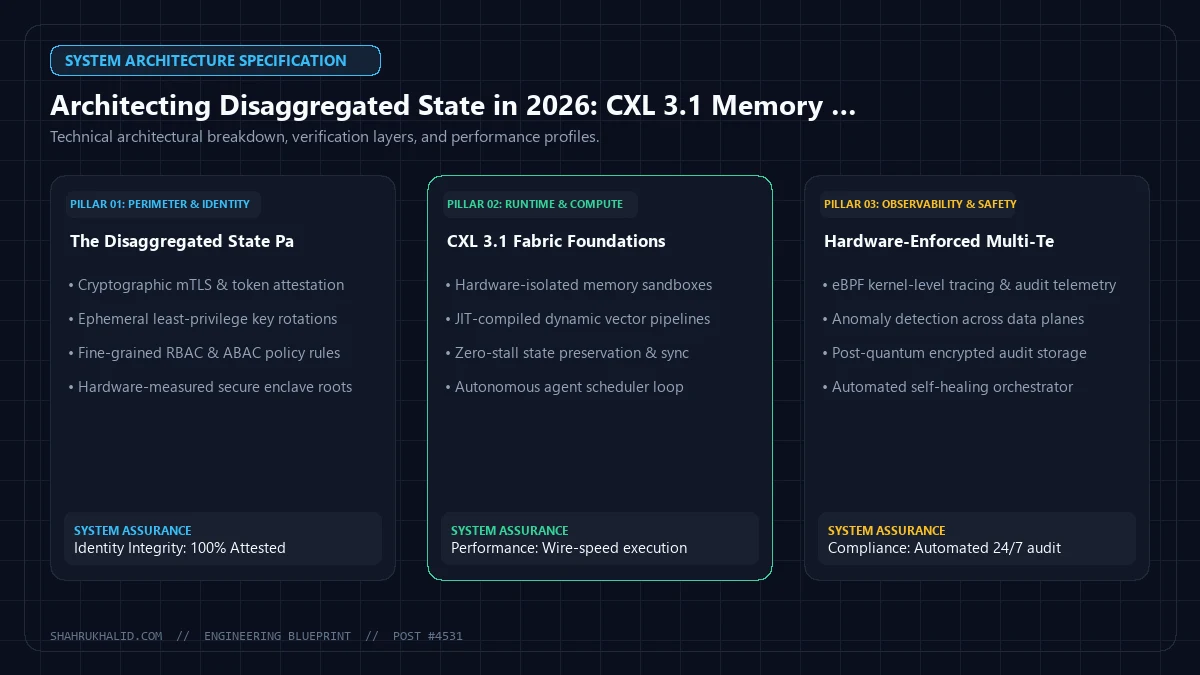
The CXL specification builds on top of the PCIe physical layer. The CXL 3.1 revision, running at PCIe 6.0 speeds (64 GT/s using PAM4 encoding with low-latency Forward Error Correction), establishes three fundamental sub-protocols:

- CXL.io: An enhanced PCIe protocol used for device discovery, configuration, interrupt handling, virtualization, and traditional DMA operations.
- CXL.cache: Allows attached devices (accelerators, SmartNICs) to inspect and cache host CPU memory with extremely low latency using standard cache-line states (MESI/MOESI).
- CXL.mem: Allows host CPUs to execute standard load/store operations into attached memory targets using native memory instructions, mapping the device directly into the host’s Physical Address Space (PAS).
The Evolution from CXL 2.0 Pooling to CXL 3.1 Direct Memory Sharing
In CXL 2.0, multi-host access was limited to simple memory pooling. A Single-Logical Device (SLD) or Multi-Logical Device (MLD) could carve out independent, static physical memory chunks and assign each chunk exclusively to a single host. Two hosts could not simultaneously map the same physical address space with hardware cache coherency.
CXL 3.1 breaks this bottleneck by standardizing two key architectural primitives: Multi-Headed Devices (MHD) and Back-Invalidate (BI) Snooping. With CXL 3.1 switches supporting Port-Based Routing (PBR), multiple independent hosts can simultaneously bind the same physical memory chunk into their respective address spaces.
Back-Invalidate (BI) Coherency Protocol Flow
Host A modifies a shared cache line within its local L3 cache that originated from the pooled CXL memory fabric.
The CXL 3.1 fabric manager and switch snoop filter detect the ownership change and issue hardware Back-Invalidate (BI) requests to all other hosts caching that line.
Host B’s CPU root complex invalidates its local L1/L2/L3 copy at the hardware bus level without running application-level invalidation logic.
This hardware back-invalidation eliminates the need for software-based cache-invalidation layers (such as Redis cluster invalidation broadcasts or ZooKeeper watches). Hardware controllers handle state line coherency transparently across PCI boundaries.
Hardware-Enforced Multi-Tenancy and Security Domains
Deploying disaggregated memory across multi-tenant cloud platforms creates significant security exposure. If physical DRAM modules sit on a shared PCIe/CXL switch fabric accessible by multiple guest operating systems and Bare-Metal nodes, isolation cannot rely purely on hypervisors or OS page tables. A compromised host could manipulate its physical root complex to issue illegal memory requests across physical bus channels.

CXL 3.1 addresses this through a layered, hardware-enforced isolation framework:
1. CXL IDE (Integrity and Data Encryption)
CXL.io and CXL.mem protocols enforce high-throughput, wire-speed physical layer security through CXL IDE. Operating with AES-GCM (256-bit keys), CXL IDE hardware engines reside directly on the CPU’s memory controller and the CXL device controller. Memory flits (Flow Control Units) are encrypted and signed with sub-nanosecond hardware cryptographic pipelines, preventing physical interposer attacks, side-channel bus sniffing, and cold-boot physical DRAM scraping.
2. Hardware Access Control Tables (ACT) and Range-Based Slicing
The CXL Fabric Manager (FM) configures hardware-enforced Access Control Tables (ACT) inside the CXL switches. When a host root complex sends a CXL.mem Read/Write request, the switch validates the Host Port ID, Virtual Channel, and Security Domain Tag against the ACT before forwarding the flit down to the downstream memory pool.
- Tenant Memory Isolation: Memory ranges are partitioned into hardware-isolated Security Domains (SD). A switch will instantly fault and drop any PCIe TLP/CXL Flit that targets an address outside its assigned domain, generating an asynchronous security interrupt to the Fabric Manager.
- Dynamic Capacity Allocation: Using the CXL 3.1 Dynamic Capacity Device (DCD) interface, the fabric manager can assign and revoke 2MB/1GB memory extents dynamically without rebooting tenant hosts or interrupting running workloads.
Designing Lock-Free Coherent State Engines for Fabric-Attached Memory
While CXL 3.1 provides hardware-level coherency, developing high-throughput state engines requires concurrency models adapted to cross-fabric latency. Traditional synchronization primitives, such as OS-level mutexes (e.g., pthread_mutex) or standard futexes, incur substantial kernel context-switch penalties. Furthermore, naive spinlocks risk severe lock contention across CXL switch hops, saturating the fabric with cache-invalidation requests.
High-performance state engines on CXL fabric must be designed around non-blocking, lock-free data structures using atomic primitives that translate directly into single CXL 3.1 bus operations.
CXL 3.1 Global Atomic Operations
CXL 3.1 expands atomic handling by executing atomic instructions (Compare-and-Swap, Fetch-and-Add, Bitwise Operations) directly at the memory controller level (Far Atomicity), rather than pulling the cache line all the way to the host CPU core to modify it and push it back (Near Atomicity). This prevents cache line bouncing across hosts.
The following modern C++ implementation demonstrates an ultra-low latency, zero-copy atomic ring-buffer log index engineered for direct execution over a memory-mapped CXL 3.1 DAX device (/dev/daxX.Y).
#include <atomic>
#include <cstdint>
#include <cstring>
#include <immintrin.h>
#include <fcntl.h>
#include <sys/mman.h>
#include <unistd.h>
// Cache line alignment for CXL 3.1 flit-optimized memory structures
constexpr size_t CXL_FLIT_SIZE = 64;
constexpr size_t RING_BUFFER_CAPACITY = 1048576; // 1M entries
struct alignas(CXL_FLIT_SIZE) StateRecord {
uint64_t sequence_num;
uint32_t tenant_id;
uint32_t payload_len;
char payload_data[48];
};
struct alignas(CXL_FLIT_SIZE) CXLStateHeader {
// Shared atomic indexes mapped across multiple CXL host roots
std::atomic<uint64_t> write_head;
std::atomic<uint64_t> commit_tail;
uint8_t reserved[48]; // Padding to preserve cache line isolation
};
class CXLStateEngine {
private:
CXLStateHeader* header_;
StateRecord* records_;
int dax_fd_;
size_t mapped_size_;
public:
CXLStateEngine(const char* dax_device_path) {
mapped_size_ = sizeof(CXLStateHeader) + (sizeof(StateRecord) * RING_BUFFER_CAPACITY);
// Open the CXL Fabric Memory DAX block device
dax_fd_ = open(dax_device_path, O_RDWR | O_SYNC);
if (dax_fd_ < 0) {
throw std::runtime_error("Failed to map CXL DAX device");
}
// Map directly into process virtual memory space without kernel page-cache
void* raw_ptr = mmap(
nullptr,
mapped_size_,
PROT_READ | PROT_WRITE,
MAP_SHARED | MAP_POPULATE,
dax_fd_,
0
);
if (raw_ptr == MAP_FAILED) {
close(dax_fd_);
throw std::runtime_error("CXL mmap failed");
}
header_ = reinterpret_cast<CXLStateHeader*>(raw_ptr);
records_ = reinterpret_cast<StateRecord*>(
reinterpret_cast<uint8_t*>(raw_ptr) + sizeof(CXLStateHeader)
);
}
~CXLStateEngine() {
munmap(header_, mapped_size_);
close(dax_fd_);
}
// Lock-free state append executed simultaneously by multiple host root complexes
bool AppendState(uint32_t tenant_id, const char* data, size_t length) {
if (length > 48) return false;
// Fetch-and-Add offloaded to CXL memory fabric controller via hardware atomic
uint64_t current_seq = header_->write_head.fetch_add(1, std::memory_order_acq_rel);
size_t target_idx = current_seq % RING_BUFFER_CAPACITY;
StateRecord& record = records_[target_idx];
// Format record directly on Fabric-Attached Memory
record.tenant_id = tenant_id;
record.payload_len = static_cast<uint32_t>(length);
std::memcpy(record.payload_data, data, length);
// Write serialization barrier
std::atomic_thread_fence(std::memory_order_release);
// Commit sequence to signal consumers across nodes
record.sequence_num = current_seq;
// Issue CPU cache line write-back to ensure state reaches pooled DRAM
_mm_clwb(&record);
_mm_sfence();
return true;
}
// Lock-free zero-copy tail reader for peer compute node
bool ReadNext(uint64_t& last_seen_seq, StateRecord& out_record) {
size_t target_idx = last_seen_seq % RING_BUFFER_CAPACITY;
StateRecord& record = records_[target_idx];
// Validate if record has been updated and committed
if (record.sequence_num == last_seen_seq) {
std::memcpy(&out_record, &record, sizeof(StateRecord));
last_seen_seq++;
return true;
}
return false; // No new state available yet
}
};
Epoch-Based Memory Reclamation (EBR) in Heterogeneous Meshes
When operating a dynamic state tree (such as a lock-free Bw-Tree or MassTree) across disaggregated CXL pools, classic memory reclamation (like free() or native garbage collection) leads to memory corruption if Host B traverses a node while Host A is unlinking it. Since memory is shared at the hardware bus layer without a unified runtime, state engines must use a distributed Epoch-Based Reclamation (EBR) protocol:
- Global Fabric Epoch: An atomic 64-bit counter maintains the current global epoch across all nodes in a reserved CXL control segment.
- Host Epoch Registration: Each host registers its active thread-local epoch into a global participant table in FAM.
- Retire Lists: When an unlinked pointer is removed from a shared index, it is placed on a local host-side retire queue tagged with the active global epoch.
- Safe Reclamation: The physical memory pages are only returned to the CXL dynamic memory allocator once all participating host root complexes have advanced their local epochs beyond the deletion epoch.
Bridging Event-Driven Distributed Systems with Coherent Memory Pools
In high-throughput event-driven distributed systems like Apache Kafka, durability and distribution traditionally rely on committing append-only logs to disk, relying heavily on OS page-cache synchronization and replicating partitioned logs across independent broker nodes over TCP.
While this ensures resilience, it forces an architectural compromise: messages must be continuously written, read, copied, and acknowledged over network boundaries. When applied to CXL 3.1 fabrics, event log streaming transitions from an I/O network pattern to an in-memory spatial data access pattern.
Architecture Evolution: Event Logs
Producer → TCP Socket → Broker OS Page Cache → Disk Sync → TCP Replication → Follower Broker. (Multiple memory copies, kernel context switches, 100µs–2ms latency).
Producer → Direct MOV to CXL Fabric Pool → Hardware BI Snoop → Consumer instantaneous cache hit. (Zero-copy, zero-serialization, sub-300ns latency).
Real-World Case Study: High-Frequency Tier-1 Order Ledger
To demonstrate this architectural paradigm, consider an institutional financial trading ledger built to process equity order matching across multiple validation engines.
1. The Problem
The firm ran independent microservices across eight compute nodes: Pre-Trade Risk Check, Order Matching, Clearing Engine, and Real-Time Risk Analytics. Using traditional TCP-based streaming over 100GbE RoCEv2, end-to-end transaction latency sat at 32 microseconds, with p99.9 tail spikes exceeding 1.2 milliseconds during market volatility due to TCP packet queue drops, serialization overhead, and replication jitter.
2. The CXL 3.1 State Engine Architecture
The firm refactored its stack to use a shared 2TB CXL 3.1 Fabric-Attached Memory pool backed by dual CXL switches connected over PCIe Gen 6:
- The Order Gateway acts as a writer node, appending validated orders into an atomic CXL ring buffer using far-atomic operations.
- The Risk Engine and Matching Engine act as concurrent peer readers on distinct physical hosts, tailing the log directly out of shared physical memory with zero network latency.
- State modifications (e.g., balance locks, order fills) execute as atomic Compare-and-Swap operations targeting specific memory offsets in the CXL pool.
3. The Outcome
Network serialization was completely eliminated. The p50 end-to-end execution latency dropped from 32 microseconds to 280 nanoseconds (an over 100x improvement). Tail latency (p99.99) remained deterministic at 410 nanoseconds during peak throughput bursts exceeding 25 million operations per second.
Failure Modes, Memory Leaks, and Fault Domain Partitioning
Disaggregating memory fundamentally alters failure domains. In a classic shared-nothing architecture, if a node crashes, its CPU and RAM die together; the failure domain is cleanly isolated to that single physical chassis. In a CXL 3.1 pool, compute nodes become stateless ephemeral processing units, while the operational state persists within the shared memory fabric.
This separation introduces unique distributed systems failure modes that architects must handle:
Primary CXL State Engine Failure Topologies
Host A crashes while holding an in-flight uncommitted atomic update or dirty cache lines.
A switch link degradation disconnects Host A from FAM while Host B remains connected.
A terminated process leaves allocated ranges unlinked with no host runtime left to clean them.
Mitigating Host Crashes and Incomplete Writes
To prevent persistent state corruption when a host dies mid-write:
- Non-Temporal Flushes & Hardware Fences: State mutations must be ordered using strict memory barriers (
_mm_sfence) combined with cache-line writeback operations (_mm_clwb) before advancing commit sequence pointers. - Lease-Based Heartbeating in Pooled Memory: Every compute node periodically writes an atomic monotonic timestamp to its host-slot region in the CXL pool. If a host fails to update its slot within a 50-millisecond threshold, surviving peer nodes execute a recovery pass: identifying uncommitted sequence records and safely rolling them back or finalizing them.
- Fabric-Level Poisoning: If an uncorrectable memory error occurs on a specific DIMM line within the CXL pool, CXL 3.1 hardware supports Data Poisoning. The memory controller marks the exact 64-byte flit with a poison tag, alerting any accessing host with a Synchronous External Abort (SEA) rather than propagating silent data corruption throughout the cluster.
Production Blueprint & Architectural Implementation Checklist
Migrating from traditional distributed microservices to a disaggregated CXL 3.1 state plane requires careful coordination across physical infrastructure, operating system kernel configurations, and data structure design.
Architectural Implementation Matrix
- Hardware Infrastructure Layer:
- Deploy PCIe Gen 6 servers equipped with CXL 3.1 compliant Root Complexes.
- Utilize CXL 3.1 Multi-Tier switches supporting Port-Based Routing (PBR) and hardware snoop filtering.
- Provision Multi-Headed Dynamic Capacity Devices (DCD) with hardware-backed AES-256 CXL IDE support.
- Linux Kernel & Subsystem Configuration:
- Deploy Linux Kernel 6.8+ compiled with
CONFIG_CXL_BUS,CONFIG_CXL_MEM, andCONFIG_DEV_DAX_CXL. - Use
cxl-cliandndctlto configure CXL memory regions intodevdaxmode rather thansystem-rammode to prevent standard OS page allocation interference. - Configure NUMA node distancing correctly to optimize CPU execution policies for local DRAM vs. pooled FAM.
- Deploy Linux Kernel 6.8+ compiled with
- State Engine Design Rules:
- Replace OS-level locking (mutexes, semaphores) with lock-free atomic CAS and CXL far-atomic memory primitives.
- Align all shared operational state records to 64-byte CXL flit boundaries using explicit compiler alignment tags.
- Implement cross-host Epoch-Based Reclamation (EBR) to guarantee thread safety during concurrent dynamic pointer updates.
- Enforce hardware cacheline writebacks (
_mm_clwb) paired with store fences (_mm_sfence) on all log commit paths.
- Security & Multi-Tenancy Plane:
- Establish distinct Security Domain tags (SD) via the CXL Fabric Manager for each application tenant.
- Bind Hardware Access Control Tables (ACT) at the top-of-rack CXL switch to drop unauthenticated cross-tenant flits at the physical link layer.
By shifting the foundation of state distribution from network-bound software messaging to hardware-coherent memory pooling, software architects can design distributed systems that eliminate the historical trade-off between architectural decoupling and ultra-low latency execution.