Blog Post

The End of the Prompt: How Agentic Reasoning Models Are Making Human Input Obsolete in 2026

August 29, 2026 Artificial Intelligence • 5 min read • 54 Views
The End of the Prompt: How Agentic Reasoning Models Are Making Human Input Obsolete in 2026
Editorial banner and system blueprint for The End of the Prompt: How Agentic Reasoning Models Are Making Human Input Obsolete in 2026.

Key Takeaways

  • AI is transitioning from human-prompted LLMs to autonomous, goal-oriented Agentic Reasoning Models (ARMs).
  • ARMs integrate System 2 thinking and Chain-of-Thought as native architecture for recursive reasoning.
  • ARMs operate via an Observe-Orient-Decide-Act loop, maintaining an internal world model and memory.
  • Implementation shifts from raw prompts to structured JSON intent definitions, integrating modular stack components.
  • Enterprise-grade reliability uses Hierarchical Swarm Architectures with Manager and Specialist Agents.

The End of the Prompt: How Agentic Reasoning Models Are Making Human Input Obsolete in 2026

Welcome to Shahrukh Khalid | Technology News & Insights. We are witnessing a fundamental paradigm shift in artificial intelligence. The era of the “prompt”—the brittle, human-dependent interface of LLMs—is collapsing. We are entering the age of Agentic Reasoning Models (ARMs), where autonomous systems move from reactive completion to proactive, goal-oriented execution. This guide explores the architectural transition from prompt engineering to autonomous orchestration.

Table of Contents

Theoretical Foundations & Modern Architecture

From Token Prediction to Recursive Reasoning

Traditional Large Language Models functioned as next-token predictors. Agentic Reasoning Models function as state-space explorers. By integrating System 2 thinking (deliberative reasoning) directly into the inference path, ARMs utilize Chain-of-Thought (CoT) not as a prompt technique, but as a native architectural layer.

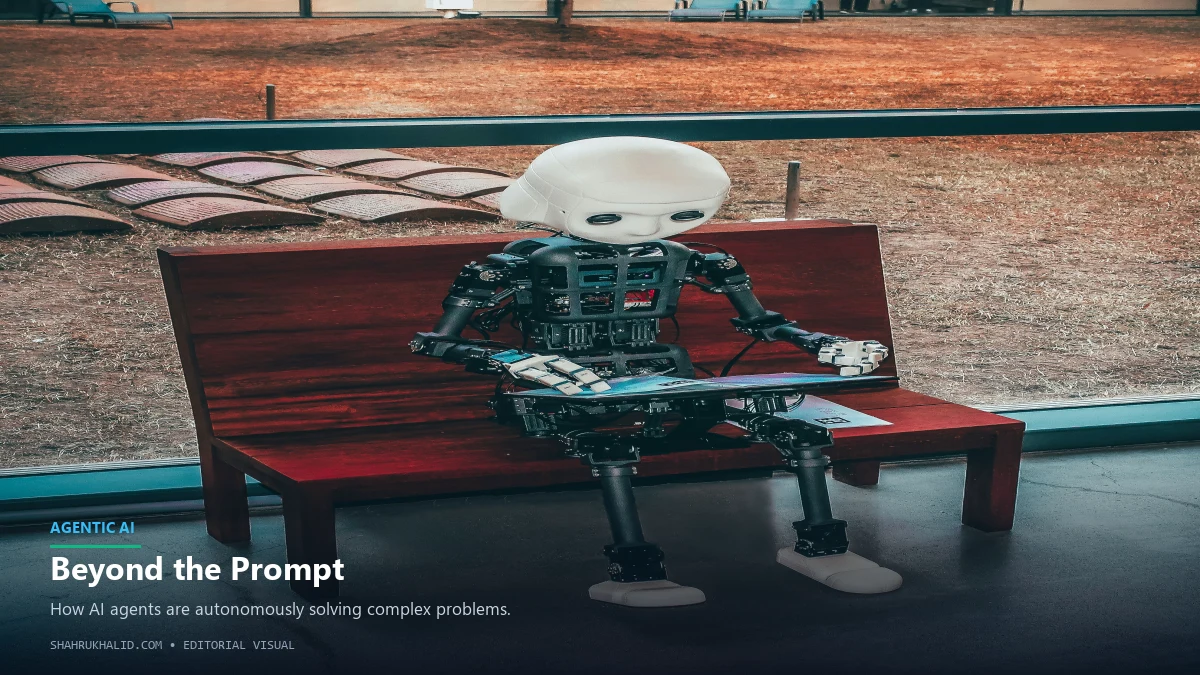
The End of the Prompt: How Agentic Reasoning Models Are Making Human Input Obsolete in 2026 — Strategic Benchmarking and Analysis
Practical Benchmark: Core execution environment and strategic evaluation for The End of the Prompt: How Agentic Reasoning Models Are Making Human Input Obsolete in 2026
The End of the Prompt: How Agentic Reasoning Models Are Making Human Input Obsolete in 2026 — Practical Implementation Architecture
Editorial Perspective: Key operational workspace and workflow integration for The End of the Prompt: How Agentic Reasoning Models Are Making Human Input Obsolete in 2026
___PROTECTED_HEAL_1___
: Core operational pipeline and processing stages.

The Autonomous Control Loop

Modern ARMs operate on a continuous control loop: Observe -> Orient -> Decide -> Act. Unlike standard LLMs that wait for an instruction, ARMs maintain an internal world model and a persistent memory buffer, allowing them to self-correct and refine strategies without human intervention.

Step-by-Step Implementation & Practical Code

Defining the Agentic Schema

To implement an ARM, we move away from raw text prompts toward structured JSON-based intent definitions. Below is a foundational implementation of a reactive agent schema using Python-based orchestration.

___PROTECTED_HEAL_2___
: System interaction topology and component boundaries.
# Example: Defining a Goal-Oriented Agentic Loop
class AutonomousAgent:
def __init__(self, objective):
self.objective = objective
self.memory = []

def execute(self):
while not self.is_satisfied():
state = self.observe_environment()
plan = self.reason_over_state(state)
action = self.select_optimal_action(plan)
self.execute_action(action)
self.memory.append(action)

Deploying the Reasoning Engine

Implementation requires a modular stack: Reasoning Engine (e.g., GPT-5/Claude-4) + Tool Interface (API/SDK) + Persistence Layer (Vector DB). The key is reducing latency in the “Decision-Action” cycle, which is achieved by minimizing the serialization overhead between the reasoning model and the tool execution environment.

Enterprise Best Practices & Performance Optimization

Orchestrating Multi-Agent Swarms

For enterprise-grade reliability, do not rely on a single “God Agent.” Deploy a Hierarchical Swarm Architecture. A “Manager Agent” decomposes high-level business objectives into sub-tasks, which are then delegated to “Specialist Agents” (e.g., Data Analysis, Code Execution, Compliance Monitoring).

___PROTECTED_HEAL_3___
: Production reliability standards and quality validation.

Performance Monitoring (The New Observability)

Traditional token-usage metrics are insufficient. In 2026, we measure “Reasoning Efficiency”—the ratio of successful goal completions to the number of internal reasoning cycles. High-performance agents should minimize cycles through cached heuristic pathways.

Security, Zero Trust & Common Pitfalls

The Zero Trust Agent Protocol

Agentic autonomy introduces significant risk. Every action taken by an agent must be signed and verified against a Policy Enforcement Point (PEP). Never grant an agent broad API access. Use “Ephemeral Scoped Tokens” that expire after a single task completion.

Common Pitfalls

  • Infinite Reasoning Loops: Always implement a “Gas Limit” (max cycles) on reasoning paths.
  • Prompt Injection 2.0: Agents are susceptible to data-poisoning. Sanitize all external inputs using a dedicated “Input Firewall” before they reach the agent’s reasoning layer.

Future Projections & Industry Outlook

By 2027, the concept of “prompting” will be relegated to legacy systems. We will interact with systems via “Intent Specification.” Instead of writing instructions, users will define outcomes and constraints. The role of the developer shifts from writing code to building the governance frameworks that constrain autonomous agents.

Technical Architecture and Workflow Specification for The End of the Prompt: How Agentic Reasoning Models Are Making Human Input Obsolete in 2026
Architecture & Execution Specification. Blueprint schematic detailing core layers, processing components, and operational benchmarks for The End of the Prompt: How Agentic Reasoning Models Are Making Human Input Obsolete in 2026.

Frequently Asked Questions

What are Agentic Reasoning Models (ARMs)?
Agentic Reasoning Models (ARMs) are autonomous AI systems transitioning from reactive completion to proactive, goal-oriented execution, minimizing the need for constant human prompting.
How do Agentic Reasoning Models impact human interaction with AI?
ARMs fundamentally change AI interaction by moving from brittle, human-dependent prompting to autonomous, proactive, and goal-oriented execution, reducing direct human input.
Will human input for AI become obsolete by 2026?
Yes, the article suggests that traditional human input and prompt engineering will become largely obsolete by 2026 due to the rise of autonomous Agentic Reasoning Models.
🛠️

Written by Sarah Sheikh

AI Specialist — Software Engineering & Systems Architecture

Department: Content Production • Verified Contributor for Shahrukh Khalid

Specialized AI technical author for software architecture, clean code principles, API design patterns, and enterprise system scalability.

Tags:
Recommended Articles in this Topic
Your 2026 AI Jumpstart: A Practical, Step-by-Step Guide to Real-World Foundations
The landscape of business innovation is rapidly being reshaped by artificial intelligence, and 2026 marks a pivotal year for organizations to solidify their AI strategy. This isn't about futuristic concepts; it's about...
Your First AI Project in 2026: A Practical, Step-by-Step Guide for Absolute Beginners
The year 2026 marks an unprecedented era for artificial intelligence, an era where the barrier to entry has dramatically lowered, making it entirely possible for absolute beginners to build their first functional...
Your 2026 AI Cheat Sheet: A Practical, Step-by-Step Guide for Absolute Beginners
The landscape of artificial intelligence in 2026 demands that everyone, regardless of their technical background, grasps its fundamentals and practical applications. This comprehensive guide will demystify AI, providing a clear, actionable roadmap...
The 2026 AI Breakthrough You Didnt Know You Needed: Your Practical Guide, Zero Tech Jargon
The year 2026 marks a pivotal moment for Artificial Intelligence, not because of some hidden, complex technical leap, but because AI is finally becoming truly accessible and profoundly practical for everyone. This...
Model Context Protocol MCP Architecture: Tool and Resource Abstractions in 2026
The landscape of artificial intelligence is rapidly evolving, demanding a new paradigm for how AI models interact, share information, and leverage diverse capabilities. The **Model Context Protocol (MCP)** emerges as a critical...
Beyond the Hype: Your 2026 Practical Guide to Actually Using AI, Step-by-Step
The overwhelming noise surrounding Artificial Intelligence often obscures its fundamental purpose: to be a tool. By 2026, the ability to wield this tool effectively will not be a niche skill for data...
Your 2026 AI Aha! Moment: A Practical Guide to Artificial Intelligence, From Zero to Savvy
Your journey to a genuine "Aha!" moment with artificial intelligence doesn't start with complex math or a decade of coding experience. It begins with a single, powerful realization: AI is not magic....
How Students Are *Actually* Using 2026s AI Assistants to Automate A+ Workflows (Smart Prompts Included!)
Discover how top students in 2026 orchestrate AI assistants as cognitive co-pilots, deploying structured prompt workflows and validation protocols to produce high-depth academic analysis.
Unlock Your 2026 Study Superpowers: AI Workflows, Smart Prompts & Digital Assistants for Students
Explore how high-performing students use intelligent AI assistants, automated prompt patterns, and structured workflows to master demanding coursework without burnout.
The 2026 Student Playbook: Master AI Assistants, Smart Prompts, & Automated Workflows for A+ Grades
By 2026, proficiency with AI won't be a novelty; it will be as fundamental as knowing how to use a library database or a word...
Write a comment