Model Context Protocol MCP Architecture: Tool and Resource Abstractions in 2026
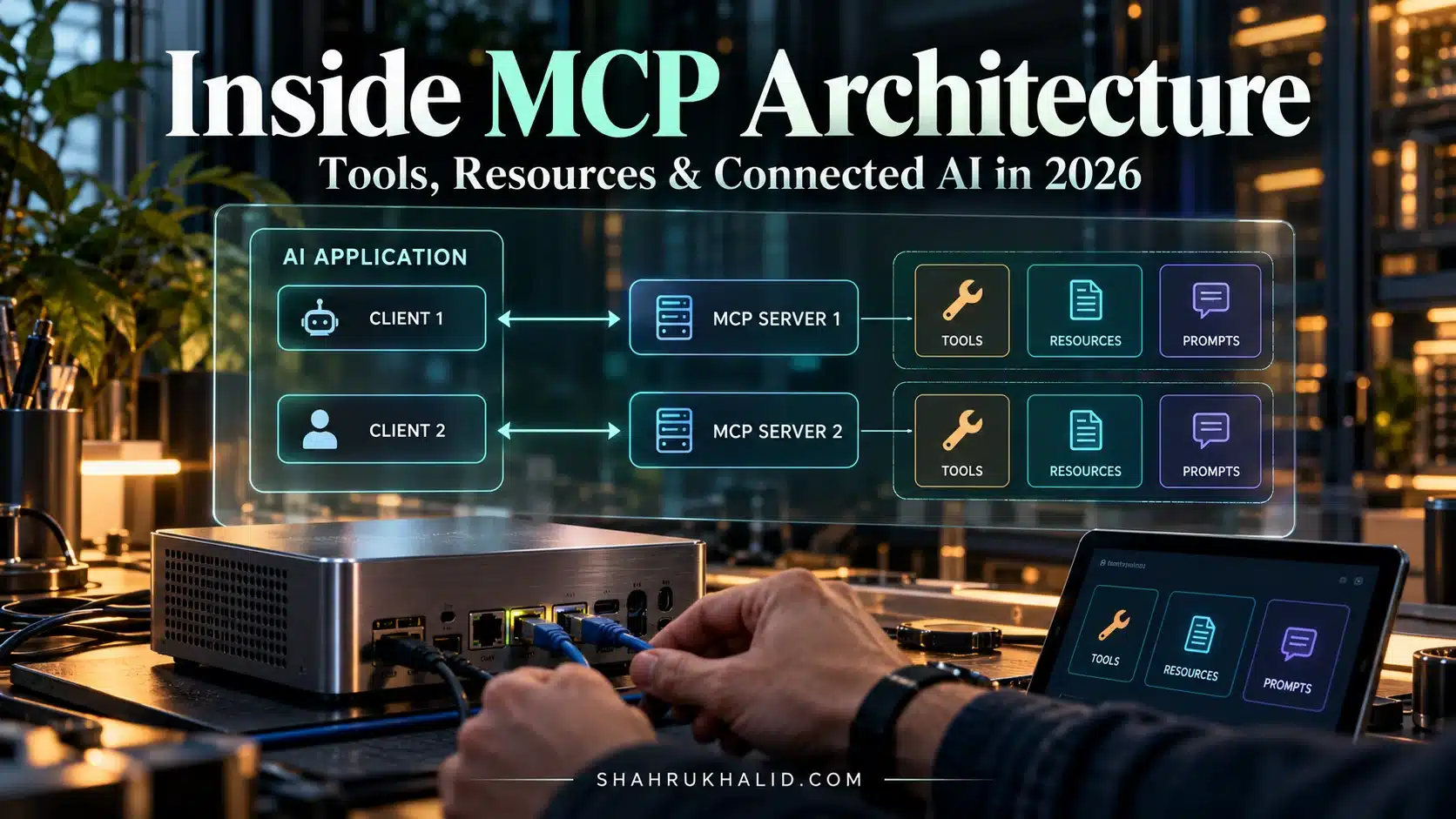
Key Takeaways
- MCP standardizes AI model interaction, enabling a unified, interoperable ecosystem.
- It defines how AI components discover each other, exchange data, and share operational context.
- MCP solves AI fragmentation due to diverse APIs, I/O formats, and operational requirements.
- A common semantic layer allows models to understand and invoke others, abstracting complexity.
- MCP prevents context fragmentation and tool sprawl, critical for advanced, adaptive AI systems.
The landscape of artificial intelligence is rapidly evolving, demanding a new paradigm for how AI models interact, share information, and leverage diverse capabilities. The Model Context Protocol (MCP) emerges as a critical architectural standard, designed to unify disparate AI tools and resources into a cohesive, interoperable ecosystem. This masterclass guide will delve into the deep internals of MCP, exploring its architecture, the crucial role of tool and resource abstractions, and its profound impact on context management for advanced AI systems in 2026.
Introduction to Model Context Protocol (MCP): The Interoperability Imperative
The promise of AI lies not just in individual model brilliance, but in the synergistic capabilities of multiple models working together. However, as AI systems grow in complexity, integrating diverse models, each with its unique API, input/output formats, and operational requirements, becomes a significant hurdle. This fragmentation leads to brittle, hard-to-maintain systems and hinders the development of truly intelligent agents. The Model Context Protocol (MCP) is a standardized framework addressing this exact challenge, providing a universal language and set of conventions for AI components to communicate and share operational context.
At its core, MCP defines how AI models, tools, and resources discover each other, exchange data, and maintain a shared understanding of the operational state—the “context.” Imagine a complex AI workflow involving a vision model for object detection, a natural language model for generating descriptions, and a planning agent for task execution. Without MCP, each integration point would require custom adapters, data transformations, and state management logic. MCP abstracts away these complexities, enabling seamless interaction. It’s not just about data formats; it’s about establishing a common semantic layer that allows models to understand what other models do and how to invoke them, along with the environmental context necessary for their operation. This foundational protocol is essential for building robust, scalable, and truly intelligent AI systems that can adapt and evolve.
The Foundational Challenges: Context Fragmentation and Tool Sprawl in 2026
As we push the boundaries of AI, the problems of context fragmentation and tool sprawl have become acute. Context fragmentation refers to the inability of different AI components to easily share and maintain a consistent understanding of the current operational state, user intent, or environmental conditions. For instance, an LLM might generate a response based on a conversation history, but a subsequent image generation model might lack access to that history, leading to inconsistent outputs. This is why context management for large language models is so crucial; without it, their utility is severely limited beyond single-turn interactions.
Tool sprawl, on the other hand, describes the proliferation of specialized AI models and external services, each with its own unique interface, authentication mechanism, and data schema. Developers often face a daunting task of integrating dozens, if not hundreds, of these tools into a coherent system. This leads to:
- Increased Development Overhead: Custom integration logic for every new tool.
- Maintenance Nightmares: Changes in one tool’s API can break multiple integrations.
- Limited Interoperability: Difficulty in composing complex workflows from diverse components.
- Inconsistent User Experience: Models might behave differently depending on which tools they can access and how their context is managed.
These challenges underscore the urgent need for a standardized approach like MCP. Without it, the vision of truly adaptive and intelligent AI agents, capable of leveraging a vast array of specialized capabilities, remains an elusive goal. MCP provides the architectural blueprint to overcome these hurdles, fostering an environment where AI components can truly collaborate.
Core Principles of MCP Architecture Design
The effectiveness of any protocol hinges on its underlying architectural principles. MCP architecture design is built upon several foundational tenets that ensure its robustness, scalability, and adaptability in complex AI ecosystems. Understanding these principles is key to leveraging MCP effectively.
- Standardized Interface Definition: MCP mandates a common way to describe a model’s capabilities, expected inputs, and guaranteed outputs. This moves beyond mere API documentation to a machine-readable schema that AI agents can interpret programmatically. Think of it as a universal “contract” for AI services.
- Semantic Abstraction: Rather than exposing low-level implementation details, MCP focuses on abstracting functionalities into semantically meaningful operations. An image generation model might expose a `generate_image(prompt, style)` function, not `call_diffusion_model(latent_vector, steps)`. This allows for interchangeable implementations behind a consistent interface.
- Contextual State Management: MCP explicitly defines mechanisms for passing and managing context across model invocations. This includes conversational history, user preferences, environmental variables, and external knowledge references. This is paramount for maintaining coherence in multi-turn interactions and complex reasoning tasks.
- Discovery and Registry: A core component of MCP is a decentralized or centralized registry where models and tools can publish their MCP-compliant interfaces. This enables other AI agents or orchestrators to dynamically discover and bind to available capabilities at runtime, fostering true model interoperability protocols.
- Versionability and Extensibility: Recognizing the rapid pace of AI development, MCP is designed to be versioned and extensible. This allows for backward compatibility while accommodating new features, model types, and interaction patterns without breaking existing integrations.
- Security and Access Control: Integrated mechanisms for authentication, authorization, and data privacy are fundamental. MCP defines how credentials and access policies are managed and enforced when models interact with sensitive data or external services.
By adhering to these principles, MCP provides a solid foundation for building resilient and intelligent AI systems.
Tool Abstraction Layers in MCP: Unifying Diverse AI Capabilities
One of the most powerful aspects of MCP is its approach to AI tool abstraction layers. In essence, tool abstraction creates a standardized, high-level interface for interacting with diverse AI models and external services, regardless of their underlying implementation. Instead of directly calling a specific model’s API (e.g., `OpenAI.chat.completions.create` or `HuggingFace.pipeline(‘text-generation’)`), an orchestrator interacts with a generic MCP-defined “tool” that performs a specific function.
Consider a scenario where you need to perform sentiment analysis. Without MCP, you might integrate directly with a vendor-specific sentiment API. If you later decide to switch vendors or use an open-source model, you’d rewrite your integration code. With MCP, you define a `SentimentAnalysisTool` with a standard `analyze(text)` method. The MCP runtime then maps this abstract call to the appropriate underlying model or service.
This layered approach offers immense flexibility. An orchestrator simply requests `ImageGeneration.generate_image(prompt=”a cat astronaut”, style=”cartoon”)`, and the MCP runtime handles the dispatch to `dalle3_api` or any other configured image generation service. This significantly enhances how Model Context Protocol enhances AI tool interoperability, making AI systems more modular, robust, and easier to evolve. For more on defining such interfaces, refer to Google AI’s developer documentation on function calling and tool definitions.
Resource Abstraction for AI: Managing Data, Compute, and External Services
Beyond abstracting tools, MCP extends its reach to resource abstraction for AI, encompassing compute infrastructure, data storage, and external APIs. Modern AI models are resource-hungry, requiring GPUs, specialized accelerators, vast datasets, and often interacting with external databases, APIs, or IoT devices. Managing these resources directly within each model or application is inefficient and error-prone. MCP introduces a layer that standardizes how AI components request, utilize, and release these underlying resources.
Consider a large language model requiring access to a vector database for RAG (Retrieval Augmented Generation) or a specialized GPU cluster for fine-tuning. Instead of the LLM directly managing database connections or cluster provisioning, it interacts with an MCP-defined `ResourceProvider`.
The MCP runtime handles the provisioning, connection, and lifecycle management of these resources. This means an AI model can declare its resource requirements in a standardized way, and the MCP orchestrator can dynamically allocate the most suitable available resources. This separation of concerns significantly simplifies implementing Model Context Protocol in AI systems, allowing developers to focus on model logic rather than infrastructure plumbing. It also enables dynamic scaling and cost optimization, as resources can be allocated and deallocated based on real-time demand, contributing to the overall benefits of MCP architecture for AI development.
Context Management for Large Language Models (LLMs) via MCP
In 2026, the capabilities of Large Language Models (LLMs) are deeply intertwined with their ability to manage and leverage context effectively. Without robust context management, even the most powerful LLMs can struggle with coherence, personalization, and complex reasoning over extended interactions. This is precisely where MCP shines, providing a structured, standardized approach to context management for large language models.
MCP defines a `ContextObject` schema, which is a dynamic, evolving data structure that encapsulates all relevant information for an ongoing interaction or task. This `ContextObject` is passed alongside model invocations, ensuring that every component has access to the necessary state.
Key elements of an MCP `ContextObject` for LLMs include:
- Conversation History: A structured log of previous turns, including user inputs and model outputs, often with metadata like timestamps and speaker roles.
- User Profile/Preferences: Information about the user, their explicit preferences, implicit behavioral patterns, and demographic data (with appropriate privacy controls).
- Environmental State: Real-world data relevant to the current interaction, such as current time, location, device type, or sensor readings.
- External Knowledge References: Pointers to external databases, documents, or APIs that the LLM has accessed or needs to access (e.g., a query to a vector database for RAG).
- Task State: Information about the current task being performed, its progress, sub-goals, and any intermediate results.
- Tool Usage Log: A record of which tools have been invoked, their inputs, outputs, and success/failure status.
This standardized `ContextObject` allows LLMs to maintain a coherent understanding across multiple turns and tool invocations. The MCP orchestrator ensures that this context is dynamically updated and passed to relevant models, addressing the critical need for robust context management for large language models in 2026. This capability is fundamental for building truly intelligent agents that can engage in complex, multi-step reasoning and personalized interactions.
Implementing Model Context Protocol: API Design and Data Schemas
Implementing the Model Context Protocol requires careful attention to API design and the definition of robust, extensible data schemas. These schemas form the backbone of MCP, dictating how models describe their capabilities, how context is structured, and how interactions are initiated and responded to.
1. MCP Service Definition (Model/Tool Manifest)
Each AI model or tool registers its capabilities using a standardized manifest. This manifest describes the tool, its versions, and its exposed functions, including input and output schemas. We typically use YAML or JSON Schema for this, ensuring machine readability and validation.
# mcp_tool_manifest.yaml
mcp_version: "1.0"
tool_id: "weather_tool_v2"
name: "WeatherForecastService"
description: "Provides real-time weather information and forecasts."
provider: "GlobalWeatherAPI"
contact: "support@globalweather.com"
capabilities:
  - name: "get_current_weather"
    description: "Retrieves current weather conditions for a given location."
    input_schema:
      type: object
      properties:
        location:
          type: string
          description: "City and country (e.g., 'London, UK')."
          pattern: "^[A-Za-zs]+, [A-Za-zs]+$"
      required: ["location"]
    output_schema:
      type: object
      properties:
        temperature: {type: number, description: "Temperature in Celsius."}
        conditions: {type: string, description: "Weather conditions (e.g., 'Sunny', 'Cloudy')."}
        humidity: {type: number, description: "Humidity percentage."}
      required: ["temperature", "conditions"]
  - name: "get_daily_forecast"
    description: "Retrieves a daily forecast for a location for a specified number of days."
    input_schema:
      type: object
      properties:
        location: {type: string}
        days: {type: integer, minimum: 1, maximum: 7, default: 3}
      required: ["location"]
    output_schema:
      type: array
      items:
        type: object
        properties:
          date: {type: string, format: "date"}
          high_temp: {type: number}
          low_temp: {type: number}
          conditions: {type: string}
2. MCP Context Object Schema
As discussed in Module 6, the `ContextObject` is central. Its schema defines the structure for conversation history, user state, environmental variables, and more. This schema is dynamic and extensible, allowing for custom context elements.
// mcp_context_schema.json
{
  "$schema": "http://json-schema.org/draft-07/schema#",
  "title": "MCPContextObject",
  "description": "Standardized context object for Model Context Protocol interactions.",
  "type": "object",
  "properties": {
    "context_id": { "type": "string", "description": "Unique identifier for the current context/session." },
    "timestamp": { "type": "string", "format": "date-time", "description": "Timestamp of the last context update." },
    "user_id": { "type": "string", "description": "Identifier for the end-user." },
    "conversation_history": {
      "type": "array",
      "items": {
        "type": "object",
        "properties": {
          "role": { "type": "string", "enum": ["user", "assistant", "tool_call", "tool_result"] },
          "content": { "type": "string" },
          "tool_id": { "type": "string", "description": "ID of the tool called (if role is tool_call/tool_result)." },
          "function": { "type": "string", "description": "Function name called (if role is tool_call)." },
          "args": { "type": "object", "description": "Arguments passed to the tool (if role is tool_call)." },
          "result": { "type": "object", "description": "Result from the tool (if role is tool_result)." }
        },
        "required": ["role", "content"]
      }
    },
    "current_task": {
      "type": "object",
      "properties": {
        "name": { "type": "string" },
        "status": { "type": "string" },
        "data": { "type": "object" }
      }
    },
    "user_preferences": { "type": "object" },
    "environmental_state": { "type": "object" },
    "external_references": {
      "type": "array",
      "items": {
        "type": "object",
        "properties": {
          "type": { "type": "string" },
          "uri": { "type": "string", "format": "uri" },
          "metadata": { "type": "object" }
        },
        "required": ["type", "uri"]
      }
    }
  },
  "required": ["context_id", "timestamp"]
}
3. MCP Interaction API
The core API for interaction would typically involve endpoints for:
- `/mcp/v1/invoke`: To request an AI model/tool to perform a capability.
- `/mcp/v1/register`: To register a new MCP-compliant tool or model.
- `/mcp/v1/discover`: To query available tools and their capabilities.
- `/mcp/v1/context/{context_id}`: To retrieve or update a specific context object.
A typical invocation might look like this:
import requests
import json

MCP_ORCHESTRATOR_URL = "http://localhost:8080/mcp/v1"

def invoke_mcp_tool(tool_id, capability_name, inputs, context_object):
    """
    Invokes an MCP-compliant tool's capability.
    """
    payload = {
        "tool_id": tool_id,
        "capability": capability_name,
        "inputs": inputs,
        "context": context_object
    }
    headers = {"Content-Type": "application/json"}
    try:
        response = requests.post(f"{MCP_ORCHESTRATOR_URL}/invoke", headers=headers, data=json.dumps(payload))
        response.raise_for_status() # Raise an exception for HTTP errors
        return response.json()
    except requests.exceptions.RequestException as e:
        print(f"Error invoking MCP tool: {e}")
        return None

# Example Usage:
current_context = {
    "context_id": "user-session-123",
    "timestamp": "2026-03-15T11:00:00Z",
    "user_id": "dev-user-001",
    "conversation_history": []
}

weather_inputs = {"location": "New York, USA"}
response = invoke_mcp_tool(
    tool_id="weather_tool_v2",
    capability_name="get_current_weather",
    inputs=weather_inputs,
    context_object=current_context
)

if response and response.get("status") == "success":
    weather_data = response.get("output")
    print(f"Current weather in New York: {weather_data['temperature']}C, {weather_data['conditions']}")
    # Update context with tool result
    current_context["conversation_history"].append({
        "role": "tool_call",
        "tool_id": "weather_tool_v2",
        "function": "get_current_weather",
        "args": weather_inputs
    })
    current_context["conversation_history"].append({
        "role": "tool_result",
        "tool_id": "weather_tool_v2",
        "result": weather_data
    })
else:
    print(f"Failed to get weather: {response.get('error', 'Unknown error')}")
This structured approach ensures that any MCP-compliant orchestrator or AI agent can seamlessly interact with any MCP-compliant tool, significantly streamlining designing resource abstractions for AI models 2026 and tool integrations. For more detailed API specifications and best practices, developers often refer to platform standards like those outlined on Shahrukh Khalid’s technical architecture documentation.
MCP in Action: A Production-Ready Architecture Walkthrough
Let’s walk through a production-ready architecture leveraging the Model Context Protocol to build an adaptive AI assistant. This architecture demonstrates how different components interact, manage context, and utilize abstracted tools and resources.
Architectural Components
- User Interface (UI): Web or mobile application where the user interacts with the AI assistant.
- MCP Gateway/Orchestrator: The central brain. It receives user requests, manages the `ContextObject`, discovers and invokes MCP-compliant tools, and orchestrates the overall workflow. This component is responsible for enforcing MCP standards.
- MCP Registry: A service that stores and provides discovery for all registered MCP Tool Manifests and Resource Providers.
- AI Models (MCP-Compliant):
- Intent Classifier: Determines user’s intent (e.g., “get weather,” “book flight”).
- LLM (Large Language Model): Generates conversational responses, performs reasoning, and can decide which tools to call based on context.
- Specialized Models: E.g., Image Generation, Data Analysis.
- MCP Tool Adapters: Lightweight services that wrap existing non-MCP APIs (e.g., a legacy weather API, a proprietary database) and expose them as MCP-compliant tools.
- Resource Providers: Services that manage and expose abstracted resources (e.g., a GPU cluster, a vector database, an external payment gateway).
Interaction Flow (User asks "What's the weather like in London?")
- User Input: UI sends “What’s the weather like in London?” to the MCP Gateway.
- Context Initialization/Retrieval: MCP Gateway retrieves or initializes a `ContextObject` for the user’s session.
- Intent Classification: Gateway sends the user input and `ContextObject` to the Intent Classifier (an MCP-compliant model).
- Invocation: `MCP_Gateway -> IntentClassifier.classify_intent(user_input, context)`
- Response: Intent Classifier returns `{“intent”: “get_weather”, “entities”: {“location”: “London”}}`.
- LLM Orchestration: Gateway updates the `ContextObject` with the classified intent and passes it to the LLM. The LLM, acting as a reasoning engine, determines that a weather tool is needed.
- Invocation: `MCP_Gateway -> LLM.generate_response(user_input, context)`
- LLM’s Internal Logic: The LLM uses its internal knowledge and the `ContextObject` to decide to call the `weather_tool_v2`. It formulates the tool call.
- LLM’s Response: LLM returns a `tool_call` object: `{“tool_id”: “weather_tool_v2”, “capability”: “get_current_weather”, “inputs”: {“location”: “London”}}`.
- Tool Discovery & Invocation: MCP Gateway receives the `tool_call`. It queries the MCP Registry for `weather_tool_v2`’s manifest, validates the inputs against the schema, and invokes the tool