The Diploma Pivot: Why Hiring Managers Are Trading Traditional Degrees for Your Verified AI-Agent Portfolio

Key Takeaways
- The Diploma Pivot: Why Hiring Managers Are Trading Traditional Degrees for Your Verified AI-Agent Portfolio
- The Erosion of the Credential Moat
- Building Your Agentic Portfolio: A Strategic Framework
- The Shift from Employee to Systems Designer
- Navigating the Transition: Advice for Students and Professionals
The Diploma Pivot: Why Hiring Managers Are Trading Traditional Degrees for Your Verified AI-Agent Portfolio
The traditional four-year degree is no longer the gold standard for employability in the rapidly evolving tech landscape of 2026; instead, hiring managers are pivoting toward verified AI-agent portfolios that demonstrate tangible, autonomous problem-solving capabilities. This shift signifies a fundamental move away from theoretical academic signaling toward a verifiable “proof-of-work” model where your ability to deploy, manage, and iterate with intelligent systems determines your market value.
For decades, the university degree functioned as a proxy for intelligence and grit. It was a filter—a way for HR departments to quickly shrink a mountain of resumes into a manageable pile. But in an era where AI agents can write code, analyze data, and optimize workflows in seconds, a static piece of paper documenting what you learned four years ago is becoming obsolete. The new currency of the job market is the “Agentic Portfolio”—a living, breathing digital footprint that showcases how you orchestrate AI to solve real-world business problems.
We are witnessing the end of the “credential era” and the beginning of the “capability era.” If you want to remain relevant, you need to understand that your portfolio is no longer just a collection of links to past projects; it is a demonstration of your ability to function as a human-in-the-loop architect who can steer artificial agents toward high-value outcomes.
The Erosion of the Credential Moat
The “credential moat”—that protective barrier of prestige and exclusivity surrounding traditional degrees—is drying up. Why? Because the half-life of technical skills has plummeted. Knowledge learned in a freshman computer science course is often outdated by the time a student reaches their senior year. Meanwhile, AI agents are constantly learning, updating, and adapting. Hiring managers are realizing that a candidate who can effectively prompt, debug, and integrate agentic workflows is inherently more valuable than a candidate who has memorized legacy frameworks.

This is not about the death of education; it is about the death of the degree as a static gatekeeper. The market now values “Verified Competence.” Verified competence is the intersection of high-level strategic thinking and the ability to execute through AI delegation. When a hiring manager looks at your portfolio today, they aren’t asking, “Where did you go to school?” They are asking, “What systems have you built, and how do your agents perform under pressure?”
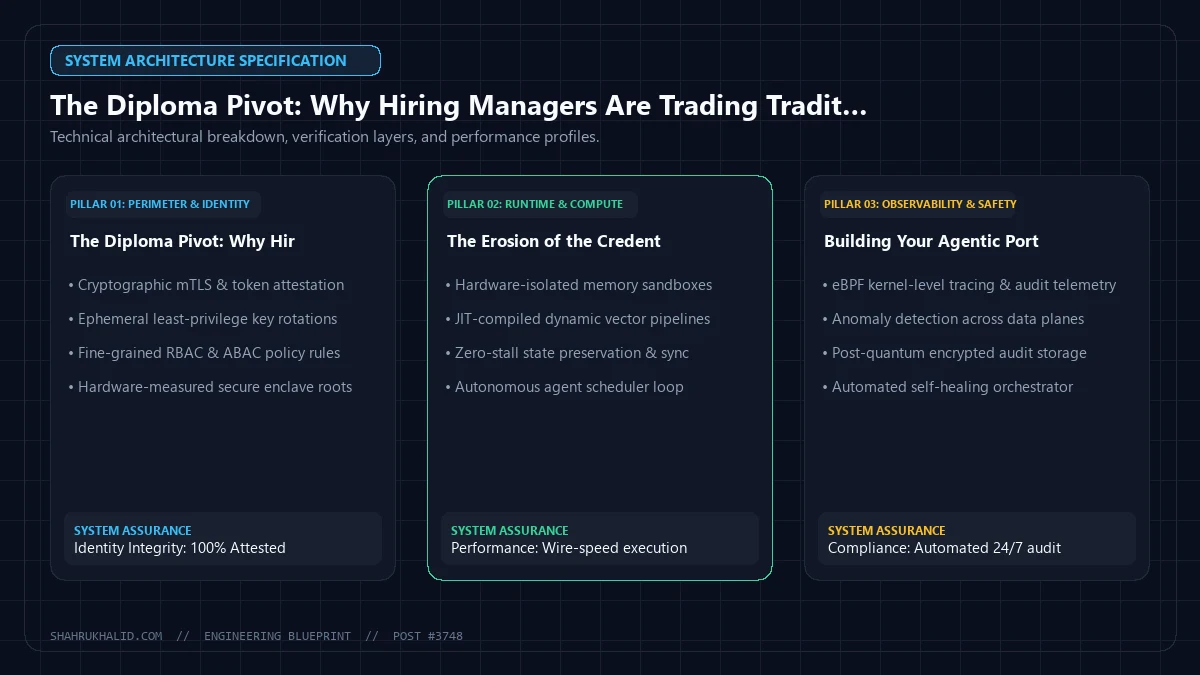
Building Your Agentic Portfolio: A Strategic Framework
To succeed in this new paradigm, you must shift your mindset from “content creator” to “agent architect.” An agentic portfolio isn’t about showing off your coding skills in a vacuum; it’s about showing how you solve business problems using autonomous systems. Here is how you build a portfolio that commands attention in 2026.

- Document the Problem-Solution Loop: Don’t just show the final output. Document the initial challenge, the constraints you faced, how you architected your agentic workflow to address those constraints, and the measurable business impact of the solution.
- Demonstrate Human-in-the-Loop Orchestration: Show that you understand the nuances of AI supervision. Highlight instances where your intervention improved the agent’s accuracy, efficiency, or safety. This is what separates “prompt engineers” from “agent architects.”
- Focus on Multi-Agent Collaboration: Modern work isn’t done by a single agent; it’s done by a fleet. Demonstrate how you have connected different agents—perhaps one for data retrieval, one for synthesis, and one for quality assurance—to create a cohesive, automated workflow.
- Prioritize Verifiability: Use blockchain-based certifications or public, reproducible logs to prove that the work in your portfolio was actually performed by you and your systems. Trust, but verify, is the new hiring mantra.
- Quantify the ROI: Did your agent reduce research time by 80%? Did it increase lead qualification accuracy? Numbers are the universal language of business, and they are far more persuasive than a GPA.
The Shift from Employee to Systems Designer
The role of the employee is evolving. We are moving away from the industrial model of “following instructions” to the knowledge-worker model of “designing systems.” In this new world, you aren’t just an individual contributor; you are a manager of digital labor. Your ability to troubleshoot an agent’s logic, optimize its token usage, and ensure its output remains compliant with industry standards is the new “essential skill set.”
Hiring managers are actively seeking candidates who understand the “failure modes” of AI. They want to know that when an agent hallucinates, you have the expertise to catch it, diagnose the root cause, and re-architect the prompt or the data retrieval path to prevent it from happening again. This level of technical maturity is rarely taught in a classroom; it is earned in the trenches of real-world deployment.
Navigating the Transition: Advice for Students and Professionals
If you are currently enrolled in a degree program, don’t drop out—pivot. Treat your education as a secondary objective while treating your agentic portfolio as your primary career engine. Use your coursework as a sandbox to test and build agentic workflows. If you are a professional, start small. Identify one repetitive, low-value task in your current workflow and build an agent to automate it. Document that process, measure the time saved, and add it to your portfolio.
The goal is to build a “proof-of-capability” that is so compelling it makes the question of your formal education irrelevant. When you can walk into an interview and demonstrate a functioning system that solves a billion-dollar problem, the hiring manager won’t care if you have a diploma from an Ivy League school or a certificate from an online bootcamp.