Beyond ChatGPT: Your 2026 Student Playbook for AI Workflows, Smart Assistants & Killer Prompts
Key Takeaways
- By 2026, AI is an indispensable academic partner, not just a tool.
- AI acts as a personal, intelligent study assistant, amplifying student capabilities.
- Future AI workflows go beyond ChatGPT to integrated, personalized learning environments.
- AI serves as a cognitive amplifier, enhancing critical thinking and freeing up time.
- Mastering an AI Student Playbook is essential for academic and future career success.
Think of AI not as a shortcut, but as your personal, infinitely patient, and incredibly knowledgeable study assistant, ready to amplify your capabilities. The core idea here is simple yet profound: AI, when used strategically, can unlock unprecedented academic success and prepare you for a world where these skills are paramount. We’re going to dive deep, starting from the very basics, and build up to sophisticated workflows that will make you a true AI-powered academic powerhouse.
Comprehensive Foundations & Concept Primer
Welcome, my friends, to the dawn of a new era in learning! If you’re reading this, you’re already ahead of the curve, recognizing that the landscape of education is shifting dramatically. By 2026, the question won’t be if you use AI, but how effectively you integrate it into your academic life. This isn’t just about getting good grades; it’s about developing a mindset and skillset that will serve you long after graduation.
The AI Revolution in Education: Why 2026 is Different
Let’s be honest, for a while, AI felt like a distant, sci-fi concept, or perhaps a novelty. Then ChatGPT arrived, and suddenly, everyone had a taste of its potential. But that was just the appetizer. By 2026, AI has matured significantly. We’re moving beyond simple query-response systems to highly integrated, personalized learning environments. Imagine an AI that understands your learning style, anticipates your knowledge gaps, and even helps you craft the perfect research question. This isn’t magic; it’s the result of rapid advancements in large language models (LLMs), multimodal AI (handling text, images, audio), and the democratization of these powerful tools.
The `Future of AI in education 2026` is one where AI acts as a cognitive amplifier. It doesn’t replace your critical thinking; it enhances it. It frees you from the mundane, repetitive tasks, allowing you to focus on deeper analysis, creativity, and problem-solving. This shift is why having a robust AI Student Playbook isn’t just an advantage; it’s a necessity. It’s about learning to collaborate with AI, making it an extension of your intellectual process, not a substitute for it.
Demystifying AI: Core Principles Without the Jargon
Let’s cut through the tech-speak. What is AI, really? At its heart, Artificial Intelligence is about creating machines that can perform tasks that typically require human intelligence. Think of it like this:
- Learning: Just as you learn from textbooks and lectures, AI models learn from vast amounts of data – billions of words, images, and code snippets. They find patterns and relationships.
- Reasoning: Once they’ve learned, they can apply that knowledge to new situations. If an AI has read countless essays, it can then help you structure your own.
- Problem-Solving: Given a goal, AI can figure out steps to achieve it. Need to summarize a long article? AI can process it and extract key points.
When we talk about “Generative AI tools for learning,” we’re specifically referring to AI that can create new content – text, images, code, even music – based on the patterns it has learned. ChatGPT is a prime example of a generative AI for text. Google’s Gemini, another powerful contender (and one we’ll reference often, drawing from `https://ai.google.dev/docs`), excels at understanding and generating various forms of content, making it incredibly versatile for students.
The key takeaway? AI isn’t a brain in a box. It’s a sophisticated pattern-matching and generation engine. Your job is to direct that engine effectively.
Your AI as a Super-Powered Study Buddy: Analogies for Understanding
Let’s make this real. Imagine your AI assistant as:
- The World’s Fastest Researcher: It can comb through libraries of information in seconds, far quicker than any human. Need to find specific facts for a paper? It’s on it.
- A Personal Tutor, 24/7: Stuck on a complex concept? Ask your AI to explain it in five different ways, or to simplify it for a 10-year-old. It won’t judge, and it won’t get tired.
- A Brainstorming Partner: Staring at a blank page for an essay? Ask your AI for ideas, angles, or even counter-arguments. It can spark your creativity.
- A Language Coach: Practicing a new language? Your AI can help you translate, correct grammar, and even simulate conversations.
This is the essence of `Smart AI assistants for education`. They are designed to augment your learning, not replace it. They handle the heavy lifting of information processing, allowing you to engage with the material on a deeper, more analytical level.
The Ethical Compass: Navigating AI Responsibly
Before we dive into the how-to, a crucial word on ethics. Using AI in your academic journey is a powerful privilege, and with it comes responsibility.
- Originality is Key: AI is a tool for assistance, not plagiarism. Always ensure the work you submit is your own original thought, even if AI helped you structure it or gather information. Cite your sources, and be transparent about AI’s role if your institution requires it.
- Fact-Checking is Non-Negotiable: AI can “hallucinate” – meaning it can confidently present false information as fact. Always verify critical information with reliable sources. Your critical thinking remains paramount.
- Bias Awareness: AI models are trained on data created by humans, and that data can contain biases. Be aware that AI outputs might reflect these biases, and question them critically.
This AI Student Playbook isn’t about cheating; it’s about learning smarter, faster, and more effectively, while upholding the highest academic standards.
Prerequisites & Complete Environment Setup
Alright, my fellow learners, let’s get our hands dirty! Before we can unleash the power of AI, we need to set up our workspace. Don’t worry, this isn’t about complex coding or expensive software. The beauty of 2026 is that powerful AI tools are more accessible than ever, often requiring just a web browser and a few strategic accounts. This module is your step-by-step guide to building your personal AI toolkit.
Your Digital Workbench: Essential Accounts and Tools
Think of your AI environment as your digital workbench. You need the right tools laid out neatly. Here’s what we’ll focus on:
- A Reliable Web Browser: Chrome, Firefox, Edge, Safari – pick your favorite. Ensure it’s up-to-date.
- Google Account: Absolutely essential. Many of the best `Generative AI tools for learning` are integrated with Google’s ecosystem. This gives you access to Gemini (Google’s powerful AI model), Google Docs, Drive, and more. If you don’t have one, create it now. It’s free and foundational.
- OpenAI Account (ChatGPT): While we’re going “Beyond ChatGPT,” it remains a foundational tool. A free account gives you access to GPT-3.5, which is still incredibly useful. Consider a paid subscription (ChatGPT Plus) if you find yourself hitting usage limits or needing access to GPT-4’s advanced capabilities.
- Perplexity AI (or similar AI-powered search engine): This is a game-changer for research. Unlike traditional search engines, Perplexity AI provides direct answers with sources cited, making it an excellent tool for `AI workflows for students` when you need quick, verifiable information.
- Notion (or similar productivity suite with AI integration): Notion is fantastic for organizing notes, projects, and tasks. Its integrated AI features can summarize notes, brainstorm ideas, and even help draft content directly within your workspace. This is a prime example of `Student productivity AI tools`.
- Grammarly (or similar AI writing assistant): While not strictly a generative AI, Grammarly’s AI-powered suggestions for grammar, style, and clarity are invaluable for refining your written work. Many modern versions now offer generative features too.
Step-by-Step Setup: Getting Your AI Tools Ready
Let’s walk through setting these up.
1. Google Account & Gemini Access
- Action: Go to `accounts.google.com` and create or sign in to your Google account.
- Verification: Once logged in, navigate to `gemini.google.com`. You should see the Gemini interface. If it asks you to join a waitlist, do so, but often access is immediate with a Google account.
- Tip: Familiarize yourself with the interface. It’s clean and intuitive, designed for conversational interaction.
2. OpenAI Account & ChatGPT
- Action: Visit `chat.openai.com` and sign up for a free account using your email or Google account.
- Verification: After signing up, you’ll be greeted by the ChatGPT interface. Try a simple prompt: “Hello, what can you do?”
- Tip: If you’re considering ChatGPT Plus, look for the “Upgrade to Plus” option. It offers faster responses and access to more advanced models.
3. Perplexity AI
- Action: Head over to `perplexity.ai`. You can use it without an account, but creating a free account allows you to save threads and access some advanced features.
- Verification: Type a research question into the search bar, e.g., “What are the main causes of climate change?” Observe how it provides a summary with cited sources.
- Tip: This is your go-to for quick, sourced information. It’s excellent for `how students can use AI for academic success 2026` by streamlining research.
4. Notion (with AI)
- Action: Go to `notion.so` and sign up for a free personal account.
- Verification: Create a new page. Type `/` and you’ll see options, including “AI.” Try typing a few notes and then selecting them and choosing “Ask AI to summarize.”
- Tip: Notion AI is a fantastic `Smart AI assistant for education` because it integrates directly into your note-taking and project management.
5. Grammarly
- Action: Visit `grammarly.com` and sign up for a free account. Download the browser extension for seamless integration.
- Verification: Open a Google Doc or any text editor. Type some text and intentionally make a few grammar errors. Watch Grammarly highlight them and offer corrections.
- Tip: This is your final quality control for written assignments.
Directory Layouts & Organization for AI Workflows
Just like a well-organized physical desk, a well-organized digital workspace is crucial for effective `AI workflows for students`.
- Cloud Storage (Google Drive/OneDrive): Create a dedicated folder for “AI Projects” or “AI-Assisted Assignments.” Inside, make subfolders for each course or major project.
- `My Drive/AI Projects/History 101/Essay 1 – AI Assisted`
- `My Drive/AI Projects/Science Lab/Report – AI Summaries`
- Notion Workspace: Create a central “Academic Hub” in Notion.
- Pages for each course.
- Database for assignments with status, due dates, and links to AI-generated content.
- A dedicated “AI Prompt Library” page where you save your best prompts (more on this in Module 4!).
This structured approach ensures that your AI-generated content is always accessible, organized, and integrated into your overall academic system. It’s about building a sustainable and scalable system for `student productivity AI tools`.
Core Implementation Architecture & Workflow Blueprint

Now that our tools are set up, let’s talk about the “how.” This module is where we design the blueprints for effective `AI workflows for students`. Think of it as learning the fundamental mechanics of how to integrate AI into your study routine, moving beyond just asking a single question to building a multi-step, intelligent process.
The AI Workflow: A Step-by-Step Mental Model
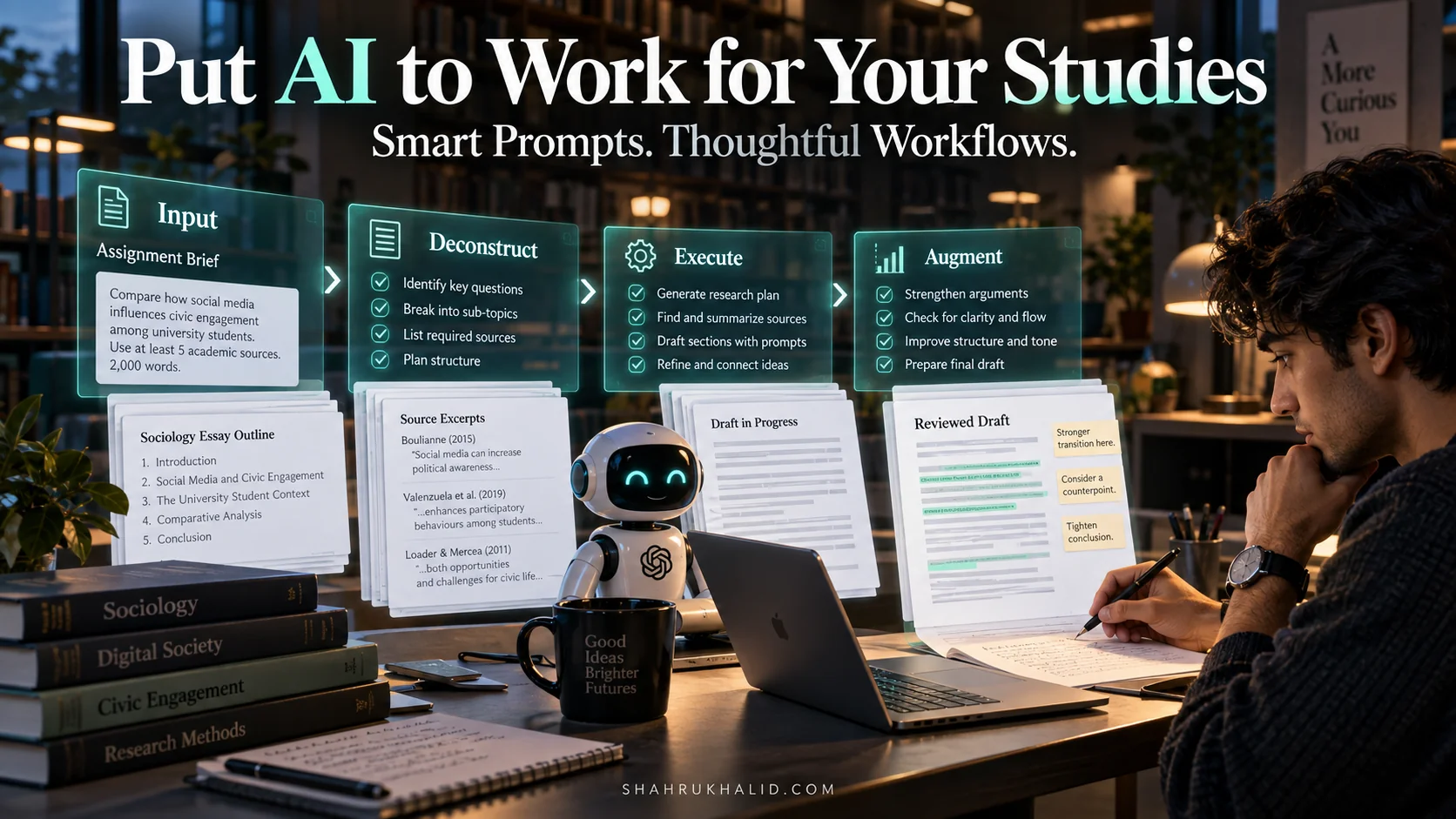
At its heart, an AI workflow is a sequence of actions, where AI plays a specific role at each stage. It’s not about offloading the entire task to AI, but strategically deploying it where it can add the most value. Here’s a general blueprint:
- Understand the Task: What’s the assignment? What are the requirements? (Human)
- Information Gathering & Synthesis: Research, reading, note-taking. (AI & Human)
- Brainstorming & Outlining: Generating ideas, structuring arguments. (AI & Human)
- Drafting & Content Generation: Initial writing, expanding on points. (AI & Human)
- Refinement & Editing: Grammar, style, clarity, factual verification. (AI & Human)
- Final Review & Personalization: Ensuring originality, voice, and meeting rubric. (Human)
The magic happens when you understand which parts AI can assist with and how to direct it. This is where `Prompt engineering for students` becomes your superpower.
Visualizing AI Integration: Workflow Card Structures
Let’s use a visual analogy. Imagine each step of your academic task as a “card.” Some cards are purely human, some are purely AI, and many are collaborative.
Example: Essay Writing Workflow
+---------------------+     +---------------------+     +---------------------+
|  **CARD 1: Task**   |     | **CARD 2: Research**|     | **CARD 3: Outline** |
|   - Understand      |     |   - Keyword search  |     |   - Brainstorm      |
|     Prompt          |     |   - Summarize docs  |     |     main points     |
|   - Define Scope    |     |   - Extract facts   |     |   - Structure essay |
|   - Set Goals       |     |   - Identify gaps   |     |     (intro, body,   |
|   (HUMAN)           |     |   (AI & HUMAN)      |     |     conclusion)     |
+---------------------+     +---------------------+     |   (AI & HUMAN)      |
          |                           |                           |
          v                           v                           v
+---------------------+     +---------------------+     +---------------------+
| **CARD 4: Drafting**|     | **CARD 5: Refine**  |     | **CARD 6: Final**   |
|   - Generate intro  |     |   - Grammar check   |     |   - Verify facts    |
|   - Expand points   |     |   - Style & tone    |     |   - Ensure original |
|   - Write sections  |     |   - Paraphrase      |     |     voice           |
|   (AI & HUMAN)      |     |   (AI & HUMAN)      |     |   - Final read-thru |
+---------------------+     +---------------------+     |   (HUMAN)           |
                                                          +---------------------+
This diagram illustrates how AI can be woven into almost every stage. For `how students can use AI for academic success 2026`, this structured thinking is key. You’re not just asking “Write me an essay.” You’re asking, “Help me research this topic,” then “Suggest an outline,” then “Draft a paragraph for this section,” and so on.
The Anatomy of a Killer Prompt: Your Communication Blueprint
This is where `Prompt engineering for students` truly shines. A “killer prompt” isn’t just a question; it’s a set of clear instructions that guides the AI to produce the best possible output. Think of it like giving directions to a very intelligent but literal assistant. The more precise you are, the better the result.
Here’s a blueprint for crafting effective prompts, often called the “PCRF” method (Persona, Context, Request, Format):
- Persona (Who are you? Who is the AI?): Define the role for the AI.
- Example: “You are a university-level history tutor.” or “Act as an expert in quantum physics.”
- Why it matters: This sets the tone, knowledge base, and style of the AI’s response.
- Context (What’s the background?): Provide all necessary background information.
- Example: “I’m writing a 1500-word essay on the causes of the French Revolution for a first-year history class. My professor emphasizes primary source analysis.” or “I’m struggling to understand the concept of ‘recursion’ in Python.”
- Why it matters: This gives the AI the necessary information to tailor its response accurately and relevantly.
- Request (What do you want?): Be explicit about the task.
- Example: “Generate an outline for the essay, focusing on socio-economic factors and intellectual movements.” or “Explain recursion using a simple, real-world analogy.”
- Why it matters: This is the core instruction. Be clear and concise.
- Format (How do you want it?): Specify the desired output structure.
- Example: “Provide the outline as a bulleted list with 3 main sections and 2-3 sub-points each.” or “Give me three distinct analogies, each no more than two sentences long.”
- Why it matters: This ensures the output is immediately usable and saves you editing time.
Example of a Killer Prompt in Action:
Scenario: You need to write an introduction for an essay on the impact of social media on political discourse.
Killer Prompt
“You are a university-level political science academic specializing in modern communication. I am a first-year student writing a 1000-word essay on ‘The Impact of Social Media on Political Discourse.’ My essay needs to argue that social media has both democratized access to information and exacerbated polarization. Please draft a compelling introductory paragraph (around 150 words) that sets up this dual argument and includes a clear thesis statement. The tone should be academic but accessible.”
See how much more effective that is than just “Write an essay intro about social media and politics”? This is the essence of `mastering AI prompts for student research papers`.
Integrating Smart AI Assistants into Your Study Routines
The question, “Are AI smart assistants beneficial for student productivity?” is a resounding YES, especially when integrated thoughtfully.
- Daily Planning: Use an AI assistant (like Gemini or ChatGPT) to help you structure your study day. “Plan a study schedule for my biology exam next week, focusing on chapters 3, 4, and 5, with breaks every hour.”
- Concept Clarification: When you hit a roadblock in a textbook, instead of getting frustrated, ask your AI. “Explain the concept of ‘supply and demand elasticity’ in simple terms, using an example from everyday life.”
- Language Practice: If you’re learning a new language, use AI for conversational practice. “Let’s role-play a conversation at a coffee shop in French. I’ll start.”
- Brainstorming for Group Projects: Share your project brief with the AI and ask it to generate ideas or potential challenges. “We’re doing a group presentation on sustainable energy. What are 5 innovative solutions we could discuss, and what are their pros and cons?”
The goal is to make AI a seamless part of your daily academic life, a constant companion that helps you learn, organize, and create more efficiently.
Hands-on Practical Implementation & Real-World Configuration
Alright, theory is great, but now it’s time to roll up our sleeves and put this AI Student Playbook into action! This module is all about practical, step-by-step exercises that will transform you from an AI observer to an AI orchestrator. We’ll walk through common student scenarios and show you exactly how to leverage your AI tools.
Scenario 1: Crafting a Research Paper Outline and Initial Draft
Let’s tackle one of the most daunting academic tasks: the research paper. We’ll use a combination of Perplexity AI for research, Gemini for outlining, and ChatGPT for drafting.
Goal: Create a detailed outline and draft the introductory paragraph for a 1500-word essay on “The Ethical Implications of AI in Healthcare.”
Step 1: Initial Research & Information Gathering (Perplexity AI)
- Action: Open `perplexity.ai`.
- Prompt: “What are the main ethical concerns regarding AI in healthcare? Provide sources.”
- Observe: Perplexity will generate a summary with bullet points and direct links to its sources. This is invaluable for quickly understanding the landscape and finding credible starting points.
- Configuration: Copy the most relevant points and source links into a Notion page or Google Doc titled “AI in Healthcare Research Notes.”
Step 2: Brainstorming & Outline Generation (Gemini)
- Action: Open `gemini.google.com`.
- Context: “I’m writing a 1500-word essay on ‘The Ethical Implications of AI in Healthcare’ for a university ethics course. I’ve gathered some initial research on privacy, bias, accountability, and job displacement. My essay needs a clear introduction, three main body paragraphs, and a conclusion.”
- Prompt: “Generate a detailed outline for this essay. For each body paragraph, suggest a specific ethical concern to focus on and 2-3 sub-points to discuss. Include a strong thesis statement for the introduction and a summary point for the conclusion.”
- Observe: Gemini will provide a structured outline. It might look something like this:
Thesis Statement: The integration of AI into healthcare presents a complex ethical landscape, promising advancements in diagnostics and treatment while simultaneously raising critical concerns regarding patient privacy, algorithmic bias, and accountability.

    I. Introduction
        A. Hook: Rapid advancements of AI in healthcare
        B. Background: AI applications (diagnostics, drug discovery)
        C. Thesis Statement (as above)

    II. Body Paragraph 1: Patient Privacy and Data Security
        A. Sub-point 1: Collection and storage of sensitive health data
        B. Sub-point 2: Risk of data breaches and misuse
        C. Sub-point 3: Informed consent challenges in AI data use

    III. Body Paragraph 2: Algorithmic Bias and Health Equity
        A. Sub-point 1: Bias in training data leading to disparate outcomes
        B. Sub-point 2: Impact on marginalized communities
        C. Sub-point 3: Strategies for fairness and transparency in AI algorithms

    IV. Body Paragraph 3: Accountability and Responsibility
        A. Sub-point 1: Who is liable for AI errors? (developers, clinicians, institutions)
        B. Sub-point 2: The "black box" problem and explainability
        C. Sub-point 3: Human oversight vs. autonomous AI decision-making

    V. Conclusion
        A. Restate Thesis (paraphrased)
        B. Summarize main ethical challenges
C. Future outlook: Balancing innovation with ethical safeguards- Configuration: Copy this outline into your Notion page or Google Doc. Crucially, review it. Does it align with your understanding? Do you want to reorder points or add your own? This is where your critical thinking comes in.
Step 3: Drafting the Introduction (ChatGPT)
- Action: Open `chat.openai.com`.
- Context: “I am a university student writing an essay on ‘The Ethical Implications of AI in Healthcare.’ My essay outline includes the following thesis statement: ‘The integration of AI into healthcare presents a complex ethical landscape, promising advancements in diagnostics and treatment while simultaneously raising critical concerns regarding patient privacy, algorithmic bias, and accountability.’ My target audience is an academic one, and the tone should be formal.”
- Prompt: “Draft a compelling introductory paragraph (approximately 150 words) that incorporates this thesis statement and sets the stage for the discussion of privacy, bias, and accountability. Ensure it has a strong hook.”
- Observe: ChatGPT will generate an introduction.
The rapid integration of Artificial Intelligence (AI) into healthcare promises a revolutionary transformation, offering unprecedented capabilities in diagnostics, personalized treatment plans, and drug discovery. From sophisticated imaging analysis to predictive analytics for disease outbreaks, AI's potential to enhance patient care and operational efficiency is undeniable. However, this technological frontier is not without its profound ethical challenges. The integration of AI into healthcare presents a complex ethical landscape, promising advancements in diagnostics and treatment while simultaneously raising critical concerns regarding patient privacy, algorithmic bias, and accountability. Navigating these intricate ethical dilemmas is paramount to harnessing AI's benefits responsibly and ensuring equitable, trustworthy healthcare systems for the future.- Configuration: Copy this into your document. Read it critically. Does it sound like you? Is there anything you’d rephrase? This is a draft, a starting point.
Step 4: Refining with Grammarly
- Action: Paste your drafted introduction into a Google Doc or directly into Grammarly’s editor.
- Observe: Grammarly will highlight grammar errors, suggest stylistic improvements, and check for clarity.
- Configuration: Accept or reject suggestions. Pay attention to the “tone” suggestions – does it match the academic tone you’re aiming for?
This multi-tool approach demonstrates effective `AI workflows for students`, showing `how students can use AI for academic success 2026` by breaking down a large task into manageable, AI-assisted steps.
Scenario 2: Understanding Complex Concepts & Language Learning
AI isn’t just for writing papers; it’s a phenomenal learning aid.
Goal: Understand a complex scientific concept and practice a foreign language.
Step 1: Concept Clarification (Gemini)
- Action: Open `gemini.google.com`.
- Prompt: “Explain the concept of ‘quantum entanglement’ to a high school student who has a basic understanding of physics but no prior knowledge of quantum mechanics. Use an analogy and keep the explanation under 200 words.”
- Observe: Gemini will break down the concept using simplified language and an analogy.
Imagine you have two coins, and you flip them simultaneously, but you don't look at them. Quantum entanglement is like these two coins being magically linked, even if they are light-years apart. If you look at one coin and it lands on heads, you instantly know the other coin, no matter how far away, *must* be tails. This isn't because they communicated, but because their fates were intertwined from the moment they were "entangled." In quantum physics, particles can become entangled, meaning their properties (like spin) are connected. Measuring one instantly tells you the state of the other, defying classical intuition about information travel. It's a fundamental, albeit mind-bending, aspect of the quantum world.- Configuration: If you still don’t get it, follow up: “Can you explain it using a different analogy, perhaps with playing cards?” This iterative prompting is key to `mastering AI prompts for student research papers` and learning.
Step 2: Language Practice (ChatGPT)
- Action: Open `chat.openai.com`.
- Prompt: “You are a friendly Spanish tutor. I want to practice ordering food at a restaurant. Start the conversation as the waiter, and I will respond in Spanish. Correct my grammar and suggest better phrasing if needed. Let’s begin with ‘¡Hola! ¿Qué le gustaría pedir?'”
- Observe: ChatGPT will engage in a conversational role-play.
- ChatGPT: “¡Hola! ¡Bienvenidos a nuestro restaurante! ¿Qué le gustaría pedir?”
- You: “Hola! Quiero un taco y agua.” (Intentionally simple)
- ChatGPT: “¡Excelente elección! Solo para aclarar, ¿quieres ‘un taco’ (singular) o ‘unos tacos’ (plural)? Y para el agua, ¿quieres agua del grifo o una botella de agua? ¿Algo más?”
- Configuration: Continue the conversation, pushing your boundaries. This is a fantastic way to get immediate, personalized feedback, making `Smart AI assistants for education` incredibly beneficial.
These hands-on examples illustrate how `integrating AI smart assistants into student study routines` can be incredibly effective, turning abstract concepts into concrete, actionable steps. Remember, the key