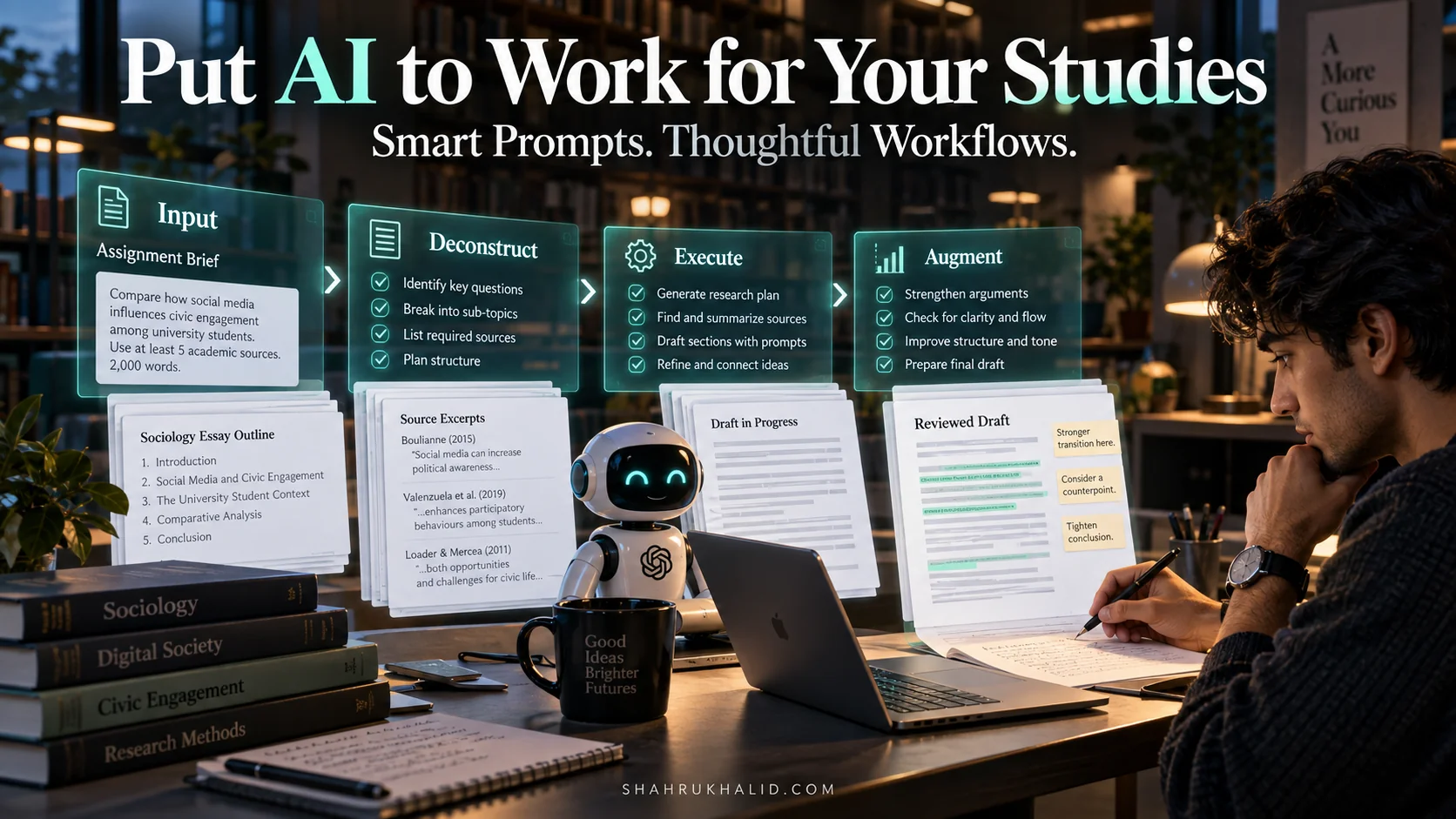
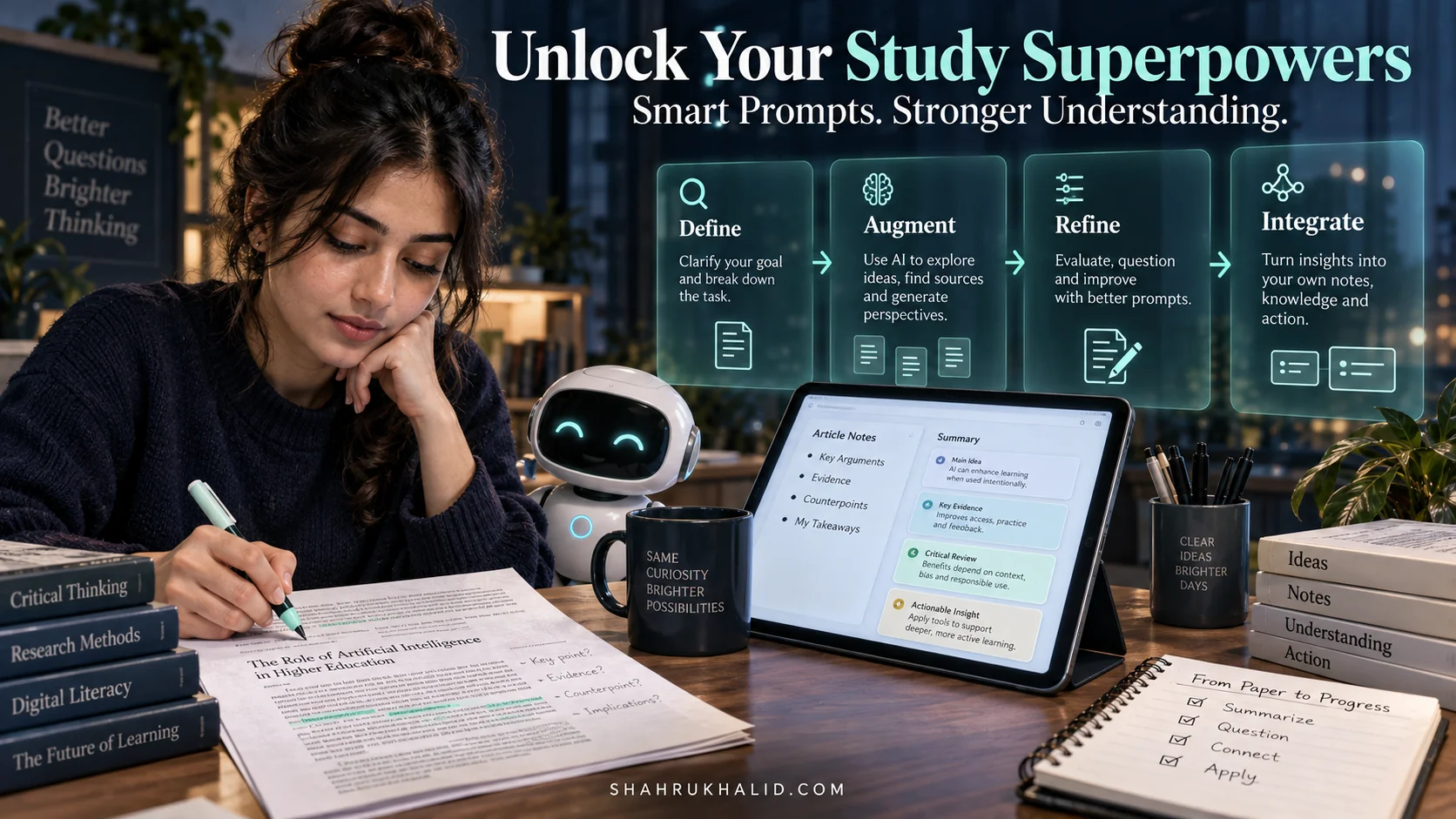
Your 2026 AI Study Hack: Mastering Workflows & Prompts for Next-Level Learning

Today, in 2026, that smarter way is here. It’s not just about having a chatbot that can answer a question; it’s about fundamentally redesigning your entire study process with Artificial Intelligence as your co-pilot. This isn’t a shortcut to avoid work. It’s a “work-smarter” revolution, a way to go deeper, learn faster, and unlock a level of understanding I could only have dreamed of.
This guide is my personal masterclass for you. We’re going to move beyond basic questions and build powerful, repeatable AI learning workflows. We’ll master the art of the prompt and turn you from a passive student into the architect of your own personalized AI education. Let’s begin.
Comprehensive Foundations & Concept Primer
Before we dive into the “how,” let’s spend a moment on the “why” and the “what.” It’s easy to see AI as a magic black box, but that’s the fastest way to get mediocre results. To truly master it, you need to understand the core principles, and I promise to do it without the soul-crushing jargon.
Why Your Study Habits of 2025 Are Already Obsolete
Think about how you study right now. It’s likely a series of disconnected activities: you read a textbook, you watch a lecture, you take some notes, you try to cram them into your brain. Each step is separate. You are the only one doing the hard work of connecting the dots. By 2026, this approach is like trying to build a car with a hammer and a wrench while everyone else is using a fully automated assembly line.
The game-changer isn’t just “using AI.” It’s about creating a system—an AI learning workflow. This is a structured, repeatable process where you use specific AI tools at specific stages of your learning to enhance your natural abilities. It’s the difference between asking a calculator “what’s 2+2?” and using a spreadsheet to model your entire personal budget. One is a simple query; the other is a system for insight. Optimizing learning with AI means building these systems for yourself.
The “Brilliant Intern” Analogy: Understanding AI’s Role
So, how can AI improve my study process? The best way to think of a Large Language Model (LLM) like Google’s Gemini or OpenAI’s GPT is as a brilliant, infinitely knowledgeable, and lightning-fast intern.
This intern has read every book, every research paper, and every article ever published. They can recall information instantly, speak any language, and write in any style. But here’s the catch: this intern is also incredibly literal. They have no personal context, no understanding of your specific course, your professor’s pet peeves, or the subtle nuances of your assignment. They will only do exactly what you tell them to do.
If you give your intern a vague instruction like “tell me about photosynthesis,” you’ll get a generic, textbook-style summary. It’s correct, but not particularly helpful for your needs.
But what if you said: “Act as a university-level biology tutor. I’m struggling to understand the difference between the light-dependent and light-independent reactions in photosynthesis for my upcoming exam. Explain it to me using an analogy related to a factory assembly line. Then, create five multiple-choice questions that test my understanding of the key inputs and outputs of each stage.”
See the difference? That’s not a query; it’s a delegation. It’s a well-defined task given to your brilliant intern. This is the essence of prompt engineering for students. Your job is no longer just to find information, but to become an expert manager of your AI intern, guiding it to deliver precisely what you need to learn effectively.
Core Principles of AI-Enhanced Learning
Our entire strategy is built on a few simple but powerful ideas:
- AI as a Socratic Partner: The goal isn’t to get AI to give you the answer. It’s to get AI to help you find the answer. You’ll use it to ask probing questions, explore counterarguments, and simplify complex ideas until they click.
- From Passive Consumption to Active Creation: Instead of just reading a chapter, you’ll use AI to instantly turn that chapter’s key concepts into flashcards, summaries, and practice quizzes. You’re actively engaging with the material from the very beginning.
- Workflow over Widgets: The power isn’t in any single AI tool. It’s in the sequence of how you use them. A research tool finds the papers, a language model summarizes them, a writing assistant polishes your report. That’s a workflow.
- You Are the Final Checkpoint: AI makes mistakes. It can “hallucinate” facts or misunderstand context. Your critical thinking is more important than ever. You are the CEO of your learning journey; the AI is your staff. You make the final call.
Embracing these principles is the first step toward building robust AI learning workflows that will feel like a superpower.
Prerequisites & Complete Environment Setup
Alright, theory is great, but let’s get practical. A master craftsperson needs a well-organized workshop. A master student in 2026 needs a well-organized digital environment. A chaotic desktop with a hundred random browser tabs is the enemy of a good workflow. Here’s how to set up your digital command center, step-by-step.
Step 1: Choose Your Core AI “Interns”
You don’t need dozens of subscriptions. You need a few, high-quality tools that will form the backbone of your study system. I recommend a “Trio of Tools” to start:
- The Generalist (Your Main LLM): This is your primary conversational AI, your “brilliant intern.”
- Examples: Google Gemini, Perplexity, OpenAI’s ChatGPT.
- What it’s for: Explaining concepts, brainstorming ideas, summarizing text, generating practice questions, and acting as a Socratic tutor.
- Beginner’s Choice: Start with a free, powerful model like Google Gemini. It’s deeply integrated with Google’s ecosystem and its capabilities are constantly being benchmarked and improved, as you can see in their official developer documentation.
- The Research Specialist: This tool is specifically designed for academic work. It cites its sources and is less prone to making up facts.
- Examples: Elicit.org, Scite.ai, Consensus.
- What it’s for: Finding relevant academic papers, summarizing research, and creating literature reviews. It answers the question, “Which AI tools help with academic research and writing?” head-on.
- Beginner’s Choice: Elicit is fantastic for finding papers based on a research question and pulling key information into a structured table.
- The Writing Assistant: This goes beyond simple spell-checking to help with tone, clarity, and style.
- Examples: Grammarly, ProWritingAid, Wordtune.
- What it’s for: Polishing your essays, lab reports, and emails. It helps you sound more professional and ensures your arguments are clear and concise.
- Beginner’s Choice: Grammarly’s free version is excellent for catching critical errors and improving readability.
Step 2: The “Digital Study Hub” Folder Structure
This might sound ridiculously simple, but it’s the most overlooked part of student productivity. A consistent folder structure is the physical architecture for your digital workflows. On your computer or cloud drive (like Google Drive or OneDrive), create the following:
├── 01_Semester_Fall_2026/
│ ├── COURSE_101_Intro_to_Psychology/
│ │ ├── 01_Lectures_and_Notes/
│ │ ├── 02_Readings_and_Sources/
│ │ ├── 03_AI_Generated_Materials/ <– THIS IS KEY
│ │ ├── 04_Assignments_and_Drafts/
│ │ └── 05_Final_Exam_Prep/
│ ├── COURSE_102_Calculus_I/
│ │ ├── … (repeat structure)
│ └── …
└── 02_Semester_Spring_2027/
└── …
Why this works
The `03_AI_Generated_Materials` folder is your secret weapon. Every summary, quiz, and explanation you generate with an AI goes here, neatly organized by topic. When you need to review, you have a personalized library of study aids you created. This simple act of organization is the first step in integrating AI into your daily study routine.
Step 3: Configure Your Browser and Note-Taking App
Your web browser is your gateway to these tools. To make your life easier:
- Bookmark Your Trio: Create a bookmark folder in your browser named “AI Tools” and save your Generalist, Research Specialist, and Writing Assistant there for one-click access.
- Choose a Central Note-Taking App: Whether it’s Notion, Obsidian, OneNote, or even Google Docs, pick one place to be your “second brain.” This is where you’ll paste, synthesize, and connect the information you gather. Many modern note-taking apps have features that integrate well with AI, allowing you to build a personal knowledge base. The key is consistency. Don’t let your notes be scattered across five different apps.
Verification: Your Environment Is Ready When…
You can sit down to study and, without thinking, you know:
- Exactly which AI tool to open for a specific task (e.g., “I need to understand a concept” -> open Gemini).
- Exactly where to save the output (`/COURSE_101/03_AI_Generated_Materials/`).
- Exactly where to synthesize your own thoughts on the topic (your chosen note-taking app).
This setup removes friction. It makes using AI a natural, seamless part of your study process, not a clunky afterthought. This structured approach mirrors the robust technical architecture we value on platforms like shahrukhalid.com, where a solid foundation enables complex and powerful operations.
Core Implementation Architecture & The 4-Stage AI Learning Workflow Blueprint
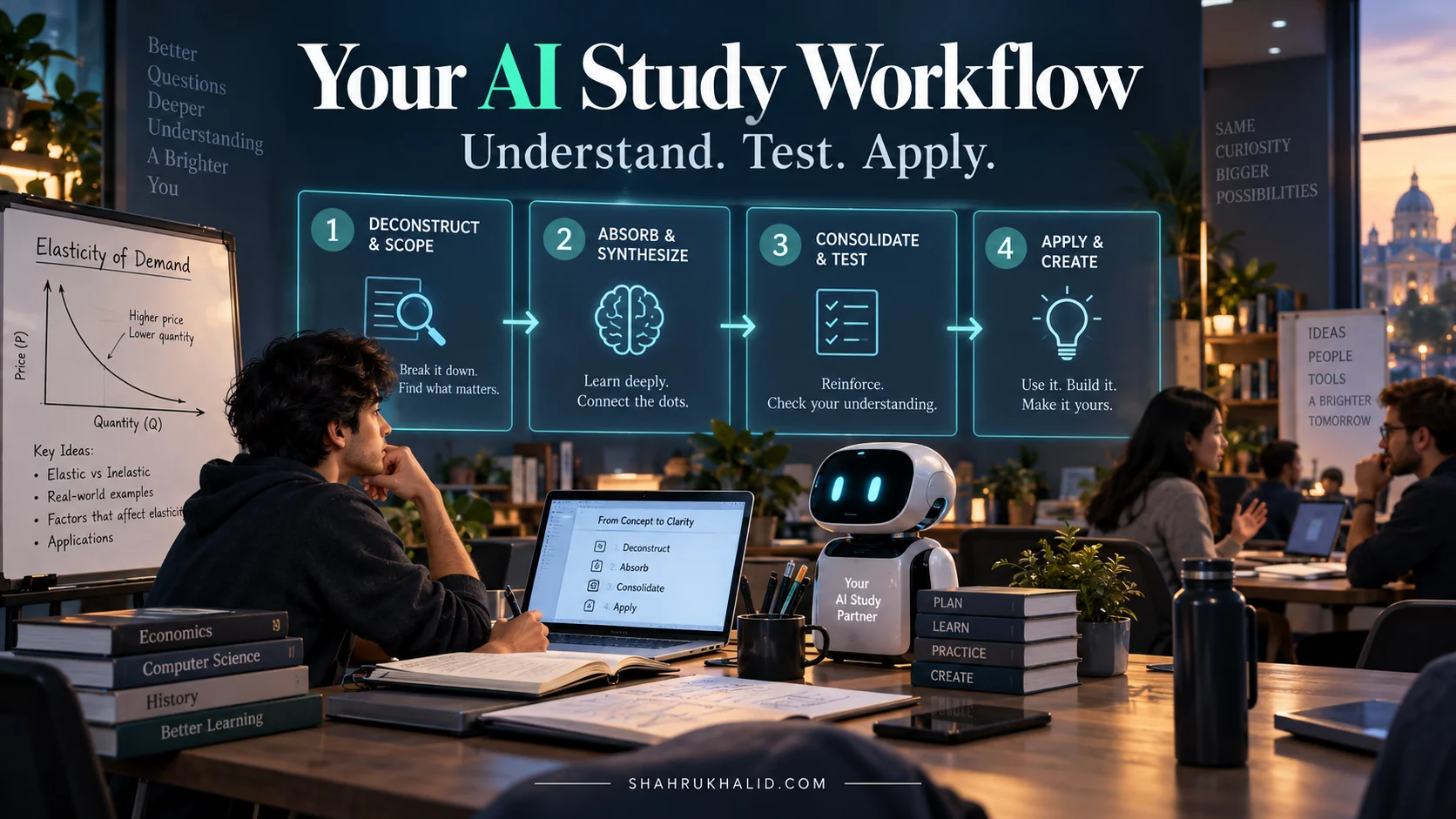
Now we get to the core of this masterclass. This is the blueprint for your very own AI learning workflows. I want you to visualize your study process not as one long slog, but as a four-stage assembly line. At each stage, you’ll use specific AI prompts to perform a key task, moving from raw information to deep, consolidated knowledge.
I call this the D.A.C.A. Framework: Deconstruct, Absorb, Consolidate, and Apply.
Here’s how it looks. Imagine each stage as a “card” in your workflow.
***
Visual Card 1: Stage 1 – DECONSTRUCT & SCOPE
- Your Goal: To take a large, intimidating topic (like a dense textbook chapter or a new lecture concept) and break it down into manageable pieces. You’re creating a roadmap before you start your journey.
- Your AI Tool: Generalist LLM (e.g., Gemini).
- Core Prompt Structure:
Act as an expert [Subject] tutor. I need to learn about [Topic]. My current understanding is [Beginner/Intermediate/Advanced].

    1.  Identify the 5-7 most critical sub-concepts I must understand.
    2.  For each concept, define it in a single, simple sentence.
    3.  Generate a logical learning path or order in which I should tackle these concepts.
    4.  Suggest one real-world analogy to help me grasp the core idea of [Topic].
***
Visual Card 2: Stage 2 – ABSORB & SYNTHESIZE
- Your Goal: To actively engage with the learning material for each sub-concept you identified. This is where you move from passive reading to active understanding.
- Your AI Tools: Generalist LLM, Research Specialist.
- Core Prompt Structures:
(For Text/Article Summarization):
I have uploaded a text about [Sub-Concept]. Analyze it and perform the following:
    1.  Summarize the three key arguments in bullet points.
    2.  Extract the most important definition and quote it directly.
    3.  Explain the concept of [Specific Term from Text] as if I were a high school student.
    4.  Identify any potential points of confusion or ambiguity in the text.
(For Socratic Tutoring):
Let's learn about [Sub-Concept]. Do not give me the answer directly. Instead, ask me a series of questions that will guide me to understand it myself. Start with a foundational question.***
Visual Card 3: Stage 3 – CONSOLIDATE & TEST
- Your Goal: To lock the knowledge into your long-term memory and identify your weak spots. The learning isn’t done until you can retrieve the information without help.
- Your AI Tool: Generalist LLM.
- Core Prompt Structures:
(To Generate Practice Problems):
Based on our discussion of [Topic], act as an exam question writer. Create the following:
    - 5 multiple-choice questions that test common misunderstandings.
    - 3 short-answer questions that require me to explain the "how" and "why".
    - 1 challenging problem that requires me to synthesize multiple concepts.

    Provide the questions first. After I answer, provide detailed feedback and explanations for each.
(To Create Custom Study Aids):
Create a two-column table summarizing [Topic]. The left column should have the key term, and the right column should have a concise definition and its significance. Also, generate a set of digital flashcards (front/back format) for these terms.***
Visual Card 4: Stage 4 – APPLY & CREATE
- Your Goal: To use your new knowledge to create something. This is the ultimate test of understanding and the step that connects learning to real-world tasks like writing an essay.
- Your AI Tools: Generalist LLM, Writing Assistant.
- Core Prompt Structures:
(For Brainstorming and Outlining an Essay):
I need to write a 2000-word essay on the topic: "[Essay Question]".
    1.  Act as a university professor and brainstorm three potential thesis statements or arguments I could explore.
    2.  For the argument "[Chosen Argument]", generate a detailed, 5-point essay outline.
    3.  For each point in the outline, suggest the type of evidence I should look for (e.g., historical data, primary source quotes, statistical analysis).
(For Polishing Your Writing):
This is where you paste your drafted text into your Writing Assistant (like Grammarly) or use a prompt like this with your Generalist LLM:
Review the following paragraph from my essay. Act as a strict academic editor.
    - Check for clarity, conciseness, and flow.
    - Suggest alternative phrasing to make the language more sophisticated.
    - Ensure the tone is appropriately academic.

    [Paste your paragraph here]
This D.A.C.A. framework is your blueprint. In the next module, we’ll bring it to life with a real-world example.
Hands-on Practical Implementation & Real-World Configuration
Let’s get our hands dirty. It’s time to move from the blueprint to a fully functional implementation. I’m going to walk you through a complete study session using the D.A.C.A. workflow. This is one of the best AI study techniques because it’s structured and comprehensive.
Our Scenario: You’re a first-year economics student, and you’ve just been introduced to the concept of “Elasticity of Demand.” It sounds abstract and confusing. Your textbook chapter is dense. Let’s master it in one focused session.
Your Tools
- Generalist LLM: Google Gemini
- Note-Taking App: Your chosen app (e.g., Notion)
- Digital Hub: Your `ECON_101/03_AI_Generated_Materials/` folder
—
Stage 1: DECONSTRUCT “Elasticity of Demand”
You open Gemini and use our Stage 1 prompt.
Your Prompt
# PROMPT START
Act as an expert Economics tutor for a first-year university student. I need to learn about "Elasticity of Demand". My current understanding is absolute beginner.

1.  Identify the 5 most critical sub-concepts I must understand.
2.  For each concept, define it in a single, simple sentence.
3.  Generate a logical learning path or order in which I should tackle these concepts.
4.  Suggest one real-world analogy to help me grasp the core idea of Elasticity of Demand.
# PROMPT END
Expected AI Output (Annotated)
Of course! Let’s break down Elasticity of Demand. It’s a crucial concept.
Real-World Analogy: Imagine you sell two products: salt and luxury concert tickets. If you double the price of salt, people will still buy it because they need it. Its demand is inelastic (not stretchy). If you double the price of concert tickets, many people will decide not to go. Its demand is elastic (stretchy). Elasticity just measures how much demand stretches when the price changes.
Your Learning Path & Key Concepts:
- Price Elasticity of Demand (PED): This is the main idea; it measures how sensitive the quantity demanded is to a change in its price.
- The Elasticity Spectrum (Elastic vs. Inelastic vs. Unitary): This is about learning the different “types” of stretchiness and what they mean.
- Determinants of Elasticity: This covers why some goods are elastic (like concert tickets) and others are inelastic (like salt).
- Cross-Price Elasticity: This measures how the demand for one good (like coffee) changes when the price of another good (like tea) changes.
- Income Elasticity: This measures how demand changes when people’s incomes go up or down.
Your Action: You now have a crystal-clear roadmap. You copy this into your notes for ECON 101. You’re not intimidated anymore; you have five specific things to learn.
—
Stage 2: ABSORB the first concept (PED)
You decide to tackle the first item: “Price Elasticity of Demand (PED).” You read the relevant two pages in your textbook, but the formula looks scary. You decide to use the Socratic method to really get it.
Your Prompt
# PROMPT START
Let's focus on "Price Elasticity of Demand (PED)". I've read the definition, but I'm confused by the formula.

Do not give me the answer directly. Act as a Socratic tutor and ask me a series of questions that will guide me to understand the formula and why it's structured the way it is. Start with a simple, foundational question about price and quantity.
# PROMPT END
Expected AI Interaction
AI: Great. Let’s start simply. If a coffee shop raises the price of a latte from $4 to $5, what do you intuitively expect to happen to the number of lattes they sell each day?
You: They’ll probably sell fewer lattes.
AI: Exactly. Now, let’s say they sold 100 lattes at $4, and now they sell 80 lattes at $5. Can you calculate the percentage change in price and the percentage change in quantity demanded?
You: Uh, the price change is ($5-$4)/$4 = 25%. The quantity change is (80-100)/100 = -20%.
AI: Perfect. The formula for PED is simply: (Percentage Change in Quantity Demanded) / (Percentage Change in Price). Using the numbers you just calculated, what is the PED for lattes in this scenario?
You: It would be -20% / 25% = -0.8.
AI: You’ve just derived it yourself. That’s all the formula is. Now, why do you think we care about this -0.8 number? What does it tell the coffee shop owner?
Your Action: The formula is no longer just symbols on a page. You’ve reasoned through it. You add this example to your notes. This is a perfect example of mastering AI prompts for academic success.
—
Stage 3: CONSOLIDATE your knowledge of PED
You feel like you understand PED, but you need to test yourself to be sure.
Your Prompt
# PROMPT START
Based on our discussion of Price Elasticity of Demand (PED), act as an exam question writer.

Create the following:
- 3 multiple-choice questions that test the difference between elastic and inelastic demand.
- 1 short-answer question that requires me to explain the business implications of having a high PED.

Provide the questions first. I will answer them, and then you can provide the correct answers with detailed explanations.
# PROMPT END
Expected AI Output
Questions:
- If the PED for a product is -2.5, the demand for the product is considered:
a) Inelastic
b) Unitary Elastic
c) Elastic- A life-saving medicine would most likely have a PED that is:
a) Close to 0
b) Close to -1
c) A large negative number (e.g., -3)- …
Short Answer:- You are the manager of a brand of luxury chocolates. A market research firm tells you your PED is -1.8. Should you consider raising or lowering your price to increase total revenue? Explain your reasoning.
Your Action: You answer the questions. The AI gives you feedback. You discover you were a bit shaky on question 2. You review the concept of “necessities” vs. “luxuries.” You save the entire Q&A session in your `ECON_101/03_AI_Generated_Materials/` folder, naming it `PED_Practice_Quiz.md`.
—
Stage 4: APPLY your knowledge
You’ve completed the D.A.C.A cycle for the first sub-concept. You would now repeat Stages 2 and 3 for the other four concepts on your list. Once you’ve mastered them all, you can move to the final application stage, which often involves writing.
Let’s say you have a small assignment: “Write a 500-word analysis on whether a university should raise tuition fees, using the concept of elasticity of demand.”
Your Prompt (for outlining)
# PROMPT START
I need to write a 500-word analysis on the topic: "Should a university raise its tuition fees? Use the concept of elasticity of demand in your answer."

Act as an economics professor and help me structure my argument.
1.  Brainstorm the main argument for and against raising fees, from an elasticity perspective.
2.  Generate a simple 3-paragraph outline: Introduction, Main Body, Conclusion.
3.  For the Main Body, suggest what key terms I must include.
# PROMPT END
Your Action: The AI gives you a solid outline. You write the draft in your own words, drawing on the deep understanding you built during the Absorb and Consolidate stages. Finally, you paste your draft into Grammarly to polish the language and check for errors before submitting. You’ve gone from confusion to confident application in a single, structured session.
Real-World Enterprise Use Cases & Case Studies
The D.A.C.A. workflow isn’t just for one subject. Its power lies in its flexibility. Let’s look at how different types of students can adapt this core blueprint for their specific needs. These case studies show how to use AI for effective studying across disciplines.
Case Study 1: Maria, the STEM Student (Computer Science)
- The Challenge: Maria is learning about data structures and is stuck on the difference between a “Linked List” and an “Array.” She needs to understand not just the theory but also the practical performance implications.
- Her AI Learning Workflow Adaptation:
- Deconstruct: Maria’s initial prompt focuses on practical differences. `Act as a senior software engineer. I’m a CS student learning about Arrays vs. Linked Lists. Break down the key differences in terms of memory allocation, insertion/deletion speed, and element access speed.`
- Absorb: Instead of an analogy, Maria asks for code. `Provide a simple Python code example that demonstrates how adding an element to the middle of a list is much slower for an Array than for a Linked List. Add comments to the code explaining each step.` This is a form of active learning specific to her field. She can then run this code herself, which is a powerful way to learn.
- Consolidate: Maria asks the AI to create a scenario-based quiz. `Give me 5 programming scenarios and ask me whether an Array or a Linked List would be a better choice of data structure, and why. For example: “Storing a list of 10,000 songs for a music player where I need to frequently add/remove songs from the middle of a playlist.”`
- Apply: For her assignment, she needs to write a function that reverses a linked list. She first tries to write it herself. When she gets stuck, she asks the AI for a hint, not the solution. `I’m trying to write a Python function to reverse a linked list. I’m stuck on how to keep track of the ‘previous’ node. Can you give me a small hint without showing me the full code?`
Case Study 2: David, the Humanities Student (History)
*