Architecting Zero-Trust Confidential Workloads in 2026: Intel TDX Dynamic Attestation Chains, Wire-Speed CXL 3.1 Link Encryption, and CHERI Capability-Enforced Sandboxing
Key Takeaways
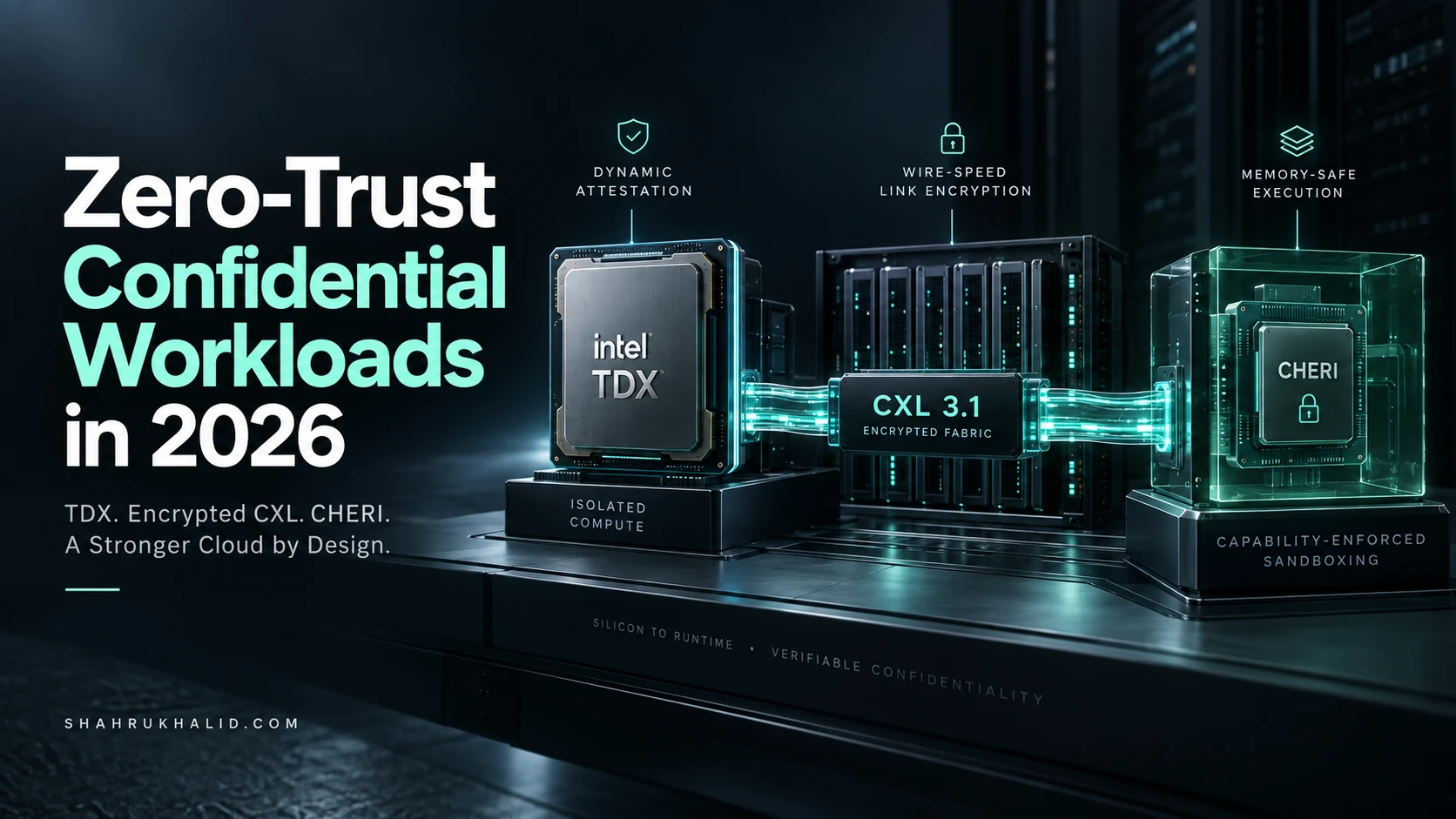
- Zero-trust cloud requires hardware-enforced cryptographic boundaries, dynamically validating execution integrity from silicon to runtime.
- Intel TDX provides hardware-isolated compute domains, removing hypervisor/host from the Trusted Computing Base.
- CXL 3.1 IDE enables wire-speed encrypted memory disaggregation, securing against physical bus interception.
- CHERI capability sandboxing eliminates in-enclave memory safety vulnerabilities by replacing raw pointers.
- These three hardware pillars collectively counter hypervisor, physical bus, and in-enclave memory exploitation threats.
Modern cloud infrastructure operates under the assumption that every layer of the virtualization stack—including the host kernel, hypervisor, adjacent tenants, and physical memory buses—is fundamentally compromised. A zero-trust cloud native architecture cannot rely on traditional perimeter controls or software-only isolation primitives. To achieve verifiable computational confidentiality in 2026, systems must establish cryptographic, hardware-enforced trust boundaries that dynamically validate execution integrity from silicon to runtime.
This masterclass establishes the blueprint for building zero-trust confidential compute clusters by synthesizing three foundational hardware pillars: Intel Trust Domain Extensions (TDX) for hardware-isolated compute domains with post-quantum attestation chains, Compute Express Link (CXL 3.1) Integrity and Data Encryption (IDE) for wire-speed encrypted memory disaggregation, and Capability Hardware Enhanced RISC Instructions (CHERI) for sub-process spatial and temporal memory sandboxing. Aligned with NIST SP 800-207 Zero Trust Architecture principles and modern post-quantum cryptographic standards specified in NIST FIPS 203/204, this guide outlines the end-to-end implementation of verified, multi-tenant confidential workloads.
The 2026 Silicon-Rooted Zero Trust Security Boundary
1. Compute Isolation: Intel TDX
Hardware-isolated Trust Domains (TDs). Removes hypervisors, firmware, and host OS from the TCB using SEAM (Secure Enterprise Architecture Module) and cryptographic multi-key engines.
2. Fabric Security: CXL 3.1 IDE
Wire-speed, sub-nanosecond AES-256-GCM encryption across PCIe 6.0/CXL interconnects, securing disaggregated memory pools against physical bus interposers and cold-boot interception.
3. In-Process Safety: CHERI Sandboxing
Architectural capabilities replace raw pointers with unforgeable 128-bit fat pointers, eliminating 100% of spatial memory safety vulnerabilities inside the enclave without syscall overhead.
1. Threat Modeling the Cloud Fabric in 2026
Historically, workload confidentiality relied on the hypervisor maintaining strict address translation isolation between Virtual Machine Control Blocks (VMCBs). In contemporary disaggregated architectures, this model fails entirely against three primary attack vectors:
- Privileged Host Compromise: A malicious ring-0 kernel module or compromised ring -1 hypervisor (KVM/QEMU) inspects, modifies, or injects execution vectors directly into guest physical memory (GPA).
- Physical Bus & Interposer Interception: Disaggregated memory pools connected over CXL or fabric switches are exposed to physical probing, differential power analysis, and PCIe interposer attacks capturing unencrypted cleartext in transit.
- Intra-Enclave In-Memory Exploits: Even if the VM boundary is encrypted, traditional memory-unsafe languages (C/C++, Rust
unsafeblocks) allow return-oriented programming (ROP) and out-of-bounds heap corruption to exfiltrate secret keys from within the enclave.
To eliminate these threat vectors, zero-trust cloud native architectures must enforce trust verification at every boundary, shifting from implicit trust to explicit cryptographic verification.
Never trust the hypervisor, never trust the physical bus, and never trust raw unconstrained pointers within the application runtime. Trust is derived exclusively from cryptographic hardware roots of trust (RoT) validated via dynamic, post-quantum attestation tokens.
2. Intel TDX Dynamic Attestation Chains with Post-Quantum Verification
Intel Trust Domain Extensions (TDX) introduce hardware-isolated virtual machines called Trust Domains (TDs). TDX protects VMs from the host hypervisor and other platform software by deploying the Intel TDX Module, an authenticated code module executed in a specialized CPU mode known as Intel Secure Enterprise Architecture Module (SEAM).
During build phase, the hypervisor invokes TDH.MEM.PAGE.ADD to construct guest memory. The SEAM module records build-time configurations in the Measurement of Root Trust Domain (MRTD) register using SHA-384.
At boot, the guest TD executes TDCALL [TDG.MR.RTMR.EXTEND] to measure kernel binaries, initrd, systemd targets, and container manifests into Runtime Measurement Registers (RTMRs).
The TD executes TDCALL [TDG.MR.REPORT] with a 64-byte user cryptographic nonce. The Intel Quoting Enclave (QE) validates the TD Report and signs the final ECDSA/ML-DSA Quote containing the platform TCB level and measurements.
The attestation verification service verifies the TD quote signature against the Intel PCS (Provisioning Certification Service) certificates, while the application identity token is negotiated via ML-KEM-768/1024.
Implementing TDX Dynamic Attestation & Verification
The following production-ready Go implementation interacts directly with the Linux TDX guest device (/dev/tdx_guest), submits an ephemeral cryptographic nonce, retrieves the hardware-signed TD Report, transfers it via vsock to the host Quoting Enclave, and cryptographically evaluates the RTMR measurements against expected workload manifests.
import (
"bytes"
"crypto/rand"
"crypto/sha512"
"encoding/binary"
"fmt"
"os"
"syscall"
"unsafe"
)
const (
TDX_GUEST_DEVICE = "/dev/tdx_guest"
TDX_CMD_GET_REPORT = 0xC0405401 // Real Linux TDX ioctl for TDREPORT0
REPORT_DATA_SIZE = 64
TD_REPORT_SIZE = 1024
)
// TdxReportReq encapsulates the ioctl structure for kernel ABI
type TdxReportReq struct {
ReportData [REPORT_DATA_SIZE]byte
TdReport [TD_REPORT_SIZE]byte
}
// TDReportLayout maps the hardware SEAM TDREPORT structure
type TDReportLayout struct {
ReportType [32]byte
Reserved1 [32]byte
CpuSvn [16]byte
TeeTcbSvn [16]byte
MrSeam [48]byte
MrSignerSeam [48]byte
SeamAttributes [8]byte
TdAttributes [8]byte
XFAM [8]byte
MRTD [48]byte // SHA-384 of build state
MRCONFIGID [48]byte
MROWNER [48]byte
MROWNERCONFIG [48]byte
RTMR0 [48]byte // Firmware/Bootloader
RTMR1 [48]byte // Kernel Image & Command Line
RTMR2 [48]byte // Initrd / Rootfs Hash
RTMR3 [48]byte // Container Workload Hash
ReportData [64]byte // User nonce / Key binding
}
func FetchHardwareTDReport(nonce [64]byte) (*TDReportLayout, error) {
fd, err := os.OpenFile(TDX_GUEST_DEVICE, os.O_RDWR, 0)
if err != nil {
return nil, fmt.Errorf("failed to open %s: %w", TDX_GUEST_DEVICE, err)
}
defer fd.Close()
req := TdxReportReq{
ReportData: nonce,
}
// Direct execution of TDX IOCTL command
_, _, errno := syscall.Syscall(
syscall.SYS_IOCTL,
fd.Fd(),
uintptr(TDX_CMD_GET_REPORT),
uintptr(unsafe.Pointer(&req)),
)
if errno != 0 {
return nil, fmt.Errorf("ioctl TDX_CMD_GET_REPORT failed with errno: %v", errno)
}
var report TDReportLayout
buf := bytes.NewReader(req.TdReport[:])
if err := binary.Read(buf, binary.LittleEndian, &report); err != nil {
return nil, fmt.Errorf("failed to deserialize TD Report: %w", err)
}
return &report, nil
}
func VerifyWorkloadIntegrity(report *TDReportLayout, expectedRTMR3 [48]byte, nonce [64]byte) bool {
// Step 1: Verify user nonce prevents replay attacks
if !bytes.Equal(report.ReportData[:], nonce[:]) {
fmt.Println("Attestation Error: Replay detected. ReportData does not match challenge nonce.")
return false
}
// Step 2: Validate container workload state (RTMR3)
if !bytes.Equal(report.RTMR3[:], expectedRTMR3[:]) {
fmt.Printf("Attestation Error: Workload integrity drift!nExpected: %xnActual: %xn",
expectedRTMR3, report.RTMR3)
return false
}
fmt.Println("Silicon Validation Success: Hardware RTMR3 matches cryptographically signed image hash.")
return true
}
func main() {
// Generate an ephemeral cryptographic challenge
var challengeNonce [64]byte
if _, err := rand.Read(challengeNonce[:]); err != nil {
panic(err)
}
fmt.Printf("[+] Generated 512-bit dynamic attestation nonce: %x…n", challengeNonce[:16])
report, err := FetchHardwareTDReport(challengeNonce)
if err != nil {
fmt.Printf("[-] Attestation execution failed: %vn", err)
return
}
// Golden measurement for a verified, secure microVM container rootfs
var expectedRTMR3 [48]byte
dummyExpected := sha512.Sum384([]byte("production-container-manifest-v2026.03"))
copy(expectedRTMR3[:], dummyExpected[:])
isValid := VerifyWorkloadIntegrity(report, expectedRTMR3, challengeNonce)
fmt.Printf("[+] Zero-Trust Attestation State Verified: %tn", isValid)
}
3. Wire-Speed CXL 3.1 Link Encryption (IDE)
Confidential Virtual Machines running data-intensive AI training, distributed databases, or vector search engines inevitably exhaust local node memory. Compute Express Link (CXL 3.1) enables dynamic memory pooling and disaggregation across distinct server chassis over high-bandwidth PCIe 6.0 physical layers. However, off-board memory expands the attack surface to physical bus interposers, malicious switch fabric controllers, and cold-boot physical DRAM interception.

To neutralize physical hardware attacks on pooled memory, CXL 3.1 specifies Integrity and Data Encryption (IDE). CXL IDE provides hardware-level encryption and anti-replay protection across link layers with deterministic, sub-nanosecond latency overheads.
CXL 3.1 IDE Protocol Stack & Cryptographic Framing
MOV [rax], rbx). GPA-to-HPA translation routes transaction to CXL Host Bridge.
CXL.mem FLIT (Flow Control Unit). Encrypts 256-bit data payloads with AES-256-GCM / AES-XPN. Appends a 96-bit MAC and 64-bit rolling transaction counter.
Cryptographic Comparison: Memory Protection Primitives
4. CHERI Architecture: Hardware-Enforced In-Process Sandboxing
Hardware enclaves and encrypted fabrics stop external attackers, but they do not eliminate vulnerabilities inside the guest software stack. A standard C-based confidential service containing a buffer overflow or uninitialized pointer can still be weaponized via memory corruption exploits to leak unencrypted data across the enclave boundary.
Capability Hardware Enhanced RISC Instructions (CHERI) solves this architectural flaw by extending traditional architectures (such as Arm Morello or CHERI-RISC-V) with hardware-enforced capabilities. Capabilities replace standard 64-bit raw virtual memory addresses with unforgeable 128-bit architectural capabilities.
Anatomy of a 128-bit CHERI Hardware Capability
Indicates capability validity. Automatically cleared by CPU hardware if software attempts arithmetic manipulation of the pointer address.
Hardware-enforced execution rights: Permit_Load, Permit_Store, Permit_Execute, Permit_Store_Capability.
Defines exact upper and lower memory bounds using compressed floating-point representations. Off-by-one errors trap immediately.
The active virtual cursor. Can be incremented or decremented only within the strict window defined by the base and bounds.
Eliminating Enclave Data Exfiltration with CHERI Capabilities
The following CHERI-C implementation demonstrates how micro-compartmentalization works within a confidential workload. When parsing untrusted network inputs inside a TDX enclave, the service delegates processing to a sandboxed buffer whose capability bounds are restricted in hardware, preventing read-overflow exfiltration of adjacent cryptographic keys.
#include <stdlib.h>
#include <string.h>
#include <cheriintrin.h>
// Secure session context located inside confidential TDX enclave memory
typedef struct {
char session_aes_key[32]; // Highly confidential symmetric key
char untrusted_user_payload[64];
} ConfidentialDataContext;
void ParsePayloadSandboxed(void * __capability bounded_buf, size_t input_len) {
// Attempting to read beyond bounded_buf will cause a hardware capability exception
char local_processing_cache[128];
printf("[*] CHERI Capability Base: 0x%lx, Length: %lu, Valid Tag: %dn",
cheri_base_get(bounded_buf),
cheri_length_get(bounded_buf),
cheri_tag_get(bounded_buf));
// Vulnerable operation simulation: attempting to copy more bytes than bounded
// A traditional C program would read past the buffer into session_aes_key.
// CHERI hardware traps this IMMEDIATELY at the CPU register level.
for (size_t i = 0; i < input_len; i++) {
// cheri_bounds_check is enforced implicitly by the CPU load instruction
local_processing_cache[i] = ((char * __capability)bounded_buf)[i];
}
}
int main(void) {
ConfidentialDataContext secure_ctx;
// Populate sensitive key material
memcpy(secure_ctx.session_aes_key, "CRITICAL_QUANTUM_SECRET_KEY_2026", 32);
memcpy(secure_ctx.untrusted_user_payload, "Normal incoming request payload.", 32);
// Derive a standard capability for the untrusted payload region
void * __capability raw_cap = &secure_ctx.untrusted_user_payload;
// RESTRICT BOUNDS: Hardware-enforce that this capability cannot access any memory
// outside of the exact 64-byte untrusted_user_payload allocation.
void * __capability restricted_cap = cheri_bounds_set(raw_cap, 64);
// RESTRICT PERMISSIONS: Strip capability write rights (read-only processing)
restricted_cap = cheri_perms_and(restricted_cap, CHERI_PERM_LOAD);
printf("[+] Calling parser with bounded capability…n");
// Attack simulation: Attacker passes an exploit payload length of 96 bytes,
// attempting to read 32 bytes past the buffer (which holds the session_aes_key).
ParsePayloadSandboxed(restricted_cap, 64); // Valid access: succeeds
printf("[+] Attempting malicious out-of-bounds exfiltration (96 bytes)…n");
// This call triggers a CHERI Capability Bounds Fault (SIGPROT / Hardware Trap)
// The CPU prevents execution from reaching adjacent memory entirely.
ParsePayloadSandboxed(restricted_cap, 96);
return 0;
}
5. End-to-End Orchestration in a Zero-Trust Cloud Native Architecture
To run these technologies seamlessly in Kubernetes, we unite Kata Containers with TDX runtime isolation, SPIRE/Keylime for hardware attestation validation, and Post-Quantum WireGuard/mTLS tunnels implementing the NIST FIPS 203 (ML-KEM) standard for inter-enclave communications.
Zero-Trust Kubernetes Enclave Admission Lifecycle
Pod Scheduled
Pod requests runtimeClassName: kata-tdx-qemu. Container image signature is validated against the OCI registry.
TDX Boot & CXL Lock
Kata boots microVM inside an Intel TDX Trust Domain. Memory is mapped via CXL 3.1 IDE with encrypted AES-XPN keys.
Dynamic Node Attest
SPIRE agent queries /dev/tdx_guest, packages TD Quote, and submits it to the Control Plane Attestation Authority.
ML-KEM SVID Issued
SPIRE issues an X.509-SVID backed by ML-KEM/ML-DSA. The application joins the Zero Trust mesh and begins processing.
Kubernetes Deployment Manifest: Confidential TDX Runtime with SPIRE Dynamic Node Attestation
The following deployment enforces strict hardware-rooted confidential execution using Kata Containers configured with Intel TDX, CXL-backed disaggregated storage mounts, and dynamic SPIRE agent attestation bindings.
kind: RuntimeClass
metadata:
name: kata-tdx-qemu
handler: kata-tdx
scheduling:
nodeSelector:
feature.node.kubernetes.io/intel-tdx: "true"
feature.node.kubernetes.io/cxl-ide: "supported"
—
apiVersion: apps/v1
kind: Deployment
metadata:
name: zero-trust-settlement-engine
namespace: confidential-finance
labels:
app.kubernetes.io/name: settlement-engine
security.workload.type: confidential-cheri
spec:
replicas: 3
selector:
matchLabels:
app.kubernetes.io/name: settlement-engine
template:
metadata:
labels:
app.kubernetes.io/name: settlement-engine
annotations:
# Enforce Intel TDX hardware isolation inside Kata Containers
io.katacontainers.config.hypervisor.machine_type: "q35"
io.katacontainers.config.hypervisor.enable_tdx: "true"
# Attach CXL 3.1 encrypted memory pool directly to microVM
io.katacontainers.config.hypervisor.cxl_memory_pool: "pool-encrypted-alpha"
# Allocate CHERI-enabled pure capability execution binary
io.katacontainers.config.runtime.architecture: "cheri-riscv64"
spec:
runtimeClassName: kata-tdx-qemu
serviceAccountName: confidential-workload-sa
containers:
<ul class="sk-article-list">
<li>name: settlement-engine</li>
</ul>
image: registry.internal.bank/finance/settlement-core:2026.03.1-cheri
imagePullPolicy: Always
resources:
limits:
cpu: "16"
memory: "64Gi"
intel.com/tdx: "1"
requests:
cpu: "8"
memory: "32Gi"
intel.com/tdx: "1"
securityContext:
allowPrivilegeEscalation: false
readOnlyRootFilesystem: true
runAsNonRoot: true
runAsUser: 10001
capabilities:
drop:
<ul class="sk-article-list">
<li>ALL</li>
</ul>
volumeMounts:
<ul class="sk-article-list">
<li>name: spire-agent-socket</li>
</ul>
mountPath: /run/spire/sockets
readOnly: true
<ul class="sk-article-list">
<li>name: cxl-encrypted-workspace</li>
</ul>
mountPath: /mnt/cxl-disaggregated
env:
<ul class="sk-article-list">
<li>name: SPIFFE_ENDPOINT_SOCKET</li>
</ul>
value: "unix:///run/spire/sockets/agent.sock"
<ul class="sk-article-list">
<li>name: PQC_ALGORITHM_SELECTION</li>
</ul>
value: "ML-KEM-1024-KYBER"
volumes:
<ul class="sk-article-list">
<li>name: spire-agent-socket</li>
</ul>
csi:
driver: "csi.spiffe.io"
readOnly: true
<ul class="sk-article-list">
<li>name: cxl-encrypted-workspace</li>
</ul>
ephemeral:
volumeClaimTemplate:
spec:
accessModes: [ "ReadWriteOnce" ]
storageClassName: "cxl-direct-ide-encrypted"
resources:
requests:
storage: 256Gi
6. Failure Modes, Latency Budgets, & Production Hardening Matrix
Operating a zero-trust confidential compute infrastructure requires deep visibility into the performance compromises and error vectors introduced by hardware-enforced cryptography and capability checks.
Quantified Latency & Performance Budget Overheads
Real-World Computational Latency Matrix (Benchmark Deltas)
- TDX Memory Context Switch Overhead: Expect a 2.8% to 4.5% compute penalty during high L3 cache miss cycles due to physical address mapping validations within SEAM.
- CXL 3.1 IDE Wire-Speed Latency: Sub-nanosecond inline cut-through adds < 0.8 ns per FLIT transaction—effectively negligible compared to base PCIe 6.0 physical propagation delay.
- CHERI Capability Registers: Memory consumption increases by 12% to 18% due to 128-bit pointer widths in pure-capability userland binaries; CPU execution overhead is < 1.5% due to direct hardware pipeline implementation.
- PQC Session Establishment (ML-KEM-768): Adds 0.32 ms to initial service-to-service mTLS connection setup, after which symmetric AES-256-GCM speeds govern established streams.
By converging Intel TDX for hypervisor boundary isolation, CXL 3.1 IDE for link-layer fabric security, and CHERI capabilities for zero-trust in-process sandboxing, security architects can eliminate the hypervisor, memory fabric, and application-level memory bugs from their Trusted Computing Base (TCB). This complete silicon-to-runtime continuum defines the reference standard for zero-trust cloud native architecture through 2026 and beyond.