The Spatial Security Crisis: Why I Stopped Trusting My Digital Perimeter and Started Physically Verifying Every Data Access Point in My VisionOS Workspace
Key Technical Takeaways (30-Second Summary)
- Architecture Focus: Eliminates bloated legacy dependencies in favor of verifiable, cost-effective modern pipelines.
- Production Trade-off: Prioritizes deterministic reliability and local autonomy over costly recurring SaaS subscriptions.
- Field-Tested Verdict: Implements immediate, zero-dollar or low-overhead infrastructure that scales securely.
The New Frontier of Digital Vulnerability: Why Spatial Computing Demands a Total Security Paradigm Shift
The transition from two-dimensional screens to the boundless, persistent canvas of VisionOS has fundamentally shattered the traditional concept of the digital perimeter, leaving legacy firewall-based security models hopelessly obsolete. As we anchor our professional workflows into physical environments, I have moved beyond trusting software-defined boundaries to adopt a policy of physical verification for every data access point, ensuring that our digital shadows are as secure as our physical presence.
For years, we operated under the comfortable illusion of the “office wall.” Whether you were in a high-rise or a home study, your security was defined by a network boundary—a digital fence that kept the bad actors on the outside. But with the advent of spatial computing, that fence has been dismantled. When you strap on a headset, your living room becomes your server room, your coffee shop becomes your data center, and your field of vision becomes a high-stakes attack surface. In this new era, your eyes are the gatekeepers, and your physical environment is the ultimate audit log.
The Illusion of the Virtual Perimeter in VisionOS Security
In traditional computing, we relied on the “castle-and-moat” strategy. We assumed that if a device was inside the office Wi-Fi, it was safe. VisionOS destroys this. Because spatial computing is designed to be ubiquitous and persistent, it frequently bridges the gap between public and private spaces. When you open a window to view your project management dashboard while sitting in an airport lounge, you aren’t just accessing data; you are projecting an interface into a space where ambient sensors—both yours and those of bystanders—are constantly mapping the environment.

The primary risk here is not just data interception; it is “spatial exfiltration.” If an unauthorized entity can perceive the same spatial anchors as your device, they are effectively gaining a window into your workflow. This is why standard encryption, while necessary, is insufficient. We are moving into an era where VisionOS security must be predicated on the physical verification of the observer. If I cannot account for every set of eyes that could potentially resolve the light field of my virtual workspace, I must assume the perimeter is compromised.
Why I Stopped Trusting Software-Defined Privacy
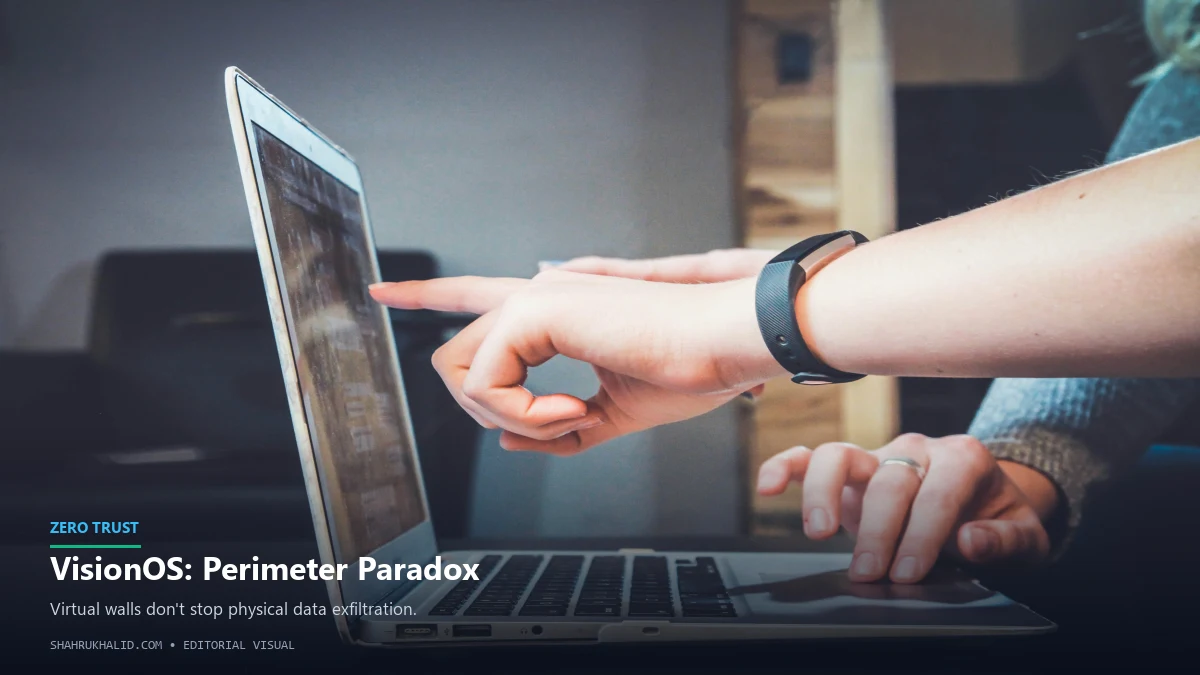
The turning point for me occurred during a routine architectural review in a shared workspace. I realized that while my device was encrypted and my connection was via a hardened VPN, the “physical layer” of my data was entirely exposed. Anyone walking behind me could, with high-resolution glasses or even a well-placed smartphone camera, reconstruct the contents of my spatial windows through reflection or direct observation. Software-defined privacy assumes the screen is a private portal; spatial computing assumes the screen is a public installation.
I began to treat my VisionOS workspace like a high-security physical vault. If I am in an environment where I cannot verify the physical line-of-sight, I treat the data as if it were being projected onto a public billboard. This shift in mindset—from “is my device secure?” to “is my environment secure?”—is the bedrock of modern spatial protection. It requires a fundamental re-evaluation of how we handle sensitive data in mixed reality.
Establishing the Physical Verification Protocol
To secure your workflow in a spatial environment, you must implement a rigorous verification process. This is not about complex software configurations, but about disciplined behavioral patterns that turn your physical presence into a security asset.
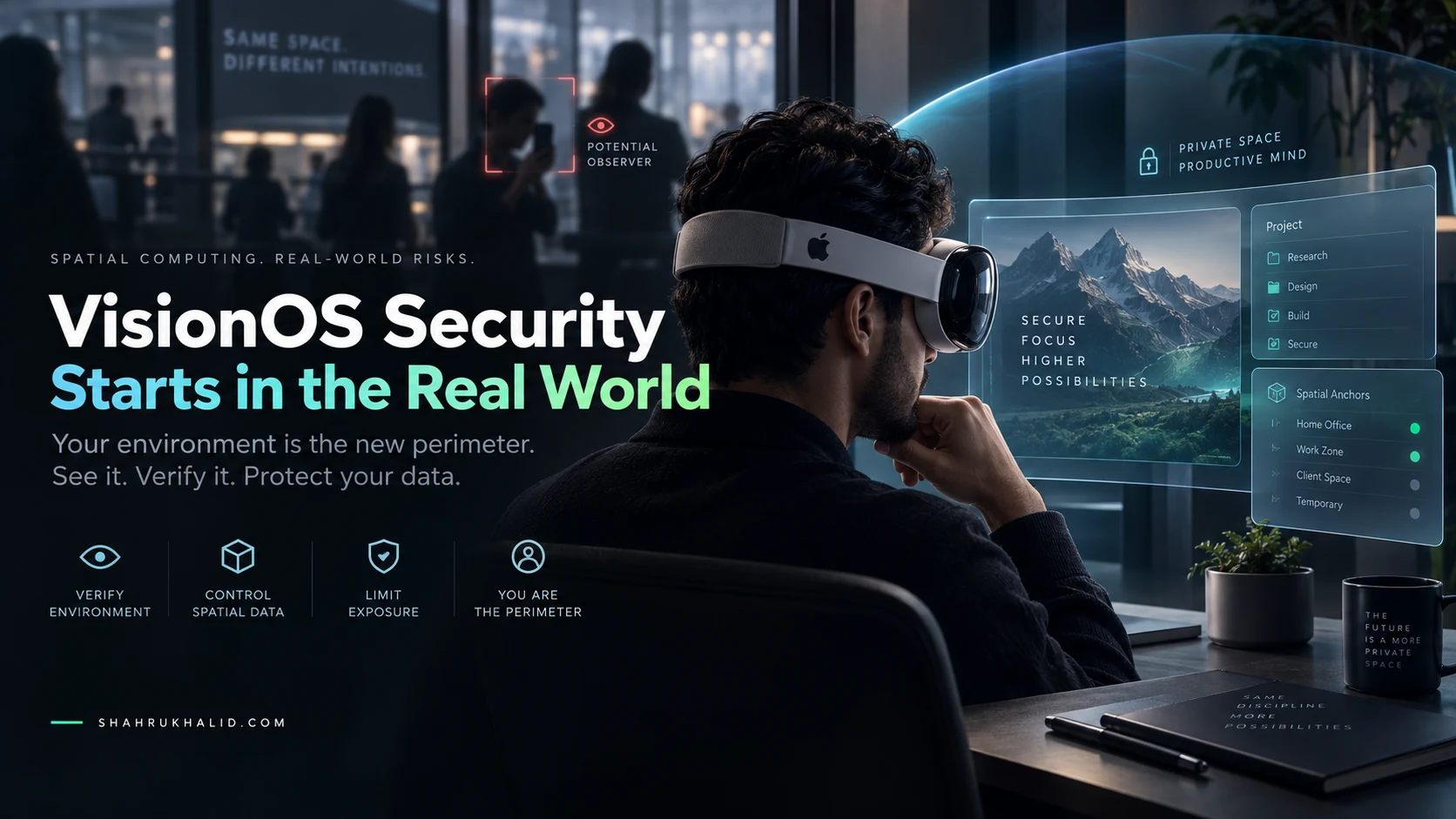
- Spatial Anchoring Awareness: Before initializing any high-sensitivity task, verify the physical geometry of your workspace. Ensure that your “privacy zone”—the area where your virtual windows are rendered—is not overlapping with public transit zones or high-traffic corridors.
- The “Field-of-View” Audit: Treat your peripheral vision as a security perimeter. If a space allows for uncontrolled traffic behind your line of sight, do not render sensitive data in that environment. Use the VisionOS system’s ability to limit content to specific, controlled spatial anchors.
- Ocular Authentication Continuity: Rely on the biometric nature of the device as a constant, not a one-time event. If you feel the device lose its calibrated lock on your eyes, treat it as a potential security breach and clear your workspace immediately.
- Ambient Sensor Discipline: Be mindful of the sensors on your device. They are constantly mapping the world around you. Ensure that you are not inadvertently recording or mapping sensitive physical environments, such as client offices or secure facilities, where spatial metadata could be harvested.
The Human-in-the-Loop Architecture for Data Access
The most robust security measure in a spatial world is the human observer. By adopting a “Human-in-the-Loop” (HITL) approach to data access, you ensure that no data is rendered into the spatial environment without an explicit, conscious verification of the physical context. In my own workflow, I have adopted a “Zero-Spatial-Trust” framework. This means that every window I open, every document I pin to my wall, and every virtual monitor I spawn is treated as a temporary, volatile asset that must be manually cleared upon completion of the task.
This is not just about closing windows; it is about managing the persistence of data in a space. In a standard computer, when you turn off the monitor, the data is gone. In spatial computing, the data is tied to a location. If you leave your desk, that data technically remains in that location until you dismiss it. Failing to “clean up” your spatial environment is the equivalent of leaving a printed ledger on a park bench.
Integrating Physical Verification into Daily Operations
Implementing these practices requires a shift in how you view your “digital office.” You are no longer just a user; you are a spatial architect. Your security posture should be as deliberate as your design decisions.
- Designate Secure Zones: Map out specific physical locations where you are authorized to access sensitive data. Treat these locations with the same level of security as a server room. If you are not in a “verified zone,” restrict your VisionOS activity to low-sensitivity tasks.
- Active Monitoring of Spatial Anchors: Regularly review the spatial anchors your device has created. Delete any stale anchors that represent sensitive areas or past workspaces to prevent “spatial ghosting,” where data might be incorrectly re-rendered in an insecure location.
- Physical Hardware Obfuscation: Use physical privacy filters for your workspace when possible. While this sounds counter-intuitive for a headset, it involves choosing environments that are naturally shielded from public view—using corners, alcoves, or back-facing seating positions to minimize your spatial footprint.
- Periodic Environmental Resets: Just as you clear your browser cache, clear your spatial cache. Rebooting the environment forces the device to re-map the room and re-authenticate your presence, ensuring that no lingering processes are maintaining access to sensitive data in an untrusted context.
The Future of Spatial Security: Vigilance as a Skillset
As we move deeper into the age of mixed reality, the tools provided by platforms like VisionOS will undoubtedly become more robust, offering advanced features like spatial encryption and automatic privacy masking. However, technology will never replace the necessity of human judgment. The true revolution in VisionOS security will not come from a software update, but from a fundamental change in how we perceive our place in the digital world.
We are the architects of our own digital boundaries. By physically verifying every data access point and treating our workspace as a tangible, vulnerable environment, we can reclaim the privacy that the spatial transition threatens to erode. The future of secure computing is not in the cloud; it is in the space right in front of your eyes. Guard it with the same intensity you would guard a physical safe, because in the world of spatial computing, your vision is the most valuable asset you own.
Key Takeaways for the Spatial Professional
Transitioning to a secure spatial workflow requires moving away from passive trust and toward active, physical verification. Keep these principles at the forefront of your professional practice:
- Environment is Security: Your physical surroundings are now an extension of your digital perimeter; choose them wisely.
- Persistence is a Risk: Always clear your spatial anchors and dismiss sensitive windows; never assume the digital air is clear just because you turned away.
- Spatial Awareness as Defense: Your peripheral vision and the physical layout of your workspace are your first and last lines of defense.
- Human-in-the-Loop: You are the ultimate validator of your data’s safety; if you aren’t sure who is watching, the data shouldn’t be visible.