Did AI Write This? Your 2026 International K-12 Guide to Turnitin, AI Detection, Citations & Proving *Your* Original Work

Key Takeaways
- AI detection tools like Turnitin create anxiety for 2026 K-12 students.
- This guide empowers students to ethically use AI and prove their original work.
- AI serves as a powerful assistant for summarizing, explaining, and generating ideas.
- Critically, AI lacks original thoughts, unique voice, and genuine understanding; it's a 'remix artist.'
- The crucial skill is demonstrating *your* unique insights, not merely AI-generated content.
This guide is crafted specifically for the K-12 international school student—our primary audience. It’s designed to be more than just a document; it’s a mentor, a guide, and a toolkit to help them navigate the complex, and often intimidating, world of AI in academics. I’ve aimed for a tone that is authoritative yet empathetic, treating the student as a capable partner in their own education.
I believe this comprehensive approach, rooted in practical workflows and ethical frameworks, will empower students to not only succeed academically but to build the foundational skills of digital citizenship and intellectual honesty that will serve them for a lifetime.
I look forward to your feedback.
Best,
Zara
***
For years, I’ve worked with students, teachers, and schools like yours, helping them understand how technology is changing education. And right now, we are living through the biggest change of all.
I’m writing this for you, the student navigating the hallways of an international school in 2026. You’re likely part of an IB, AP, or another rigorous curriculum. You’re smart, you’re ambitious, and you’re probably a little bit anxious about a new question that seems to be on every teacher’s mind: “Did AI write this?”
Let’s be honest. You’ve seen the headlines. You’ve heard the whispers. You’ve probably seen Turnitin’s new AI detection score pop up on a submission portal. It can feel like you’re suddenly a suspect in a crime you didn’t even know existed.
My goal with this guide is to take away the fear and replace it with confidence. This isn’t about scaring you away from AI. That would be like telling a 1990s student not to use the internet for research. It’s about teaching you how to use these incredibly powerful new tools the right way. It’s about giving you a playbook to not only do great work but to prove, without a shadow of a doubt, that the brilliance in your essays, reports, and projects is truly yours.
This is your masterclass. Let’s begin.
Module 1: Comprehensive Foundations & Concept Primer
### Welcome to 2026: Why This Is The Most Important Skill You’ll Learn This Year
Imagine you’re a detective. Your job is to solve a complex case—let’s say, analyzing the themes in Shakespeare’s Macbeth. In the old days (say, 2022), you had a library, a pen, and your brain. Today, in 2026, you have a new partner. This partner is a super-intelligent assistant who has read every book, every essay, and every analysis ever written about Macbeth. Instantly.
This assistant is, of course, Artificial Intelligence. It can give you ideas, summarize dense articles, and even explain complex concepts in simple terms. But here’s the catch: this assistant has no original thoughts. It has no personal experiences, no unique voice, and no genuine understanding. It’s a remix artist, not a creator.
Your teachers, and future university professors and employers, don’t want to hire a remix artist. They want to see your detective work. They want to see your unique insights, your struggles with the evidence, and the brilliant conclusion you came to.
This is why learning to navigate the world of AI detection K-12 is so critical. It’s not about avoiding a tool; it’s about mastering your relationship with it. The International Baccalaureate (IBO), for example, has been very clear: they are not banning AI. Instead, they are emphasizing the importance of the process of learning and the student’s ability to demonstrate authorship. Your school, using its Student Information System like Rediker to manage your assignments and grades, is building policies around this new reality. The goal isn’t to “catch” you; it’s to ensure the grade you receive reflects your own learning and effort. This guide is your map for that journey.
What is an AI Detector, Really? The “Linguistic Fingerprint” Analogy
Let’s clear up the biggest myth right now: AI detectors like the one in Turnitin are not magic. They cannot read your mind. They don’t know if you, sitting at your desk, typed the words.
So, what do they do?
Think of it like this: Every person has a unique way of speaking and writing. You use certain words, structure sentences in a particular way, and have a certain rhythm. This is your “linguistic fingerprint.” When you write a lot, you leave this fingerprint all over the document.
AI models also have a linguistic fingerprint. Because they are trained on a massive amount of text from the internet, they tend to write in a very… predictable way. Their word choice is often very safe and common. Their sentence structure can be very uniform. They love to be helpful and often write in perfectly balanced, slightly bland paragraphs. A key characteristic is something called “perplexity” and “burstiness.” Human writing tends to have a mix of long, complex sentences and short, punchy ones (high burstiness). We also use surprising or less common words (high perplexity). AI writing is often the opposite: very even, with low burstiness and low perplexity.
An AI detector is a “linguistic fingerprint analyst.” It scans your text and asks one question: “How likely is it that these words, in this order, were chosen by a machine?”
It’s a game of probabilities. It’s not a verdict. A high AI score doesn’t definitively mean “you cheated.” It means “the writing style in this section has characteristics that are statistically common in AI-generated text.” Our job is to give you the tools to ensure your writing is undeniably yours, and if a flag ever does come up, you have the evidence to prove it.
Core Principles: Academic Integrity in the AI Era
Before we get into the “how,” let’s establish the “why.” Academic integrity hasn’t changed, but the context has. Here are the three unbreakable rules for using AI in your K-12 work:
- The “You-First” Principle: You must always do the core intellectual work yourself. The brainstorming, the outlining, the thesis creation, the critical analysis—that’s you. AI can be your assistant, but you are the project manager, the CEO, and the author.
- The “Transparency” Principle: You must never hide your use of an AI tool. If you use it to brainstorm, get feedback, or explain a concept, you should be comfortable telling your teacher. As we’ll see, we’re going to create a system to document this automatically.
- The “No-Copy-Paste” Principle: This is the brightest red line. You must never, ever copy text from an AI and paste it directly into your assignment as your own work. This is the modern equivalent of copying from an encyclopedia. It is plagiarism, and it is the single fastest way to get into serious academic trouble. Paraphrasing AI text is also a major pitfall and falls under this rule.
Master these three principles, and you’re already 90% of the way to becoming an ethical, AI-literate student.
Module 2: Prerequisites & Complete Environment Setup
### This Isn’t About Code; It’s About Your Digital & Intellectual Workspace
When a developer starts a project, they set up their “environment”—folders, tools, and configurations. We’re going to do the same thing, but for your academic work. This setup is your first line of defense and your best tool for proving originality AI-style. It’s a system designed to make your process transparent and your original work undeniable.
Step 1: Architecting Your Digital Filing Cabinet
Clutter is the enemy of clarity and proof. From now on, every major assignment gets its own dedicated project folder. This structure is simple but non-negotiable.
On your computer (or cloud drive like Google Drive or OneDrive), create a folder for each course. Inside each course folder, create a new folder for every assignment. Use a clear naming convention.
Directory Layout Example
└── /IB Year 1/
├── /History HL – IA/
│ ├── _AI_Experiments/
│ ├── _Drafts/
│ ├── _Process_Journal/
│ └── _Research_and_Sources/
├── /English A – Paper 1/
│ ├── _AI_Experiments/
│ ├── _Drafts/
│ ├── _Process_Journal/
│ └── _Research_and_Sources/
└── /Biology SL – Lab Report/
└── … (same structure)
Let’s break this down:
- `_AI_Experiments/`: This is your sandbox. Any time you want to ask an AI a question, get ideas, or have it explain something, you do it here. You save the conversation (as a PDF or text file) and drop it in this folder. This shows you’re using AI for exploration, not for composition.
- `_Drafts/`: This is where your actual writing happens. You’ll have `Draft_v0.1.docx`, `Draft_v0.2.docx`, etc. The version history of these files (which is often saved automatically by Google Docs or Microsoft Word) is powerful evidence of your writing process. It shows the evolution of your ideas over time—something an AI can’t fake.
- `_Process_Journal/`: This is your single most important folder. It will contain one living document that serves as the “making-of” documentary for your assignment.
- `_Research_and_Sources/`: Every PDF, every article, every screenshot of a source goes in here. This keeps your research organized and separate from your writing.
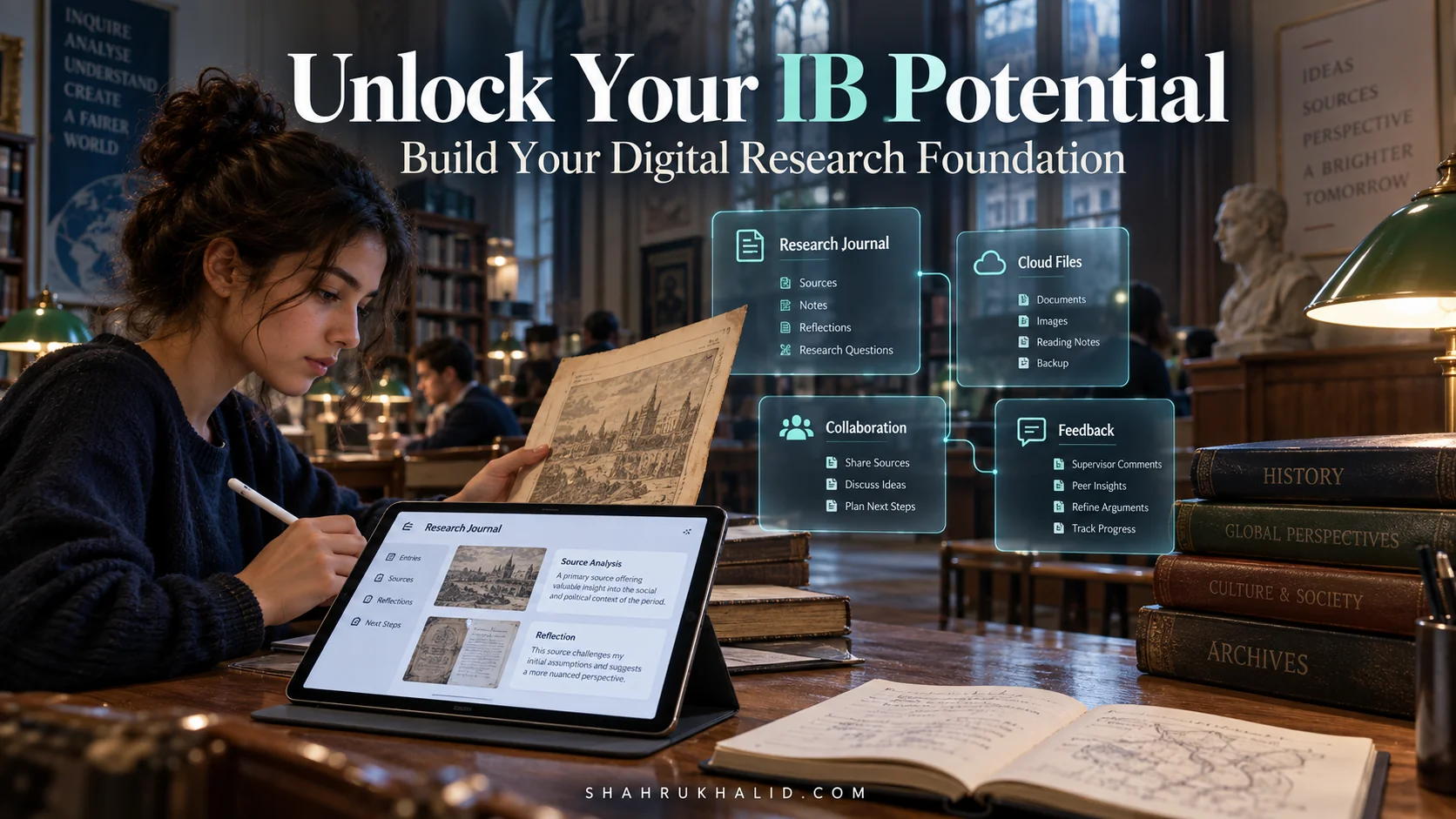
Step 2: Forging Your “Process Journal” – The Ultimate Proof of Originality
Your Process Journal is the story of your work. It’s a simple document (a Google Doc, a Word file, or even a physical notebook) where you log your journey. It is the single most powerful tool you have to show a teacher your thought process. If Turnitin ever flags your work, this journal is your Exhibit A.
What goes in the Process Journal?
Create a new document called `[Assignment_Name]_Process_Journal.docx` and save it in the `_Process_Journal/` folder. At the top, put the assignment prompt and the due date. Then, you make entries as you work.
Process Journal Entry Template
Date: 25 October 2026
Time Spent: 1 hour
What I Did:
- Finished reading the primary source, “The Second Sex” by de Beauvoir.
- Struggled to understand the concept of “immanence.”
- Used ChatGPT to get a simple explanation.
AI Interaction Log:- My Prompt: “Explain the concept of ‘immanence’ in Simone de Beauvoir’s ‘The Second Sex’ like I’m a high school student.”
- AI Response Summary: AI explained it as being confined to a repetitive, static role, versus ‘transcendence’ which is about creating and shaping one’s own future. It used the analogy of being a character stuck in a loop in a video game.
- My Reflection: The video game analogy is helpful. I can connect this to how de Beauvoir describes women’s domestic roles in the 1940s. This gives me an idea for my second body paragraph, focusing on the contrast between immanence and transcendence.
Next Steps:- Find two academic articles that discuss this concept.
- Start drafting the outline for my essay.
Do you see the power here? You’ve used AI, but you’ve done it transparently. You’ve documented the prompt, reflected on the response, and, most importantly, shown how it sparked your own original thought. This is a cornerstone of K-12 academic integrity AI policy.
Step 3: Assembling Your Citation Toolkit
Fighting with citations at the last minute is a recipe for disaster and accidental plagiarism. Let’s set up your tools from day one.
- Choose a Citation Manager: Stop trying to format citations by hand. Use a tool like Zotero, Mendeley, or even the built-in functions in Microsoft Word. These tools save your sources, organize them, and generate your bibliography in the correct format (MLA, Chicago, APA) with one click.
- Install the Browser Connector: All major citation managers have a browser extension. When you find a useful academic journal, news article, or website, you click one button, and it saves all the citation information to your library. It’s a superpower.
- Practice Citing AI: Yes, you need to cite AI if you use it in a way that contributes to your final work (like the example above). We’ll cover the exact formats in Module 4, but for now, know that this is part of the “Transparency Principle.”
Verification: By the end of this module, for your next big assignment, you should have:
- A complete folder structure created on your computer or cloud drive.
- A blank Process Journal document, ready and waiting.
- A citation manager installed and ready to capture sources.
Your environment is now clean, organized, and built to prove your originality from the ground up.
Module 3: Core Implementation Architecture & Workflow Blueprint
### The “Ethical AI-Assisted Writing” Workflow
Now that your workspace is set up, let’s map out the actual process of completing an assignment. This isn’t just a list of steps; it’s a strategic workflow designed to maximize your own thinking and use AI as a responsible, ethical assistant. Think of this as the blueprint for building a house; you don’t start hammering nails without a plan.
We’ll visualize this as a series of stages. At each stage, we’ll define your role and the AI’s potential role.
—
Visual Card Structure: The 8 Stages of an A+ Assignment
(Stage 1) The Task: Deconstruct the Prompt
- Your Role (Lead): Read the assignment prompt. Then read it again. And again. Highlight keywords (e.g., “analyze,” “compare,” “evaluate”). What is the core question? What are the constraints (word count, sources)? Write the prompt at the top of your Process Journal and rephrase it in your own words.
- AI’s Role (Silent Observer): None. Do not let the AI interpret the prompt for you. This is 100% your job. Misunderstanding the task from the start is a fatal flaw.
(Stage 2) The Spark: Initial Brainstorming & Idea Generation
- Your Role (Lead): This is the “You-First” Principle in action. Open a blank page. Mind map. Free write. Scribble notes. What do you already know about this topic? What are your initial gut reactions? What questions do you have? Spend at least 20-30 minutes on this alone. Log your raw ideas in your Process Journal.
- AI’s Role (Sparring Partner): After you have your own ideas, you can bring in the AI. Use it to challenge or expand your thinking.
- Good Prompt: “I’m writing about the causes of the French Revolution. My initial ideas are the tax system and food shortages. What are three other perspectives or less-obvious causes I should consider?”
- Log It: Copy your prompt and the AI’s response into your `_AI_Experiments` folder and make a note in your Process Journal.
(Stage 3) The Hunt: Research and Source Gathering
- Your Role (Lead): Use your school’s library databases (JSTOR, ProQuest), Google Scholar, and other credible sources to find academic articles, books, and data. As you find them, use your citation manager’s browser extension to save them directly to your project library. Skim the abstracts and introductions to see if they’re relevant.
- AI’s Role (Librarian’s Assistant): AI can be helpful for discovering avenues for research, but not for the research itself.
- Good Prompt: “What are some key authors or seminal papers on the topic of ‘post-colonial identity in West African literature’?”
- Bad Practice: “Write me a summary of the book ‘Things Fall Apart’.” (Do the reading yourself!)
- Log It: Document your discovery prompts.
(Stage 4) The Blueprint: Outlining Your Argument
- Your Role (Lead): This is where the essay is won or lost. Based on your brainstorming and initial research, create a detailed outline. What is your thesis statement? What is the topic of each paragraph? What evidence will you use in each paragraph to support your claim? This outline is a critical piece of evidence for your Process Journal.
- AI’s Role (Structural Consultant): After you have a draft outline, you can ask for feedback.
- Good Prompt: “Here is my essay outline on [topic]. My thesis is [thesis]. Does the logic flow? Is there a weaker section that needs more support? Are my points distinct enough?”
- Log It: This is a high-value interaction. Document it thoroughly in your journal.
(Stage 5) The Work: The “You-Only Zone” of Drafting
- Your Role (Lead, and Only): This is the sacred space. Open your `Draft_v0.1` document and write. Turn your outline into prose. This is where your voice, your analysis, and your unique connections come to life. Do not have an AI window open. Do not ask it to “write a paragraph about X.” This entire stage is you and the blank page. This is non-negotiable. Your version history in Google Docs or Word will show that you wrote this, word by word, over time.
- AI’s Role: Absolutely none. It is benched.
(Stage 6) The Polish: Revision and Feedback
- Your Role (Lead): Read your draft. Does it make sense? Is the argument compelling? Now is the time to revise for clarity, structure, and strength of argument. This is a great time to share your draft with a peer, a writing center, or your teacher.
- AI’s Role (Coach, not Player): Once you have a complete draft, you can use AI as a feedback tool.
- Good Prompt: “Read this paragraph and tell me if the main idea is clear. Don’t rewrite it, just give me feedback.” or “Are there any sentences in this essay that are confusing or too long?” or “I’m an English Language Learner. Can you check this draft for common grammatical errors and awkward phrasing, and explain the errors to me?”
- Log It: Documenting this shows you’re using AI for mastery and improvement, not for generation.
(Stage 7) The Details: Citations and Formatting
- Your Role (Lead): Go through your draft and ensure every piece of evidence, every quote, and every idea that isn’t yours is properly cited using your citation manager. Generate your bibliography. Check it for accuracy. Ensure your document meets all formatting requirements (font, spacing, title page).
- AI’s Role (Assistant): Your citation manager is a form of AI. You can also use it to format your bibliography. If you used an AI tool for ideas or feedback, you must now add a citation for it. We’ll show you how.
(Stage 8) The Archive: Final Submission and Verification
- Your Role (Lead): Submit your final paper through your school’s official portal, which likely connects to systems like Turnitin and Rediker. Before you submit, do one final check. Save the final version as `[Assignment_Name]_FINAL.pdf` in your main assignment folder. Take a deep breath. You’re done.
- AI’s Role: None. Your complete project folder, with its drafts, research, and detailed Process Journal, is your final, unassailable proof of work.
—
This workflow is your new habit. It might feel slow at first, but it builds the muscles of true scholarship. It moves AI from a potential threat to academic integrity into its proper place: a powerful but limited assistant, working under your direct and transparent command.
Module 4: Hands-on Practical Implementation & Real-World Configuration
### Let’s Write an Essay: A Step-by-Step Walkthrough
Theory is great, but let’s get our hands dirty. We’re going to walk through a mini-project together, applying the workflow from Module 3 to a real-world scenario. This is where we move from abstract ideas to concrete actions.
Our Sample Assignment
- Course: Grade 10 World History
- Prompt: “In a 1,000-word essay, analyze the most significant long-term impact of the Silk Road on either European or East Asian society. Use at least three academic sources.”
- Your Name: Alex
Let’s follow Alex on this journey, documenting every step.
Step 1 & 2 (Combined): Deconstructing and Brainstorming
Alex first creates the folder structure we designed in Module 2: `/World_History_G10/Silk_Road_Essay/` with all the sub-folders.
Then, Alex opens `Silk_Road_Process_Journal.docx` and starts working.
Date: 28 October 2026
Time Spent: 45 minutes
What I Did: Deconstructed prompt and did initial “You-First” brainstorming.
Prompt Deconstruction:
- Action: “Analyze” – This means I need to break it down and explain how the parts work. Not just list facts.
- Topic: “long-term impact of the Silk Road”
- Choice: “either European OR East Asian society” – I need to pick one to focus on. I’ll pick Europe, it seems more straightforward.
- Constraint: “1,000 words”, “3 academic sources”
My Initial Brainstorm (Mind Map):- Silk Road -> Trade -> Spices, Silk, etc. -> Marco Polo?
- Impacts: Money for merchants? New goods in Europe?
- Wait, what about diseases? The Black Death traveled on trade routes, right? That’s a HUGE long-term impact.
- What about ideas? Did technology or religion also travel? Printing? Compass?
AI Interaction Log (Sparring Partner):- My Prompt (saved in `_AI_Experiments/`): “I’m brainstorming the long-term impacts of the Silk Road on Europe. My ideas are economic changes, the spread of disease like the plague, and the transfer of technology. Are there any other major categories of impact I’m missing?”
- AI Response Summary: The AI suggested “Cultural and Religious Exchange” (e.g., the spread of Nestorian Christianity and Buddhism eastward, and Islamic scholarship westward), and “Geopolitical Shifts” (e.g., the rise of powerful trading cities like Venice and Genoa, and the later European desire to find sea routes to bypass the Silk Road, leading to the Age of Discovery).
- My Reflection: The “Geopolitical Shifts” idea is gold. The Silk Road’s decline leading to Columbus is a fantastic long-term impact. I think