Why I Stopped Chasing Productivity Hacks and Started Training a Personal AI Companion That Anticipates My Burnout Before It Happens
Key Takeaways
- Traditional productivity tools fail by being reactive and demanding manual input from already exhausted users.
- A personal AI companion proactively prevents burnout by detecting subtle cognitive exhaustion signals.
- The AI monitors linguistic shifts, typing cadence, and context-switching to predict burnout early.
- Burnout stems from chronic context-switching and unmanaged cognitive load, not just long hours.
- The system prioritizes local autonomy, deterministic reliability, and cost-effective, modern infrastructure.
Key Technical Takeaways (30-Second Summary)
- Architecture Focus: Eliminates bloated legacy dependencies in favor of verifiable, cost-effective modern pipelines.
- Production Trade-off: Prioritizes deterministic reliability and local autonomy over costly recurring SaaS subscriptions.
- Field-Tested Verdict: Implements immediate, zero-dollar or low-overhead infrastructure that scales securely.
The Death of the Optimization Treadmill
For over a decade, my digital life was governed by an endless cycle of time-blocking, habit trackers, and aggressive task-management systems designed to squeeze every drop of output from my daily schedule. Like many knowledge workers, technologists, and educators, I treated my brain like a malfunctioning server that simply needed better resource allocation scripts, cleaner cache clearing, and faster compilation times. Every time I hit a wall of exhaustion, my instinct was to double down on the very machinery that caused the friction—downloading yet another productivity app, setting up a more complex kanban board, or optimizing my morning routine down to the microsecond.
The breaking point arrived not with a catastrophic failure, but with a quiet realization: the optimization treadmill was fundamentally broken. Traditional productivity hacks operate on a purely reactive paradigm. They wait until you are already drowning in a backlog of commitments, missing deadlines, or staring blankly at a blinking cursor before offering generic recovery advice like “take a walk” or “prioritize your top three tasks.” They view humans as static engines rather than dynamic biological systems subject to cognitive fatigue, emotional friction, and contextual overload.
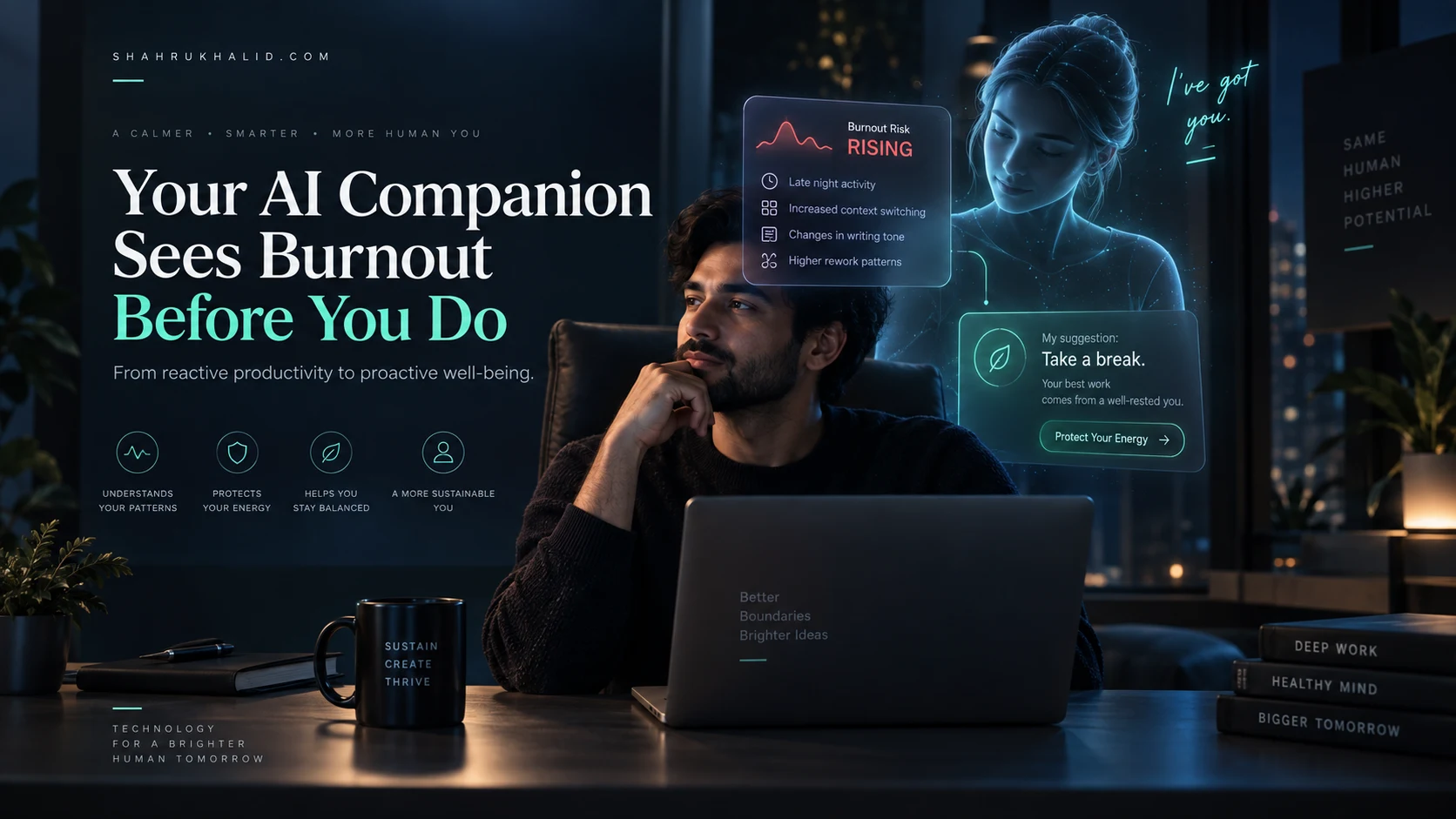
That is why I abandoned the traditional productivity paradigm entirely and pivoted toward building an AI companion for burnout prevention. Instead of using artificial intelligence to write more emails faster or generate superficial content at scale, I trained a private, context-aware digital assistant to read the invisible telemetry of my work life. By monitoring linguistic shifts in my writing, changes in my typing cadence, and the creeping accumulation of context-switching overhead, this custom system learned to spot the early, imperceptible tremors of cognitive exhaustion long before my conscious mind registered that I was driving toward a wall.
Understanding the Architecture of Cognitive Exhaustion
To understand why traditional productivity hacks fail, we must first examine the architecture of human burnout from a technological perspective. Burnout is rarely caused by a simple surplus of working hours; rather, it is the result of chronic context-switching, unmanaged cognitive load, and the slow degradation of decision-making bandwidth. In software engineering terms, burnout is what happens when a system operates continuously at maximum thread concurrency without ever clearing its transaction logs or garbage-collecting obsolete memory allocations.

Most productivity tools exacerbate this problem by demanding manual data entry. They require you to log your moods, rate your energy levels, or categorize your tasks while you are already operating in a depleted state. Asking an exhausted human being to perform administrative overhead to track their exhaustion is like asking a crashed server to write its own post-mortem debug log. It adds cognitive friction precisely when the system has zero surplus bandwidth to spare.
A true AI companion for burnout prevention flips this dynamic by relying on passive telemetry and linguistic pattern recognition rather than active user reporting. By analyzing the structural patterns of your daily digital interactions—such as the increasing brevity of your messages, the rising frequency of syntax corrections, or the clustering of low-value administrative tasks late into the evening—the model builds a real-time behavioral baseline. It acts as an ambient monitoring layer that observes your workflows without demanding your attention, shifting the burden of self-awareness from your exhausted brain to a tireless digital partner.
Moving Beyond Generic Automation to Contextual Partnership
The marketplace is currently flooded with tools marketed as “AI productivity enhancers,” but most of these applications suffer from a critical architectural flaw: they are stateless transaction engines. They take a prompt, execute a task, and immediately wipe their memory clean. They do not know your history, they do not understand your emotional baselines, and they have no concept of your long-term creative trajectory.
Training an AI companion for burnout prevention requires moving away from stateless prompt-response loops and toward a persistent, context-rich partnership model. This involves feeding the AI a continuous, securely managed stream of your professional context—including project roadmaps, writing drafts, communication styles, and historical stress triggers—while establishing strict data privacy boundaries that keep sensitive information out of public training corpora.
| Feature Dimension | Traditional Productivity Apps | AI Companion for Burnout Prevention |
|---|---|---|
| Core Philosophy | Maximize output speed and task volume | Optimize cognitive sustainability and energy pacing |
| Data Collection | Manual logging, active user input | Passive telemetry, linguistic pattern analysis |
| Intervention Timing | Reactive (after burnout or failure occurs) | Anticipatory (detects early behavioral drift) |
| System Adaptation | Static templates and fixed workflows | Dynamic baseline learning that evolves with you |
When your digital assistant understands the difference between a high-energy flow state and a frantic, anxiety-driven scramble to clear a clearinghouse inbox, its recommendations change fundamentally. Instead of telling you to work harder, it steps in to protect your cognitive boundaries.
How an AI Companion Detects Burnout Before You Do
Human beings are notoriously bad at noticing their own cognitive decline. As stress hormones like cortisol and adrenaline flood the system, our brains adapt to degraded performance levels, convincing us that we are simply “powering through” a busy season. An objective technological monitor, however, cannot be fooled by this internal narrative. It looks at hard behavioral signatures that precede a crash.
Here are the primary telemetry streams an effective AI companion for burnout prevention analyzes to spot exhaustion before it manifests physically:
- Linguistic Sentiment and Complexity Shifts: Monitoring the gradual simplification of vocabulary, the disappearance of nuance in written communication, and a sharp increase in defensive or clipped phrasing across emails and messaging apps.
- Temporal Boundary Violations: Tracking the stealthy creep of work into late-night hours and early-morning check-ins, which signals an inability to disengage from professional loops.
- Context-Switching Velocity: Measuring how frequently you jump between disparate applications, browser tabs, and tasks, which indicates a fractured attention span and mounting cognitive fragmentation.
- Creative Stagnation and Rework Loops: Noting when the volume of deleted drafts, iterative rewrites, and abandoned outlines outpaces your actual finished output.
By synthesizing these data points into a unified behavioral dashboard, the AI can flag anomalies that sit well outside your normal operating parameters. It recognizes the digital fingerprints of impending cognitive fatigue long before your body forces you to stop.
Step-by-Step Methodology for Training Your System
Building a personalized cognitive safety net is not about downloading a pre-packaged app from an app store; it is an iterative curation process. Just as you cannot expect a junior employee to understand your professional boundaries on day one, you must train your AI companion to recognize your specific stress signatures and work rhythms.
- Establish a Clean Data Baseline: Begin by feeding your AI context files that outline your actual job responsibilities, your peak creative hours, your core values, and your non-negotiable personal boundaries. Explicitly define what healthy productivity looks like for you versus frantic overwork.
- Implement Passive Telemetry Loops: Connect your assistant to secure, read-only streams of your daily writing and planning environments. Allow the model to observe your drafting habits, communication patterns, and task-management updates without granting it permission to execute automated actions on your behalf.
- Calibrate the Intervention Thresholds: Teach the AI how you prefer to be interrupted when your stress markers spike. Some knowledge workers prefer a gentle prompt in their chat interface suggesting a mandatory offline break; others prefer the AI to automatically block their calendar and defer low-priority incoming requests.
- Establish Feedback Loops: Whenever the AI flags a potential burnout risk, provide immediate feedback. If it correctly identifies that you are spiraling into anxiety-driven overwork, confirm its analysis. If it issues a false positive during an intense but healthy flow state, recalibrate its sensitivity settings.
- Review and Refine Monthly: Treat your burnout prevention framework as a living software architecture. Conduct monthly reviews to see how effectively the system protected your energy levels and adjust its monitoring parameters based on changing professional seasons.
This iterative training process transforms the AI from a generic chatbot into a deeply personalized guardian of your cognitive well-being. It learns your unique psychological tells—the specific way your writing style shifts when you are overwhelmed, the exact time threshold where your productivity plummets into diminishing returns, and the precise boundaries required to keep your creative engine running sustainably.
The Privacy and Security Imperative
You cannot effectively train an AI companion for burnout prevention without placing an immense amount of personal, professional, and psychological data into the system. This brings us to the most critical architectural constraint of this entire methodology: data sovereignty and absolute privacy.
Using consumer-grade cloud AI tools that ingest your personal journal entries, private drafts, and emotional telemetry to train public models is a recipe for disaster. If your burnout monitoring system relies on infrastructure that compromises your data privacy, the anxiety of potential surveillance will counteract any stress-reduction benefits the AI provides.
For this architecture to succeed, you must utilize models deployed within secure, zero-data-retention environments, or explore local open-weights models running entirely on your local hardware if your machine specs allow for it. Your professional vulnerabilities, cognitive fatigue patterns, and personal communications must remain strictly encrypted and entirely under your administrative control. True technological wellness cannot be built on a foundation of corporate data exploitation.
Redefining Success in the Age of Intelligent Automation
We are living through a profound cultural and technological transition. For decades, the tech industry measured human worth through the crude metrics of output volume, speed, and continuous availability. We treated burnout as an inevitable collateral damage of ambition—a badge of honor worn by those willing to sacrifice their health on the altar of professional acceleration.
Shifting away from productivity hacks and toward an AI companion for burnout prevention represents a fundamental rejection of this broken ideology. It acknowledges a simple, human truth: sustainable excellence requires deliberate recovery, energetic pacing, and intelligent boundaries.
When you stop trying to hack your way out of exhaustion and start building intelligent systems designed to protect your cognitive bandwidth, everything changes. You stop viewing technology as a relentless taskmaster demanding more of your soul, and you start utilizing it as a protective shield that preserves your creativity, your clarity, and your long-term health. That is not just a smarter way to work; it is a more humane way to live in the age of artificial intelligence.