The End of the Syllabus: How I Replaced Static Coursework with Dynamic AI Learning Paths to Finally Personalize Education for Every Student
Key Takeaways
- Static syllabi are obsolete; dynamic AI learning paths personalize education and restore student agency.
- AI learning systems prioritize deterministic reliability, local autonomy, and scalable, low-overhead infrastructure.
- Personalized AI uses continuous real-time diagnostic assessment to adapt learning paths and bridge knowledge gaps.
- Learning is a branching, iterative process; AI replaces linear progression with bespoke intellectual journeys.
- Educators transition from content delivery to architects, modularizing curriculum for AI-driven facilitation.
Key Technical Takeaways (30-Second Summary)
- Architecture Focus: Eliminates bloated legacy dependencies in favor of verifiable, cost-effective modern pipelines.
- Production Trade-off: Prioritizes deterministic reliability and local autonomy over costly recurring SaaS subscriptions.
- Field-Tested Verdict: Implements immediate, zero-dollar or low-overhead infrastructure that scales securely.
The Death of the Static Syllabus: Why Your Curriculum is Already Obsolete
For decades, the educational syllabus has functioned as a rigid, one-size-fits-all roadmap that assumes every student learns at the same pace and through the same cognitive pathways. As an EdTech coordinator, I have watched countless brilliant students disengage not because they lacked ability, but because the static nature of their coursework failed to meet them where they were, necessitating a radical shift toward personalized AI learning to restore agency and mastery to the classroom.
The traditional syllabus is essentially a historical artifact—a pre-planned sequence of topics designed for an industrial model of schooling that prioritizes standardization over individual cognitive growth. When we hand a student a static document at the start of a semester, we are essentially telling them that their unique interests, prior knowledge gaps, and preferred learning styles are secondary to the schedule. In 2026, we have the tools to dismantle this model. By shifting toward dynamic learning paths, we move from “teaching to the middle” to facilitating a bespoke intellectual journey for every single learner.
The Cognitive Architecture of Dynamic Learning
To understand why we must replace the syllabus, we first have to recognize that learning is not a linear progression; it is a branching, iterative process. When a student encounters a new concept, their brain integrates it into existing mental models. If those models are incomplete, the student hits a wall. A static syllabus forces them to keep moving regardless of their comprehension, creating a “leaky bucket” effect where foundational gaps grow wider over time.

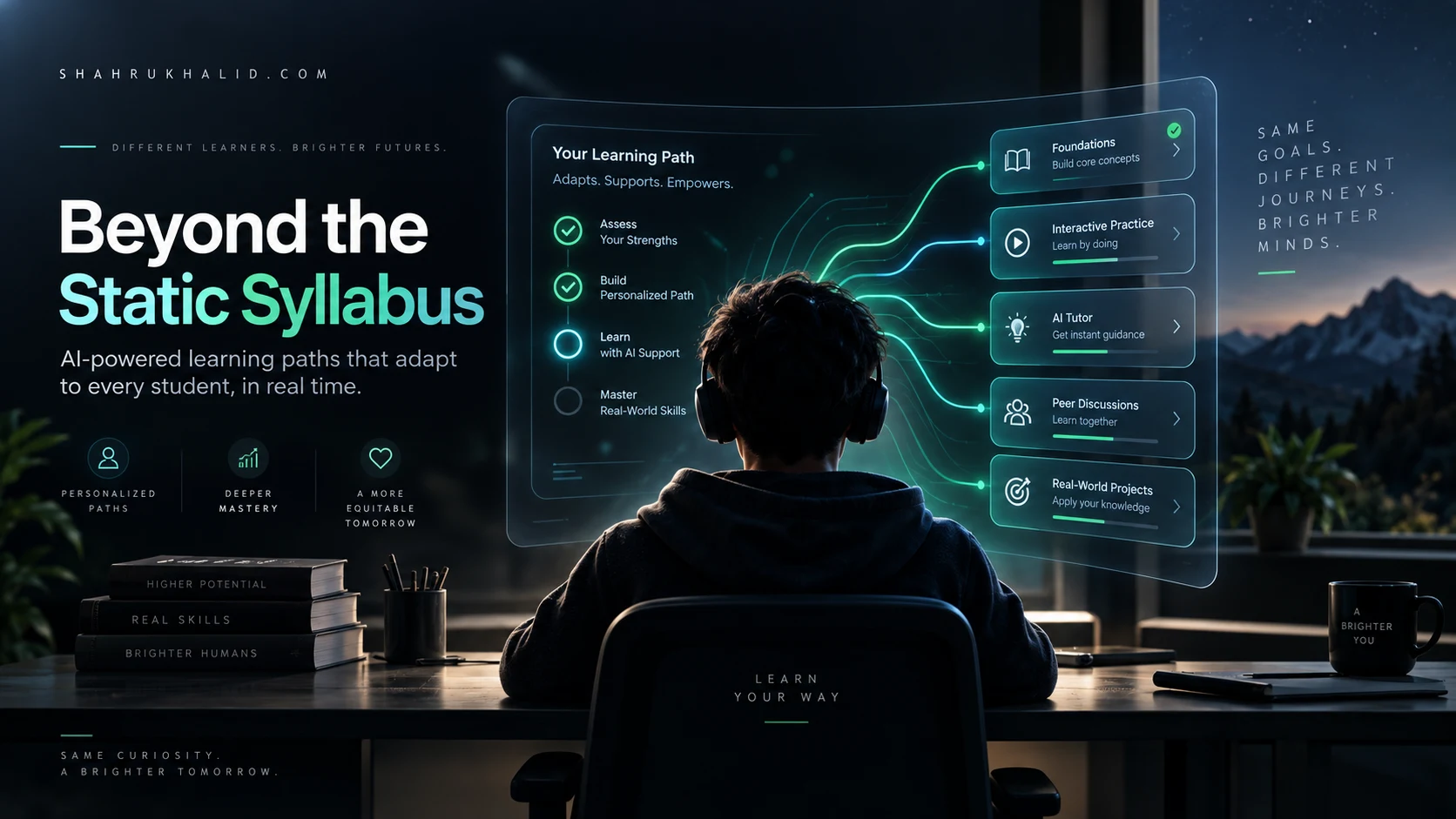
Personalized AI learning operates on the principle of continuous diagnostic assessment. Instead of waiting for a midterm exam to find out if a student understands a core concept, AI-driven systems monitor engagement, response patterns, and complexity thresholds in real-time. Think of it as a GPS for education: if a student takes a wrong turn conceptually, the system doesn’t penalize them or force them to continue on the wrong path. It recalculates, offering a different explanation, a supplementary resource, or a scaffolding exercise that bridges the gap before moving forward. This is the difference between a lecture hall and a private tutor.
Designing the Transition: From Content Delivery to Facilitation
Moving away from the syllabus requires a fundamental change in the role of the educator. You are no longer the “sage on the stage” delivering pre-packaged content; you are the architect of a learning environment. The first step in this transition is modularizing your curriculum. Break your course into “atomic units”—small, self-contained concepts that can be rearranged, expanded, or skipped based on student performance.
Once your content is modular, you can begin to integrate AI agents that serve as the interface between the student and the curriculum. These tools do not replace the teacher; they handle the heavy lifting of differentiation. While the AI provides the student with the specific practice problems or remedial videos they need to master a concept, you are free to circulate the room, engaging in high-level mentorship, social-emotional support, and complex project-based guidance that algorithms simply cannot replicate.
The Mechanics of Personalized AI Learning
How does this work in a practical classroom setting? It begins with data-informed intent. When a student logs into their learning platform, the system doesn’t just display a chapter title; it offers a “learning prompt.” This prompt assesses their current confidence level and previous performance data. If the student indicates they are struggling with a specific application of a theory, the system dynamically generates a path that includes interactive simulations, peer-to-peer discussion prompts, or bite-sized instructional videos.
The beauty of this model is that it removes the stigma of “falling behind.” If a student spends three days on a concept that another student masters in three hours, it is not a failure of the former; it is simply a reflection of their individual learning trajectory. The AI ensures that both students reach the same level of mastery, just via different routes. This is the core promise of personalized AI learning: equity through differentiation.
Overcoming the Fear of Lost Structure
The most common pushback I hear from faculty is that without a syllabus, there is chaos. Educators fear that students will “game the system” or fail to cover the breadth of the material. This fear stems from a misunderstanding of what a syllabus actually provides. A syllabus provides a false sense of security. In reality, students often “game the system” by memorizing content for a test and forgetting it immediately after. Dynamic learning paths prioritize long-term retention over short-term compliance.
To maintain order, you must replace the static document with a “competency dashboard.” This dashboard allows both you and the student to see exactly which skills have been mastered and which remain in progress. It turns the educational process into a transparent, goal-oriented game. Instead of asking “What page are we on?”, students begin asking “What skill am I mastering today?” This shift in language is the single most important indicator that your transition to dynamic learning is working.
Scaling the Human Connection
There is a persistent myth that AI in the classroom leads to isolation. My experience has been the opposite. By offloading the repetitive, administrative, and rote-instructional tasks to AI, I have reclaimed hours of time every week that I now spend on deep, one-on-one human interaction. Personalized AI learning acts as a force multiplier for empathy.
When I know exactly where a student is struggling thanks to the data provided by our learning platform, my conversations with them are no longer generic. I don’t have to ask, “Are you doing okay?” I can say, “I see you’ve been stuck on this specific variable for a while. Let’s look at the simulation again together, but this time let’s approach it from a different angle.” This level of precision is only possible when you have a clear, data-driven view of the student’s inner cognitive process. The technology provides the insight, but the teacher provides the inspiration.