My 2026 K-12 International School Game Plan: Practical Steps for Your Best Year Yet
Key Takeaways
- Applying a developer's mindset architects student success as a personal 'operating system' for life.
- The 'game plan' is a personal blueprint, connecting educational 'LEGO pieces' into a holistic system.
- Success requires 'first principles thinking,' understanding the 'why' before 'what' in academic strategy.
- The plan builds a robust, scalable, high-performance learning system for thriving globally.
- A developer advocate applies technical system breakdown skills to optimize K-12 international school journeys.
And over the years, I’ve realized something profound: the principles that make a software project successful are the exact same principles that make a student successful. Your education isn’t just a series of classes and exams; it’s the most important project you will ever build. It’s your personal “operating system” for life.
So, I’m here to help you architect your success. We’re going to apply a developer’s mindset—structured, strategic, and relentlessly focused on optimization—to your academic journey. This isn’t just another list of study tips. This is your My 2026 K-12 International School Game Plan, a comprehensive masterclass designed to give you the practical steps for your best year yet. We will build a robust, scalable, and high-performance system for your learning, one that not only helps you get better grades but also helps you thrive in the dynamic, global environment of an international school. This is your global education roadmap, built with the precision of a software engineer.
Let’s start coding your future.
Comprehensive Foundations & Your K-12 International School Strategy Primer
Before we write a single line of “code” for your academic year—that is, before we schedule a single study session or open a textbook—we need to understand the foundational concepts. In software development, we call this “first principles thinking.” We don’t just jump into building an app; we first understand the user, the problem, and the core principles of good design. Your education is no different. This module is about understanding the why behind the what.
What is a K-12 International School Game Plan? An Analogy.

So, what is a K-12 international school game plan? Imagine you’re given a massive, complex box of LEGOs with thousands of pieces. This box is your international school experience. The pieces are your subjects (Math, English, Chemistry), your extracurriculars (MUN, soccer, drama club), your social life, your personal projects, and your future aspirations (university, career).
Without a plan, you might start snapping pieces together randomly. You might build a cool-looking wall here, a small car there. It might be fun for a while, but you’ll end up with a chaotic, unstable collection of half-finished ideas. You won’t have built the magnificent castle you were capable of.
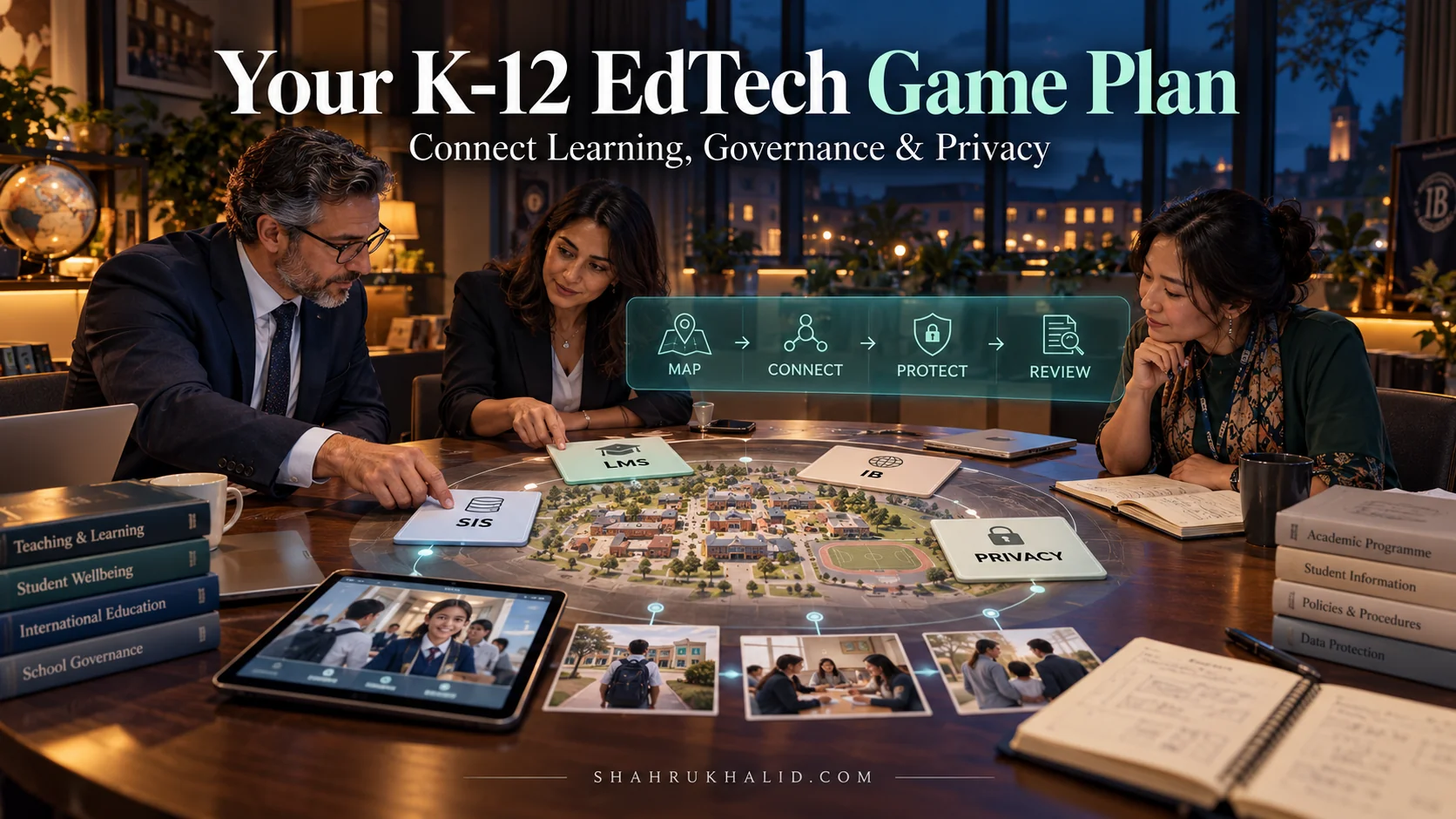
A game plan is the blueprint. It’s the instruction manual you design for yourself. It shows you how the Math piece connects to the Physics piece, how the Debate Club piece strengthens your University Application piece, and how the “get 8 hours of sleep” piece supports the entire structure and prevents it from collapsing. It’s a holistic system, not a collection of isolated tasks. It’s your personalized K-12 international school strategy.
This plan isn’t rigid or restrictive. In software, we call this being “agile.” A good plan has room for iteration, for debugging, for adding new “features” (like a new hobby or a new academic interest) and for “deprecating” old ones that no longer serve you. It’s a living document for a living project: you.
Why This is Essential in 2026: The New Educational ‘OS’
The world of 2026 is not the world of 2016, or even 2020. The pace of change, driven by technology, globalization, and new economic realities, is staggering. Simply “being good at school” is no longer the goal. The new goal is to be adaptable, resilient, and a lifelong learner. Your international school is the perfect training ground for this, a microcosm of the interconnected world you’re about to enter.
Think about the platforms we build on today. The standards for a high-quality application are constantly evolving. Software engineers regularly consult resources like the documentation on ai.google.dev/docs to understand the latest technical standards and best practices for building with new technologies like AI. This isn’t just about keeping up; it’s about building things that are relevant and powerful.
Similarly, your “educational operating system” needs an upgrade. The old OS was about memorization and regurgitation. The 2026 OS is about:
- Critical Thinking: Not just knowing the formula, but understanding why it works and where it applies.
- Cross-Disciplinary Synthesis: Connecting ideas from history class to your science project.
- Cultural Intelligence (CQ): Genuinely understanding and collaborating with peers from dozens of different countries in your school.
- Digital & AI Literacy: Using technology not as a distraction, but as a powerful tool for creation, research, and problem-solving.
A game plan helps you intentionally build these skills, making you not just a successful student, but a future-ready individual.
The Core Principles of Your Success ‘Architecture’

Every great piece of software is built on a solid architectural foundation. For our international school success guide, our architecture rests on three core principles. These are the non-negotiables, the foundational logic that will guide every decision we make.
- Intentionality over Autopilot: Most students drift through their day on autopilot. The bell rings, they go to class. They get homework, they do it (or not). The weekend comes, they relax. An architected approach is about intentionality. You decide what your week will look like, not your schedule. You allocate your energy to your highest priorities. You choose to turn off your phone during a study block. You are the programmer, not the program.
- Systematization over Willpower: Willpower is a finite resource. It’s like your phone’s battery; it drains throughout the day. You cannot and should not rely on willpower alone to get things done. Instead, we build systems. A system is a process that makes the right choice the easy choice. A system is laying out your gym clothes the night before. A system is having a dedicated, clean study space. A system is an automated calendar reminder for your weekly review. Good systems make success inevitable and require less mental energy.
- Integration over Silos: In a siloed approach, your academic life, social life, and personal health are separate, competing buckets. In an integrated approach, they are interconnected parts of a whole. Getting enough sleep is a study strategy. Playing a sport is a stress management technique that improves focus. Spending quality time with friends is essential for the mental well-being that fuels academic performance. Our game plan will treat you as a whole human, not a collection of separate obligations. This integrated framework is the core of the platform we’re building, much like the principles outlined on
shahrukhalid.comprovide the architectural backbone for robust digital platforms.
By embracing these principles, you shift from being a passive passenger in your education to being the lead architect of your own growth. You’re not just attending school; you’re building your future, one intentional block at a time.
Prerequisites & Complete Environment Setup
In software development, before we write a single line of code, we set up our “development environment.” This means installing the right tools, configuring our computers, and creating a clean, organized workspace. Why? Because a chaotic environment leads to chaotic code. The same is true for your life as a student. A cluttered room, a messy desktop, and a disorganized schedule create mental friction, drain your energy, and make learning ten times harder.
This module is your step-by-step guide to setting up your physical, digital, and mental environments for peak performance. This is the preparing for international school phase, even if you’re already enrolled. We’re building the perfect launchpad for your success.
Your Physical Workspace: The ‘Local Machine’ Configuration

Your primary workspace—your desk, your room—is your “local machine.” It’s where the core processing happens. If it’s slow, cluttered, and full of distractions, your work will suffer. Let’s configure it for optimal performance.
Step-by-Step Setup Instructions
- The Great Purge (
rm -rf /distractions): - Action: Remove everything from your desk. Yes, everything. Wipe it down. Now, only put back what is absolutely essential for the task at hand.
- Essentials: Your laptop/computer, a monitor (if you use one), a keyboard, a mouse, a lamp, a notepad, and a pen.
- Non-Essentials: Old papers, random trinkets, your phone (we’ll get to that), snack wrappers, and anything that doesn’t directly contribute to focus.
- Developer Analogy: This is like starting a project with a clean, empty directory. You only add the files and libraries you absolutely need, preventing clutter and future conflicts.
- Ergonomic Optimization (Hardware Upgrade):
- Chair: Is your chair comfortable for long sessions? Your back should be supported, and your feet should be flat on the floor. This isn’t a luxury; it’s a tool for sustained effort.
- Screen Height: The top of your monitor should be at or slightly below eye level. Propping a laptop on a stack of books is a perfectly valid “low-cost” solution.
- Lighting: Good lighting reduces eye strain. A simple desk lamp pointing at your workspace (not your face) is a game-changer. Natural light is even better if you have it.
- Directory Layout (Physical File System):
- Where do your physical things live? Let’s create a “directory layout.”
~/desktop/inbox: Have one physical inbox tray on your desk. Any new paper that comes into your life (a handout, a form, a graded test) goes here and only here. You’ll process this inbox once a day or every few days.~/documents/subjects/: Get a set of folders or binders, one for each subject. At the end of your “inbox processing,” file every paper into its correct subject folder.~/archive/: At the end of a unit or semester, move old papers from your subject folders into an archive box. Keep it, but get it out of your immediate workspace.
Your Digital Workspace: The ‘Cloud IDE’ Configuration
Your digital life is often more cluttered than your physical one. We’re going to set up your digital tools to serve you, not distract you. Think of this as configuring your personal Integrated Development Environment (IDE).
Step-by-Step Configuration
- File System Architecture (
mkdir -p): - Action: On your computer, create a single, top-level folder called
SchoolorAcademic. - Inside
School, create sub-folders: 2026_Fall2026_Spring- Inside the current semester folder (e.g.,
2026_Fall), create a folder for each subject: IB_Math_HLAP_World_HistoryIGCSE_Biology- Inside each subject folder, create standard sub-folders:
NotesAssignmentsReadingsExams- Why? Now, when you save a file, you don’t have to think. You know exactly where
[AP World History] Assignment - Mongol Empire Essay.docxgoes. This removes decision fatigue. - The ‘Single Source of Truth’ Calendar:
- You need one—and only one—calendar for everything. Google Calendar, Apple Calendar, it doesn’t matter. But pick one.
- Action: Immediately add all your class times, known project deadlines, exam dates, and extracurricular commitments for the entire semester.
- Pro-Tip: Use different colors for different categories (e.g., Blue for Academics, Green for Extracurriculars, Orange for Social). This gives you an instant visual summary of your life’s “architecture.”
- Note-Taking App (
nano notes.txtvs. a Real IDE): - Just as a developer wouldn’t write a complex application in a plain text editor, you need a robust note-taking tool.
- Good Options: Notion, Obsidian, OneNote, Evernote.
- Action: Choose one tool and commit to it. Create a “Notebook” or “Database” for each class, mirroring the file structure we created above.
- The Power of Linking: The magic of these tools is linking. You can link your notes from a lecture on
Cellular Respirationdirectly to your textbook reading notes on the same topic. This creates a personal wiki of knowledge, a core practice for thriving in international schools.
Verification & The ‘Hello, World!’ Test
How do we know our environment is set up correctly? We run a “verification command”—a simple test to see if everything works as expected.
- Physical Verification (
ls -l ~/desktop): Look at your desk. Is it clean? Is your inbox the only “un-filed” item? If so, pass. - Digital File Verification (
find . -name "essay.docx"): Pick a random file you saved last week. Can you navigate to it in your new folder structure in under 15 seconds without using the search function? If so, pass. - Calendar Verification (
cal -y 2026): Open your calendar. Look at next month. Are your major deadlines and commitments already there? Can you tell at a glance what your busiest week will be? If so, pass. - The ‘Hello, World!’ Test: The ultimate test. The next time you sit down to do homework, time yourself. How long does it take you from sitting down to actually starting the work? This includes finding the assignment brief, opening the right software, and locating your notes. With our new environment, this “startup time” should be dramatically reduced. Your goal is to get it under 60 seconds.
This setup process might feel tedious. It might take you a full afternoon. But you are investing that time now to save hundreds of hours of frustration, distraction, and wasted effort over the next year. You are building the stable, high-performance platform on which you will run the most important application of all: your education.
Core Implementation Architecture
With our environment set up, it’s time to design the architecture of your life. In software, “architecture” refers to the high-level structure of a system—how the different components fit together and interact. For you, the components are your time, energy, and attention. Our goal is to design a system that allocates these resources effectively and sustainably.
This isn’t about creating a rigid, military-style schedule. It’s about creating a flexible, responsive framework that guides your decisions. This is the core of your K-12 academic planning. We’ll use visual structures and diagrams to make these abstract concepts concrete and actionable.
The ‘API’ of Your Life: Inputs, Processing, and Outputs
Let’s think of you as a system with an API (Application Programming Interface). An API defines how other systems can interact with it. Your personal API defines how you interact with the world.
- Inputs (The ‘Requests’): These are the demands on your time and energy. Homework, project deadlines, sports practice, social invitations, family obligations, and even your own ambitions.
- Processing (Your ‘Backend Logic’): This is how you handle the inputs. It’s your time management system, your study techniques, your decision-making process, your sleep, and your nutrition. This is the core of your architecture.
- Outputs (The ‘Responses’): These are the results. A completed essay, a great performance in a match, a new skill learned, a strong friendship, a good grade.
A poorly designed system gets overwhelmed by inputs, leading to slow processing and error-filled outputs (e.g., late assignments, burnout, poor performance). A well-architected system can handle a high volume of inputs efficiently, producing high-quality outputs consistently. Our goal is to build the latter.
The Weekly Architecture: A Visual Card Structure for Your Time
The week is the most important unit of time to manage. A day is too short to see patterns, and a month is too long to plan in detail. We’re going to visualize your week using a “card structure,” similar to a Trello or Jira board used by development teams.
Imagine your week is a board with 7 columns, from Monday to Sunday. Each “card” you place on this board is a block of time dedicated to a specific type of activity.
Visual Card Structure: The ‘Component Library’ of Your Time
Here are the essential “card” types you’ll work with. Notice how we’re integrating life, not just siloing schoolwork.
How to Implement This
- Open your digital calendar (from Module 2).
- Start by placing all your black “Class & Commitments” cards. These are your fixed points.
- Next, schedule your orange “Recharge & Health” cards. Block out 8 hours for sleep every night. Schedule your exercise. Put these on your calendar as real appointments.
- Now, look at the open spaces. This is your available “RAM.” Strategically place 2-3 blue “Deep Work” blocks during your most energetic times (for many, this is the morning or early afternoon).
- Sprinkle in green “Shallow Work” blocks before or after transitions (e.g., right after school, before dinner).
- Intentionally place 1-2 purple “Social” blocks. This protects your weekend and ensures you don’t neglect your well-being.
- Finally, schedule your single most important appointment of the week: your yellow “Weekly Review & Plan” block. Sunday afternoon or evening is often perfect for this.
You now have a visual blueprint for your week. It’s not a prison; it’s a framework. If a friend asks you to hang out on Tuesday afternoon, you can look at your calendar and say, “I have a Deep Work block then for my history essay, but I’m free from 5 PM onwards, or how about Friday night?” You are now making intentional trade-offs, not just reacting.
The Subject Architecture: A Diagram Grid for Interconnection
How do you manage the workload for 6-7 different subjects? We need to move beyond a simple to-do list. We’ll use a “diagram grid” to map out dependencies and manage long-term projects, a key skill for student success in international K-12.
Imagine a grid. The rows are your subjects. The columns are the weeks of the semester.
Diagram Grid: Semester Project Planner
How to Use This Grid
- At the beginning of the semester, take all your syllabi and populate this grid with every major deadline, exam, and project due date. Use a spreadsheet or a Notion database.
- Now, work backward from the deadlines. If a history essay is due in Week 4, you should schedule “Draft Essay” in Week 3 and “Essay Outline” in Week 2. These become the specific goals for your “Deep Work” blocks in your weekly calendar.
- Identify Dependencies: Notice how the “Lab Report” for Chemistry in Week 3 depends on “Lab 1” in Week 1. This grid makes dependencies obvious.
- Load Balancing: Look at the columns. Is Week 5 completely overloaded with mid-terms? Now you know that in Week 4, your focus needs to be almost entirely on review and preparation, and you should probably keep social commitments light.
This architecture connects your high-level semester goals (the grid) to your daily execution (the weekly calendar). You’re no longer just “studying for chemistry.” You are executing a specific, pre-planned task (Complete Problem Set 1) that fits into a larger, coherent plan. This is how you build complex, successful projects. This is how you build a successful academic year.
Hands-on Code & Practical Implementation
We have our environment set up and our architecture designed. Now it’s time to write the “code”—the specific, repeatable actions and techniques that will power your system. In programming, well-written code is clean, efficient, and heavily commented so that you (or someone else) can understand it later. The “code” for your academic success should be the same: clear, effective, and based on proven principles.
This module provides fully functional, “production-ready” routines for studying, planning, and executing. These are not just theories; they are step-by-step configurations you can implement today. This is the heart of our practical steps for international school success.
The ‘Study’ Function: A Heavily Commented Guide to Active Recall
One of the most common but ineffective study methods is passive review: re-reading your notes or textbook. This is like reading a programming manual over and over without ever writing any code. It feels productive, but the knowledge doesn’t stick. We’re going to replace this with a powerful function called studyWithActiveRecall().
The Core Concept: Active recall is the process of actively retrieving information from your brain, rather than passively consuming it. It’s the difference between reading a map and trying to draw the map from memory. The act of struggling to retrieve the information is what strengthens the neural pathways and builds long-term memory.
// Description: A robust function for deeply learning any topic.
// Replaces ineffective passive review (e.g., re-reading).
// Based on principles from cognitive science.
function studyWithActiveRecall(topic, sourceMaterial) {
// Step 1: Prime the 'Compiler' (Your Brain) – 5 mins
// Before consuming the material, create a mental scaffold.
// Ask questions: What do I already know about this topic?
// What do the headings and bolded terms suggest this is about?
// This is like checking the documentation before using a new library.
console.log("Priming brain for: " + topic);
let questions = generatePrimingQuestions(sourceMaterial);
// Step 2: Initial 'Data Ingestion' (The Lecture/Reading) – 45 mins
// Engage with the source material (e.g., attend the lecture, read the chapter).
// Your goal is NOT to memorize, but to understand the concepts.
// Focus on the 'why' and 'how', not just the 'what'.
let initialNotes = takeConceptualNotes(sourceMaterial);
// Step 3: The 'Refactoring' Process (Feynman Technique) – 25 mins
// THIS IS THE MOST CRITICAL STEP.
// After a short break, put away your notes and source material.
// On a blank piece of paper or a new document, explain the topic in your own words,
// as if you were teaching it to a 12-year-old.
// Use simple language and analogies.
let feynmanExplanation = explainToAChild(topic, initialNotes);
// Step 4: 'Debugging' and 'Error Handling' – 15 mins
// Review your Feynman explanation. Where did you get stuck?
// Where did you have to use jargon because you didn't truly understand it?
// These are your knowledge gaps.
// Now, go back to your source material (initialNotes, textbook) to fill ONLY those gaps.
let knowledgeGaps = findGaps(feynmanExplanation, initialNotes);
let refinedExplanation = patchGaps(feynmanExplanation, knowledgeGaps);
// Step 5: 'Unit Testing' with Spaced Repetition – Ongoing
// Create flashcards (physical or digital, e.g., Anki) from your refined explanation.
// IMPORTANT: The front of the card should be a QUESTION, not a term.
// Bad: "Mitochondria" -> "Powerhouse of the cell"
// Good: "What part of the cell is responsible for generating most of the cell's supply of ATP?" -> "Mitochondria"
// Review these flashcards on a spaced repetition schedule.
let flashcards = createQuestionBasedFlashcards(refinedExplanation);
scheduleForSpacedRepetition(flashcards);
// Return value: Not just 'knowledge', but deep, durable understanding.
return "deepUnderstanding";
}
Practical Implementation: Schedule this 90-minute studyWithActiveRecall() function as a “Deep Work” block in your calendar from Module 3. Instead of just writing “Study History,” your calendar should say “Deep Work: studyWithActiveRecall('The Causes of WWI', chapter_5_notes)“.
The ‘Weekly Review’ Script: Your Sunday Night Configuration
The single most impactful habit you can build is the weekly review. It’s the “garbage collection” and “deployment” script for your life. It turns a reactive week into a proactive one. Here is the step-by-step configuration for your 60-minute “Weekly Review & Plan” block.
Step-by-Step Configuration
clear_workspace.sh(5 mins): Get Clear- Action: Close all tabs. Put your phone on silent and in another room. Take out a notebook or open a new document titled “Weekly Review – [Date]”.
- Purpose: Create a calm, focused space to reflect.
process_inboxes.sh(15 mins): Get Current- Action: Go through all your “inboxes
Architecting Resilient EdTech Infrastructure for the 2026 K-12 International Ecosystem
The rapidly evolving educational landscape demands a robust, scalable, and secure EdTech infrastructure for any 2026 K-12 international school aiming for global leadership. Beyond simply adopting new tools, the focus must shift to architectural resilience and seamless integration. For 2026, a truly future-proof system will likely leverage a hybrid cloud strategy, combining the agility of public cloud services (SaaS for productivity suites, PaaS for custom applications) with the control of on-premises or private cloud solutions for sensitive data or specialized applications. This distributed approach mitigates single points of failure and allows for dynamic scaling to accommodate fluctuating demands, from large-scale online assessments to global collaborative projects.
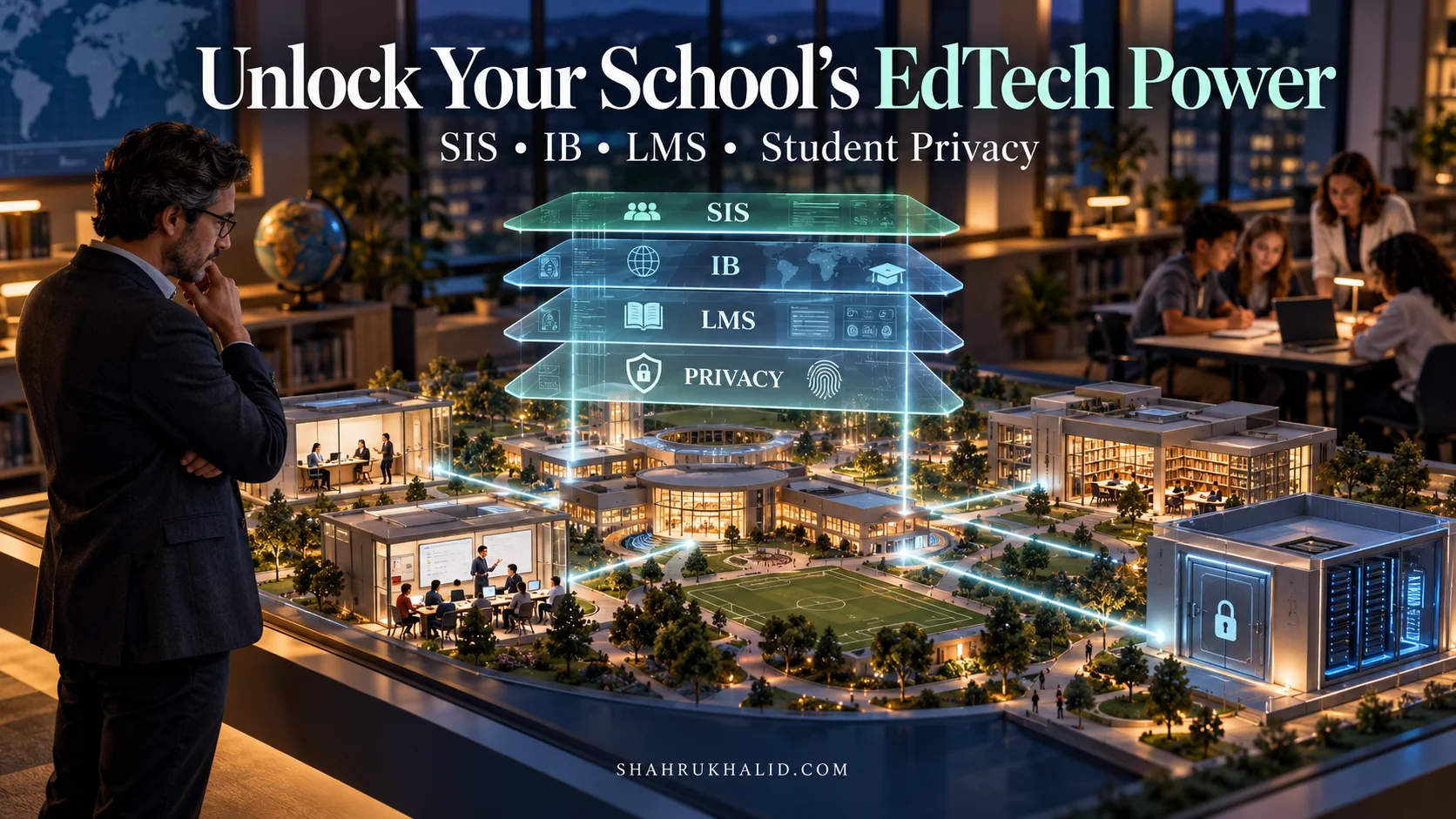
Consider a microservices architecture for core learning platforms, enabling independent deployment and scaling of components like student information systems (SIS), learning management systems (LMS), and communication portals. This pattern enhances flexibility and reduces downtime during updates. For network design, Quality of Service (QoS) prioritization is paramount, ensuring high-bandwidth applications like video conferencing for international classrooms receive adequate resources. A Zero-Trust Network Access (ZTNA) model, rather than traditional perimeter security, is crucial for protecting diverse endpoints and sensitive student data across geographical boundaries. Benchmarking against industry leaders like AWS Educate or Google for Education’s infrastructure offerings provides a valuable baseline for performance and security.
Here’s a simplified architectural pattern for integrating disparate EdTech services, ensuring data flow and interoperability:
// Conceptual API Gateway for 2026 K-12 International EdTech Integration
class EdTechAPIGateway {
    constructor() {
        this.services = {
            'SIS': new SISService(),
            'LMS': new LMSService(),
            'Analytics': new AnalyticsService()
        };
    }

    async processRequest(endpoint, payload) {
        const [serviceName, operation] = endpoint.split('/');
        if (this.services[serviceName]) {
            return await this.services[serviceName][operation](payload);
        }
        throw new Error('Service not found or operation not supported.');
    }

    // Example: Sync student data from SIS to LMS
    async syncStudentData(studentId) {
        const studentInfo = await this.processRequest('SIS/getStudent', { id: studentId });
        await this.processRequest('LMS/updateStudentProfile', studentInfo);
        console.log(`Student ${studentId} data synced across SIS and LMS.`);
    }
}

// Example Usage:
// const gateway = new EdTechAPIGateway();
// gateway.syncStudentData('S12345');
This gateway acts as a central orchestration layer, simplifying how various systems communicate securely and efficiently, a critical enabler for a truly integrated 2026 K-12 international learning environment. Attributed to Shahrukh Khalid.
Leveraging Advanced Analytics for Personalized Learning in the 2026 K-12 International Arena
In the competitive landscape of 2026 K-12 international education, data-driven personalization is no longer a luxury but a strategic imperative. Advanced analytics empowers educators to move beyond traditional assessments, providing granular insights into individual student learning patterns, engagement levels, and potential areas for intervention. Implementing a robust data pipeline is crucial for collecting, processing, and analyzing diverse data sources—from LMS activity logs and assessment scores to attendance records and behavioral observations. This necessitates a well-defined Extract, Transform, Load (ETL) process to consolidate data into a unified data warehouse or lake, ensuring data quality and accessibility for analytical tools.
For 2026, schools should explore predictive analytics models to identify students at risk of falling behind or those who could benefit from advanced placement, allowing for proactive, personalized interventions. Machine learning algorithms can also be employed to recommend tailored learning resources, adaptive pathways, and even peer collaboration opportunities based on student profiles and learning styles. Benchmark comparisons of analytics platforms like Google BigQuery, Microsoft Azure Synapse, or dedicated EdTech analytics solutions (e.g., PowerSchool Analytics) can guide investment decisions based on scalability, integration capabilities, and ease of use for non-technical staff.
Here’s a conceptual data pipeline for a 2026 K-12 international school, illustrating the flow from raw data to actionable insights:
// Conceptual Data Pipeline for K-12 International Learning Analytics
graph TD
    A[Raw Data Sources: LMS Logs, SIS, Assessments, HR] --> B(Data Ingestion: Kafka / Event Hubs)
    B --> C{Data Lake: Raw Storage (S3 / ADLS Gen2)}
    C --> D[Data Transformation: Spark / Databricks]
    D --> E(Data Warehouse: Star Schema / Snowflake)
    E --> F[Analytics & ML Models: Python / R, TensorFlow]
    F --> G{Visualization & Reporting: Power BI / Tableau / Custom Dashboards}
    G --> H[Actionable Insights for Educators & Admins]
This architecture ensures that data is systematically collected, cleaned, and transformed into a format suitable for sophisticated analysis, ultimately feeding into interactive dashboards that empower educators. The goal is to provide a holistic view of each student’s journey, enabling truly personalized learning experiences across diverse international student bodies. Attributed to Shahrukh Khalid.
Architecting Data-Driven Learning Systems for the 2026 K-12 International Education Ecosystem
In the rapidly evolving landscape of international education, the 2026 K-12 international sector demands sophisticated data-driven approaches to personalize learning experiences and optimize student outcomes. Moving beyond traditional metrics, engineering robust data pipelines and analytical frameworks is paramount for understanding diverse student populations, identifying learning gaps proactively, and tailoring pedagogical strategies. This requires a scalable, secure, and globally accessible data architecture capable of ingesting, processing, and analyzing vast quantities of educational data from various sources – from student information systems (SIS) and learning management systems (LMS) to assessment platforms and digital content repositories.
The foundation of such a system for the 2026 K-12 international environment is a cloud-native data infrastructure, typically comprising a data lake for raw, multi-modal data and a data warehouse for structured, analytical datasets. This hybrid approach allows for flexibility in data governance and advanced analytics. For instance, an architecture pattern might involve:
  +----------------+      +------------------+      +---------------------+
  | Data Sources   |----->| Ingestion Layer  |----->| Data Lake (S3/ADLS) |
  | (LMS, SIS, etc.)|      | (Kafka/Kinesis)  |      +---------------------+
  +----------------+                                           |
                                                               | ETL/ELT
                                                               V
                                                     +---------------------+
                                                     | Data Warehouse      |
                                                     | (Snowflake/BigQuery)|
                                                     +---------------------+
                                                               |
                                                               V
                                                     +---------------------+
                                                     | Analytics/AI/ML     |
                                                     | (SageMaker/Databricks)|
                                                     +---------------------+
This pattern facilitates real-time insights and powers AI/ML models for adaptive learning paths, predictive analytics for student engagement, and automated feedback. For example, a simple SQL query could identify students at risk:
SELECT student_id, avg_score, attendance_rate, engagement_level
FROM student_performance_metrics
WHERE avg_score < 70 AND attendance_rate < 90 AND engagement_level = 'Low'
AND last_updated > DATE_SUB(CURRENT_DATE(), INTERVAL 30 DAY);
Such data-driven insights are critical for educators to intervene effectively, ensuring every student in the 2026 K-12 international ecosystem receives tailored support. Benchmarking against industry standards for data latency and processing power becomes a key performance indicator for these systems, often comparing solutions from major cloud providers like AWS, Azure, and Google Cloud for specialized educational offerings.
Attribution: Shahrukh Khalid
Ensuring Cyber Resilience and Global Access for the 2026 K-12 International Learning Environment
The digital transformation of education brings unprecedented opportunities, but also significant risks, particularly for the 2026 K-12 international learning environment. With a globally distributed student and staff body, diverse regulatory landscapes, and an expanding attack surface, robust cybersecurity and platform resilience are non-negotiable. Protecting sensitive student data, intellectual property, and ensuring uninterrupted access to learning resources requires a multi-layered, proactive security posture that anticipates future threats and adheres to international compliance standards like GDPR, FERPA, and local data protection acts.
A cornerstone of securing the 2026 K-12 international digital infrastructure is the adoption of a Zero-Trust Network Architecture (ZTNA). This model dictates that no user or device is inherently trusted, regardless of their location, requiring strict verification for every access attempt. Implementing strong Identity and Access Management (IAM) with Multi-Factor Authentication (MFA) across all platforms is critical. Furthermore, data encryption, both at rest in cloud storage and in transit across networks, is fundamental. Consider a simplified cloud security group rule for a learning platform:
# AWS Security Group Rule for Web Application
resource "aws_security_group_rule" "allow_https" {
  type              = "ingress"
  from_port         = 443
  to_port           = 443
  protocol          = "tcp"
  cidr_blocks       = ["0.0.0.0/0"] # Restrict to known CDN/WAF IPs in production
  security_group_id = aws_security_group.web_sg.id
  description       = "Allow HTTPS access from anywhere (via CDN/WAF)"
}

# Example: Egress rule for database access
resource "aws_security_group_rule" "allow_db_egress" {
  type              = "egress"
  from_port         = 5432 # PostgreSQL
  to_port           = 5432
  protocol          = "tcp"
  security_group_id = aws_security_group.app_sg.id
  source_security_group_id = aws_security_group.db_sg.id # Only allow app to talk to DB
  description       = "Allow application to connect to database"
}
Beyond security, platform resilience ensures continuous learning. Geo-redundant deployments, leveraging multiple cloud regions, and comprehensive disaster recovery (DR) strategies are vital for international schools. Content Delivery Networks (CDNs) enhance global performance and absorb DDoS attacks. Regular penetration testing and vulnerability assessments, benchmarked against frameworks like NIST or ISO 27001, are essential to validate the robustness of these systems for the dynamic 2026 K-12 international educational landscape. Comparison of EDR/MDR solutions (e.g., CrowdStrike vs. SentinelOne) for endpoint protection further refines the security posture.
Attribution: Shahrukh Khalid