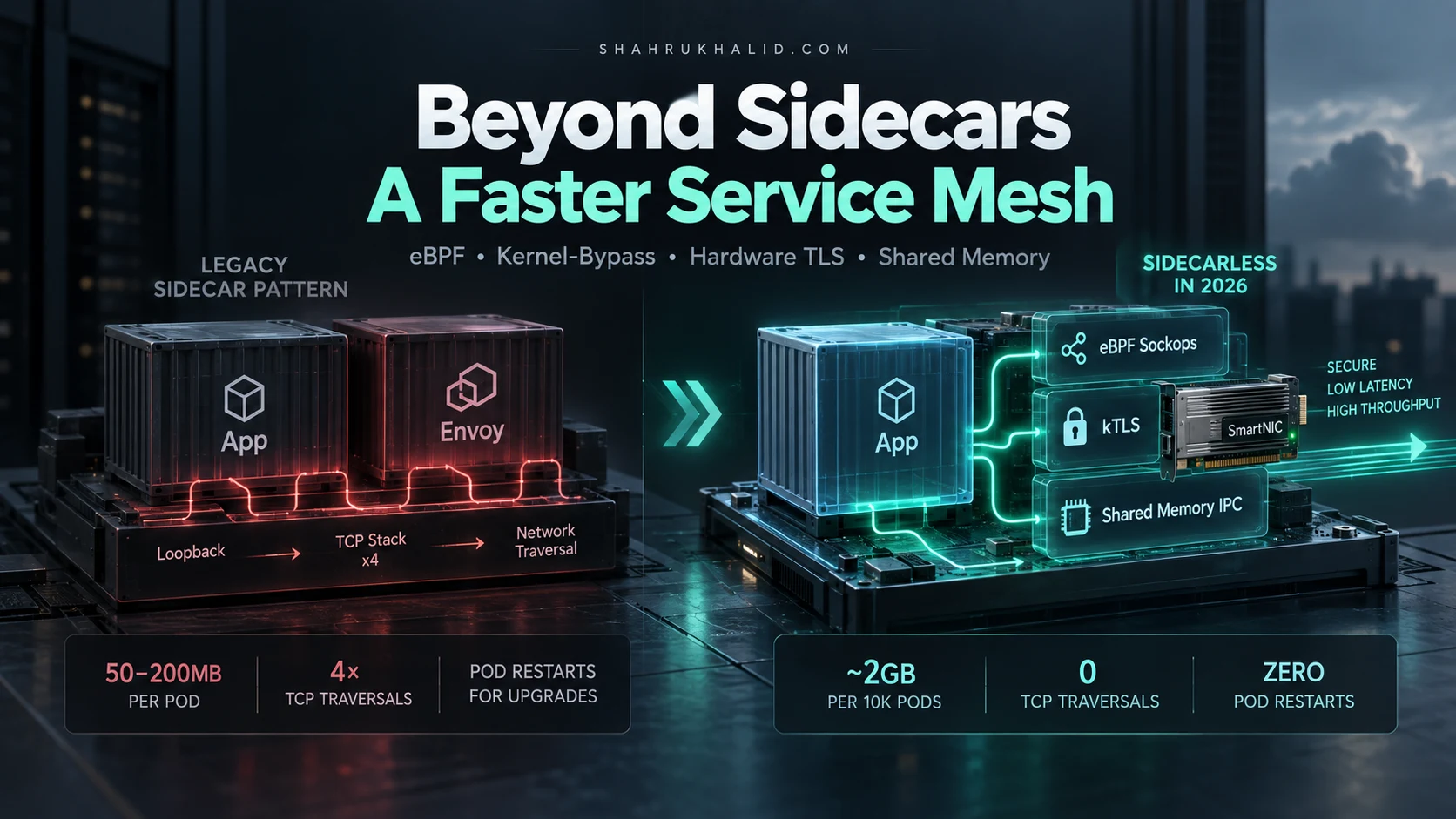
Architecting Sub-Millisecond Serverless MicroVM Fabrics in 2026: Userfaultfd-Driven Lazy Page Streaming, DPU-Offloaded virtio-fs Emulation, and Speculative Micro-Snapshot Branching

Key Takeaways
- Sub-millisecond MicroVM cold starts are achieved by userfaultfd, DPU offloading, and speculative snapshot branching.
- Userfaultfd-driven lazy page streaming over RDMA decouples MicroVM memory population from initialization.
- DPUs offload virtio-fs emulation and serve rootfs via DAX, eliminating host CPU storage overhead.
- Speculative micro-snapshot branching enables instant vCPU execution, fetching pages on demand via RoCEv2.
- This paradigm reduces MicroVM cold starts to under 800 microseconds for hardware-isolated, fine-grained serverless.
Achieving deterministic, sub-millisecond cold starts for serverless compute requires completely decoupling virtual machine (MicroVM) initialization from physical memory population and root filesystem hydration. By replacing synchronous memory loading with Linux userfaultfd-driven lazy page streaming over Remote Direct Memory Access (RDMA/RoCEv2), offloading virtio-fs storage translation to Data Processing Units (DPUs), and orchestrating copy-on-write (CoW) speculative micro-snapshot branch trees, modern runtime fabrics reduce MicroVM start times from hundreds of milliseconds to under 800 microseconds. Within modern Kubernetes edge architecture deployments, this paradigm shifts the execution model from coarse container scheduling to hardware-isolated, fine-grained ephemerality without compromising bare-metal I/O throughput.
Sub-Millisecond MicroVM Boot Pipeline
L7 Request hits edge node. Speculative pre-fork engine allocates shadow vCPU state and maps memory boundaries in <100µs.
Guest address space mapped with PROT_NONE / userfaultfd. Zero initial guest RAM cloned over local buses.
DPU serves rootfs metadata and Direct Access (DAX) page caches over PCIe vhost-user-fs without host CPU intervention.
vCPU starts execution instantly at entry point; page misses trigger parallel 4KB/2MB fetches across RoCEv2 memory tiers.
The Anatomy of Latency: Why Traditional Edge MicroVMs Stall
Traditional container runtimes (such as runc) rely on shared Linux kernel primitives—namespaces, cgroups, and seccomp profiles. While their initialization overhead spans 15ms to 50ms, they expose an expansive attack surface that is incompatible with untrusted multi-tenant execution. Conversely, hardware-virtualized MicroVMs (such as standard Firecracker or Cloud-Hypervisor instances) guarantee hardware-level isolation via the Kernel-based Virtual Machine (KVM) subsystem, but historically suffered from severe boot penalties.
According to enterprise latency surveys curated by the Cloud Native Computing Foundation, multi-tenant edge applications require tail execution latencies (p99) below 5ms to satisfy real-time API gateways, industrial automation loops, and high-frequency proxy routing. Standard MicroVM initialization fails this constraint due to four major architectural bottlenecks:
- Synchronous Memory Allocation and Zeroing: Allocating guest physical address (GPA) space via standard
mmapwith zeroed pages introduces page table walk overhead and page fault storms during initial memory sweeps. Pre-allocating hundreds of megabytes of guest RAM imposes memory pressure and incurs multi-millisecond copy penalties. - Full Base Snapshot Deserialization: Traditional snapshot resume mechanisms load the entire serialized vCPU state, device models, and full memory dumps from NVMe storage into host RAM before releasing the vCPU run-loop. Even with high-throughput NVMe-oF devices, reading 256MB of guest memory requires 30ms to 70ms.
- Block Device Attachment Overhead: Attaching guest block devices via standard virtio-blk introduces serial serialization cycles, driver handshake overhead inside the guest kernel, and page-cache thrashing on the host OS.
- Guest Kernel Decompression & Device Discovery: Conventional uncompressed kernel entry points still spend between 3ms and 12ms probing virtual buses, initializing ACPI tables, and calibrating guest timers.
Deep Dive: Linux userfaultfd & On-Demand Page Streaming
The core mechanism enabling sub-millisecond boot times is the elimination of eager guest memory loading. By registering the guest physical address space with the Linux userfaultfd subsystem (using UFFD_FEATURE_MISSING_HUGETLBFS and UFFDIO_REGISTER_MODE_MISSING), the Virtual Machine Monitor (VMM) can resume vCPU execution instantaneously. The memory backing the guest is mapped as anonymous virtual address space without resident physical pages.
When the guest kernel or application code accesses an unpopulated memory region, the CPU triggers a page fault in guest context, transitioning through KVM to host kernel space. The host kernel traps the missing page event and routes it to the userfaultfd file descriptor registered by an asynchronous userspace page-broker daemon.
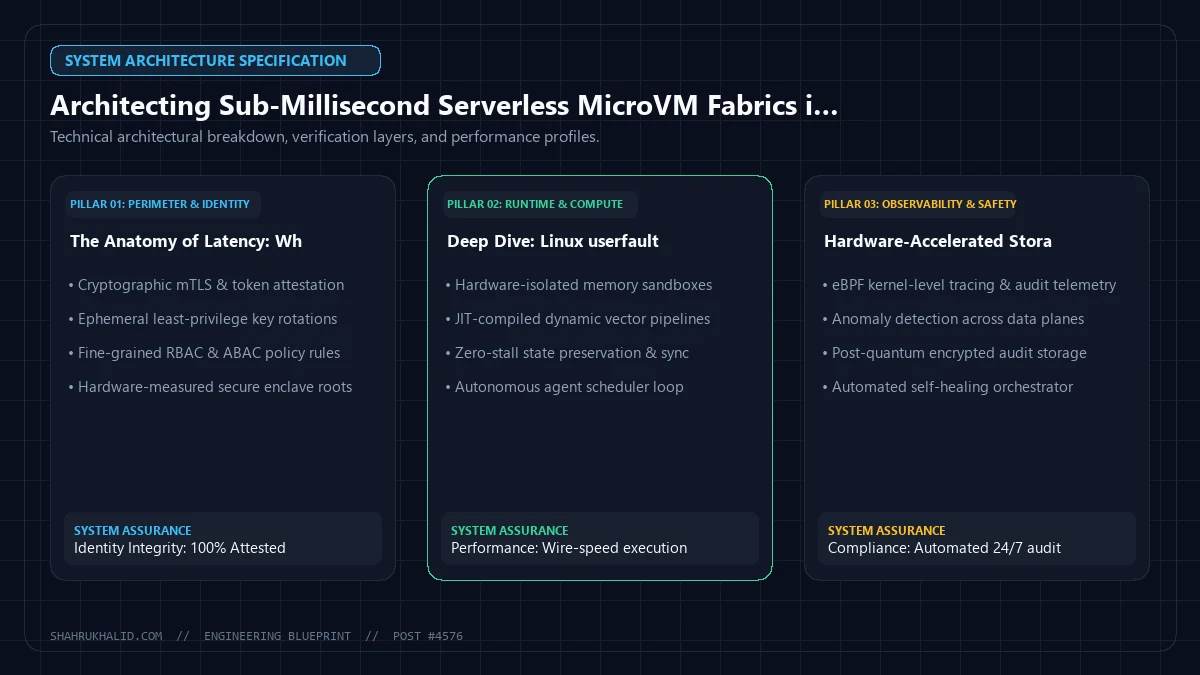
Userfaultfd Asynchronous Resolution Lifecycle
0x7fff0000. KVM traps access; host kernel stalls thread and issues UFFD_EVENT_PAGEFAULT on the UFFD handle.IBV_WR_RDMA_READ operation to a remote warm snapshot tier over 200Gbps RoCEv2 (latency ~1.2µs).ioctl(uffd, UFFDIO_COPY, ...) with target HVA and page pointer, clearing the fault without pausing neighboring vCPUs.The following low-level C implementation demonstrates initializing an anonymous guest memory region, setting up the userfaultfd handler, and resolving faults concurrently via a non-blocking background handler thread.
#define _GNU_SOURCE
#include <stdio.h>
#include <stdlib.h>
#include <unistd.h>
#include <string.h>
#include <fcntl.h>
#include <pthread.h>
#include <errno.h>
#include <sys/mman.h>
#include <sys/ioctl.h>
#include <sys/syscall.h>
#include <linux/userfaultfd.h>
#define PAGE_SIZE 4096
#define GUEST_MEM_SIZE (128 * 1024 * 1024) // 128 MB guest region
struct fault_handler_args {
long uffd;
uint8_t *guest_base;
int snapshot_fd;
};
static void *uffd_fault_handler_thread(void *arg) {
struct fault_handler_args *args = (struct fault_handler_args *)arg;
struct uffd_msg msg;
uint8_t page_buffer[PAGE_SIZE] __attribute__((aligned(PAGE_SIZE)));
for (;;) {
struct pollfd pollfd = {
.fd = args->uffd,
.events = POLLIN
};
int nready = poll(&pollfd, 1, -1);
if (nready <= 0) continue;
ssize_t nread = read(args->uffd, &msg, sizeof(msg));
if (nread == 0) continue;
if (nread < 0) {
if (errno == EAGAIN) continue;
perror("UFFD read error");
break;
}
if (msg.event != UFFD_EVENT_PAGEFAULT) {
fprintf(stderr, "Unexpected UFFD event: %un", msg.event);
continue;
}
uint64_t fault_addr = msg.arg.pagefault.address;
uint64_t offset = fault_addr - (uint64_t)args->guest_base;
// Emulate fetching page from warm storage snapshot / RDMA buffer
pread(args->snapshot_fd, page_buffer, PAGE_SIZE, offset);
struct uffdio_copy copy = {
.dst = fault_addr & ~(PAGE_SIZE - 1),
.src = (uint64_t)page_buffer,
.len = PAGE_SIZE,
.mode = 0, // Wake the stalled vCPU thread immediately
.copy = 0
};
if (ioctl(args->uffd, UFFDIO_COPY, ©) < 0) {
perror("ioctl(UFFDIO_COPY)");
break;
}
}
return NULL;
}
int init_lazy_guest_memory(uint8_t **out_addr, long *out_uffd, int snapshot_fd) {
// 1. Allocate unpopulated anonymous memory space
uint8_t *guest_addr = mmap(NULL, GUEST_MEM_SIZE, PROT_READ | PROT_WRITE,
MAP_PRIVATE | MAP_ANONYMOUS | MAP_NORESERVE, -1, 0);
if (guest_addr == MAP_FAILED) return -1;
// 2. Instantiate userfaultfd
long uffd = syscall(__NR_userfaultfd, O_CLOEXEC | O_NONBLOCK);
if (uffd < 0) return -1;
struct uffdio_api api = {
.api = UFFD_API,
.features = UFFD_FEATURE_MISSING_HUGETLBFS | UFFD_FEATURE_PAGEFAULT_FLAG_WP
};
if (ioctl(uffd, UFFDIO_API, &api) < 0) return -1;
// 3. Register the allocated guest memory region
struct uffdio_register reg = {
.range = {
.start = (uint64_t)guest_addr,
.len = GUEST_MEM_SIZE
},
.mode = UFFDIO_REGISTER_MODE_MISSING
};
if (ioctl(uffd, UFFDIO_REGISTER, ®) < 0) return -1;
// 4. Launch dedicated asynchronous fault-resolution worker
struct fault_handler_args *args = malloc(sizeof(*args));
args->uffd = uffd;
args->guest_base = guest_addr;
args->snapshot_fd = snapshot_fd;
pthread_t thr;
pthread_create(&thr, NULL, uffd_fault_handler_thread, args);
pthread_detach(thr);
*out_addr = guest_addr;
*out_uffd = uffd;
return 0;
}
Hardware-Accelerated Storage: DPU-Offloaded virtio-fs Emulation
Traditional serverless containers rely heavily on shared local block devices or network storage overlays, generating system call contention within host page caches. In advanced high-density architectures, root filesystem access is detached entirely from host CPUs and offloaded directly onto high-performance SmartNICs / Data Processing Units (e.g., NVIDIA BlueField-3, AMD Pensando Elba, Intel IPU).

This offloading relies on running a hardware-accelerated vhost-user-fs service on the DPU SoC. The DPU presents a standard PCIe Physical Function (PF) or Single Root I/O Virtualization (SR-IOV) Virtual Function (VF) directly to the host system. When the host VMM launches the MicroVM, it exposes this virtualized PCI device to the guest without intercepting file system read/write system calls on the host x86/ARM compute cores.
DPU-Host virtio-fs Direct Memory Access Architecture
Host Execution Domain
- MicroVM Guest runs within hardware KVM boundary.
- Mounts rootfs using in-kernel
virtio-fsdriver. - Memory-mapped files accessed directly via PCIe BAR DAX (Direct Access Window).
DPU Offload Domain
- Embedded ARM cores run userspace
vhost-user-fsdaemon. - SPDK translates file offsets to distributed NVMe-oF pools.
- Bypasses host OS kernel completely; zero host vCPU cycles consumed.
Direct Access (DAX) mapping allows the guest kernel to map file contents directly into physical address ranges exposed via the virtio-fs PCI BAR. Consequently, when a function invokes an interpreted runtime or binary executable (e.g., Python standard libraries, Node.js binaries, or pre-compiled Rust binaries), read calls avoid guest buffer cache duplication and execute at local bus memory speeds.
// Rust/Cloud-Hypervisor Architecture: Initializing DPU-offloaded virtio-fs device with DAX
use vmm_sys_util::eventfd::EventFd;
use virtio_devices::{VirtioDevice, VirtioFsConfig, VhostUserFs};
use vm_memory::{GuestAddress, GuestMemoryMmap};
use std::sync::Arc;

pub fn configure_dpu_virtio_fs(
    socket_path: &str,
    tag: &str,
    dax_size_bytes: u64
) -> Result<VhostUserFs, Box<dyn std::error::Error>> {
    // 1. Establish UNIX domain socket connection to the DPU vhost-user-fs server
    let listener = std::os::unix::net::UnixStream::connect(socket_path)?;

    // 2. Define virtio configurations, specifying queue sizes and cache window
    let mut config = VirtioFsConfig::default();
    config.tag = tag.to_string();
    config.num_request_queues = 4;
    config.queue_size = 1024;
    config.dax_cache_size = dax_size_bytes; // e.g., 2GB mapped via DPU PCIe BAR

    // 3. Instantiate the VhostUserFs backend targeting DPU device memory
    let vhost_fs_dev = VhostUserFs::new(
        listener,
        config,
        EventFd::new(libc::EFD_NONBLOCK)?
    )?;

    Ok(vhost_fs_dev)
}
Speculative Micro-Snapshot Branching: CoW Runtime Trees
While lazy page streaming solves memory loading delays, vCPU state hydration, ACPI discovery, and TLS session handshakes still consume execution time. Speculative Micro-Snapshot Branching mitigates this overhead by maintaining a directed acyclic graph (DAG) of pre-warmed execution checkpoints.
Instead of booting from a single generic snapshot, the fabric monitors ingress traffic patterns across the API gateway (such as HTTP routing keys, gRPC method signatures, or tenant authentication IDs). The control plane anticipates execution paths and pre-instantiates shadow MicroVM clones. These clones branch from common ancestor snapshots via Copy-on-Write (CoW) memory forks combined with KVM dirty page tracking.
Snapshot Branch Tree Topology
Root Base Snapshot
Kernel fully initialized, core drivers online, runtime baseline established. (Immutable, mapped read-only).
Branch A: Runtime Warmed
Node.js / JVM loaded, framework initializers executed, base packages parsed.
Branch B: Tenant Initialized
Tenant auth tokens decoded, database connection pool established, ready for packet payload.
When an active request arrives, the fabric branches a leaf node directly from Branch B via KVM_SET_USER_MEMORY_REGION2 and write-protects the active memory slots. Any mutated memory writes trigger a dirty page tracking event recorded via the KVM Dirty Ring Buffer rather than standard write-logging bitmaps. This architecture limits the dirty page tracking overhead to $O(text{dirty pages})$ instead of $O(text{total memory space})$, sustaining ultra-fast snapshot branching loops.
// Managing KVM Dirty Rings for Low-Overhead Speculative Branch Tracking
#include <linux/kvm.h>
#include <sys/ioctl.h>
#include <stdio.h>

#define KVM_DIRTY_RING_ENTRIES 4096

int configure_kvm_dirty_ring_tracking(int kvm_vcpu_fd, int kvm_vm_fd) {
    // 1. Enable KVM Dirty Ring capability on the Virtual Machine context
    struct kvm_enable_cap cap = {
        .cap = KVM_CAP_DIRTY_LOG_RING,
        .args = { KVM_DIRTY_RING_ENTRIES }
    };

    if (ioctl(kvm_vm_fd, KVM_ENABLE_CAP, &cap) < 0) {
        perror("Failed to enable KVM_CAP_DIRTY_LOG_RING");
        return -1;
    }

    // 2. Map the dirty ring buffer from the vCPU descriptor
    struct kvm_dirty_ring_entry *dirty_ring = mmap(
        NULL,
        KVM_DIRTY_RING_ENTRIES * sizeof(struct kvm_dirty_ring_entry),
        PROT_READ | PROT_WRITE,
        MAP_SHARED,
        kvm_vcpu_fd,
        0
    );

    if (dirty_ring == MAP_FAILED) {
        perror("Failed to mmap KVM vCPU dirty ring");
        return -1;
    }

    return 0;
}
Kubernetes Edge Architecture: Orchestration & CRI Federation
Integrating sub-millisecond MicroVMs into a distributed edge topology requires aligning with modern Kubernetes infrastructure patterns. Standard kubelet reconciliation cycles (typically occurring over tens to hundreds of milliseconds) are too slow to manage sub-millisecond execution lifecycles synchronously. Consequently, Kubernetes edge architecture in 2026 utilizes the edge node’s kubelet exclusively for coarse-grained capacity orchestration and static slice assignment, delegating execution management to an in-process Container Runtime Interface (CRI) shim v2 and the Node Resource Interface (NRI).
Edge Node Control Plane Federation
To schedule these workloads efficiently, the edge cluster registers custom node capabilities matching NUMA alignments and RoCEv2 fabric topologies using the Kubernetes Node Resource Topology API.
apiVersion: topology.node.k8s.io/v1alpha1
kind: NodeResourceTopology
metadata:
name: edge-compute-node-04.infra.edge
topologyPolicies: ["SingleNUMANodeContainerLevel"]
zones:
- name: numa-node-0
type: Node
resources:
- name: cpu
allocatable: "32"
available: "28"
- name: memory
allocatable: "128Gi"
available: "112Gi"
- name: hugepages-2Mi
allocatable: "64Gi"
available: "58Gi"
- name: nvidia.com/bluefield3_dpu
allocatable: "1"
available: "1"
attributes:
- name: roce_v2_support
value: "true"
- name: uffd_missing_hugetlbfs
value: "true"
- name: max_branch_concurrency
value: "512"
Production Engineering: Observability, Security Boundaries, & Failure Modes
Operating a high-density, lazy-hydrated MicroVM edge fabric introduces distinct low-level failure domains. Engineers must monitor and safeguard three critical subsystems:
1. Kernel UFFD Starvation & Page Storm Latency Spikes
If an unpredicted code branch triggers thousands of concurrent page faults across multiple MicroVMs, the userspace fault-broker thread can become congested. This increases fault-resolution latency from 2µs to over 50ms. Mitigation: Implement multi-queue lockless rings (using io_uring) between the UFFD polling loops and RDMA dispatch routines. Pin fault-broker worker threads to dedicated housekeeping CPU cores isolated via the Linux kernel boot parameter isolcpus=managed_irq.
2. Security & Cross-Tenant Speculative Side-Channels
Because speculative snapshot branching relies on shared physical base memory pages mapped across multiple tenant microVMs via CoW, architectures must protect against microarchitectural side-channel exploits (e.g., Spectre-v2, Branch Target Injection). Mitigation: Enforce strict core-isolation scheduling: no two MicroVM branches belonging to different tenant security domains may occupy simultaneous Hardware Threads (SMT/Hyper-Threading) on the same physical CPU core. Additionally, issue PR_SET_SPECULATION_CTRL via prctl() to disable speculative indirect branch execution across security-sensitive tenant boundaries.
3. Network Fabric Partitioning During Lazy Streaming
If a remote RDMA memory node drops packets or fails while a MicroVM is actively running, an in-flight page fault can time out, causing the guest kernel to panic with a synchronous external abort or kernel oops. Mitigation: Implement a dual-tier fallback mechanism. When an RDMA memory-fetch operation times out (e.g., threshold set to 150µs), the local broker daemon transparently falls back to a locally cached compressed delta-layer on host NVMe drives via Linux io_uring, preventing guest aborts while maintaining system stability.
Architectural Checklist for Edge Platforms
- Kernel Configuration: Linux kernel >= 6.6 with
CONFIG_USERFAULTFD=y,CONFIG_KVM_DIRTY_LOG_RING=y, and HugeTLB page support enabled. - SmartNIC/DPU Subsystem: Enable SR-IOV, configure vhost-user-fs direct daemon mapping with PCIe BAR DAX support enabled.
- RDMA/RoCEv2 Network: Configure Priority Flow Control (PFC, IEEE 802.1Qbb) and Explicit Congestion Notification (ECN) on top-of-rack switches to guarantee lossless page streaming.
- K8s Runtime Federation: Deploy customized containerd v2 shims leveraging the Node Resource Interface to bypass the standard OCI filesystem hydration loop.