Architecting Ultra-Low-Latency Actor Runtimes in 2026: Lock-Free Work-Stealing Schedulers, One-Sided RDMA Remote Mailboxes, and Generational Arena Allocators

Key Takeaways
- Ultra-low-latency actor runtimes converge on lock-free work-stealing, RDMA mailboxes, and generational arena allocators.
- Traditional actor systems degrade due to OS sockets, dynamic allocations, coarse scheduling, and non-deterministic GC pauses.
- One-sided RDMA reduces network ingress latency to sub-2u00b5s, significantly outperforming traditional TCP/Netpoll.
- Generational arena allocators enable zero-byte allocation costs, avoiding heap overhead and problematic garbage collection pauses.
- Cache-aligned lock-free work-stealing schedulers use Chase-Lev deques for efficient task locality and load balancing.
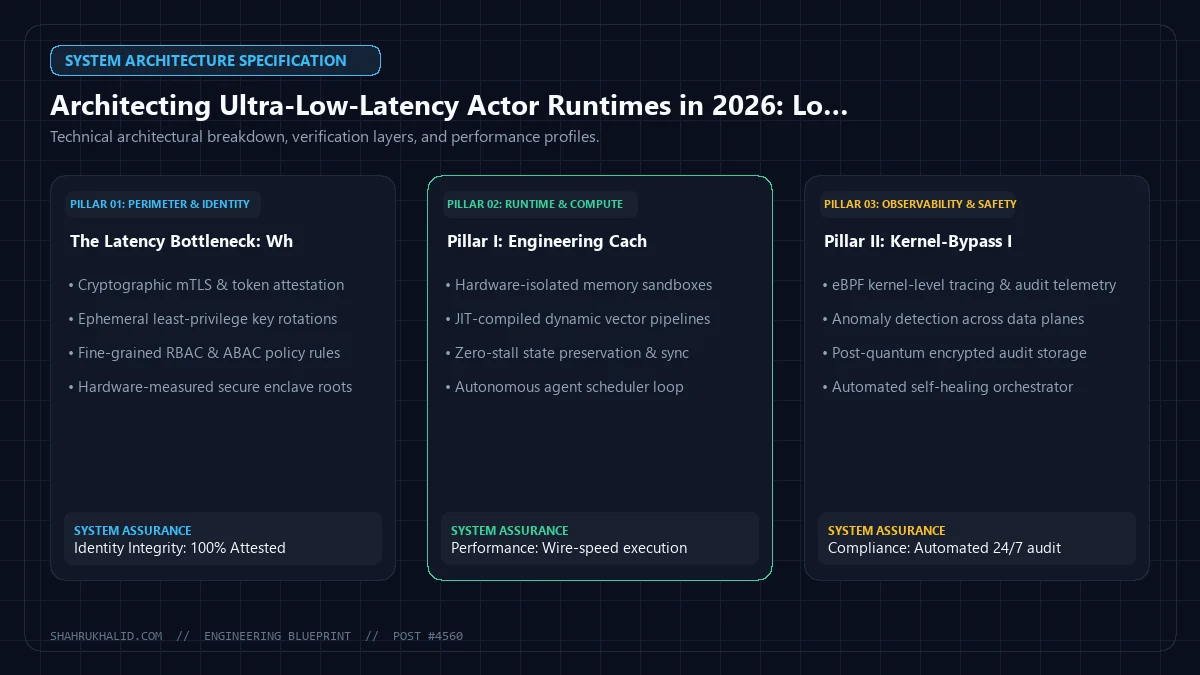
To achieve sub-microsecond P99 latencies in modern distributed systems, infrastructure engineers must bypass the operating system kernel, eliminate non-deterministic garbage collection pauses, and avoid global lock contention. Modern ultra-low-latency actor runtimes converge three architectural paradigms: cacheline-aligned lock-free work-stealing schedulers, hardware-offloaded one-sided Remote Direct Memory Access (RDMA) mailboxes, and deterministic generational arena allocators. This masterclass provides a deep-dive architectural blueprint and production-grade implementation patterns for engineering such systems using Rust and Go.
The Latency Bottleneck: Why Traditional Actor Frameworks Degrade at Scale
Traditional actor runtimes like classic Erlang/OTP (BEAM), Akka (JVM), and naive Go channel-based actor abstractions fail when message throughput crosses tens of millions of operations per second per node. The degradation stems from three foundational design assumptions: OS-managed network sockets, dynamic heap allocations per envelope, and coarse-grained runtime scheduling loops.
Memory & Context-Switch Overhead Pipeline in Naive Frameworks
POSIX epoll/TCP involves multiple context switches, SKB dynamic allocation, and double-copying across kernel/user space boundaries.
Each message payload triggers allocator locks (ptmalloc/JVM heap) and creates cache fragmentation across non-contiguous arenas.
Synchronized queues with mutexes or unbounded linked lists cause cacheline bouncing across distinct CPU core L1/L2 domains.
Stop-the-world or concurrent mark-sweep phases scan millions of ephemeral message envelopes, destroying deterministic tail latencies.
When engineering high performance API design in Rust and Go, performance limits are defined by hardware memory topologies (NUMA nodes), CPU cache line invalidation rules (MESI protocols), and PCIe bus bandwidth. Addressing these requires analyzing how message transport and worker scheduling intersect at the hardware level.
Pillar I: Engineering Cache-Aligned Lock-Free Work-Stealing Schedulers
Work-stealing schedulers balance workloads across heterogeneous CPU cores while maintaining strict data locality. The core worker uses an adaptation of the Chase-Lev deque (Double-Ended Queue). The owning thread pushes and pops actor task pointers from the bottom (LIFO order for warm L1/L2 cache affinity), while idle foreign worker threads steal tasks from the top (FIFO order to prevent actor starvation).

To eliminate false sharing—where different cores invalidate each other’s CPU cache lines because independent variables share the same 64-byte segment—all worker structures and atomic indices must be padded explicitly to the processor cache line boundary.
Chase-Lev Deque Memory Layout & Core Interactions
bottomLIFO (Cache Hot)
topFIFO (Anti-Starvation)
Lock-Free Work-Stealing Deque in Rust
The following production implementation uses Rust’s memory safety guarantees and fearless concurrency to construct a cache-padded, sequentially consistent work-stealing deque. It uses explicit atomic ordering (Acquire, Release, Relaxed) to eliminate full memory fences on the fast execution path.
use std::sync::atomic::{AtomicIsize, AtomicPtr, Ordering};
use std::cell::UnsafeCell;
use std::ptr;
use std::alloc::{alloc, dealloc, Layout};

const BUFFER_CAPACITY: usize = 1024; // Must be power of 2
const CACHE_LINE_SIZE: usize = 64;

#[repr(align(64))]
struct CachePadded<T>(T);

pub struct ActorTask {
    pub actor_id: u64,
    pub mailbox_slot: u32,
    pub run_fn: fn(u64, u32),
}

struct RingBuffer {
    capacity: usize,
    mask: usize,
    buffer: *mut AtomicPtr<ActorTask>,
}

impl RingBuffer {
    fn new(capacity: usize) -> Self {
        assert!(capacity.is_power_of_two());
        let layout = Layout::array::<AtomicPtr<ActorTask>>(capacity).unwrap();
        let buffer = unsafe { alloc(layout) as *mut AtomicPtr<ActorTask> };
        for i in 0..capacity {
            unsafe {
                ptr::write(buffer.add(i), AtomicPtr::new(ptr::null_mut()));
            }
        }
        Self {
            capacity,
            mask: capacity - 1,
            buffer,
        }
    }

    #[inline(always)]
    unsafe fn store(&self, index: isize, task: *mut ActorTask) {
        let offset = (index as usize & self.mask);
        (*self.buffer.add(offset)).store(task, Ordering::Relaxed);
    }

    #[inline(always)]
    unsafe fn load(&self, index: isize) -> *mut ActorTask {
        let offset = (index as usize & self.mask);
        (*self.buffer.add(offset)).load(Ordering::Relaxed)
    }
}

pub struct WorkStealingDeque {
    top: CachePadded<AtomicIsize>,
    bottom: CachePadded<AtomicIsize>,
    buffer: UnsafeCell<RingBuffer>,
}

unsafe impl Send for WorkStealingDeque {}
unsafe impl Sync for WorkStealingDeque {}

impl WorkStealingDeque {
    pub fn new() -> Self {
        Self {
            top: CachePadded(AtomicIsize::new(0)),
            bottom: CachePadded(AtomicIsize::new(0)),
            buffer: UnsafeCell::new(RingBuffer::new(BUFFER_CAPACITY)),
        }
    }

    pub fn push(&self, task: *mut ActorTask) -> Result<(), *mut ActorTask> {
        let b = self.bottom.0.load(Ordering::Relaxed);
        let t = self.top.0.load(Ordering::Acquire);
        let buffer = unsafe { &*self.buffer.get() };

        if b.wrapping_sub(t) >= (buffer.capacity as isize) {
            return Err(task); // Queue is saturated
        }

        unsafe {
            buffer.store(b, task);
        }
        // Enforce write ordering: store message payload before advancing bottom index
        self.bottom.0.store(b.wrapping_add(1), Ordering::Release);
        Ok(())
    }

    pub fn pop(&self) -> Option<*mut ActorTask> {
        let b = self.bottom.0.load(Ordering::Relaxed).wrapping_sub(1);
        let buffer = unsafe { &*self.buffer.get() };
        self.bottom.0.store(b, Ordering::Relaxed);
        std::sync::atomic::fence(Ordering::SeqCst);

        let t = self.top.0.load(Ordering::Relaxed);

        if t <= b {
            // Non-empty queue condition
            let task = unsafe { buffer.load(b) };
            if t == b {
                // Contention window with a concurrent stealer
                if self.top.0.compare_exchange(
                    t,
                    t.wrapping_add(1),
                    Ordering::SeqCst,
                    Ordering::Relaxed,
                ).is_err() {
                    // Lost the race to the stealer
                    self.bottom.0.store(b.wrapping_add(1), Ordering::Relaxed);
                    return None;
                }
                self.bottom.0.store(b.wrapping_add(1), Ordering::Relaxed);
            }
            Some(task)
        } else {
            // Empty queue condition
            self.bottom.0.store(b.wrapping_add(1), Ordering::Relaxed);
            None
        }
    }

    pub fn steal(&self) -> Option<*mut ActorTask> {
        let mut t = self.top.0.load(Ordering::Acquire);
        loop {
            std::sync::atomic::fence(Ordering::SeqCst);
            let b = self.bottom.0.load(Ordering::Acquire);
            if t >= b {
                return None; // Nothing to steal
            }

            let buffer = unsafe { &*self.buffer.get() };
            let task = unsafe { buffer.load(t) };

            // Attempt to update top index via CAS
            match self.top.0.compare_exchange_weak(
                t,
                t.wrapping_add(1),
                Ordering::SeqCst,
                Ordering::Relaxed,
            ) {
                Ok(_) => return Some(task),
                Err(actual_top) => t = actual_top, // Retry with updated top
            }
        }
    }
}
Pillar II: Kernel-Bypass Ingress with One-Sided RDMA Mailboxes
Traditional network models require the OS kernel to intercept packets, manage TCP windowing, and route payload buffers through socket descriptors. RDMA (over InfiniBand or RoCEv2) enables direct read and write operations on registered physical memory belonging to a remote compute node without traversing the remote OS kernel or consuming remote CPU cycles.

One-Sided RDMA Ingress Pipeline Architecture
IBV_WR_RDMA_WRITE_WITH_IMM) into Send Queue. Zero CPU involvement on receiver node.
ibv_poll_cq), avoiding hardware interrupt handling overhead.
RDMA Memory Ring Structures and Direct Poller
Below is the memory interface pattern for a low-latency one-sided RDMA mailbox poller, designed to run directly alongside the actor core without thread suspension.
use std::sync::atomic::{AtomicU32, Ordering};

#[repr(C, align(64))]
pub struct RdmaMailboxSlot {
    pub sequence: AtomicU32,
    pub payload_size: u32,
    pub sender_actor_id: u64,
    pub target_actor_id: u64,
    pub payload: [u8; 256], // Inline fixed-size payload for zero-copy deserialization
}

#[repr(C)]
pub struct RemoteMemoryRegion {
    pub raddr: u64,
    pub rkey: u32,
    pub total_slots: u32,
}

pub struct RdmaMailboxPoller {
    slots: *mut RdmaMailboxSlot,
    slot_count: usize,
    current_index: usize,
    expected_sequence: u32,
}

impl RdmaMailboxPoller {
    pub unsafe fn new(memory_base: *mut RdmaMailboxSlot, slot_count: usize) -> Self {
        Self {
            slots: memory_base,
            slot_count,
            current_index: 0,
            expected_sequence: 1,
        }
    }

    /// Polls the RDMA registered buffer for new incoming messages without kernel mediation.
    #[inline(always)]
    pub fn poll_next_envelope(&mut self) -> Option<&RdmaMailboxSlot> {
        unsafe {
            let slot = &*self.slots.add(self.current_index);
            // Acquire fence ensures that memory payload loads are not reordered
            // before we verify the incoming sequence token written by the remote NIC DMA
            let seq = slot.sequence.load(Ordering::Acquire);

            if seq == self.expected_sequence {
                self.current_index = (self.current_index + 1) % self.slot_count;
                if self.current_index == 0 {
                    self.expected_sequence = self.expected_sequence.wrapping_add(1);
                }
                Some(slot)
            } else {
                None // No new packet written by remote RDMA controller
            }
        }
    }
}
Pillar III: Generational Arena Allocators & Zero-GC Message Lifecycles
General-purpose dynamic allocators like malloc, jemalloc, or runtime heaps suffer from lock contention and memory fragmentation when handling millions of short-lived actor messages. To achieve zero runtime allocation cost and eliminate dangling references across actor lifecycles, runtimes must use Generational Arena Allocators paired with generational identifiers (Slot Maps).
Generational indices bundle two distinct fields into an identifier: a concrete buffer index and a generation marker. Even if an actor terminates or a memory slot is reclaimed, stale references bearing older generational values fail lookup checks immediately, avoiding the ABA problem without pointer validation passes.
Generational Arena Memory Structure
Generational Slot Token
Unique 64-bit handle that prevents stale handle resolution without mutex guards.
Pre-Allocated Contiguous Storage
All actor memory remains pre-allocated on the local NUMA node; lookups are simple $O(1)$ indexed reads.
High-Performance Arena Allocator Implementation
#[derive(Clone, Copy, Debug, PartialEq, Eq)]
pub struct GenerationalHandle {
    pub index: u32,
    pub generation: u32,
}

enum ArenaEntry<T> {
    Occupied { generation: u32, data: T },
    Free { next_free: Option<u32> },
}

pub struct GenerationalArena<T> {
    storage: Vec<ArenaEntry<T>>,
    free_head: Option<u32>,
    capacity: usize,
    active_count: usize,
}

impl<T> GenerationalArena<T> {
    pub fn with_capacity(capacity: usize) -> Self {
        let mut storage = Vec::with_capacity(capacity);
        for i in 0..capacity {
            let next_free = if i + 1 < capacity { Some((i + 1) as u32) } else { None };
            storage.push(ArenaEntry::Free { next_free });
        }
        Self {
            storage,
            free_head: Some(0),
            capacity,
            active_count: 0,
        }
    }

    pub fn insert(&mut self, value: T) -> Result<GenerationalHandle, T> {
        let index = match self.free_head {
            Some(idx) => idx as usize,
            None => return Err(value), // Out of pre-allocated slots
        };

        let current_gen = match &self.storage[index] {
            ArenaEntry::Free { next_free } => {
                self.free_head = *next_free;
                0 // Initial generation
            }
            _ => unreachable!(),
        };

        self.storage[index] = ArenaEntry::Occupied {
            generation: current_gen + 1,
            data: value,
        };
        self.active_count += 1;

        Ok(GenerationalHandle {
            index: index as u32,
            generation: current_gen + 1,
        })
    }

    #[inline(always)]
    pub fn get(&self, handle: GenerationalHandle) -> Option<&T> {
        match self.storage.get(handle.index as usize) {
            Some(ArenaEntry::Occupied { generation, data }) if *generation == handle.generation => {
                Some(data)
            }
            _ => None, // Stale or invalid handle
        }
    }

    #[inline(always)]
    pub fn get_mut(&mut self, handle: GenerationalHandle) -> Option<&mut T> {
        match self.storage.get_mut(handle.index as usize) {
            Some(ArenaEntry::Occupied { generation, data }) if *generation == handle.generation => {
                Some(data)
            }
            _ => None,
        }
    }

    pub fn remove(&mut self, handle: GenerationalHandle) -> Option<T> {
        let index = handle.index as usize;
        if index >= self.capacity {
            return None;
        }

        match &self.storage[index] {
            ArenaEntry::Occupied { generation, .. } if *generation == handle.generation => {
                let current_gen = *generation;
                let old_entry = std::mem::replace(
                    &mut self.storage[index],
                    ArenaEntry::Free { next_free: self.free_head },
                );
                self.free_head = Some(index as u32);
                self.active_count -= 1;

                if let ArenaEntry::Occupied { data, .. } = old_entry {
                    Some(data)
                } else {
                    unreachable!()
                }
            }
            _ => None,
        }
    }
}
Edge Ingress Layer: Go Low-Allocation Integration Patterns
Distributed low-latency architectures often pair a core actor framework written in Rust with edge API gateways written in Go due to Go’s developer velocity and fast network multiplexing. High performance API design in Go requires matching the core engine’s zero-copy architecture. By adhering strictly to Go runtime zero-allocation memory conventions, we can enforce heap-escape mitigation using sync.Pool and direct buffer slicing.
The following example implements a zero-allocation edge parser in Go that normalizes ingress API commands and directly marshals them into an arena payload targeting the actor fabric.
package main

import (
	"encoding/binary"
	"errors"
	"sync"
	"sync/atomic"
	"unsafe"
)

var (
	ErrPayloadTooLarge = errors.New("payload exceeds static buffer limits")
	ErrBufferExhausted = errors.New("ring buffer slot occupied")
)

const (
	MaxCommandSize  = 256
	RingSlotCapacity = 65536
)

// FastCommand matches the memory layout expected by the Rust RDMA poller
type FastCommand struct {
	ActorID   uint64
	Operation uint32
	Length    uint32
	Payload   [MaxCommandSize]byte
}

type IngressBufferPool struct {
	pool sync.Pool
}

func NewIngressBufferPool() *IngressBufferPool {
	return &IngressBufferPool{
		pool: sync.Pool{
			New: func() any {
				// Allocate contiguous, cacheline-aligned structs that do not escape to heap
				return &FastCommand{}
			},
		},
	}
}

// ZeroAllocParse transforms a raw socket wire slice without dynamic heap allocations
func (p *IngressBufferPool) ZeroAllocParse(wireData []byte) (*FastCommand, error) {
	if len(wireData) < 16 {
		return nil, errors.New("wire data truncated")
	}

	cmd := p.pool.Get().(*FastCommand)

	// Zero out older memory without reallocating
	cmd.ActorID = binary.LittleEndian.Uint64(wireData[0:8])
	cmd.Operation = binary.LittleEndian.Uint32(wireData[8:12])
	cmd.Length = binary.LittleEndian.Uint32(wireData[12:16])

	if int(cmd.Length) > MaxCommandSize || int(16+cmd.Length) > len(wireData) {
		p.pool.Put(cmd)
		return nil, ErrPayloadTooLarge
	}

	// Copy into static byte array (avoids dynamic heap escape)
	copy(cmd.Payload[:cmd.Length], wireData[16:16+cmd.Length])
	return cmd, nil
}

func (p *IngressBufferPool) Release(cmd *FastCommand) {
	p.pool.Put(cmd)
}

// DirectRingSubmit passes memory straight to the lockless shared memory envelope
type RingSubmitter struct {
	head     uint64
	tail     uint64
	ringBase unsafe.Pointer
}

func (r *RingSubmitter) DirectSubmit(cmd *FastCommand) error {
	nextTail := atomic.AddUint64(&r.tail, 1) - 1
	slotOffset := (nextTail & (RingSlotCapacity - 1)) * uint64(unsafe.Sizeof(FastCommand{}))

	targetSlot := (*FastCommand)(unsafe.Pointer(uintptr(r.ringBase) + uintptr(slotOffset)))

	// Copy through memory assignment using direct pointer mapping
	*targetSlot = *cmd
	return nil
}
Unified Architecture: Distributed Zero-Copy Actor Fabric
When the three core pillars (lock-free scheduling, one-sided RDMA, and generational arenas) are unified, the execution path processes messages deterministically end-to-end. Incoming packets move from external network ingress to actor state execution without a single dynamic memory allocation, kernel interrupt, or OS context switch.
Deterministic Actor Execution Lifecycle
1. Network Layer: Remote Node Emits Hardware DMA
Remote node issues an RDMA_WRITE_WITH_IMM targeting the local registered memory region. The local NIC pins the bits directly into pre-allocated memory via the PCIe bus.
2. Dispatch Layer: Completion Queue Polling to Deque
A dedicated pinning core polls the memory ring buffer. On sequence advance, it wraps the pointer into an ActorTask and pushes it to the worker’s Chase-Lev deque.
3. Execution Layer: Generational Actor State Access
The assigned CPU worker pops the task from its local LIFO queue, checks the target actor’s generational index within the static arena, and executes the actor loop within a warm L1/L2 cache.
Production Integration Driver: Rust Core
The following engine drives the worker lifecycle by coupling the work-stealing scheduler with generational actor instances and network mailboxes.
pub struct ActorEngine {
    arena: GenerationalArena<ActorInstance>,
    local_deque: WorkStealingDeque,
    stealers: Vec<WorkStealingDeque>,
}

pub struct ActorInstance {
    pub id: u64,
    pub state_counter: u64,
}

impl ActorEngine {
    pub fn new(capacity: usize) -> Self {
        Self {
            arena: GenerationalArena::with_capacity(capacity),
            local_deque: WorkStealingDeque::new(),
            stealers: Vec::new(),
        }
    }

    /// Primary execution loop running on each pinned worker thread
    pub fn process_cycle(&mut self) {
        // Step 1: Pop highest-affinity task from local Chase-Lev deque (LIFO)
        if let Some(task_ptr) = self.local_deque.pop() {
            self.execute_task(task_ptr);
            return;
        }

        // Step 2: If local work is missing, attempt to steal from adjacent core queues (FIFO)
        for stealer in &self.stealers {
            if let Some(task_ptr) = stealer.steal() {
                self.execute_task(task_ptr);
                return;
            }
        }
    }

    #[inline(always)]
    fn execute_task(&mut self, task_ptr: *mut ActorTask) {
        unsafe {
            let task = &*task_ptr;
            let handle = GenerationalHandle {
                index: task.mailbox_slot,
                generation: 1,
            };

            // Safe validation of actor target state via generational arena
            if let Some(actor) = self.arena.get_mut(handle) {
                actor.state_counter += 1;
                (task.run_fn)(actor.id, task.mailbox_slot);
            }
        }
    }
}
Production Diagnostics and Profiling
Standard OS profiling utilities such as top-level profilers introduce systemic skew into sub-microsecond systems. Verifying and tuning low-latency actor runtimes requires monitoring CPU-level microarchitectural counters directly.
- Hardware PMU Profiling: Use Linux
perfto trackcache-misses,L1-dcache-load-misses, andLLC-load-misses. In a properly aligned arena runtime, L1 cache miss rates for message dispatch should remain under 1.5%. - eBPF Lock Contention Tracing: Profile atomic contention hotspots and memory bus locks via
bpftracescripts inspecting hardware pipeline stalls (RESOURCE_STALLS). - Memory Fencing Audit: Minimize
SeqCstatomic fences on fast paths. Use relaxed reads followed by Acquire/Release pairs to maximize performance across NUMA topologies.
By bypassing the operating system network stack via one-sided RDMA, organizing memory into generational arenas, and scheduling execution with lock-free work-stealing, you can eliminate GC pauses, avoid lock contention, and process millions of messages per second with deterministic, sub-microsecond tail latencies.