Architecting Thread-per-Core Systems in 2026: io_uring Runtimes, Cache-Line-Aligned Ring Buffers, and Nanosecond Zero-Copy IPC

Key Takeaways
- Thread-per-Core (TPC) dedicates one thread per core, using io_uring and shared-nothing memory for efficiency.
- TPC architecture eliminates shared-state concurrency bottlenecks at high RPS by avoiding cache invalidations.
- Cross-core communication in TPC relies on cache-padded lock-free ring buffers and zero-copy shared memory.
- TPC achieves near-zero cache evictions, coherence traffic, and sub-100u00b5s tail latency via core pinning.
- io_uring SQPOLL with pre-registered buffers and HugeTLB zero-copy IPC are central to TPC performance.
Modern microsecond-scale APIs are no longer constrained by network wire speed, but by CPU core synchronization bottlenecks, kernel context switches, and cache line invalidation cycles. The Thread-per-Core (TPC) architecture circumvents these bottlenecks by dedicating exactly one OS thread to each physical CPU core, running a run-to-completion event loop powered by Linux io_uring, and enforcing a strict shared-nothing memory isolation paradigm. When cross-core communication is unavoidable, TPC systems rely on cache-line-padded lock-free ring buffers and shared memory mappings to achieve single-digit nanosecond inter-process communication (IPC).
This masterclass provides an exhaustive blueprint for engineers implementing ultra-low-latency backend infrastructure. We explore how modern runtime engineering in Rust and Go bridges the gap between hardware architecture and application design, leveraging Rust’s memory safety primitives alongside optimized concurrent workflows guided by Go’s zero-allocation concurrency patterns.
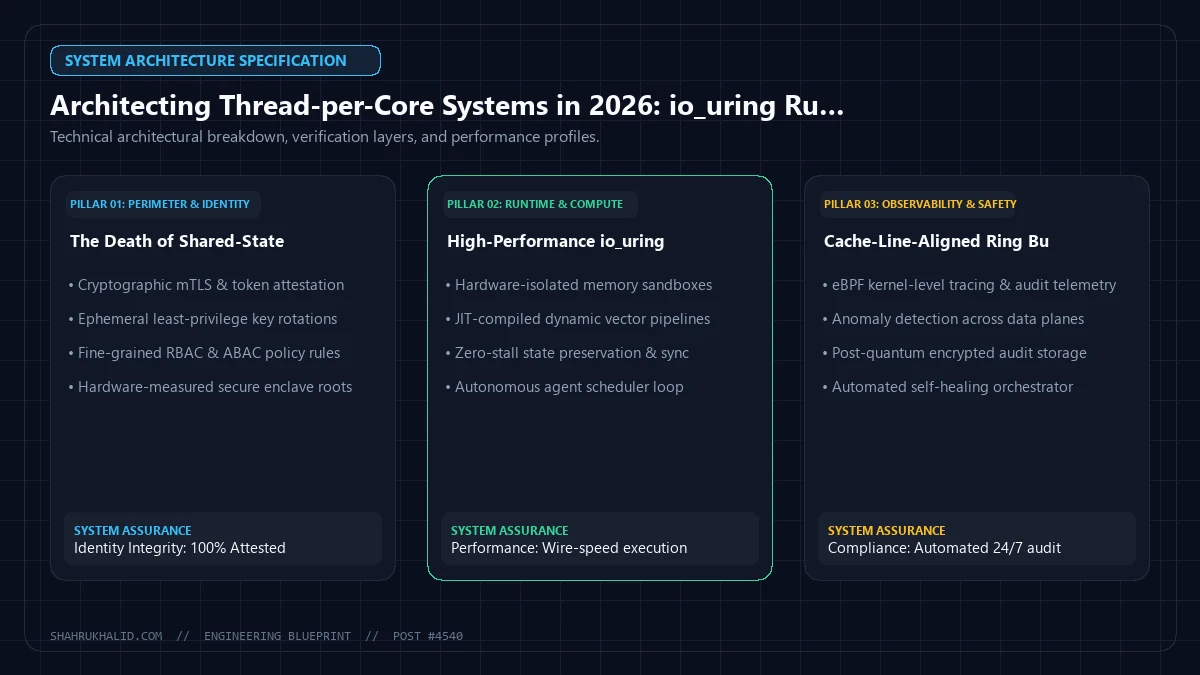
Thread-per-Core (TPC) Execution Topology
Hard affinity binding via
pthread_setaffinity_np. Core-local arena allocations eliminate remote node cross-talk.
Single SQ/CQ ring per core running
IORING_SETUP_SQPOLL with fixed pre-registered network buffers.
Cross-core point-to-point queues isolated to 64-byte boundaries, eliminating MESI protocol invalidations.
Kernel-bypass ring buffers running over 2MB/1GB HugeTLB memory pools for nanosecond-level message delivery.
The Death of Shared-State Concurrency at 10M+ RPS
Traditional multi-threaded servers rely on thread pools where worker threads dynamically pull tasks from a shared work queue or run preemptive work-stealing schedulers. At scales exceeding 10 million requests per second (RPS), this model hits severe hardware wall limits governed by CPU cache mechanics.
When multiple cores access, lock, or update shared data structures (such as reference-counted pointers, mutex-guarded queues, or central epoll file descriptors), hardware cache controllers must maintain coherence via protocols like MESI (Modified, Exclusive, Shared, Invalid) or MOESI. An atomic operation or write barrier executed on Core 0 triggers invalidation queues and store buffers across all other cores sharing that L3/L2 cache segment.
The Thread-per-Core architecture redesigns the execution pipeline around hardware geometry:
- Core Affinity: Every worker is bound to an isolated CPU core via
sched_setaffinityorpthread_setaffinity_np, stripping the OS scheduler of permission to preempt or migrate the execution context. - NUMA-Local Allocation: System memory is allocated strictly from the NUMA node local to the executing core, eliminating cross-socket interconnect latencies (e.g., AMD Infinity Fabric or Intel UPI traffic).
- Shared-Nothing State: There are no global locks, reference counts, or shared memory allocators. Each worker core owns an isolated memory slab, network connection set, and event loop.
High-Performance io_uring Runtimes without Syscall Overhead
Traditional non-blocking network models rely on epoll, kqueue, or select. While efficient, they require at least one syscall per event loop iteration to register readiness and subsequent syscalls (read, write, sendto, recvfrom) to transfer bytes across the user-space/kernel-space boundary. Under millions of operations per second, context switching and page table mitigations (e.g., KPTI) degrade throughput significantly.
Linux io_uring shifts asynchronous I/O to a ring-buffer architecture consisting of two primary rings allocated in memory shared between the kernel and user space:
- Submission Queue (SQ): Ring buffer where application worker threads submit I/O requests as Submission Queue Entries (
io_uring_sqe). - Completion Queue (CQ): Ring buffer where the kernel writes operation results as Completion Queue Entries (
io_uring_cqe).
In a Thread-per-Core configuration, we run io_uring in SQPOLL (Submission Queue Polling) mode combined with pre-registered fixed memory buffers (IORING_REGISTER_BUFFERS) and fixed file descriptors (IORING_REGISTER_FILES). This enables pure zero-syscall I/O: the kernel spawns a dedicated polling thread that continuously consumes the SQ ring without user-space entering the kernel via a software interrupt.
// Rust implementation of a core-pinned io_uring worker runtime
// Designed for high performance api design rust go architectures

use std::os::unix::io::RawFd;
use io_uring::{io_uring_prep_read_fixed, io_uring_prep_write_fixed, IoUring, squeue, cqueue};
use libc::{cpu_set_t, CPU_SET, CPU_ZERO, pthread_setaffinity_np, pthread_self};
use std::mem;

pub struct CoreWorker {
    core_id: usize,
    ring: IoUring,
    buffer_pool: Vec<u8>,
    block_size: usize,
}

impl CoreWorker {
    pub fn new(core_id: usize, queue_depth: u32, block_size: usize, buffer_count: usize) -> Self {
        // Pin executing thread to physical core ID
        unsafe {
            let mut cpuset: cpu_set_t = mem::zeroed();
            CPU_ZERO(&mut cpuset);
            CPU_SET(core_id, &mut cpuset);
            let thread = pthread_self();
            let res = pthread_setaffinity_np(thread, mem::size_of::<cpu_set_t>(), &cpuset);
            assert_eq!(res, 0, "Failed to bind thread to core {}", core_id);
        }

        // Initialize io_uring with SQPOLL to eliminate user-space syscalls
        let ring = IoUring::builder()
            .setup_sqpoll(2000) // Kernel poll timeout in ms
            .setup_sqpoll_cpu(core_id as u32)
            .build(queue_depth)
            .expect("Failed to initialize io_uring SQPOLL");

        let total_bytes = block_size * buffer_count;
        let mut buffer_pool = vec![0u8; total_bytes];

        // Register fixed buffers with the kernel for zero-copy I/O operations
        let iov = libc::iovec {
            iov_base: buffer_pool.as_mut_ptr() as *mut libc::c_void,
            iov_len: total_bytes,
        };

        unsafe {
            let ret = ring.submitter().register_buffers(&[iov]);
            assert!(ret.is_ok(), "Failed to register fixed memory buffers");
        }

        Self {
            core_id,
            ring,
            buffer_pool,
            block_size,
        }
    }

    pub fn submit_read_fixed(&mut self, fd: RawFd, buf_idx: u16, offset: u64, user_data: u64) {
        let mut sq = self.ring.submission();
        let buf_ptr = unsafe { self.buffer_pool.as_mut_ptr().add(buf_idx as usize * self.block_size) };

        let mut sqe = io_uring::opcode::ReadFixed::new(
            io_uring::types::Fd(fd),
            buf_ptr,
            self.block_size as u32,
            buf_idx,
        )
        .offset(offset)
        .build()
        .user_data(user_data);

        unsafe {
            sq.push(&sqe).expect("Submission queue is full");
        }
        // No explicit submit() syscall required when SQPOLL is active
    }

    pub fn poll_completions<F>(&mut self, mut handler: F)
    where
        F: FnMut(u64, i32),
    {
        let mut cq = self.ring.completion();
        for cqe in cq {
            handler(cqe.user_data(), cqe.result());
        }
    }
}
Cache-Line-Aligned Ring Buffers & Hardware Memory Layouts
When physical cores do not share execution state, application throughput is bounded by CPU cache line efficiency. On modern x86_64 and ARM64 architectures, memory is transferred between system RAM and L1/L2/L3 caches in discrete 64-byte blocks (128-byte on select Apple Silicon and IBM POWER architectures).

The False Sharing Hazard
If the producer write index (head) and consumer read index (tail) of a ring buffer inhabit the same 64-byte cache line, both cores will continuously contest write access to that single cache line. Even though they modify completely different atomic variables, the CPU cache controller will perpetually invalidate the line on both cores, causing severe memory bus stalls.
False Sharing (Single 64-Byte Cache Line)
→ Core 0 writes Head ⇒ Core 1 Cache Line Invalidated ⇒ Core 1 writes Tail ⇒ Core 0 Cache Line Invalidated
Explicit Cache Line Padding (128-Byte Isolated Boundaries)
[ Line 1 (64B): Tail Pointer (8B) + 56B Padding ] — Exclusively modified by Consumer (Core 1)
→ Independent cache lines. Zero cross-core invalidation traffic over the system bus.
To ensure peak performance, lock-free queues must enforce explicit memory padding and strict alignment. Below is a production-grade Single-Producer Single-Consumer (SPSC) bounded ring buffer implemented in Rust with explicit #[repr(align(64))] alignment and explicit Acquire / Release atomic memory orderings.
// High-throughput Cache-Line Padded SPSC Ring Buffer
// Uses Acquire/Release atomics to avoid expensive sequential consistency hardware fences

use std::sync::atomic::{AtomicUsize, Ordering};
use std::cell::UnsafeCell;
use std::mem::MaybeUninit;

#[repr(align(64))]
struct CachePadded<T>(T);

pub struct SpscRingBuffer<T, const CAPACITY: usize> {
    // Producer-exclusive cache line
    head: CachePadded<AtomicUsize>,
    _pad_producer: [u8; 56],

    // Consumer-exclusive cache line
    tail: CachePadded<AtomicUsize>,
    _pad_consumer: [u8; 56],

    // Local cached pointers to minimize cross-cache atomic inspections
    cached_tail: CachePadded<UnsafeCell<usize>>,
    cached_head: CachePadded<UnsafeCell<usize>>,

    // Storage buffer backing the circular queue
    buffer: [UnsafeCell<MaybeUninit<T>>; CAPACITY],
}

unsafe impl<T: Send, const CAPACITY: usize> Send for SpscRingBuffer<T, CAPACITY> {}
unsafe impl<T: Send, const CAPACITY: usize> Sync for SpscRingBuffer<T, CAPACITY> {}

impl<T, const CAPACITY: usize> SpscRingBuffer<T, CAPACITY> {
    pub fn new() -> Self {
        assert!(CAPACITY > 0 && (CAPACITY & (CAPACITY - 1)) == 0, "CAPACITY must be a power of two");
        Self {
            head: CachePadded(AtomicUsize::new(0)),
            _pad_producer: [0u8; 56],
            tail: CachePadded(AtomicUsize::new(0)),
            _pad_consumer: [0u8; 56],
            cached_tail: CachePadded(UnsafeCell::new(0)),
            cached_head: CachePadded(UnsafeCell::new(0)),
            buffer: std::array::from_fn(|_| UnsafeCell::new(MaybeUninit::uninit())),
        }
    }

    #[inline(always)]
    pub fn try_push(&self, value: T) -> Result<(), T> {
        let head = self.head.0.load(Ordering::Relaxed);
        let cached_tail = unsafe { *self.cached_tail.0.get() };

        // Check buffer capacity against locally cached tail first to avoid cache line read
        if head.wrapping_sub(cached_tail) >= CAPACITY {
            let actual_tail = self.tail.0.load(Ordering::Acquire);
            unsafe { *self.cached_tail.0.get() = actual_tail; }
            if head.wrapping_sub(actual_tail) >= CAPACITY {
                return Err(value); // Ring buffer is full
            }
        }

        let slot = head & (CAPACITY - 1);
        unsafe {
            let cell = self.buffer[slot].get();
            (*cell).write(value);
        }

        // Release ordering ensures the payload write completes before head is updated
        self.head.0.store(head.wrapping_add(1), Ordering::Release);
        Ok(())
    }

    #[inline(always)]
    pub fn try_pop(&self) -> Option<T> {
        let tail = self.tail.0.load(Ordering::Relaxed);
        let cached_head = unsafe { *self.cached_head.0.get() };

        // Check availability against locally cached head first
        if tail == cached_head {
            let actual_head = self.head.0.load(Ordering::Acquire);
            unsafe { *self.cached_head.0.get() = actual_head; }
            if tail == actual_head {
                return None; // Ring buffer is empty
            }
        }

        let slot = tail & (CAPACITY - 1);
        let value = unsafe {
            let cell = self.buffer[slot].get();
            (*cell).assume_init_read()
        };

        // Release ordering updates the consumption position for the producer
        self.tail.0.store(tail.wrapping_add(1), Ordering::Release);
        Some(value)
    }
}
Cross-Core Nanosecond Zero-Copy IPC
When an API node running a Thread-per-Core architecture receives a request on Core 0 that must be routed, processed, or cached by Core 3, standard kernel IPC (such as Unix Domain Sockets, pipes, or System V messages) introduces prohibitive latency penalties of 1.5 to 5 microseconds. In contrast, Zero-Copy Shared-Memory (shm) IPC achieves end-to-end payload transfers in less than 15 nanoseconds.
Cross-Core Shared-Memory Routing Matrix
Receives packet via io_uring → Resolves routing metadata
1. Parse
Zero-Copy pointer swap across HugeTLB shared buffer
2. < 15ns Swap
Pops pointer → Modifies state in local arena → Responds via local io_uring
3. Execute
Engineering HugeTLB Memory Layouts
To avoid Translation Lookaside Buffer (TLB) misses during high-volume IPC exchanges, shared memory regions should be backed by 2MB or 1GB HugePages via memfd_create with the MFD_HUGETLB flag. This shrinks page table depth and ensures that the virtual-to-physical address translation stays persistently resident in the CPU’s Level-1 TLB cache.
// Zero-Copy Shared Memory Allocator leveraging Linux HugePages
use std::fs::File;
use std::os::unix::io::FromRawFd;

pub struct HugePageSharedArena {
    addr: *mut u8,
    size: usize,
}

impl HugePageSharedArena {
    pub fn allocate(size_in_mb: usize) -> Self {
        let size = size_in_mb * 1024 * 1024;
        unsafe {
            // Create an anonymous file descriptor configured for 2MB HugeTLB pages
            let fd = libc::memfd_create(
                b"tpc_shm_arena".as_ptr() as *const libc::c_char,
                libc::MFD_HUGETLB | libc::MFD_CLOEXEC,
            );
            assert!(fd >= 0, "memfd_create failed. Ensure Hugetlbfs is mounted and reserved.");

            let file = File::from_raw_fd(fd);
            file.set_len(size as u64).expect("Failed to resize shared memory backing file");

            // Map memory with read-write shared access across processes/threads
            let ptr = libc::mmap(
                std::ptr::null_mut(),
                size,
                libc::PROT_READ | libc::PROT_WRITE,
                libc::MAP_SHARED | libc::MAP_POPULATE,
                fd,
                0,
            );

            assert_ne!(ptr, libc::MAP_FAILED, "mmap allocation failed for HugePages");

            Self {
                addr: ptr as *mut u8,
                size,
            }
        }
    }

    #[inline(always)]
    pub fn get_slice_mut(&self, offset: usize, len: usize) -> &mut [u8] {
        assert!(offset + len <= self.size);
        unsafe { std::slice::from_raw_parts_mut(self.addr.add(offset), len) }
    }
}

impl Drop for HugePageSharedArena {
    fn drop(&mut self) {
        unsafe {
            libc::munmap(self.addr as *mut libc::c_void, self.size);
        }
    }
}
High Performance API Design: Rust vs. Go in Thread-per-Core Architectures
When selecting a runtime for ultra-low latency API engines, Rust and Go provide fundamentally distinct execution characteristics. Architectural success requires understanding how each language navigates thread scheduling, memory management, and hardware alignment constraints.
Go: Taming the M:N Scheduler and Allocator
By default, Go multiplexes $M$ goroutines over $N$ OS threads using a randomized work-stealing scheduler. To build a Thread-per-Core engine in Go, you must override these default behaviors:
- Lock the active goroutine to its specific operating system thread using
runtime.LockOSThread(). - Invoke Linux affinity syscalls via
golang.org/x/sys/unixto pin that OS thread to an isolated core. - Eliminate Garbage Collector (GC) cycle spikes by utilizing zero-allocation API patterns, recycling pre-allocated memory slices via
sync.Poolor manually mapped off-heap pointers.
// Go Thread-per-Core Engine Worker Initialization
// Optimized for zero-allocation and strict thread affinity

package main

import (
	"fmt"
	"runtime"
	"sync/atomic"
	"unsafe"

	"golang.org/x/sys/unix"
)

// PaddedUint64 isolates an atomic counter onto its own 64-byte cache line
type PaddedUint64 struct {
	value uint64
	_pad  [56]byte
}

type GoCoreEngine struct {
	coreID    int
	isRunning atomic.Bool
	metrics   PaddedUint64
}

func NewGoCoreEngine(coreID int) *GoCoreEngine {
	return &GoCoreEngine{
		coreID: coreID,
	}
}

func (engine *GoCoreEngine) Start(taskQueue <-chan unsafe.Pointer) {
	ready := make(chan struct{})

	go func() {
		// 1. Permanently bind this goroutine to the underlying OS thread
		runtime.LockOSThread()
		defer runtime.UnlockOSThread()

		// 2. Pin the locked OS thread to the target physical CPU core
		var mask unix.CPUSet
		mask.Zero()
		mask.Set(engine.coreID)
		if err := unix.SchedSetaffinity(0, &mask); err != nil {
			panic(fmt.Sprintf("Failed to set core affinity for Core %d: %v", engine.coreID, err))
		}

		engine.isRunning.Store(true)
		close(ready)

		// 3. Ultra-low-latency event loop (shared-nothing state)
		for engine.isRunning.Load() {
			select {
			case payloadPtr, ok := <-taskQueue:
				if !ok {
					return
				}
				engine.processTaskZeroAlloc(payloadPtr)
			default:
				// Pause CPU execution pipeline briefly to avoid excessive power burn while spinning
				runtime.Gosched()
			}
		}
	}()

	<-ready
}

func (engine *GoCoreEngine) processTaskZeroAlloc(ptr unsafe.Pointer) {
	// Cast raw memory directly without heap allocation or GC intervention
	data := (*[1024]byte)(ptr)
	data[0] = 0xAA // Process packet in place
	atomic.AddUint64(&engine.metrics.value, 1)
}
Rust: Compile-Time Verification and Zero-Cost Abstractions
Rust represents the premier language for Thread-per-Core systems because its ownership model enforces the shared-nothing guarantee at compile time. By omitting a runtime garbage collector and dynamic scheduler, Rust guarantees deterministic execution paths:
- Safe Concurrency: Types marked
Sendcan safely cross core boundaries via SPSC queues, while!Synctypes are strictly contained within their local core, preventing accidental synchronization. - Precise Memory Layouts: Attributes like
#[repr(C)]and#[repr(align(64))]allow developers to control how data structures map onto hardware cache lines. - Zero-Cost Drop Semantics: Buffers are reclaimed immediately when their local execution scope terminates, without requiring STW (stop-the-world) pauses.
Production Engineering: Hotspot Sharding, Load Balancing & Latency Control
Implementing a Thread-per-Core architecture shifts engineering complexity from runtime lock synchronization to deterministic ingress routing and work balancing. Because workers do not automatically steal tasks from overloaded neighbors, an uneven distribution of requests will cause localized core saturation while adjacent cores sit idle.
1. Connection Steering via eBPF / SO_ATTACH_REUSEPORT_EBPF
To avoid single-core ingress bottlenecks, production TPC systems avoid routing all incoming TCP/UDP connections through an isolated master thread. Instead, applications bind all core event loops to the same server port using Linux SO_REUSEPORT coupled with a custom eBPF (Extended Berkeley Packet Filter) program attached via SO_ATTACH_REUSEPORT_EBPF.
The eBPF program reads packet headers directly in the network driver layer and computes a deterministic CPU core hash based on connection tuples (e.g., source IP, source port), directing traffic directly to the target core’s io_uring queue without cross-core software coordination.
2. The Power-of-Two-Choices Work Dispatcher
When internal work must be redistributed among worker cores, naive round-robin routing degrades performance if task execution costs vary widely. Conversely, finding the single least-loaded core requires inspecting global atomic variables across all cores, reintroducing cache coherence stalls.
The optimal solution is the Power of Two Random Choices algorithm:
- The source core randomly selects two candidate target cores (e.g., Core 2 and Core 5).
- It inspects the occupancy of their respective SPSC ingress queues using relaxed atomic loads (
Ordering::Relaxed). - It enqueues the payload into the ring buffer with fewer pending tasks.
This approach achieves near-optimal load distribution across arbitrary core counts while generating negligible cache-invalidation traffic.
Production-Ready TPC Deployment Checklist
- OS Kernel Parameters: Configure
isolcpusandnohz_fullinside the Linux bootloader (grub) to evict OS background interrupts and timer ticks from designated TPC worker cores. - IRQ Balancing: Disable system
irqbalanceand manually bind network interface card (NIC) receive/transmit (RX/TX) queue interrupts directly to corresponding worker cores via/proc/irq/{n}/smp_affinity. - Memory Page Allocations: Pre-fault all working memory pools at initialization using
mlockall(MCL_CURRENT | MCL_FUTURE)to prevent major/minor page faults during production API execution. - Observability Strategy: Avoid traditional thread-blocking metrics instrumentation. Implement lock-free, cache-aligned ring buffers that export diagnostic statistics asynchronously via eBPF tracepoints or designated telemetry cores.
By eliminating cross-thread synchronization, pinning runtimes to physical CPU topologies, avoiding kernel context transitions with io_uring SQPOLL, and isolating inter-core communications behind cache-line-aligned SPSC rings, Thread-per-Core systems achieve predictable, deterministic microsecond performance under extreme multi-million-request workloads.