How I Stopped an AI Voice-Clone Scam at Our School’s Front Desk and Built a Simple Security Protocol Any District Can Use in 2026
Key Takeaways
- AI voice clone scams exploit human trust in vocal cues, creating hyper-realistic impersonations from public audio.
- Schools are uniquely vulnerable to voice clone scams due to transparent leadership and public audio sources.
- Traditional human safeguards against social engineering are insufficient against advanced AI voice cloning.
- A field-tested, low-cost security protocol hardens human infrastructure against synthetic audio attacks.
- Effective security prioritizes deterministic reliability and local autonomy over costly recurring SaaS solutions.
Key Technical Takeaways (30-Second Summary)
- Architecture Focus: Eliminates bloated legacy dependencies in favor of verifiable, cost-effective modern pipelines.
- Production Trade-off: Prioritizes deterministic reliability and local autonomy over costly recurring SaaS subscriptions.
- Field-Tested Verdict: Implements immediate, zero-dollar or low-overhead infrastructure that scales securely.
The Morning the Assistant Superintendent Called From the Parking Lot
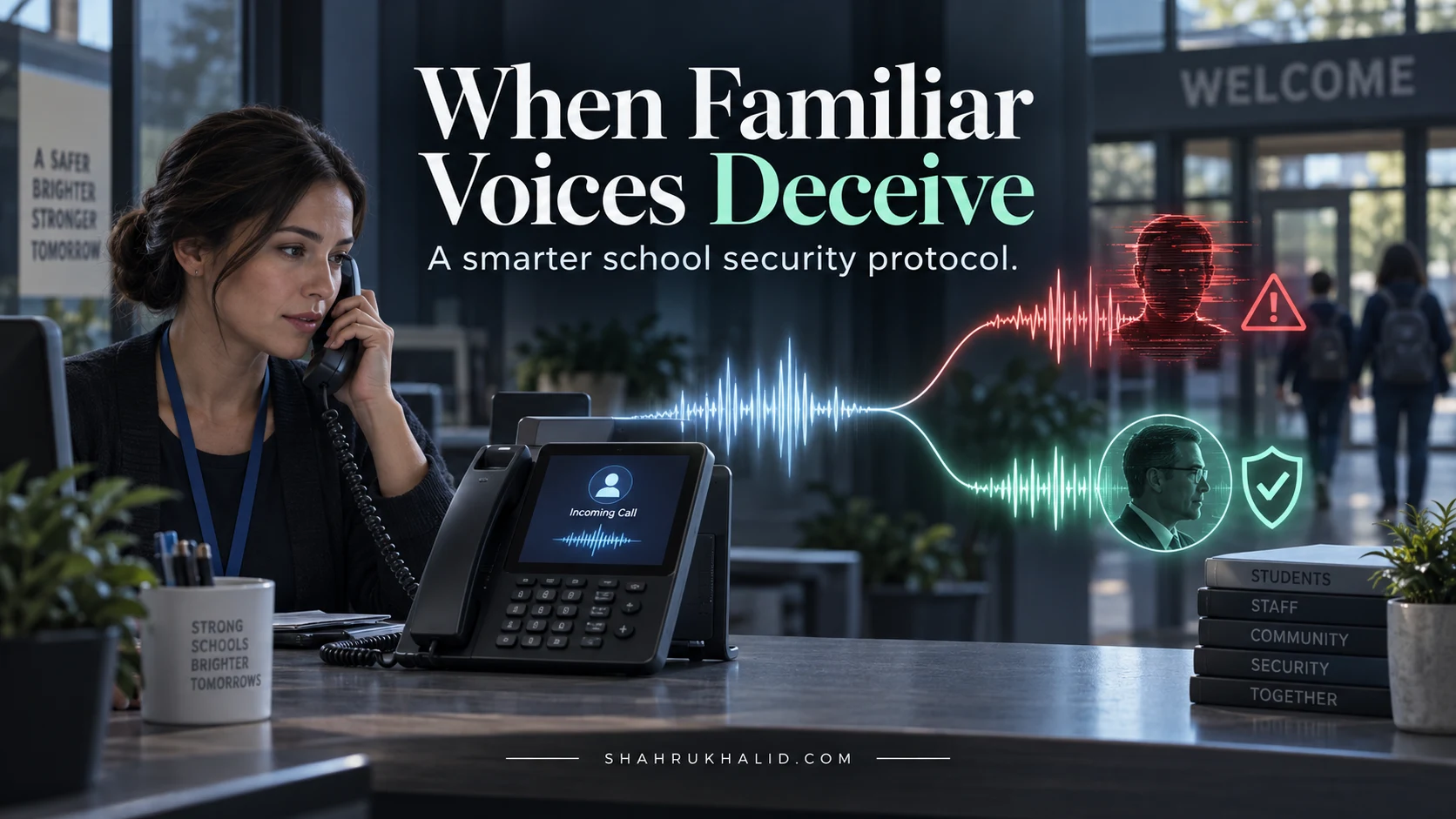
It was a crisp Tuesday in late autumn when our front desk receptionist buzzed my office with a tremor in her voice that immediately made my stomach drop. On the line was the familiar, measured cadence of our assistant superintendent, urgently explaining that he was stranded off-campus with a flat tire, locked out of his district digital wallet, and needed an immediate emergency wire transfer to settle a towing invoice before he could return for the morning board meeting. The voice was unmistakable—it carried his exact pitch, his signature mid-sentence pauses, and the warm, reassuring chuckle we had all heard in a hundred staff meetings.
There was just one fatal flaw in the con: the real assistant superintendent was currently standing three feet away from my office door, holding a steaming cup of black coffee and discussing the agenda for the upcoming curriculum review. That chilling realization was the genesis of our encounter with an AI voice clone scam school security crisis, exposing a terrifying new vulnerability that every educational institution now faces. In an era where generative audio models can harvest a few seconds of public board meeting footage from YouTube and synthesize a hyper-realistic replica in real-time, the traditional trust-based perimeter of our front offices has officially evaporated.
This masterclass guide breaks down the exact anatomy of that attack, the systemic vulnerabilities that allowed it to bypass our human safeguards, and the field-tested, low-cost security protocol we built to protect our schools. Whether you are a district chief technology officer, a building principal, or a front-desk administrative assistant, this blueprint will show you how to harden your human infrastructure against the next generation of social engineering.
Anatomy of a Synthetic Audio Attack on Educational Institutions
To understand why an AI voice clone scam school security breach succeeds, we must first deconstruct the mechanics of modern generative audio. Unlike traditional phishing emails that rely on clumsy grammar and spoofed headers, synthetic voice attacks exploit our deepest evolutionary wiring. Humans are hardwired to trust vocal prosody, emotional inflection, and timbre. When a bad actor mimics a trusted authority figure, the recipient’s cognitive defenses drop significantly lower than they would when reading a suspicious text message or email.
The attack vector typically begins with reconnaissance. School districts are uniquely vulnerable because our leadership teams are hyper-transparent by design. Budget workshops, superintendent updates, athletic broadcasts, and board meetings are routinely streamed in high definition and archived publicly on YouTube, Facebook, and district websites. A bad actor can scrape hours of clean, isolated audio of a superintendent, principal, or chief financial officer with a single Python script or commercial scraping tool. This audio dataset is then fed into neural text-to-speech models that map vocal patterns, accent shifts, and emotional cadence with frightening fidelity.
Once the model is trained, the attacker initiates a real-time deepfake audio stream or pre-recorded audio file via phone, VoIP, or video conferencing platforms like Zoom or Microsoft Teams. They rely on manufactured urgency—a crisis, a sudden safety threat, an imminent financial deadline, or a confidential personnel matter—to trigger panic and bypass standard verification protocols. Front-desk staff, caught off guard and eager to be helpful to leadership, abandon routine procedural friction in favor of immediate compliance.
Consider the structural breakdown of how these social engineering vectors manifest in typical school environments:
- The Emergency Financial Request: An attacker clones a central office administrator’s voice to demand immediate wire transfers, gift card purchases for staff appreciation, or urgent invoice settlements over the phone.
- The Student Safety Crisis: A bad actor targets a school secretary claiming to be a parent or local law enforcement official, using synthesized emotional stress to extract student directory information, pickup schedules, or address data.
- The Credential Harvesting Ploy: An attacker mimics an IT director calling a teacher or administrative assistant to demand password resets, multi-factor authentication bypass codes, or direct login assistance under the guise of an urgent cybersecurity audit.
- The Board Member Pressure Tactic: A synthetic audio clip impersonates an elected school board member demanding immediate policy exceptions, contract approvals, or release of confidential executive session data.
Recognizing these patterns is the first step toward building an effective defense. Traditional cybersecurity has long focused on firewalls, endpoint detection, and spam filters, largely ignoring the human firewall sitting at the physical and digital threshold of the school building. Securing our districts now requires bridging the gap between hardware defense and behavioral protocols.
Evaluating Your District’s Exposure and Vulnerability Surface
Before implementing new countermeasures, you must conduct an honest audit of your district’s current exposure profile. An effective AI voice clone scam school security assessment looks beyond software firewalls and examines how information, communication, and authority flow through your administrative channels. Most districts suffer from systemic blind spots that make them prime targets for sophisticated social engineering campaigns.
The primary vulnerability lies in our culture of radical accessibility. Public education is built on community engagement, openness, and responsiveness. Front-desk personnel are explicitly trained to be welcoming, accommodating, and helpful to anyone who walks through the doors or calls the main line. When an attacker weaponizes this cultural norm against us, helpfulness becomes our greatest liability. Furthermore, internal communication channels are often fragmented across personal cell phones, district-issued smartphones, unencrypted messaging apps, and traditional desk phones, creating massive gaps in verification consistency.

Let us examine the common architectural and cultural vulnerabilities found across typical school districts in the following comparative analysis:
| Vulnerability Area | Traditional District Practice | The Modern AI Risk Profile |
|---|---|---|
| Leadership Audio Footprint | Hours of unedited public board meetings and superintendent podcasts hosted openly online. | Provides pristine, high-fidelity training data for commercial voice-cloning neural networks. |
| Front-Desk Verification | Relying on caller ID, familiar vocal tones, and administrative hierarchy out of respect. | Attackers easily spoof caller ID numbers and perfectly replicate trusted vocal characteristics. |
| Emergency Protocol Agility | Informal verbal overrides for “urgent” financial or operational requests from executives. | Creates a fatal loophole where synthetic voice pressure bypasses multi-person sign-offs. |
| Staff Security Training | Annual compliance modules focused exclusively on phishing emails and password hygiene. | Leaves employees completely unprepared for real-time audio deepfakes and phone-based social engineering. |
Mapping your district against this matrix reveals immediate remediation targets. If your superintendent or principals have extensive public-facing video and audio archives without accompanying out-of-band verification workflows, your front desk is operating without a safety net. The goal is not to eliminate public transparency—which remains vital for democratic governance—but to decouple public visibility from internal authorization authority.
Designing a Zero-Trust Communication Protocol for School Front Offices
Building a resilient defense against synthetic voice attacks requires adopting a Zero-Trust architecture for all administrative communications. In cybersecurity, Zero-Trust is built on the mantra “never trust, always verify.” Applied to our front desk and administrative workflows, this means that no matter how familiar a voice sounds, how high the urgency appears, or how authoritative the caller claims to be, high-stakes decisions, financial authorizations, and data disclosures can never rely on vocal recognition alone.
Our district engineered a simple, repeatable, and non-punitive protocol that any school can implement regardless of budget or technical sophistication. We call it the Out-of-Band Challenge-Response Protocol (OBCRP). The philosophy is simple: if an inbound request involves money, student data, credentials, or policy overrides, the recipient must instantly sever the inbound channel and initiate a secondary, independent out-of-band verification loop.
Implementing this protocol required rewriting our standard operating procedures for front-desk staff and central office administrators. Here are the core operational pillars of the system we deployed across all school sites:
- The Mandatory Disconnect Rule: Staff are legally and procedurally empowered to immediately hang up on any caller—even the superintendent—who demands urgent, sensitive compliance, with zero fear of administrative repercussions.
- The Pre-Shared Secret Phrase: District leadership and administrative assistants share a rolling, cryptographically random, or securely generated pass-phrase updated quarterly. This phrase is never spoken over regular phone lines casually; it must be requested during high-stakes verification.
- Independent Callback Mandate: Verification must occur by dialing a known, internal extension or a verified cellular number stored in the internal staff directory, never by hitting redial on an inbound call or trusting the caller ID display.
- The Two-Person Integrity Threshold: Any financial transfer, vendor payment change, or emergency override of student privacy settings requires dual authorization from two physically present or independently verified staff members.
This protocol removes the psychological burden from the front-desk receptionist. Instead of forcing an administrative assistant to make a subjective judgment call about whether the voice on the line sounds authentic, the protocol makes verification an absolute, mandatory procedural check. It transforms a stressful interpersonal confrontation into a routine administrative safeguard.
Furthermore, we integrated this protocol into our visitor management software and physical security check-in stations. When walk-in visitors claim to represent district leadership or external emergency agencies, identical verification loops are triggered before access or information is granted. By unifying our physical and digital security protocols, we closed the loop on multi-vector social engineering attempts.
Training Your Staff to Spot Deepfakes and Social Engineering
A security protocol is only as strong as the human beings executing it. Technology can flag anomalies, but the final line of defense against an AI voice clone scam school security breach is human skepticism and awareness. Traditional cybersecurity awareness training often bores educators with dry compliance videos, leaving them unprepared for the psychological manipulation of a sophisticated audio deepfake.
We completely overhauled our professional development modules to focus on practical, scenario-based resilience training. We introduced our staff to the concept of “synthetic friction”—the deliberate introduction of healthy skepticism into high-pressure communications. Teachers, secretaries, and principals participated in tabletop simulation exercises where they received simulated deepfake phone calls and had to correctly execute the Out-of-Band Challenge-Response Protocol under time pressure.
To make training sticky and memorable, we equipped our staff with a mental checklist of audio deepfake indicators. While advanced models are increasingly smooth, real-time synthesis often betrays itself through subtle technological artifacts that human ears can learn to detect:
- Unnatural Cadence and Pacing: Listen for missing vocal fillers (like “um,” “uh,” or transitional breathing sounds) that characterize natural human speech patterns. Deepfakes often sound artificially crisp, rhythmic, or relentless.
- Emotional Disconnect: Notice if the emotional tone doesn’t match the severity of the crisis. An attacker might simulate frantic words while the underlying vocal timber remains unnaturally calm or flat.
- Audio Artifacts and Digital Hiss: Pay attention to background noise that drops out completely during pauses, or metallic, robotic digital phasing artifacts common in low-latency VoIP streams.
- Evasion of Secondary Verification: When challenged with a request for a pass-phrase or an out-of-band callback, synthetic callers often resort to aggressive bullying, appeals to authority (“Do you know who I am?”), or sudden connection dropouts.
Empowering staff with this knowledge changes the institutional culture from passive compliance to active defense. When our front-desk staff realized that questioning authority was not an act of insubordination, but a critical duty safeguarding district resources, their confidence skyrocketed. They stopped worrying about offending the superintendent and started focusing on protecting the school community.
Technical Countermeasures and Future-Proofing Your District Infrastructure
While human protocols and training form the bedrock of your defense, technology must support your staff by hardening your communication channels against automated interception and spoofing. Future-proofing your district against evolving AI threats requires intentional upgrades to your telephony, network architecture, and administrative software stacks.
We began by auditing our telephony infrastructure. Traditional analog phone lines and legacy Private Branch Exchange (PBX) systems are notoriously easy to manipulate, allowing bad actors to spoof caller ID numbers with complete impunity. We migrated our district to a modern cloud-based VoIP ecosystem featuring robust STIR/SHAKEN caller ID authentication protocols. STIR/SHAKEN cryptographic signatures verify whether an incoming call actually originates from the number displayed on the screen, drastically reducing the effectiveness of basic caller ID spoofing.
Next, we implemented strict access control policies for administrative directory data. Many districts publish exhaustive staff directories featuring direct phone numbers, personal email addresses, and organizational hierarchies. We restricted detailed organizational charts behind our single-sign-on (SSO) employee portal, making it significantly harder for automated scrapers and bad actors to map our internal communication pathways and identify high-value targets.
Consider the core technical architecture pillars necessary for maintaining a secure administrative environment:
- STIR/SHAKEN Telephony Integration: Ensure your cloud VoIP provider cryptographically signs inbound calls to verify caller ID authenticity and flag unverified or spoofed external numbers.
- Directory Access Hardening: Move comprehensive staff directories behind authenticated portals to prevent automated OSINT (Open Source Intelligence) harvesting by malicious actors.
- Multi-Factor Authentication (MFA) Enforcement: Require phishing-resistant, hardware-token or authenticator-app MFA for all administrative accounts capable of authorizing financial transactions or accessing student data.
- Out-of-Band Verification Tooling: Establish secure, encrypted internal messaging channels (such as Signal or enterprise-managed chat tools) specifically designated for rapid administrative verification.
By coupling these technical controls with our rigorous human protocols, we created a defense-in-depth architecture. Even if an attacker successfully circumvents a technical filter or crafts a flawless voice clone, they inevitably crash against the unyielding barrier of our out-of-band verification procedures.
Scaling Your Protocol Across Multi-School Districts
Deploying a security protocol in a single building is challenging; scaling that protocol across a multi-school district with diverse campuses, varying administrative experience levels, and decentralized front offices requires a strategic, district-wide implementation plan. When we rolled out our anti-deepfake framework district-wide, we learned valuable lessons about change management in educational environments.
The key to successful scaling is consistency paired with localized empowerment. You cannot simply email a PDF policy document to building principals and expect flawless execution. Change in schools requires active leadership modeling, continuous professional development, and regular low-stakes drills that reinforce muscle memory.
We initiated our district-wide rollout using a phased deployment model:
- Phase 1: Central Office Hardening: We secured our central administration building first—the primary target for executive voice impersonation—testing our out-of-band protocols on executive assistants, finance personnel, and board clerks.
- Phase 2: Pilot School Rollout: We selected two high schools and three elementary schools to pilot our staff training modules and front-desk verification workflows, gathering feedback and refining our documentation.
- Phase 3: Full District Deployment: We deployed the finalized framework across all remaining facilities, incorporating the protocol into mandatory annual onboarding for all new hires and substitute personnel.
- Phase 4: Continuous Auditing and Drills: We instituted unannounced, benign social engineering tests conducted by our internal IT security team, measuring response compliance and identifying areas requiring refresher training.
This systematic approach ensured that the security upgrade was perceived not as an administrative burden, but as a shared community achievement. By treating cybersecurity as a collective protective shield rather than a punitive compliance mandate, we successfully transformed our district’s operational culture.
Conclusion
The morning the fake assistant superintendent tried to siphon funds from our district was a terrifying wake-up call, but it ultimately forced us to confront vulnerabilities we didn’t even know existed. As generative artificial intelligence continues to accelerate, bad actors will increasingly weaponize synthetic media to exploit the trusting, helpful nature of educational institutions. However, technology alone cannot solve a human problem.
By acknowledging our exposure, discarding outdated trust assumptions, implementing the Out-of-Band Challenge-Response Protocol, and training our front-desk staff to recognize the subtle artifacts of deception, we built a robust, low-cost defense that any school district can replicate. Securing your schools against AI voice clone scams does not require a million-dollar cybersecurity budget; it requires clear procedures, unwavering leadership support, and a culture that values verification just as much as hospitality. Guard your front desk, empower your people, and ensure your district remains resilient in the face of tomorrow’s technological threats.