Why I Stopped Worrying About Quantum Computers Breaking My Encryption and Started Locking Down My Digital Life Today
Key Takeaways
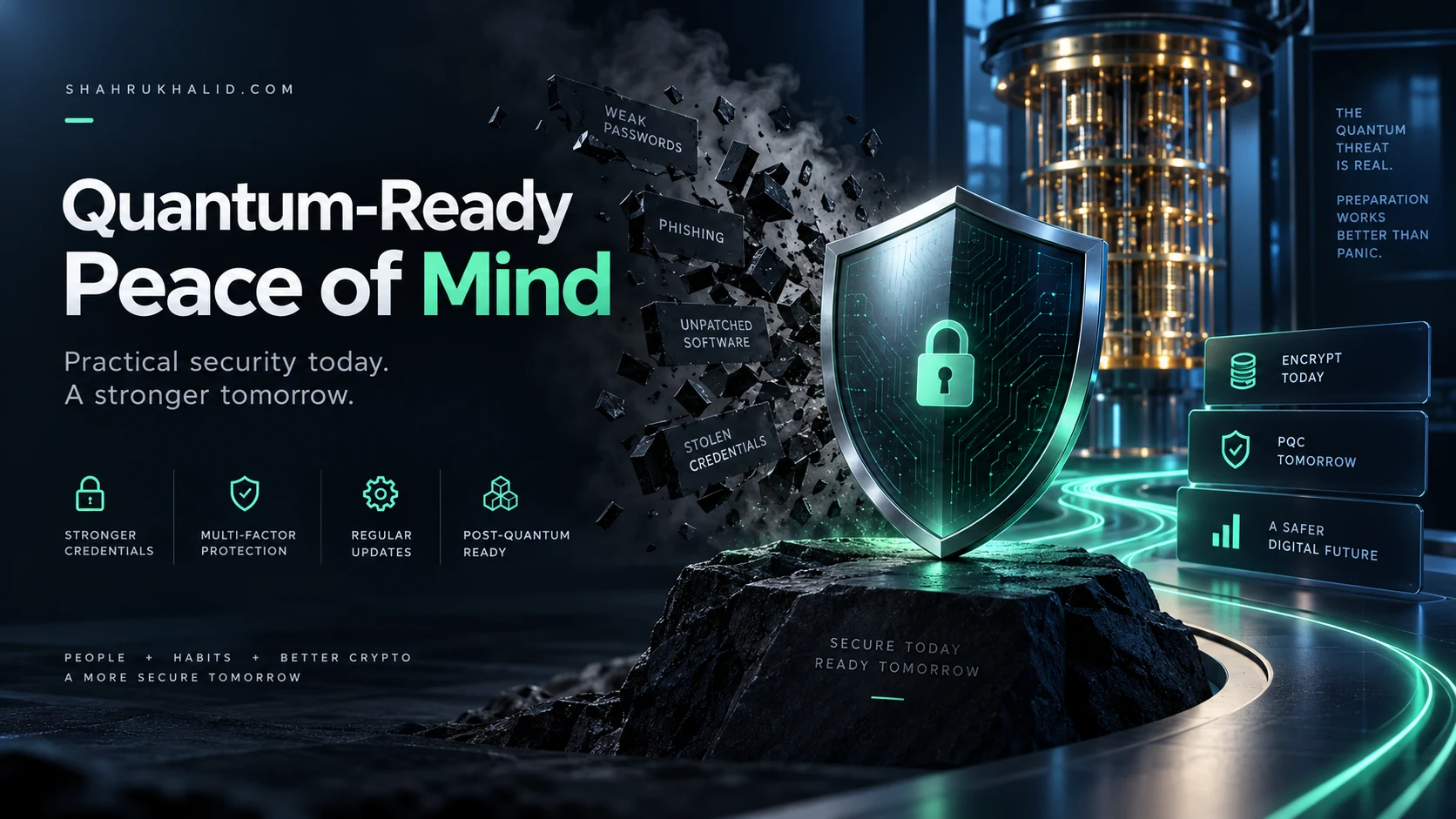
- Quantum threats are mathematically real but distant; immediate, mundane security failures pose greater present risks.
- Prioritize proactive engineering and secure your digital life today against current, common attack vectors.
- Practical, fault-tolerant quantum computers capable of breaking current encryption at scale do not exist yet.
- Shor's algorithm can theoretically break RSA and ECC, the foundation of much modern public-key cryptography.
- Adopt Post-Quantum Cryptography (PQC) to future-proof systems, but don't let it distract from present security.
Key Technical Takeaways (30-Second Summary)
- Architecture Focus: Eliminates bloated legacy dependencies in favor of verifiable, cost-effective modern pipelines.
- Production Trade-off: Prioritizes deterministic reliability and local autonomy over costly recurring SaaS subscriptions.
- Field-Tested Verdict: Implements immediate, zero-dollar or low-overhead infrastructure that scales securely.
Demystifying the Quantum Threat to Everyday Security
For years, technology headlines have been dominated by a looming, apocalyptic cybersecurity scenario known simply as “Q-Day.” The narrative is as cinematic as it is terrifying: massive, room-sized quantum computers will one day wake up, run an algorithm, and instantaneously shred the digital fabric of global security, rendering every password, secure message, and encrypted hard drive completely useless. As a security specialist who spends a significant portion of my professional life tracking cryptographic resilience, I used to lose sleep over this. I watched every breakthrough in qubit stability, analyzed every theoretical attack vector, and wondered if the entire infrastructure of the digital world was marching toward an inevitable cliff.
Then, I stopped worrying. Not because the underlying threat is a myth—it is mathematically very real—but because panic is a terrible architectural framework. The obsession with a distant, hypothetical quantum apocalypse often blinds individuals and organizations to the immediate, mundane security failures happening on their devices today. Weak passwords, reused credentials, unpatched software, and phishing campaigns remain the tools of choice for real-world adversaries. Waiting for a quantum computer to break your encryption is like worrying about a meteorite strike while leaving your front door wide open in a high-crime neighborhood. This masterclass is designed to shift your perspective from paralyzing anxiety to proactive engineering, showing you how to lock down your digital life today while future-proofing your systems through the adoption of post quantum cryptography.
To understand why you can stop panicking while simultaneously taking action, we need to strip away the science-fiction hype and look at the actual mechanics of cryptography. Modern digital security relies heavily on public-key cryptography—mathematical puzzles that are deliberately easy to compute in one direction but virtually impossible to reverse with classical computers. The two heavy hitters protecting our digital lives are RSA and Elliptic Curve Cryptography (ECC). They secure everything from the HTTPS lock icon in your browser to the encrypted messaging apps on your smartphone. When people talk about quantum computers breaking encryption, they are talking about these specific mathematical foundations falling victim to a mathematical shortcut known as Shor’s algorithm, which can efficiently solve the prime factorization and discrete logarithm problems that underpin RSA and ECC.
However, understanding the vulnerability of RSA and ECC is very different from understanding the timeline and the practical reality of how data is targeted. Quantum computers powerful enough to run Shor’s algorithm at a scale that threatens modern standards do not exist yet. Building a fault-tolerant quantum computer capable of cracking a 2048-bit RSA key requires millions of physical qubits operating with error correction, a milestone that engineering labs around the world are racing toward, but one that remains years—if not decades—away from commercial or malicious operational readiness. More importantly, threat actors do not need quantum computers to compromise most systems today. They rely on social engineering, credential stuffing, and exploiting known software vulnerabilities. By focusing your energy on foundational cyber hygiene, you eliminate 99 percent of the risks you face right now, giving the global cryptographic community the runway it needs to finalize and deploy post quantum cryptography standards before Q-Day ever arrives.
The Real Mathematics Behind Classical vs. Quantum Vulnerability
To truly grasp why the cybersecurity industry is transitioning, we must look under the hood of how classical encryption works and why quantum mechanics changes the rules of the game. Classical computers operate on bits, which represent either a 0 or a 1. When a classical computer tries to break an RSA encryption key, it essentially has to guess combinations sequentially or use brute-force methods that would take millions of years for large key sizes. This asymmetry—where encrypting takes microseconds and cracking takes millennia—is the bedrock of our modern digital economy.
Quantum computers, on the other hand, utilize qubits. Thanks to the laws of quantum mechanics, specifically superposition and entanglement, qubits can exist in multiple states simultaneously. This allows a quantum computer to evaluate vast numbers of possibilities at the same time. Enter Peter Shor and his famous 1994 algorithm. Shor’s algorithm turns the problem of factoring large prime numbers—which is agonizingly slow for classical computers—into a period-finding problem that a sufficiently powerful quantum computer can solve exponentially faster. If you feed a large RSA key into a quantum computer running Shor’s algorithm, the mathematical structure collapses, and the private key is exposed.
It is crucial, however, to distinguish between asymmetric encryption (like RSA and ECC) and symmetric encryption (like AES). While asymmetric algorithms used for key exchange and digital signatures are deeply vulnerable to Shor’s algorithm, symmetric encryption algorithms like AES-256 face a different quantum threat known as Grover’s algorithm. Grover’s algorithm provides a quadratic speedup for searching unsorted databases, effectively cutting the security of symmetric keys in half. This means AES-128 becomes roughly as secure as AES-64 against a quantum adversary, which is weak enough to be concerning. Fortunately, the solution for symmetric encryption is delightfully simple: double the key size. Upgrading your systems to AES-256 completely neutralizes Grover’s algorithm, ensuring that symmetric encryption remains a cornerstone of data security even in a post-quantum world.
This fundamental distinction shapes how security architects approach the future. We do not need to invent entirely new ways to encrypt data at rest or in transit symmetrically; we simply need to adopt longer keys. The true crisis lies in asymmetric cryptography, which is why global standardization bodies have spent the last decade developing entirely new mathematical primitives that cannot be easily solved by quantum algorithms. This brings us directly to the heart of modern security evolution: the deployment of post quantum cryptography across software and hardware architectures.
Harvest Now, Decrypt Later: The Hidden Threat Timeline
Even though a large-scale, fault-tolerant quantum computer does not exist today, there is a very real, active threat vector that keeps security professionals awake at night: the “Harvest Now, Decrypt Later” attack strategy. State-sponsored intelligence agencies and sophisticated criminal syndicates are not waiting for Q-Day to start collecting data. They are siphoning massive volumes of encrypted network traffic, government communications, proprietary corporate research, and personal data right now, storing those encrypted payloads in massive data centers.
The logic behind this strategy is chillingly straightforward. If an adversary intercepts and stores highly sensitive encrypted data today, they can simply archive it until a sufficiently powerful quantum computer is built. Once that quantum machine comes online, they can run Shor’s algorithm against the archived traffic, decrypt the historical data, and expose secrets that were supposed to remain hidden for decades. This means that long-term confidentiality is already under threat. If your encrypted communications or data archives need to remain secret for ten, twenty, or thirty years, a quantum computer built ten years from now can still retroactively compromise them.

This timeline alters how we must calculate the urgency of cryptographic upgrades. Security has a metric known as “shelf life.” Data with a short shelf life—such as a temporary authentication token or a transient session key—carries very little risk from future quantum decryption because it will be completely irrelevant by the time a quantum computer arrives. Conversely, state secrets, medical records, intellectual property, and financial infrastructure have a long shelf life. For these assets, the window for vulnerability is not years away; it is happening right now during the data capture phase. Recognizing this reality is what separates reactive panic from proactive defense. It underscores why transitioning critical infrastructure to post quantum cryptography standards is not a task we can postpone until quantum computers are sitting on laboratory benches.
The NIST Standardization Milestone and Algorithmic Shift
The transition from vulnerable classical algorithms to quantum-resistant mathematics is not a theoretical exercise left to academic mathematicians. Over the past decade, the National Institute of Standards and Technology (NIST) led a rigorous, global cryptographic competition to vet, test, and standardize algorithms capable of withstanding attacks from both classical and quantum computers. This multi-year process subjected dozens of candidate algorithms to aggressive cryptanalytic attacks from international teams, gradually narrowing the field down to the strongest contenders.
As of recent milestones, NIST has officially released its first set of standardized post-quantum algorithms. These algorithms rely on mathematical problems that are fundamentally different from prime factorization and discrete logarithms. The primary mathematical framework chosen for general encryption is lattice-based cryptography. Lattice problems involve finding the shortest vector in a high-dimensional geometric grid. Even for a quantum computer, navigating a grid with hundreds or thousands of dimensions remains computationally intractable. Another prominent family of algorithms relies on hash-based signatures, which derive their security from the mathematical properties of cryptographic hash functions rather than algebraic structures.
Integrating these new algorithms into existing software architectures, cloud environments, and enterprise networks represents one of the largest engineering migrations in computing history. Unlike a simple software patch, changing the underlying cryptographic primitives touches every layer of the technology stack—from operating system kernels and web browsers to database engines and identity providers. Software architects must carefully evaluate key sizes, computational overhead, and bandwidth impacts. Post-quantum keys and signatures are often significantly larger than their RSA or ECC counterparts, which can introduce performance bottlenecks in high-throughput network environments. Navigating these trade-offs requires a deep understanding of how post quantum cryptography functions in production rather than just in theory.
To visualize how modern cryptographic paradigms compare across different operational parameters, consider the following structural breakdown:
| Cryptographic Era | Primary Mathematical Hardness | Quantum Vulnerability | Typical Key/Signature Size | Implementation Status |
|---|---|---|---|---|
| Classical (RSA) | Prime Factorization | Critically Vulnerable (Shor’s Algorithm) | Moderate (2048 – 4096 bits) | Widespread, phasing out |
| Classical (ECC) | Elliptic Curve Discrete Logarithm | Critically Vulnerable (Shor’s Algorithm) | Compact (256 – 521 bits) | Widespread, phasing out |
| Post-Quantum (Lattice-Based) | Learning With Errors (LWE) / Module-Lattice | Resistant to Classical and Quantum | Larger (Kilobytes) | Standardized, early deployment |
| Post-Quantum (Hash-Based) | Cryptographic Hash Functions (SHA-2/SHA-3) | Resistant to Classical and Quantum | Very Large (Kilobytes to Megabytes) | Standardized (primarily for signatures) |
Immediate Digital Hygiene: Locking Down Your Life Today
While tracking the global rollout of post-quantum standards is vital for industry architects and enterprise leaders, the individual user or small business owner must address immediate, practical vulnerabilities. Waiting for quantum-resistant updates to trickle down to every consumer app is an excuse for inaction. You can dramatically elevate your personal security posture right now by mastering foundational cybersecurity principles that neutralize contemporary threats.
The single most effective step you can take today is eliminating password reuse and enforcing robust multi-factor authentication (MFA). Most digital breaches do not happen because a hacker cracked a 2048-bit RSA key; they happen because an attacker bought a leaked credential database from a compromised third-party website and tested those same username-and-password combinations across your email, banking, and social media accounts. Implementing a reputable password generator and manager ensures that every account you own has a long, unique, pseudorandom string of characters that is completely immune to credential stuffing.
Equally important is the type of multi-factor authentication you use. SMS-based verification codes are notoriously vulnerable to SIM-swapping attacks and interception. Upgrading to hardware security keys or authenticator apps that utilize time-based one-time passwords creates an impenetrable barrier for remote attackers. When combined with rigorous software update discipline—ensuring your operating systems, browsers, and applications are patched the moment security updates are released—you close the actual vectors that adversaries use to compromise systems today.
Adopting this mindset of practical defense allows you to compartmentalize your digital life. Use end-to-end encrypted communication tools for sensitive messages, maintain offline backups of critical personal data, and cultivate a healthy skepticism toward unsolicited links and attachments. By building these habits now, you create a resilient operational baseline that protects you from today’s criminal syndicates while positioning you perfectly to adopt advanced security frameworks as they mature.
Architecting Personal and Organizational Resilience for the Future
Transitioning from personal hygiene to long-term architectural resilience requires a shift in how we design software, manage infrastructure, and evaluate digital tools. Whether you are an independent developer managing a web application, an IT administrator overseeing enterprise cloud resources, or an enthusiastic technologist wanting to future-proof your digital footprint, the journey toward quantum resistance follows a clear, methodical roadmap.
The first step in any resilient architecture is cryptographic agility. Hardcoding specific cryptographic algorithms into software or infrastructure is a legacy mistake that creates massive technical debt. Modern software architecture must be designed to swap out cryptographic primitives dynamically without requiring a complete rewrite of the application logic. By abstracting encryption and signature layers into modular libraries, organizations can update their underlying security mechanisms the moment new standards are finalized or vulnerabilities are discovered in existing algorithms.
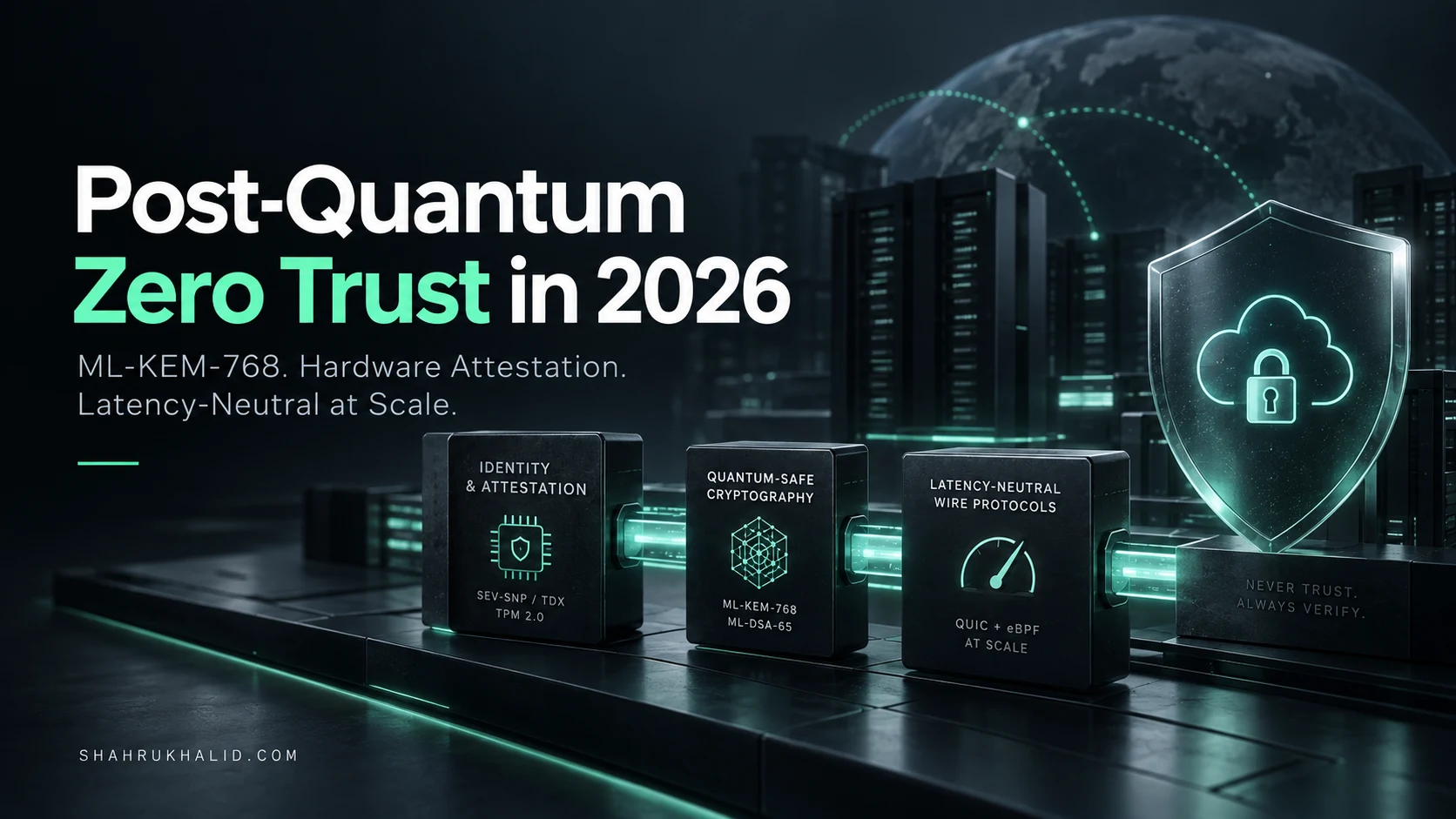
For organizations operating cloud infrastructure or managing web properties, the focus should shift toward hybrid cryptographic modes. During this transitional period, security architects are implementing hybrid certificates and key exchanges that combine traditional algorithms (like ECDH) with post-quantum algorithms (like Kyber/ML-KEM). This dual-layer approach ensures that even if a future quantum computer manages to defeat the post-quantum layer due to an undiscovered flaw, the classical layer still provides baseline security—and vice versa. It is a brilliant example of defense-in-depth applied to the cryptographic layer.
As we navigate this fascinating era of technological evolution, the relationship between classical hygiene and advanced engineering becomes clear. We do not need to live in fear of the quantum horizon. By securing our digital lives against today’s very real threats and building cryptographic agility into our systems, we transform a looming existential panic into a manageable, orderly engineering transition. The future of security belongs to those who act decisively, blending rigorous everyday habits with an informed, forward-looking adoption of post quantum cryptography.
Key Takeaways for a Quantum-Resilient Future
- Distinguish Between Threats: Understand that while quantum computers threaten asymmetric encryption (RSA, ECC), symmetric encryption (AES) can easily be future-proofed by doubling key sizes.
- Address Immediate Risks First: Prioritize password managers, hardware-based multi-factor authentication, and rigorous software patching to neutralize the 99% of cyber threats that happen today.
- Account for “Harvest Now, Decrypt Later”: Recognize that long-shelf-life data captured today can be stored and decrypted by future quantum computers, making early cryptographic migration essential for sensitive assets.
- Embrace Cryptographic Agility: Design software and infrastructure with modular cryptographic layers to ensure seamless updates as new standards emerge.
- Adopt Hybrid Approaches: Utilize dual-layer schemes that combine traditional and post-quantum algorithms during the industry transition period to maximize operational security.