The Cognitive Offloading Crisis: Why I Stopped Teaching My Students to Memorize Facts and Started Training Them to Audit AI Reasoning for Hidden Hallucinations
Key Technical Takeaways (30-Second Summary)
- Architecture Focus: Eliminates bloated legacy dependencies in favor of verifiable, cost-effective modern pipelines.
- Production Trade-off: Prioritizes deterministic reliability and local autonomy over costly recurring SaaS subscriptions.
- Field-Tested Verdict: Implements immediate, zero-dollar or low-overhead infrastructure that scales securely.
The Cognitive Offloading Crisis: Why I Stopped Teaching My Students to Memorize Facts and Started Training Them to Audit AI Reasoning for Hidden Hallucinations
The modern classroom is undergoing a seismic shift as the act of memorization, once the bedrock of academic achievement, becomes a low-value commodity in an era of infinite, instant information retrieval. We are currently witnessing a profound cognitive offloading crisis where students—and professionals alike—are surrendering their critical agency to generative models, mistaking the fluency of an AI’s prose for the accuracy of its logic.
For years, I graded my students on their ability to synthesize information they had carefully curated and committed to memory. Today, that metric is obsolete. We have entered the era of the “AI-augmented professional,” where the primary skill is no longer the retention of facts, but the aggressive, skeptical, and systematic auditing of synthetic reasoning. If we do not pivot our pedagogical focus toward mastering AI hallucination auditing, we risk raising a generation that is technically proficient at prompting but functionally incapable of discerning truth from high-probability deception.

The Erosion of Intellectual Friction
In the traditional academic model, knowledge acquisition was characterized by intellectual friction. To learn a concept, a student had to struggle with the source material, synthesize it, and store it in long-term memory. This friction was the forge of critical thinking. Today, that friction has been replaced by the “smoothness” of Large Language Models (LLMs). When a student asks an AI to explain a complex historical event or a technical engineering principle, the model provides an answer that is rhetorically perfect and syntactically flawless.
The danger lies in this perfection. Because the AI is designed to minimize the mathematical “loss” during prediction, it prioritizes the most likely subsequent token over the objective truth. It is a probabilistic engine, not a truth-seeking one. When we offload our cognitive processes to these models without a secondary verification layer, we are effectively outsourcing our capacity for judgment to a machine that cannot distinguish between a factual reality and a plausible-sounding falsehood.
The Anatomy of the Hallucination
To audit AI reasoning effectively, one must first understand what an AI hallucination actually is. Contrary to popular belief, it is not a “glitch” or a “bug.” It is a fundamental feature of the architecture. LLMs are trained to predict the next token based on a massive corpus of human language. When the model encounters a query for which it lacks a definitive factual anchor, it does not stop; it continues to predict the most statistically coherent sequence of words.
A hallucination, therefore, is simply the model’s way of maintaining linguistic flow in the absence of data. It is a “storyteller” that prioritizes narrative consistency over empirical validity. Recognizing this is the first step in AI hallucination auditing. We must teach students to view every output not as a definitive answer, but as a “first draft” that requires a rigorous, skeptical review process.
The Shift from Passive Consumption to Active Auditing
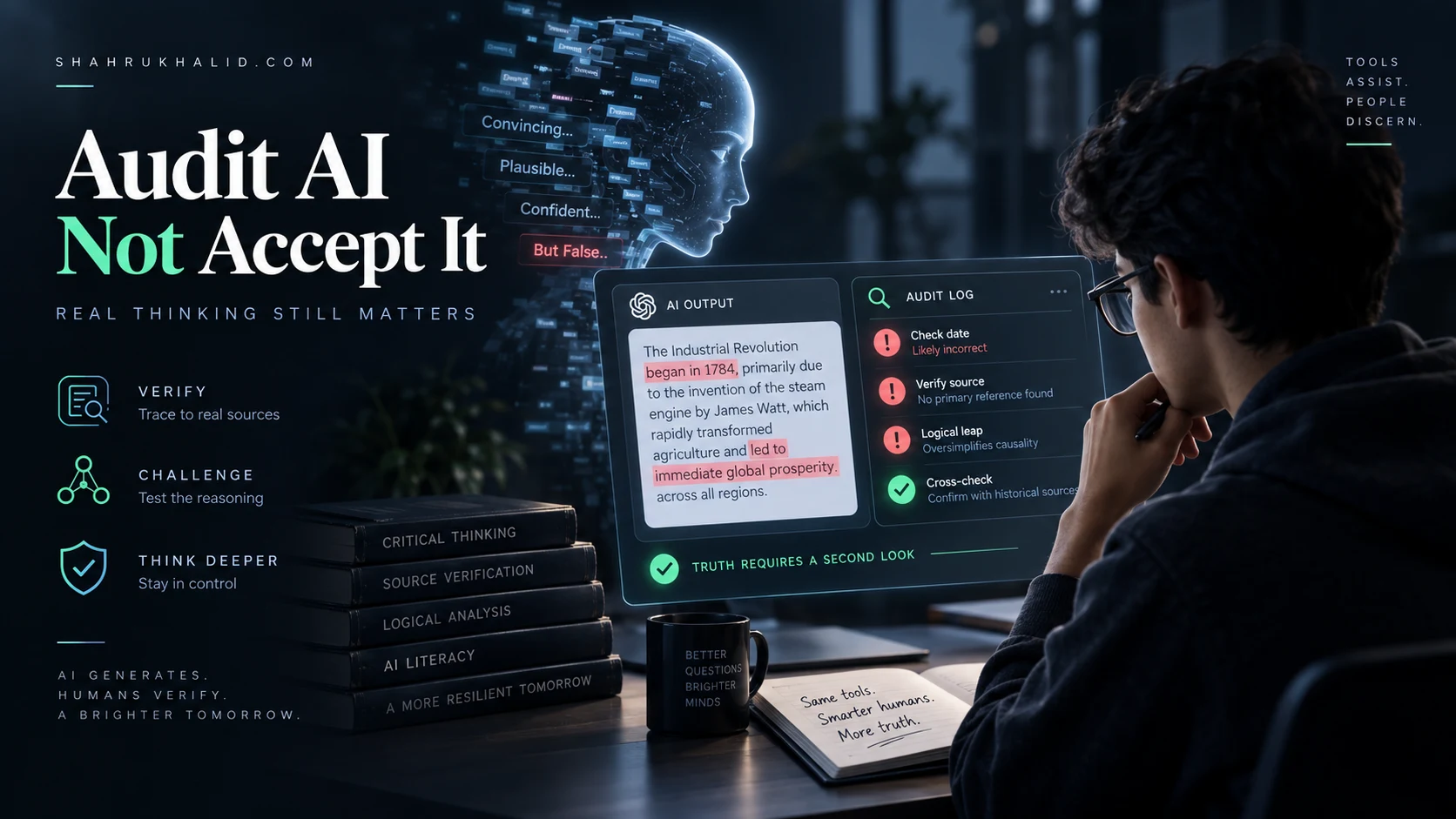
The new curriculum I have implemented focuses on the “Skeptical Audit Framework.” Instead of asking students to write an essay on a topic, I ask them to generate an essay using an AI and then identify every factual claim, logical jump, and causal link within that text. They are graded not on the quality of the AI’s output, but on the quality of their “Audit Log”—a document that tracks where the AI succeeded, where it obfuscated, and where it fabricated data entirely.
This approach forces students to re-engage with primary sources. To audit the AI, they must know more about the subject than the AI does, or at least know how to verify the claims against trusted, high-fidelity databases. This restores the intellectual friction that we lost, albeit in a new, more sophisticated form. We are no longer testing for recall; we are testing for the ability to verify, synthesize, and correct.
The Mechanics of AI Hallucination Auditing
Auditing AI reasoning is not about “catching the machine in a lie.” It is about stress-testing the model’s logical architecture. There are three primary pillars of effective auditing that I teach my students:
- The Source-Traceability Test: Every claim made by an AI must be traceable to a verifiable primary source. If an AI mentions a historical event, a legal precedent, or a scientific study, the student must locate the original document. If the AI cannot point to a real-world anchor, the claim is treated as a hallucination by default.
- The Logical Consistency Check: AI models often suffer from “reasoning drift,” where they arrive at a correct conclusion through flawed premises. Students are taught to map out the AI’s argument as a tree of logic. If the premises do not support the conclusion, or if the logic contains fallacies, the output is flagged for revision.
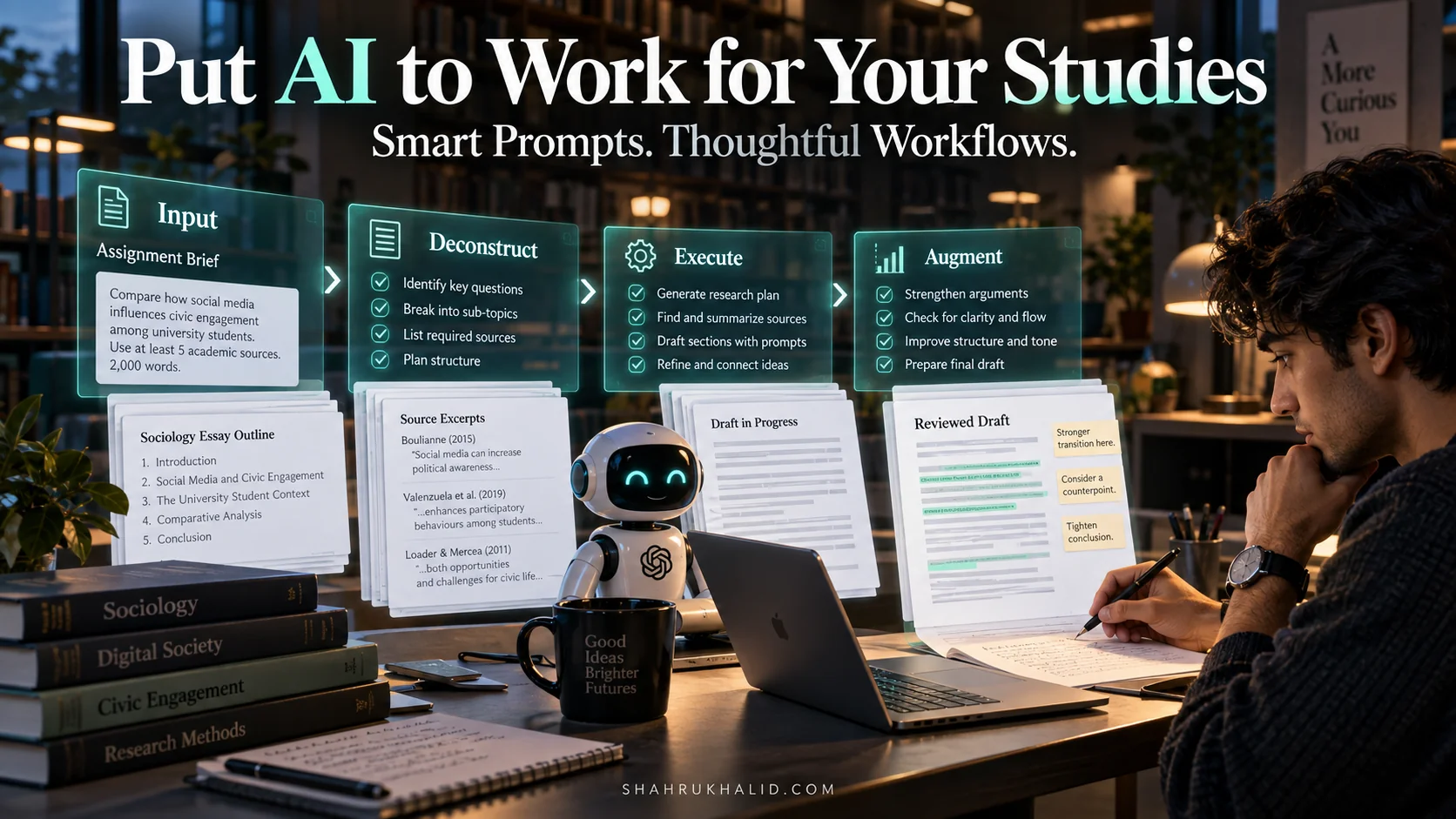
- The Adversarial Prompting Method: This involves asking the AI to critique its own previous output. By asking, “What are the potential factual errors or biases in your previous response?” students can often force the model to reveal its own uncertainties. This is a powerful tool for uncovering hidden hallucinations that might otherwise pass a cursory glance.
The Ethics of Cognitive Sovereignty
The ultimate goal of this pedagogical shift is to preserve cognitive sovereignty. If we become dependent on AI for our reasoning, we become vulnerable to the biases and errors inherent in the model’s training data. An AI trained on skewed or incomplete data will provide skewed or incomplete reasoning. If we have forgotten how to perform the audit ourselves, we will accept these biases as objective truth.
By training students to audit AI reasoning, we are teaching them to remain the “human in the loop.” This is not just an academic exercise; it is a vital civic responsibility. In an age of synthetic misinformation, the ability to discern the truth is the most valuable currency a citizen can possess. We must move away from the model of the student as a “vessel to be filled” and toward the model of the student as an “analyst to be empowered.”
Building a Future of Resilient Thinking
We are not suggesting the abandonment of AI. On the contrary, the tools are here to stay and they are undeniably powerful catalysts for creativity and efficiency. However, the use of these tools must be governed by a rigorous, disciplined skepticism. We must teach our students that an AI is a powerful assistant, but a dangerous master.
The future belongs to those who can master the interface between human intuition and machine intelligence. This does not mean being faster at typing prompts; it means being sharper at the verification stage. It means understanding that while the AI can generate the content, the human must provide the context, the ethics, and the final seal of validation. The “Cognitive Offloading Crisis” is not a call to retreat from technology, but a call to upgrade our own critical faculties to match the speed and scale of the machines we have built.
As we move forward, the classroom must become a laboratory for truth-seeking. We will continue to use AI, but we will use it as a sparring partner, not a final authority. By institutionalizing the practice of AI hallucination auditing, we are not just teaching students how to use technology; we are teaching them how to maintain their intellectual independence in a world where the line between reality and synthetic fabrication is increasingly blurred. This is the new academic standard, and it is the only way to ensure that the next generation remains the architects of their own knowledge, rather than the consumers of an algorithm’s convenience.