Beyond the Gradebook: How I Swapped Standardized Testing for Dynamic Skill-Badging and Finally Unlocked Student Potential
Key Takeaways
- Standardized testing and A-F grades measure compliance, not true skill mastery or potential.
- Dynamic skill-badging replaces reductive grades with granular, verifiable competency-based mastery.
- Badges create a digital, evolving portfolio, proving specific competencies through authentic application.
- Competency-based education ensures mastery by allowing variable time/path, preventing foundational gaps.
- This approach shifts from industrial-era compliance to human-centric, capability-focused learning.
The Broken Promise of the A-F Scale: Moving Toward Competency-Based Education
For decades, we have treated the classroom like a factory assembly line, where students are stamped with a letter grade at the end of a cycle, regardless of whether they have truly mastered the underlying concepts. As an EdTech coordinator, I have watched countless brilliant minds wither under the pressure of standardized testing, only to realize that our assessment systems were measuring compliance rather than capability—until I swapped the gradebook for dynamic skill-badging, a pivot that finally unlocked true student potential through the architecture of competency-based education.
The Architecture of Failure: Why Standardized Testing Stifles Growth
In our traditional pedagogical model, the gradebook acts as a black box. A student receives a “B” in Algebra, but that grade tells us nothing about their ability to solve quadratic equations or their struggle with variable isolation. It is a reductive metric that masks the nuances of cognitive development. Standardized testing exacerbates this by creating a “high-stakes” environment where learning is sacrificed for memorization. We have built a system that incentivizes the short-term retention of facts for an exam, rather than the long-term acquisition of durable skills.

When we rely on the gradebook, we create a ceiling for high achievers and a trap for those who learn at different cadences. Competency-based education flips this logic entirely. Instead of a fixed timeline with a static grade, we move toward a system where the “what” (the skill) remains constant, while the “how” (the time and path) becomes variable. This is the fundamental shift from an industrial-era model to a modern, human-centric approach to learning.
What is Dynamic Skill-Badging?
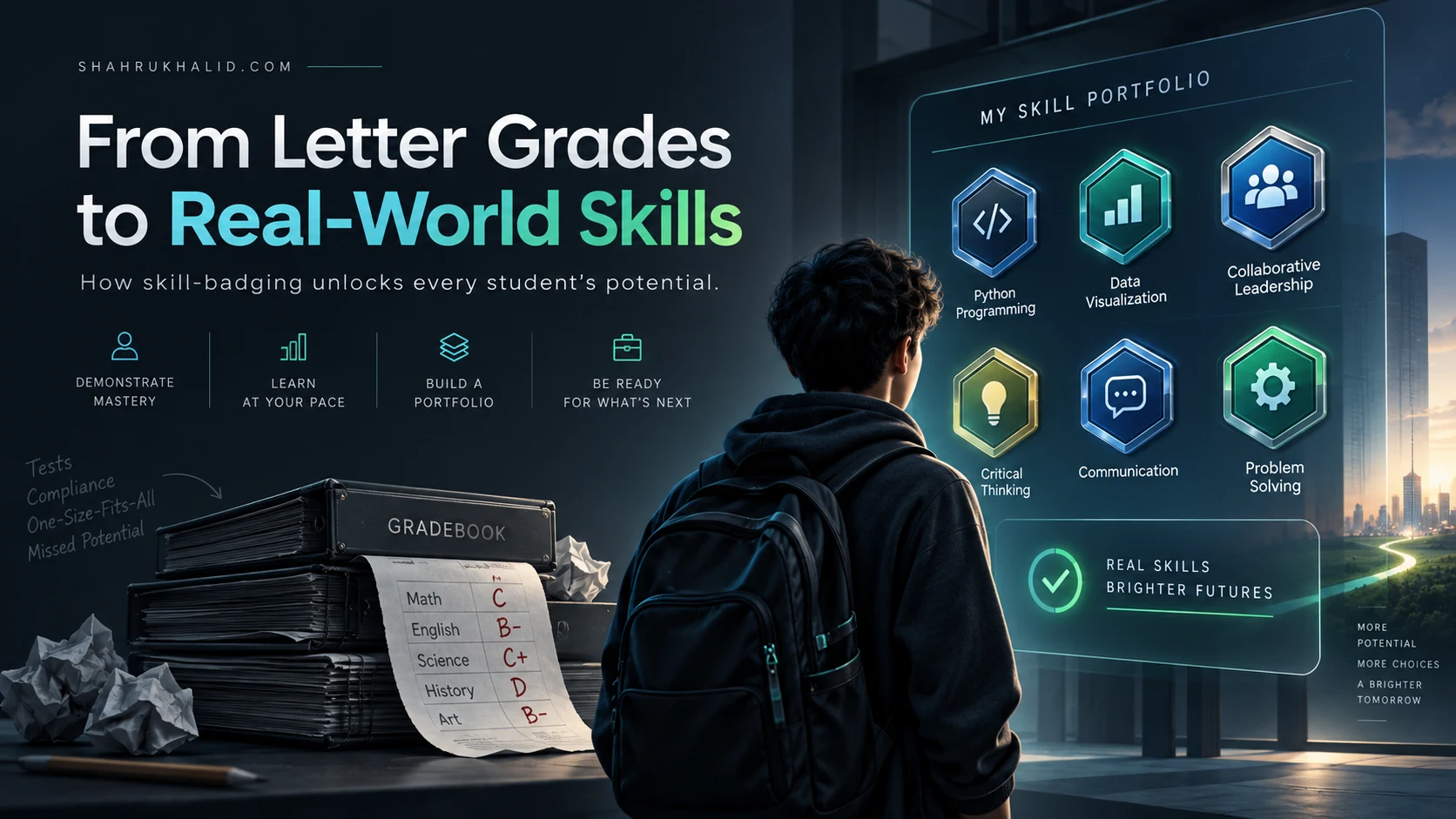
Dynamic skill-badging is the digital equivalent of a professional portfolio, providing a granular, verifiable, and evolving map of a student’s mastery. Unlike a grade, which is a snapshot in time, a badge is a living credential. It signifies that a student has demonstrated a specific competency—such as “Data Visualization,” “Collaborative Conflict Resolution,” or “Python Scripting Fundamentals”—through project-based work, peer review, and authentic application.

In a classroom integrated with modern Learning Management Systems, these badges serve as modular building blocks. A student doesn’t just “pass” a class; they accumulate a digital transcript of badges that represent their actual capabilities. This approach aligns perfectly with the principles of competency-based education, as it requires students to prove mastery before moving to the next level of complexity, ensuring no foundational gaps are left behind.
Designing the Transition: A Step-by-Step Implementation
Moving away from the gradebook is not an overnight task; it requires a systemic redesign of your classroom culture and technological infrastructure. Here is how we bridge the gap:
- Deconstruct the Curriculum: Break your course down into discrete, measurable competencies. If you are teaching history, move away from “Chapter 4 Test” and toward “Primary Source Analysis” or “Historical Contextualization.”
- Define the Evidence: For each competency, create a rubric that defines what “mastery” looks like. This isn’t just about getting an answer right; it’s about demonstrating the skill in a real-world scenario.
- Select Your Digital Infrastructure: Utilize an LMS or a dedicated badging platform that allows for micro-credentialing. The technology should be invisible—a seamless way for students to upload evidence and for you to verify mastery.
- Implement Iterative Feedback Loops: In a competency-based system, a “not yet” is more valuable than an “F.” Allow students to resubmit work based on your feedback until they reach the mastery threshold.
- Gamify the Journey: Use the visual nature of badges to help students see their own progress. When a student sees their “Skill Map” grow, it triggers the same psychological reward mechanisms as leveling up in a game, but the reward is genuine intellectual growth.
The Human Nuance: Why This Works for Diverse Learners
The beauty of this model lies in its inherent equity. In a traditional system, a student who takes longer to grasp a concept is penalized by a lower grade, which often leads to disengagement. In a competency-based education framework, time is the variable. If a student needs three weeks to master a concept that another student masters in three days, both arrive at the same destination of mastery. The badge doesn’t care how long it took; it only cares that the student can perform the task.
Furthermore, this system prepares students for the 2026 workforce. Employers are no longer looking for GPA; they are looking for specific, verifiable skills. By teaching students to curate their own digital badging portfolio, we are giving them a competitive edge that a standard transcript simply cannot provide.
Overcoming the Resistance: Navigating Institutional Change
The biggest hurdle to ditching the gradebook is not technological; it is psychological. Parents, administrators, and even students are conditioned to equate learning with grades. To succeed, you must become a communicator. You need to show stakeholders that while the “letter” is gone, the “rigor” has increased. Use data from your LMS to show how students are achieving higher levels of mastery when they are given the agency to own their learning path.
Start small. Pilot a competency-based unit within your existing course structure. Use the badges as “bonus” indicators of mastery before fully transitioning to a badge-only system. By building proof of concept, you create the momentum necessary for broader institutional change.