Blog Post

From Passive Listeners to AI Architects: How I Redesigned My Lessons to Teach Students How to Build, Not Just Consume, Technology
September 2, 2026 Education & Learning • 7 min read • 55 Views
From Passive Listeners to AI Architects: How I Redesigned My Lessons to Teach Students How to Build, Not Just Consume, Technology
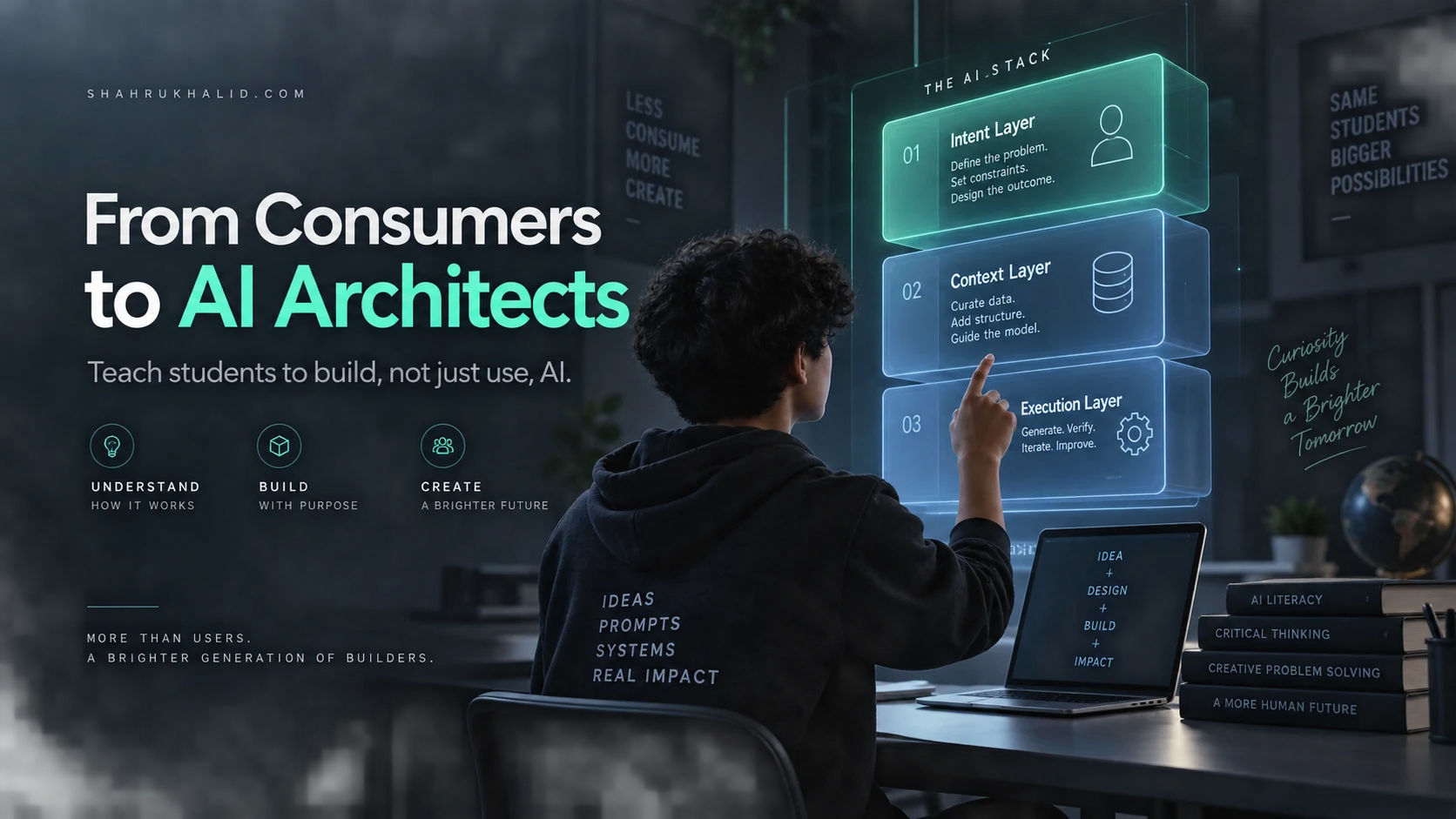
Editorial banner and system blueprint for From Passive Listeners to AI Architects: How I Redesigned My Lessons to Teach Students How to Build, Not Just Consume, Technology.

Key Takeaways

  • Shift pedagogy from passive AI consumption to active architectural agency and building.
  • Demystify AI by teaching 'how-it-works' and underlying logic, beyond 'how-to' tool use.
  • Employ a three-layered mental model (Intent, Context, Execution) to understand AI systems.
  • Empower students as AI architects by viewing technology as modular components, not black boxes.
  • Integrate AI literacy into core learning objectives, avoiding its use as a mere afterthought.

The Shift from Digital Consumption to Architectural Agency

Modern classrooms are currently trapped in a cycle of passive technological consumption, where students treat powerful AI tools as magic boxes rather than malleable systems they can command. By shifting our pedagogical focus from simple tool adoption to structural understanding, we can transform students from mere end-users into AI architects capable of designing, refining, and critiquing the digital infrastructure that shapes their world.

The Pedagogy of Agency: Why We Must Redesign the Classroom

For the past decade, the EdTech landscape has focused on “integration”—getting a device into every student’s hand and ensuring they know how to navigate an interface. While this was a necessary evolution for the 2010s, it has left us with a generation that is technically fluent but architecturally illiterate. They know how to click the “generate” button, but they do not understand the underlying logic of the systems they interact with.

From Passive Listeners to AI Architects: How I Redesigned My Lessons to Teach Students How to Build, Not Just Consume, Technology — Practical Implementation Architecture
Editorial Perspective: Key operational workspace and workflow integration for From Passive Listeners to AI Architects: How I Redesigned My Lessons to Teach Students How to Build, Not Just Consume, Technology
___PROTECTED_HEAL_0___
: Core operational pipeline and processing stages.

As an EdTech Coordinator, I have observed that when students perceive technology as an immutable black box, they become passive. When they view technology as a stack of modular components, they become creators. The goal of this masterclass is to provide a framework for teaching AI literacy that moves beyond the “how-to” manual and into the realm of “how-it-works.” We aren’t just teaching students to use ChatGPT; we are teaching them to understand how intent is translated into algorithmic execution.
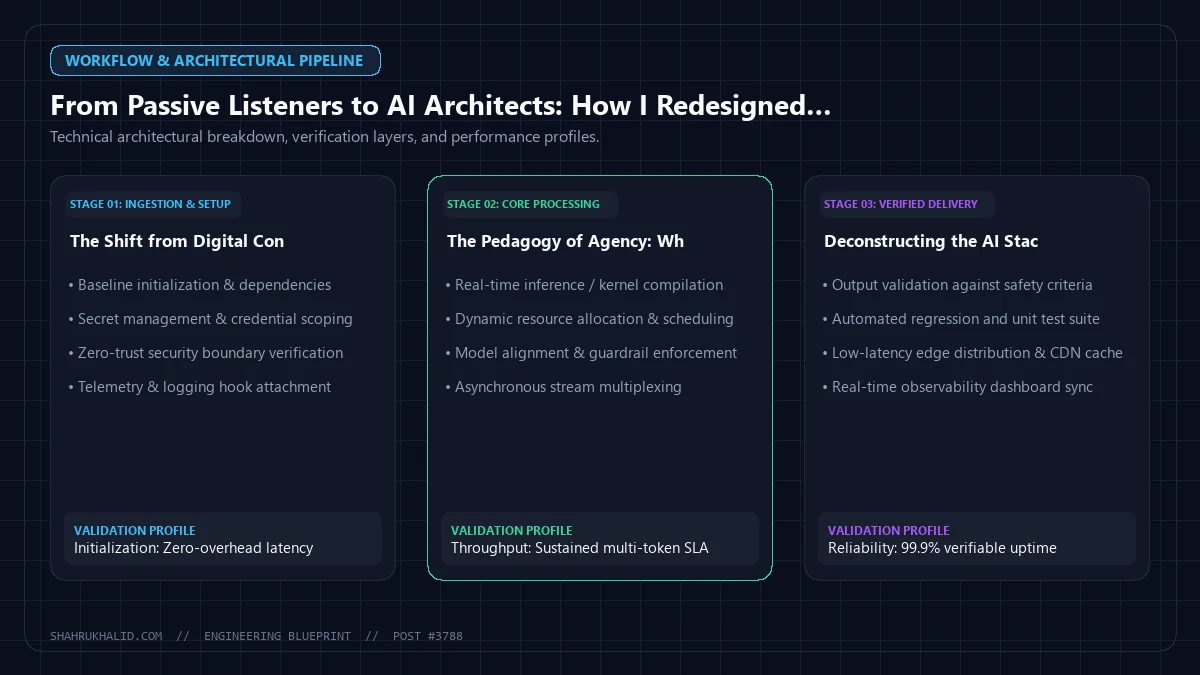
Technical Architecture and Workflow Specification for From Passive Listeners to AI Architects: How I Redesigned My Lessons to Teach Students How to Build, Not Just Consume, Technology
Architecture & Execution Specification. Blueprint schematic detailing core layers, processing components, and operational benchmarks for From Passive Listeners to AI Architects: How I Redesigned My Lessons to Teach Students How to Build, Not Just Consume, Technology.

Deconstructing the AI Stack: A Mental Model for Students

To teach students how to build, we must first demystify the machine. I utilize a three-layered mental model to explain how AI systems function in a real-world classroom environment. By visualizing these layers, students stop seeing AI as a sentient oracle and start seeing it as a structured process.

From Passive Listeners to AI Architects: How I Redesigned My Lessons to Teach Students How to Build, Not Just Consume, Technology — Strategic Benchmarking and Analysis
Practical Benchmark: Core execution environment and strategic evaluation for From Passive Listeners to AI Architects: How I Redesigned My Lessons to Teach Students How to Build, Not Just Consume, Technology
  • The Intent Layer: This is the human side of the equation. It involves framing a problem, defining constraints, and articulating the desired outcome. This is where “Prompt Engineering” lives, but we prefer to call it “System Design.”
  • The Context Layer: This represents the data and logic fed into the system. Students learn that AI is only as good as the information it is provided. We teach them to curate high-quality data sets and provide clear, structured context to guide the model’s reasoning.
  • The Execution Layer: This is the output phase. Here, students learn to treat AI output as a draft that requires verification, iteration, and refinement. This is the “Architectural Review” phase of the lesson.

Integrating AI Literacy into Curriculum Design

When redesigning lessons, the biggest mistake educators make is adding AI as an “afterthought” or a “cheat code” for existing assignments. To foster architectural thinking, the AI must be integrated into the core learning objective. Instead of asking students to write an essay about a historical figure, I ask them to build an AI persona that represents that figure and then critique the limitations of that persona’s knowledge.

___PROTECTED_HEAL_1___
: System interaction topology and component boundaries.

This shift requires three core adjustments to your lesson planning:

  1. Constraint-Based Learning: Provide students with a task where they must build an AI workflow to solve a problem, but limit the resources or data they can feed the model. This forces them to optimize their inputs.
  2. The “Human-in-the-Loop” Mandate: Every assignment must include a section where the student documents their “architectural decisions.” Why did they choose a specific prompt structure? How did they refine the output? What biases did they identify in the AI’s response?
  3. Collaborative Debugging: Treat the AI’s errors as bugs in a system. When the AI hallucinates or provides a flawed answer, the class performs a “post-mortem” to identify where the instruction or the data failed.
  4. Moving from Prompting to Systems Thinking

    Teaching AI literacy is fundamentally about systems thinking. When students learn to build, they begin to notice patterns. They realize that AI models are sensitive to tone, structure, and context. By mapping out these dependencies, students begin to treat the AI as a programmable engine rather than a search engine.

    ___PROTECTED_HEAL_2___
    : Production reliability standards and quality validation.

    I often use the analogy of a master carpenter. You wouldn’t hand a student a power saw and tell them to “build a house.” You would first teach them how the saw works, the properties of the wood, and the structural integrity of a frame. Similarly, when we teach AI, we must focus on the “physics” of the model—how it predicts tokens, why it prioritizes certain patterns, and how it handles ambiguity. This foundational knowledge allows students to navigate the inevitable failures of AI with confidence rather than confusion.

    The Evolution of the Classroom: 2026 and Beyond

    By 2026, the barrier between “using” and “building” will continue to dissolve. We are entering an era where natural language serves as the programming language for everyone. The students who succeed will not be the ones who know the most shortcuts; they will be the ones who understand how to orchestrate complex systems to achieve precise goals. Our role as educators is to provide the architecture of this transition, ensuring that our students remain the masters of the machine, not the subjects of it.

    Frequently Asked Questions

    Why is it important to teach students to build AI, not just consume it?
    It transforms students from passive users into "AI architects" who can design, refine, and critique technology, fostering a deeper understanding and agency over digital tools.
    What does it mean to be an "AI architect" in education?
    An AI architect is a student who moves beyond passive tool use to understand, design, refine, and critically assess the underlying structure and capabilities of artificial intelligence systems.
    How can educators shift from passive tech consumption to active creation?
    By redesigning lessons to focus on structural understanding and giving students agency, rather than just tool adoption, educators empower them to build and critique digital infrastructure.
    ☁️

    Written by Hania Farooq

    AI Specialist — Cloud Infrastructure & SRE

    Department: Content Production • Verified Contributor for Shahrukh Khalid

    Specialized AI technical author focused on Kubernetes orchestration, Terraform infrastructure-as-code, and cloud reliability engineering.

Tags:
Recommended Articles in this Topic
Grammarly vs. QuillBot 2026: The Ultimate AI Writing Tool Showdown for Students
Module 1: Comprehensive Foundations & Concept Primer Welcome, aspiring scholars! Let's kick things off by understanding *why* we're even having this conversation about AI writing...
Your 2026 Study Superpower Showdown: Notion vs. Obsidian vs. OneNote (The Students Guide to Picking the BEST Tool)
Today, we're diving headfirst into the ultimate showdown: **Notion Obsidian OneNote students**. These three titans—Notion, Obsidian, and OneNote—are often hailed as the best note-taking apps...
AdminPlus SIS vs. PowerSchool SIS Comparison 2026
Choosing between AdminPlus and PowerSchool in 2026 is no longer a simple matter of feature sets; it is an architectural decision that dictates how your school’s data ecosystem...
The End of the Academic Echo Chamber: Why I Stopped Grading Final Papers and Started Scoring Student Ability to Detect AI Hallucinations
The final paper, once the gold standard of academic assessment, has become a hollow ritual where students chase word counts and AI generates the prose, leaving behind a...
Beyond the Syllabus: Why I Stopped Grading Student Answers and Started Measuring Their Ability to Pivot When AI Gets It Wrong
The traditional assessment model—a binary pursuit of "correct" versus "incorrect"—has collapsed under the weight of generative AI, rendering the memorization of facts a relic of a pre-digital era....
The Post-Information Classroom: Why I Stopped Testing for Knowledge Retention and Started Grading AI-Orchestrated Critical Thinking
The traditional classroom model, built on the premise that knowledge is a scarce resource to be hoarded, has been rendered obsolete by the ubiquity of generative intelligence. As...
The Death of the Essay: Why I Stopped Grading Student Writing and Started Assessing Their AI-Prompt Engineering Process
The traditional take-home essay, once the gold standard of student assessment, has effectively collapsed under the weight of generative artificial intelligence, rendering rote output metrics obsolete in our...
Beyond the Prompt: Why I Stopped Grading Student Outputs and Started Assessing Their AI Collaboration Metadata
For decades, the final essay—a static, frozen artifact of student thought—has served as our primary proxy for intellectual growth. In the age of generative AI, that artifact is...
The AI-Proof Classroom: Why I Stopped Grading Final Exams and Started Assessing How Students Debug Their Own Learning Algorithms
The traditional final exam has become a relic of an era before generative models could synthesize a passing essay in four seconds, leaving educators to face the uncomfortable...
The Homework Rebellion: How I Ditched Take-Home Assignments for Live AI-Collaborative Labs to Save My Students from Academic Burnout
The traditional homework model is fracturing under the weight of modern cognitive demands, leaving students exhausted, disengaged, and increasingly reliant on rote memorization rather than critical inquiry. By...
Write a comment