The End of the Syllabus: How Local-First AI Tutors Are Personalizing Education in Real Time Without Cloud Latency
Key Takeaways
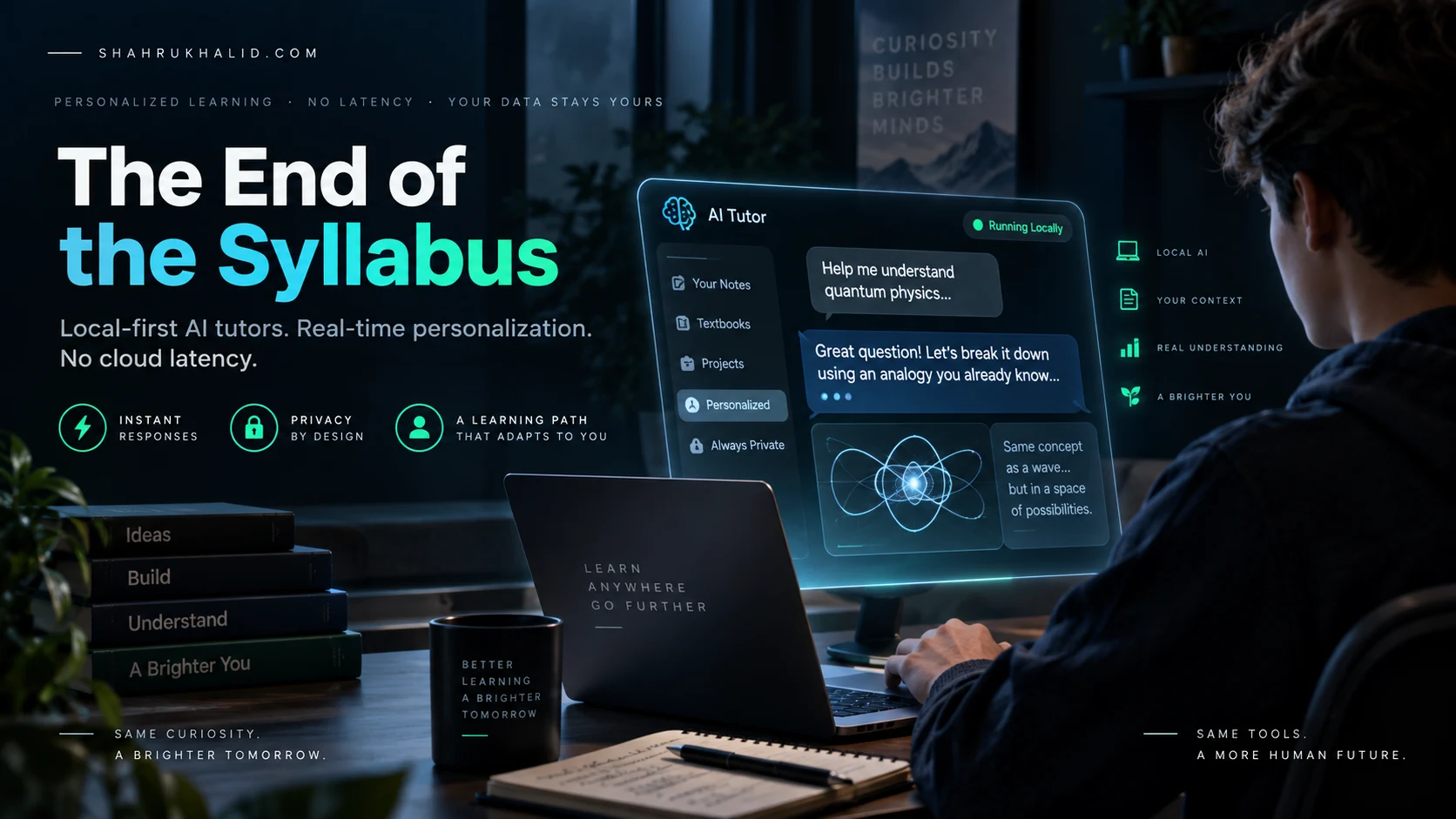
- Local-First AI tutors eliminate cloud latency and privacy issues, enabling real-time personalized education.
- This architecture runs LLMs via WebAssembly/WebGPU directly in the browser for zero-latency processing.
- Privacy-by-design ensures student data remains local in IndexedDB, never leaving the device.
- Real-time personalization and contextual awareness are achieved by processing AI directly on the user's machine.
- Local-First AI marks the end of the static syllabus, liberating learners from rigid, cloud-dependent systems.
Table of Contents
- The Death of the Static Syllabus: A Paradigm Shift
- Why the Cloud Failed the Classroom
- Defining Local-First AI: The Architecture of Privacy and Speed
- Under the Hood: WebLLM, WASM, and Vector Databases
- Building Your First Local-First Tutor: A Step-by-Step Guide
- From Curriculum to Context: How Personalization Actually Works
- The Road Ahead: 2026 and Beyond
- Frequently Asked Questions
The Death of the Static Syllabus: A Paradigm Shift
For decades, education has been shackled to the “Syllabus”—a rigid, linear, one-size-fits-all document designed for the industrial age. We taught the same content to thirty students at the same pace, regardless of their unique cognitive architecture or prior knowledge. As a web architect, I’ve watched the EdTech revolution struggle with the same bottleneck: the “Cloud-First” dependency. We built powerful AI tutors, but they were tethered to remote servers, suffering from latency, privacy concerns, and the dreaded “offline” error screen.
Today, that changes. We are witnessing the rise of Local-First AI Tutors. By shifting the heavy lifting of Large Language Models (LLMs) directly into the browser or the edge device, we are eliminating latency and enabling a level of personalization that was previously impossible. This isn’t just a technical upgrade; it is the liberation of the learner.
Why the Cloud Failed the Classroom
In the “Cloud-First” era of EdTech, every interaction with an AI tutor required a round-trip to a data center. Imagine a student asking a complex question about quantum physics. The request travels through the ISP, hits a load balancer, processes on a GPU cluster, and returns. If the network jitters, the “flow state”—that delicate psychological balance required for deep learning—is shattered.
Furthermore, privacy is a non-negotiable requirement in modern education. Sending a student’s granular learning struggles, personal notes, and cognitive patterns to a central server creates a massive data footprint. Local-first architecture solves this by keeping the model weights and the student’s vector database on the local machine. Your data never leaves your device.
Defining Local-First AI: The Architecture of Privacy and Speed
Local-first AI is a design philosophy where the application functions primarily on the local client, using the cloud only for synchronization or heavy-duty collaborative tasks when necessary. In the context of an AI tutor, this means the LLM runs via WebAssembly (WASM) or WebGPU directly inside the browser’s sandbox.
Key pillars of this architecture include:
- Zero Latency: Inference happens at the speed of your hardware.
- Privacy-by-Design: Student data is stored in IndexedDB, never in a remote SQL database.
- Contextual Awareness: Because the AI lives on your machine, it can “see” your current desktop state, your open PDFs, and your previous coding projects without violating data privacy laws like GDPR or FERPA.
Under the Hood: WebLLM, WASM, and Vector Databases
To build a local-first tutor, we leverage the WebLLM project—a high-performance in-browser LLM inference engine. By utilizing the WebGPU API, we can tap into the local graphics card to run quantized models (like Llama 3 or Mistral) with astonishing speed.
The “brain” of the tutor relies on Retrieval-Augmented Generation (RAG), but executed locally. We convert a student’s textbook or lecture notes into vector embeddings stored in a local ChromaDB or LanceDB instance. When the student asks a question, the local engine performs a semantic search on these embeddings, feeding relevant context to the model.
async function getContext(query) {
const vectorStore = await LocalVectorDB.connect('student-notes');
const context = await vectorStore.similaritySearch(query, 3);
return context.map(doc => doc.pageContent).join('n');
}
// Inference via WebLLM
const engine = await CreateWebLLMEngine("Llama-3-8B-q4f16_1");
const response = await engine.chat.completions.create({
messages: [{role: "user", content: `Using this context: ${context}, explain: ${query}`}]
});
Building Your First Local-First Tutor: A Step-by-Step Guide
If you are a developer looking to build the next generation of educational tools, follow this architectural roadmap:
- Select a Runtime: Use
MLC LLMorWebLLMto ensure hardware acceleration. - Quantization: Use 4-bit quantization. It reduces the model size from 16GB to roughly 4GB, allowing it to fit into the browser’s memory allocation.
- Local Storage: Use
IndexedDBfor persistence. This ensures that when the student refreshes the browser, their learning progress and custom syllabus are still there. - The UI Layer: Use a reactive framework like
SvelteorReactto handle the streaming response. Since inference is local, you can achieve “typewriter” speeds that feel instantaneous.
From Curriculum to Context: How Personalization Actually Works
The “End of the Syllabus” means the AI tutor adapts to the student’s current goal. If a student is struggling with a concept, the tutor doesn’t just repeat the definition; it scans the student’s local vector store to find a concept they already understand and draws an analogy. This is the “Zone of Proximal Development” in real-time. The AI isn’t teaching a static curriculum; it is scaffolding the student’s existing knowledge architecture.
The Road Ahead: 2026 and Beyond
By 2026, we will see “personal learning agents” that reside on our laptops and tablets, constantly updating their understanding of our knowledge gaps. We will move away from Learning Management Systems (LMS) that track completion percentages and toward systems that track conceptual mastery. The syllabus is dead; long live the personalized learning path.