Zero Trust Architecture for Modern Cloud Security in 2026

As organizations continue migrating complex workloads, containerized applications, and distributed databases into multi-cloud and hybrid infrastructures, traditional perimeter-based security models have become entirely obsolete. In 2026, the perimeter is no longer defined by physical firewalls or corporate office walls; instead, it is defined by identity, device health, and real-time context. Organizations face increasingly sophisticated cyber threats, making Zero Trust Architecture (ZTA) an absolute standard rather than an optional modernization framework. Grounded in the core principle of “never trust, always verify,” modern ZTA implementation requires a comprehensive reimagining of network design, data protection, and access control.
Implementing a robust Zero Trust strategy requires adherence to established frameworks, such as the guidelines outlined by the National Institute of Standards and Technology (NIST) Special Publication 800-207. According to NIST, ZTA shifts defenses from static, network-based perimeters to focus on users, assets, and resources. By treating every request as untrusted until authenticated and authorized, cloud security teams can significantly minimize lateral movement during a security breach.
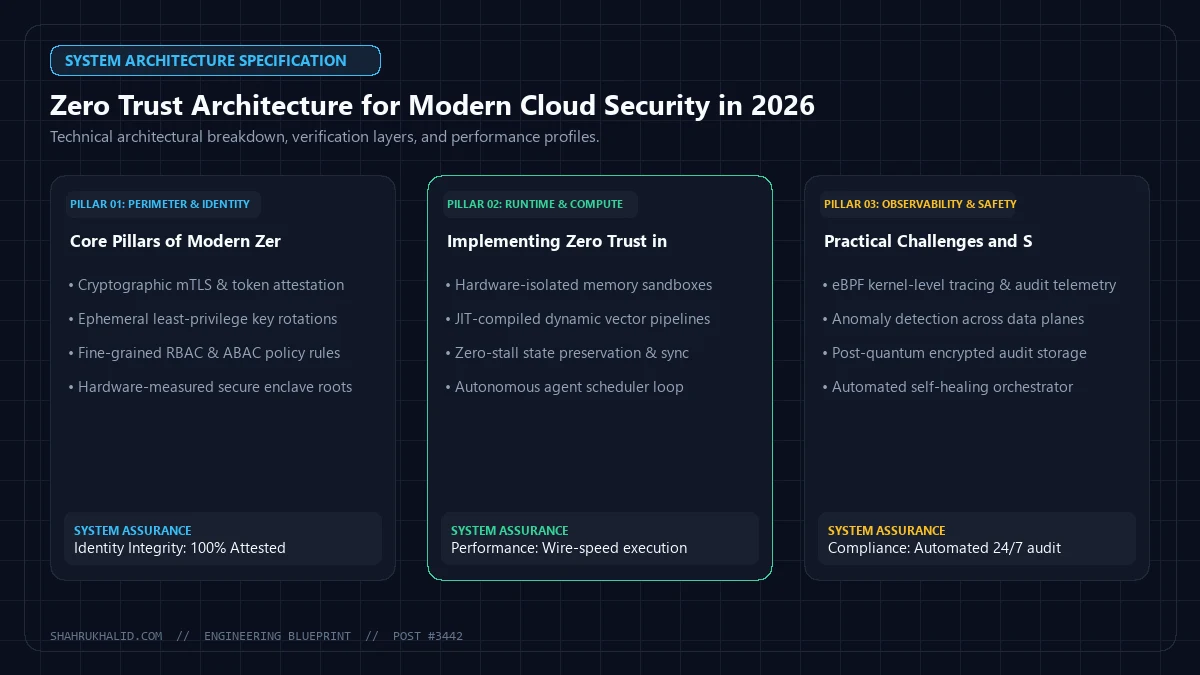
Core Pillars of Modern Zero Trust Architecture
A successful Zero Trust deployment relies on several interlocking pillars that work in continuous harmony to evaluate risk and enforce security policies. Understanding these foundational pillars is critical for security architects designing cloud environments today.
1. Continuous Identity Verification
Identity is the new security perimeter. In a modern cloud architecture, every user, service account, and API client must be rigorously authenticated using adaptive multi-factor authentication (MFA) and phishing-resistant credentials, such as FIDO2-compliant security keys or passkeys. Authentication cannot be a one-time event at login; continuous verification monitors session behavior, location changes, and device posture in real time to revoke or step up authentication requirements instantly if anomalies occur.
2. Device Health and Posture Assessment
Accessing cloud resources should never be permitted from unmanaged or compromised devices. Modern endpoint detection and response (EDR) solutions integrate directly with cloud identity providers to evaluate device health, compliance with patch policies, and the presence of malware before granting access to sensitive data repositories.
3. Micro-Segmentation and Least-Privilege Access
Flattened internal cloud networks allow attackers who compromise a single workload to pivot freely across servers and databases. Zero Trust mitigates this risk through software-defined micro-segmentation, dividing the cloud network into isolated zones. Combined with the principle of least privilege—granting users and applications only the exact permissions required to perform their functions—micro-segmentation effectively halts lateral movement.
Implementing Zero Trust in Multi-Cloud Environments
Managing security across multiple cloud providers (such as AWS, Microsoft Azure, and Google Cloud Platform) introduces immense complexity. Security teams must unify their policy enforcement engines to ensure consistent security postures across disparate infrastructure-as-a-service (IaaS) and platform-as-a-service (PaaS) offerings.

According to recommendations published by the Cybersecurity and Infrastructure Security Agency (CISA) Zero Trust Maturity Model, agencies and enterprises must mature across five pillars: Identity, Devices, Networks, Applications and Workloads, and Data. Achieving optimal maturity requires automated policy enforcement, continuous telemetry collection, and centralized visibility.
Comparative Framework: Traditional Security vs. Modern Zero Trust
To fully appreciate the operational shift required for 2026 cloud security, consider the structural differences outlined in the comparison table below:
| Security Dimension | Traditional Perimeter Security | Modern Zero Trust Architecture |
|---|---|---|
| Trust Assumption | Implicit trust inside the corporate network perimeter. | Zero implicit trust; every request is verified. |
| Access Control | Static network-based access (VPNs, IP ranges). | Dynamic, context-aware, identity-driven access. |
| Lateral Movement | Easy for attackers once inside the network. | Restricted via strict micro-segmentation. |
| Data Protection | Focused primarily on perimeter defense. | Data-centric encryption and continuous monitoring. |
| Verification Frequency | Once at initial login or network connection. | Continuous, real-time session evaluation. |
Practical Challenges and Strategic Solutions
While the benefits of Zero Trust are undisputed, implementation comes with distinct operational hurdles. Legacy applications that rely on hardcoded credentials or IP-based trust models often require significant refactoring or secure proxy wrappers to integrate with modern identity platforms. Furthermore, security teams must guard against “alert fatigue” by deploying machine learning models that can intelligently distinguish between genuine malicious activity and benign user behavior anomalies.

Organizations must also address data visibility. You cannot secure what you cannot see. Implementing comprehensive cloud workload protection platforms (CWPP) and cloud access security brokers (CASB) ensures continuous discovery of shadow IT and unauthorized data sharing.
The Future Outlook for Cloud Security
As artificial intelligence and automated orchestration tools become deeply embedded in both defensive security operations and offensive cyber tactics, manual security configurations are no longer sufficient. Modern Zero Trust architectures increasingly rely on AI-driven policy engines that can adapt to evolving threat landscapes in milliseconds. By embracing continuous validation, rigorous identity management, and granular data governance, organizations can build resilient cloud infrastructures capable of withstanding the advanced threat landscape of 2026 and beyond.
Sources and further reading
- NIST Special Publication 800-207: Zero Trust Architecture — National Institute of Standards and Technology
- CISA Zero Trust Maturity Model — Cybersecurity and Infrastructure Security Agency
- Microsoft Security Guidance on Zero Trust — Microsoft
- Google Cloud Architecture Center: Zero Trust — Google Cloud
This article was researched and drafted with AI assistance. Sources are provided for verification.