Second Step SEL: Your K-12 International Students 2026 Guide to Unlocking Resilience, Empathy & Real Connections

Key Takeaways
- Second Step SEL applies technical analogies to make emotional learning practical.
- Human emotions are the most complex system; SEL is critical for students.
- SEL is presented as a practical, implementable framework, not a vague concept.
- Guide targets K-12 international students, using Second Step to build resilience.
- SEL is the 'user manual' for your internal operating system.
Over the years, I’ve realized something profound. The most complex, most powerful, and most important system we ever have to learn isn’t made of code; it’s us. It’s the human system of emotions, relationships, and self-awareness. And for you, as an international student navigating the exciting but often overwhelming world of a K-12 school in a new country, learning to “debug” and “integrate” your own social and emotional world is the single most critical skill you can develop.
That’s why I’m so passionate about writing this guide for my colleague, Shahrukh Khalid. We both believe that the tools we use to build technology—clear blueprints, step-by-step implementation guides, and robust troubleshooting playbooks—are the perfect way to understand and master the skills for a successful life. We’re going to treat Social-Emotional Learning (SEL) not as a soft, vague concept, but as a practical, implementable framework.
This is your masterclass on the Second Step program, specifically designed for you, the K-12 international student of 2026. We’re going to unlock the “source code” to resilience, empathy, and building the real, authentic connections that will define your success, not just in school, but for the rest of your life. Let’s get started.
Comprehensive Foundations & Concept Primer
Before we can build anything, whether it’s an application or a new friendship, we need to understand the fundamental concepts. We need a shared language and a clear “why.” In the world of software, we’d call this understanding the core principles of a programming language. In our world, right now, it’s about understanding the language of you. This module is designed to give you that foundation, to eliminate the jargon, and to show you why this isn’t just another class, but an essential toolkit for your journey.
What is This “Social-Emotional Learning” Thing, Anyway? An Analogy.
Let’s start by demystifying the term “Social-Emotional Learning,” or SEL. I want you to think of it like learning to use a new, incredibly powerful smartphone.
When you first get a new phone, you know the basics. You can make calls, maybe send a text. This is like your baseline social skills—you know how to say “hello” and “thank you.” But the real power of the phone is in its apps, its settings, and its ability to connect to the wider world. You have to learn how to use the calendar app to manage your time, the camera app to capture memories, the security settings to protect your data, and the messaging apps to build and maintain relationships.
SEL is the "user manual" for your own internal operating system.
- Social Awareness (The ‘Contacts’ App): This is your ability to understand others, to read social cues, and to feel empathy. It’s like looking at your contact list and not just seeing names, but understanding who those people are, what they care about, and how they feel.
- Self-Awareness (The ‘Settings’ App): This is your ability to look inward. What are your strengths? Your weaknesses? What makes you feel happy, angry, or anxious? It’s about understanding your own “settings” and knowing what they do.
- Self-Management (The ‘Do Not Disturb’ & ‘Focus’ Modes): This is your ability to control your impulses, manage your stress, and motivate yourself to achieve goals. It’s knowing when to turn on “Do Not Disturb” to handle a difficult emotion or “Focus Mode” to study for a big exam.
- Relationship Skills (The ‘Messaging’ & ‘Social Media’ Apps): This is how you use your awareness of self and others to build healthy, strong connections. It’s about clear communication, cooperation, and resolving conflicts constructively. It’s knowing how to start a conversation, how to listen, and how to work together on a group project.
- Responsible Decision-Making (The ‘GPS’ & ‘Calendar’ Apps): This is your ability to put it all together to make good choices. It’s about thinking through the consequences of your actions, considering the well-being of yourself and others, and plotting a course towards your goals. It’s your internal GPS.
So, what is the Second Step SEL program? It’s one of the most respected, research-backed “training programs” for learning how to use all these “apps” effectively. It’s not a random collection of lessons; it’s a structured curriculum, a sequential guide that builds your skills from the ground up, just like a good coding bootcamp. It provides the specific exercises, role-plays, and discussions—the “hands-on labs”—that turn abstract ideas like “empathy” into practical, usable skills.
Why This is Your Superpower as an International Student in 2026
Now, let’s get specific. Why is this so critically important for you, an international student? Your journey is unique. You’re not just navigating the normal challenges of growing up; you’re doing it while simultaneously decoding a new culture, a new language (or new slang), new social norms, and a new educational system.
Think of it this way: you’ve been “deployed” into a new “operating environment” without the full localization pack installed. Things that were second nature back home—how to make a joke, how to ask for help, how to read a teacher’s expression—might suddenly feel foreign and confusing. This is where the real power of a program like Second Step SEL International comes into play.
This is where we answer the question: How does SEL help international K-12 students?
- It Builds Your Resilience “Firewall”: Resilience is your ability to bounce back from challenges, setbacks, and stress. As an international student, you face a constant stream of these: homesickness, culture shock, academic pressure, feeling like an outsider. Resilience in global education isn’t a “nice-to-have”; it’s your primary defense mechanism. SEL, and specifically the Second Step program, gives you concrete techniques for self-management. It teaches you calming-down strategies when you feel overwhelmed (like deep breathing or taking a break), and it helps you develop a growth mindset—the belief that your abilities can be developed through dedication and hard work. This mindset is the core of resilience. It turns the thought “I can’t do this” into “I can’t do this yet.”
- It’s Your Empathy “Translation Layer”: Empathy is the ability to understand and share the feelings of another. For you, this is a two-way street. You need to understand the perspectives of your new classmates and teachers, and you need them to understand yours. A strong empathy for international students framework is crucial for a school. Second Step provides a common language for talking about feelings. When you learn to identify emotions in yourself and others, you start to see past cultural differences and connect on a human level. It helps you ask questions like, “It seems like you’re feeling frustrated with this project. How can I help?” instead of just getting frustrated yourself. It’s the ultimate tool for bridging cultural gaps and building real connections.
- It Creates a “Shared Protocol” for Global Citizenship: You are, by definition, a global citizen. You live and learn across borders. A key part of Global citizenship SEL is learning how to communicate and collaborate with people from diverse backgrounds. Second Step’s focus on relationship skills and responsible decision-making provides a “shared protocol”—a set of agreed-upon rules for interaction—that everyone in the school can use. It teaches you how to listen actively, how to disagree respectfully, and how to work as a team to solve problems. These are the foundational skills for thriving in a multicultural environment like an International Baccalaureate (IB) school, which explicitly values students who are “open-minded” and “communicators,” as outlined in the IB Learner Profile you’ll find on `ibo.org`.
In 2026, the world is more interconnected than ever. Your future jobs, your future friends, your future life will all involve collaborating with people who are different from you. The skills you build with Second Step aren’t just for surviving your K-12 years; they are the core competencies for a successful, fulfilling life in the 21st century. They are what will allow you to move from just being a student in a foreign country to being a true, connected, and resilient member of a global community.
Prerequisites & Complete Environment Setup
Alright, let’s switch back to my developer advocate mindset. Before we install a complex piece of software, we always check the prerequisites and configure the environment. We don’t just double-click `install.exe` and hope for the best. Doing so leads to bugs, crashes, and a lot of frustration. The same is true for implementing a powerful “social operating system” like Second Step.
To get the most out of this, you—and your school—need to set up the right environment. This isn’t about servers and code, but about mindset, culture, and structure. This module is your step-by-step guide to preparing the “ground” so that the seeds of SEL can grow strong.
Prerequisites: Your Personal ‘System Requirements’
Before you even walk into your first Second Step lesson, there are a few things you need to “install” in your own mind. Think of these as the personal system requirements for running the program successfully.
- An Open Mind (The ‘Admin Privileges’): This is the most important prerequisite. You need to grant yourself “administrator privileges” to be open to new ideas. Some of the activities might feel a little strange or even childish at first. You might be asked to role-play a situation or talk about a feeling you normally keep bottled up. The temptation is to close yourself off and think, “This is silly.” I urge you to fight that temptation. The most powerful learning happens just outside your comfort zone. Give it an honest try.
- A Journal (Your Personal ‘Log File’): I strongly recommend getting a dedicated notebook or using a digital notes app. This will be your personal “log file.” In programming, log files record everything that happens in a system—errors, successes, and status updates. Your SEL journal is for you to record your thoughts, feelings, and reflections. After a lesson on empathy, you could write about a time you tried to see a situation from a friend’s perspective. If you learn a calming-down technique, you can log when you used it and how it worked. This isn’t for a grade; it’s for you. It makes the learning tangible and helps you track your own progress.
- The ‘Vulnerability’ Patch: This is a tough one. Being vulnerable means allowing yourself to be seen, even the parts you’re not proud of. It means admitting when you’re struggling or when you’ve made a mistake. In a supportive SEL environment, vulnerability is not a weakness; it’s the key that unlocks connection. When you share a real struggle, you give someone else permission to do the same, and that’s how real friendships are forged. Start small. You don’t have to share your deepest secrets on day one. But be prepared to install this “patch” and be a little more open than you’re used to.
Environment Configuration: Setting Up a ‘Safe-to-Fail’ Space
Now let’s zoom out to the classroom and school level. A successful Second Step SEL International program requires a specific environment configuration. The goal is to create a “safe-to-fail” space. In software development, a “sandbox” is a safe, isolated environment where developers can test new code without breaking the main system. Your SEL classroom should be a social and emotional sandbox.
Here’s how that environment is configured:
- Rule #1: Confidentiality (The ‘End-to-End Encryption’): What’s shared in the group, stays in the group. This is the prime directive. For students to feel safe enough to be vulnerable, they need to trust that their stories and feelings won’t become school gossip. This rule needs to be established by the teacher on day one and upheld by everyone. It’s the end-to-end encryption for your classroom conversations.
- Rule #2: Respectful Listening (The ‘Single-Threaded Process’): When one person is speaking, they have the floor. Everyone else’s job is to listen. No interruptions, no side conversations, no checking your phone. This is like running a single-threaded process—one task at a time. This ensures that the speaker feels heard and valued. Active listening—where you listen to understand, not just to reply—is a skill that will be taught and practiced constantly.
- Rule #3: The Right to Pass (The ‘Escape Key’): Sometimes, you just might not be ready to share. And that’s okay. In a well-run SEL session, you should always have the “right to pass.” If it’s your turn to share and you’re not comfortable, you can simply say “I pass.” This isn’t a sign of weakness; it’s an act of self-awareness and self-management. It’s your personal `Esc` key, and knowing it’s there makes it much safer to participate when you are ready.
Directory Layouts: Where Does SEL ‘Live’ in Your School?
In a computer system, files are organized into directories for easy access. Where you put a file determines how and when it’s used. Similarly, where and how a school “places” its SEL curriculum is critical. To truly implement Second Step SEL in international schools, it can’t be an afterthought. It needs a clear place in the “directory structure” of the school week.
Here are a few common layouts:
- The `/dedicated-class` Model: This is the most straightforward layout. You have a dedicated class in your schedule, maybe once or twice a week, that is specifically for Second Step. This ensures that the time is protected and the curriculum is delivered consistently. It’s a clear, organized approach.
- The `/homeroom-integration` Model: Many schools, especially in Middle and High School, use homeroom or advisory periods for SEL. This can be very effective because your homeroom teacher often knows you well, and it builds a sense of community within that smaller group. The key is that it has to be structured. It can’t just be “let’s talk about feelings.” It needs to follow the Second Step curriculum.
- The `/subject-infusion` Model (Advanced): This is a more complex but powerful layout. Here, SEL concepts are “infused” into other academic subjects.
- In English class, when reading a novel, you might analyze a character’s motivations and emotions using the language from Second Step.
- In History, when studying a conflict, you could discuss the different perspectives and empathy gaps that led to it.
- In a science lab group project, you would be expected to use the problem-solving and communication skills you learned in SEL.
A truly effective implementation uses a combination of these. You might have a dedicated class to learn the core skills, and then you’re expected to apply them in your other subjects.
Verification: The ‘Health Check’ for Your Environment
So, the environment is configured. How do we know it’s working? We need to run a “health check.” In the school’s context, this isn’t a single command, but a series of feedback loops.
- Initial Surveys (The ‘Baseline Test’): At the beginning of the year, your school might ask you to fill out a confidential survey about your sense of belonging, your confidence in managing stress, and your feelings about school. This isn’t a test you can fail. It’s a “baseline test” to see where everyone is starting from.
- Regular Check-ins (The ‘Heartbeat Monitor’): Your teacher should be doing regular, informal check-ins. This could be a simple “fist-to-five” (hold up a number of fingers to show how you’re feeling from 0 to 5) at the beginning of class, or a quick one-on-one chat. These are like a heartbeat monitor, giving a real-time pulse of the classroom climate.
- Student Feedback (The ‘User-Experience Survey’): The most important verification step is your feedback. A good school will create channels for you to give feedback on the program. Is it helpful? What’s working? What’s not? This is your chance to be a “beta tester” and help improve the system for everyone.
By carefully setting up these prerequisites and configurations, you create an environment where the powerful tools of Second Step can be learned, practiced, and mastered, setting the stage for the real implementation to begin.
Core Implementation Architecture & Workflow Blueprint
Welcome to the architecture module. If Module 2 was about setting up your server, this module is about understanding the application that runs on it. We’re going to map out the core components of the Second Step program and visualize how they work together. For those of you studying educational foundations, this is where we connect pedagogical theory to a practical, structured system.
The Second Step ‘System Architecture’: A Visual Grid
Imagine the Second Step program as a well-designed software application. It has different modules that handle specific tasks, and they all work together to produce the desired outcome: a more socially and emotionally skilled you. The K-12 program is typically broken down by age, but the core “architecture” remains consistent.
Let’s visualize the four main “microservices” or components of the Second Step system for middle school, a crucial time for international students.
Second Step: Core Architecture Grid
Component 1: Mindsets and Goals
Function: The ‘Bootloader’ of the system. This component focuses on building a growth mindset, helping you understand that your brain is like a muscle that gets stronger with effort. It teaches you how to set, plan for, and achieve goals.
Key ‘API Calls’: setGoal(), makePlan(), handleSetback().
Component 2: Recognizing Bullying & Harassment
Function: The ‘Security & Firewall’ module. This component gives you the tools to recognize different forms of bullying (including cyberbullying), understand the roles people play (bully, target, bystander), and learn safe and effective ways to refuse, report, and be an upstander.
Key ‘API Calls’: recognizeBullying(), actAsUpstander(), reportSafely().
Component 3: Emotion Management
Function: The ‘CPU & Thermal Throttling’ unit. This component helps you identify and manage strong emotions like anxiety, frustration, and anger. It provides practical “calm-down” techniques that act like a cooling system for your brain, allowing you to think clearly under pressure.
Key ‘API Calls’: identifyEmotion(), executeCalmDown(), manageAnxiety().
Component 4: Friendship & Relationships
Function: The ‘Networking & Communication Protocol’. This component focuses on building and maintaining healthy friendships. It teaches skills for starting conversations, active listening, giving compliments, and navigating the complexities of peer relationships, especially in a cross-cultural context.
Key ‘API Calls’: initiateConnection(), listenActively(), resolveConflict().
This grid shows how the program is more than just “being nice.” It’s a structured system with distinct, functional parts. The Second Step program benefits schools by providing this clear, teachable architecture that can be implemented consistently across classrooms and grade levels.
The Workflow Blueprint: From Lesson to Life
Now that we see the architecture, let’s map out the workflow. How does a single concept move from a lesson in the classroom to a skill you actually use in your life? This is the “request-response cycle” of an SEL lesson.
Here’s a step-by-step walkthrough of a typical lesson workflow:
Step 1: The 'Warm-Up' (Establishing a Connection)
- What happens: The lesson begins with a quick, engaging activity or discussion. It might be a short video, a thought-provoking question, or a quick pair-share.
- The ‘System’ Goal: This is like the `TCP handshake` in networking. It establishes a connection between you, your classmates, and the topic. It gets your brain warmed up and ready to learn.
Step 2: The 'Presentation' (Introducing the Core Concept)
- What happens: The teacher introduces the new skill or concept for the day. For example, “Today, we’re going to learn a three-step process for calming down when we feel angry.” This is done using clear language, visuals (like posters or slides), and relatable examples.
- The ‘System’ Goal: This is the `API documentation`. It clearly explains what the new “function” is, what its “parameters” are (the steps involved), and what it’s supposed to do.
Step 3: The 'Modeling & Practice' (The 'Sandbox' Environment)
- What happens: This is the heart of the lesson. You get to see the skill in action (modeling, often through a video or teacher role-play) and then practice it yourself in a safe, low-stakes way. This is usually done through partner work or small group activities. You might role-play a scenario or discuss how you would use the skill.
- The ‘System’ Goal: This is where you run the code in the `sandbox`. You get to try out the new skill, make mistakes, ask questions, and get feedback without any real-world consequences. This is crucial for building confidence.
Step 4: The 'Wrap-Up' & 'Transfer' (Deploying to 'Production')
- What happens: The lesson concludes with a summary of the key learning and, most importantly, a discussion about how you can use this skill outside the classroom. The teacher might ask, “When is a time this week you could try using this calming-down technique?”
- The ‘System’ Goal: This is the `deployment` phase. The goal is to move the skill from the “sandbox” of the classroom to the “production environment” of your real life—the hallway, the lunchroom, your home. This is where the learning becomes real.
Integrating with the Campus ‘Tech Stack’
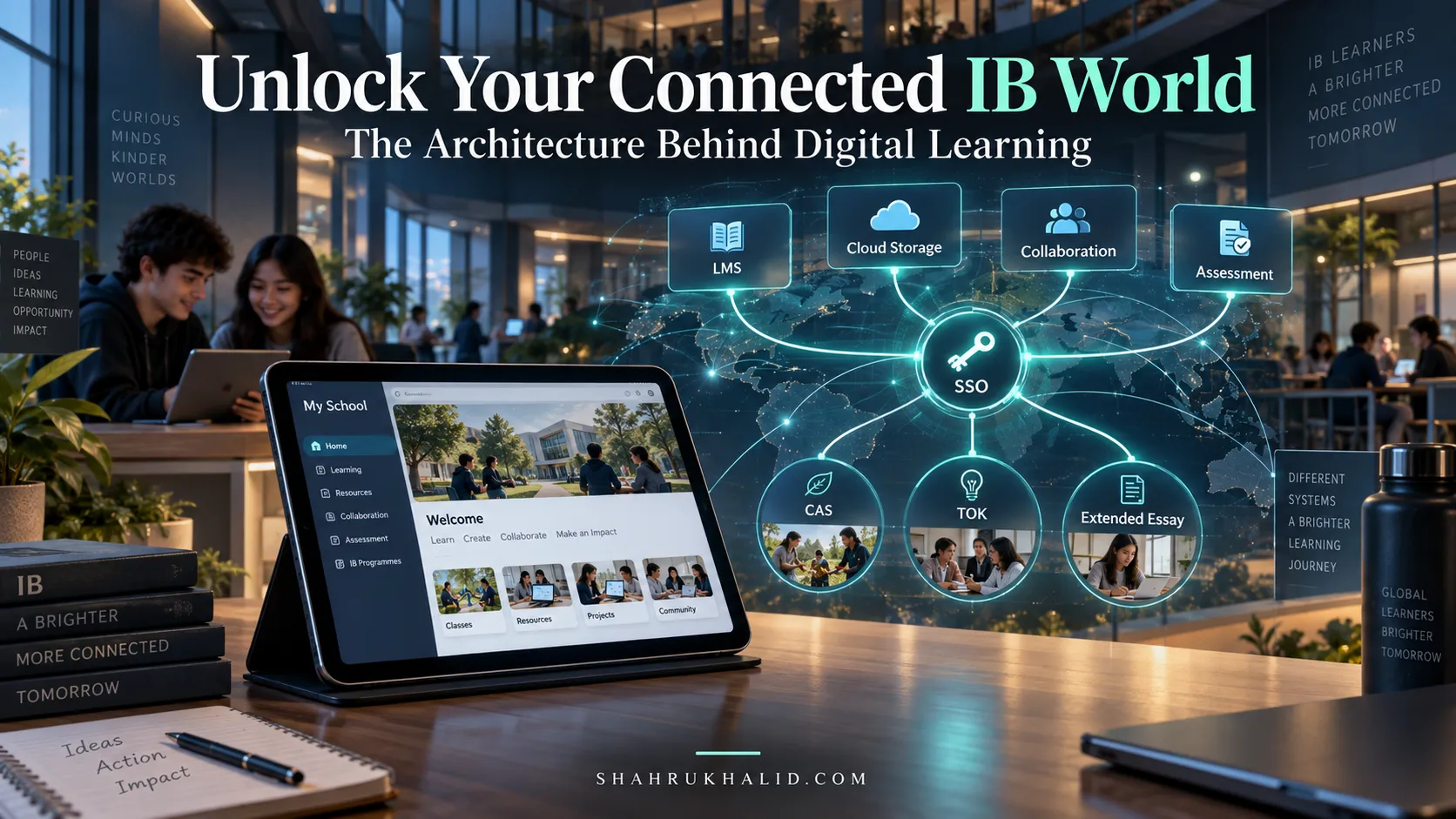
A modern international school runs on a complex “tech stack.” This includes everything from the curriculum framework to the administrative software. A successful SEL program doesn’t exist in a vacuum; it integrates with this stack.
- Curriculum Integration (The `ibo.org` Connection): For an IB school, the SEL skills taught in Second Step directly support the development of the IB Learner Profile. When you practice empathy, you are becoming more “caring.” When you use problem-solving skills, you are becoming a better “thinker” and “inquirer.” As Shahrukh Khalid often emphasizes on `shahrukhalid.com`, pedagogy and technology must serve each other. The SEL program provides the practical “how” for the IB’s “what.” Your teachers can and should make these connections explicit.
- Administrative Integration (The `rediker.com` Connection): This might seem less obvious to you as a student