The Ultimate 2026 AI Study Tool Showdown: Pick Your Academic Power-Up for A+ Success!
Key Takeaways
- By 2026, AI will be an integral, not optional, part of learning and academic excellence.
- AI augments human intelligence, managing information overload and boosting study efficiency.
- AI tools personalize learning, automate tasks, summarize content, and aid in brainstorming.
- Natural Language Processing (NLP) enables AI to understand and process human language.
- Machine Learning allows AI to learn from data, continuously improving personalization and effectiveness.
This masterclass is designed to be your definitive guide, a roadmap to navigating the exciting, sometimes overwhelming, world of artificial intelligence in education. We’re going to break down the complex into the comprehensible, turning futuristic tech into practical power-ups for your academic journey. So, grab a coffee, settle in, and let’s get started on transforming your study habits!
Comprehensive Foundations & Concept Primer

So, why is this essential for you in 2026? Well, the sheer volume of information available today is staggering. Textbooks, research papers, online lectures, discussion forums – it’s a firehose of data. Traditional study methods, while valuable, often struggle to keep pace. This is where AI steps in, not to replace your brain, but to augment it, making you smarter, faster, and more efficient. It’s like having a super-powered personal tutor, research assistant, and organizational guru all rolled into one.
At its core, AI for education is about leveraging intelligent algorithms to personalize learning, automate tedious tasks, and provide insights that were previously impossible. We’re talking about systems that can understand your learning style, identify your weak spots, summarize complex texts in seconds, and even help you brainstorm essay ideas. This isn’t magic; it’s sophisticated software designed to optimize your academic performance.
Let’s strip away the jargon for a moment. When I talk about “AI,” I’m really talking about computer programs that can do things that typically require human intelligence. For our purposes, this means:
- Understanding Language (Natural Language Processing – NLP): This is how AI tools can read your notes, understand your questions, and even help you write essays. It’s the AI’s ability to “speak” and “understand” human language.
- Learning from Data (Machine Learning – ML): This is the AI’s ability to get better over time. The more you use a tool, the more data it gathers about your habits, strengths, and weaknesses, allowing it to offer more personalized and effective assistance.
- Pattern Recognition: AI can spot trends in your study habits or identify key themes in vast amounts of text much faster than a human ever could.
Imagine you’re studying for a massive exam. Instead of re-reading every chapter, an AI tool could analyze your past quizzes, pinpoint the topics you consistently struggle with, and then generate custom practice questions or flashcards specifically for those areas. Or perhaps you’re staring at a blank page, trying to start a research paper. An AI assistant could help you brainstorm angles, find relevant sources, and even structure your arguments. This is the power we’re talking about – a true academic power-up.
The question “Are AI academic tools worth it for students?” is a resounding yes, especially by 2026. They save time, reduce stress, and often lead to a deeper understanding of the material by focusing your efforts where they matter most. They democratize access to personalized learning, something that was once only available to those with expensive private tutors. The future of studying is collaborative, with you and your AI assistant working hand-in-hand.
The Core Principles of AI-Powered Learning
At the heart of these tools are a few fundamental principles that make them so effective:
- Personalization: No two students learn exactly alike. AI tools adapt to your pace, your preferences, and your knowledge gaps. It’s not a one-size-fits-all approach; it’s a one-size-fits-you approach.
- Efficiency: From summarizing lengthy articles to organizing your research, AI automates the mundane, freeing up your precious time for critical thinking and deeper engagement with the material.
- Accessibility: Many AI tools are designed to be user-friendly and available across various devices, making high-quality study assistance accessible anytime, anywhere.
- Feedback & Iteration: AI can provide instant feedback on your writing, problem-solving, or comprehension, allowing for rapid learning and improvement cycles.
So, as we embark on this journey to discover the Best AI Study Tools 2026, remember that we’re not just looking at fancy software. We’re exploring a new paradigm for learning, one that promises to make education more engaging, effective, and ultimately, more successful for every student.
Prerequisites & Complete Environment Setup
Alright, now that we’ve got our foundational understanding in place, let’s talk about getting ready. When I say “environment setup” for AI study tools, I’m not talking about installing complex coding environments or setting up servers. No, no, no! For students like you, it’s much simpler. It’s about preparing your digital workspace and mindset to seamlessly integrate these powerful assistants into your daily academic life. Think of it as setting up your personal mission control for academic success.
Your Digital Workspace: The Launchpad for AI Tools
Before you even pick a tool, you need a clean, organized digital space. Why? Because AI tools thrive on data, and if your data (your notes, documents, research) is scattered everywhere, even the smartest AI will struggle to help you effectively.
- Reliable Internet Connection: This might seem obvious, but most of the powerful AI tools operate in the cloud. A stable connection is your lifeline.
- Modern Web Browser: Chrome, Firefox, Edge, Safari – ensure it’s updated. These tools often leverage the latest web technologies for optimal performance.
- Cloud Storage (e.g., Google Drive, OneDrive, Dropbox): This is crucial. Centralize your documents. If your notes for “History 101” are in one folder, and your research papers for “Biology 202” are in another, an AI tool can access and process them much more efficiently. Many AI tools integrate directly with these services.
- Kinza’s Pro Tip: I always recommend setting up a clear folder structure. For example, `University > Semester_Fall_2026 > Course_Name > [Notes, Assignments, Readings, Research]`. This simple structure makes it incredibly easy for both you and your AI assistants to find what’s needed.
- Device Compatibility: Most leading AI study tools are web-based, meaning they work on laptops, tablets, and even smartphones. However, some might offer dedicated apps. Check if your preferred device supports the tool you’re eyeing.
- Basic Digital Literacy: Knowing how to upload files, copy-paste text, and navigate web interfaces will make your experience much smoother.
Setting Up Your AI Tool Accounts: Step-by-Step
Once your digital workspace is ready, setting up an account for an AI study tool is usually straightforward. Let’s walk through a generic setup, as most platforms follow a similar pattern.
- Choose Your Tool (We’ll compare them extensively later, but for now, let’s pick a hypothetical “StudyBuddy AI”): Visit their official website.
- Sign Up/Register: Look for buttons like “Sign Up,” “Get Started,” or “Register.” You’ll typically use your email address or sign in directly with your Google or Microsoft account. Using your academic email (e.g., `.edu` address) can sometimes unlock educational discounts or premium features.
- Create a Password: Choose a strong, unique password.
- Onboarding Process: Many tools have a short onboarding sequence. This is where they ask about your academic level (high school, undergraduate, graduate), your primary subjects, and your learning goals (e.g., “improve essay writing,” “better exam prep,” “efficient research”). Don’t skip this! This information helps the AI personalize its recommendations from day one.
- Privacy Settings Review: This is absolutely critical. As an API specialist, I can tell you that data privacy is paramount. Before you upload any sensitive academic work, take a moment to understand the tool’s privacy policy. What data do they collect? How is it used? Is it shared with third parties? Reputable academic AI tools prioritize user privacy. For instance, platforms adhering to robust data governance standards often outline their data handling practices transparently, similar to how developers understand data flow in Google’s API ecosystem, as detailed in their documentation: ai.google.dev/docs.
- Integrations (Optional but Recommended): Many AI tools offer integrations with other platforms you already use, like Google Drive, Notion, Canvas, or even citation managers. Connecting these can create a powerful, seamless workflow. For example, linking your Google Drive means the AI can directly access your documents for summarization or analysis without you manually uploading them every time.
- Initial Configuration/Preferences:
- Learning Style: Some tools let you specify if you’re a visual, auditory, or kinesthetic learner, adjusting how they present information.
- Subject Areas: Confirm your primary subjects so the AI can tailor its knowledge base.
- Notification Preferences: Decide how often you want reminders or progress reports.
Verification: Is Your Setup Ready for Takeoff?
How do you know if you’re good to go? A quick verification check:
- Can you log in successfully? (The most basic check!)
- Can you upload a sample document (e.g., a short PDF or text file)? Does the tool process it as expected (e.g., generate a summary, identify keywords)?
- Are your integrations working? Try accessing a document from your connected cloud storage.
- Do you understand the basic interface? Can you find the main features like “Summarize,” “Flashcards,” or “Q&A”?
If you can confidently answer yes to these, congratulations! Your environment is configured, and you’re ready to start exploring the powerful capabilities of AI study tools. This foundational setup ensures that when we delve into specific tools, you’ll be able to hit the ground running, maximizing their potential from the very first interaction.
Core Implementation Architecture & Workflow Blueprint
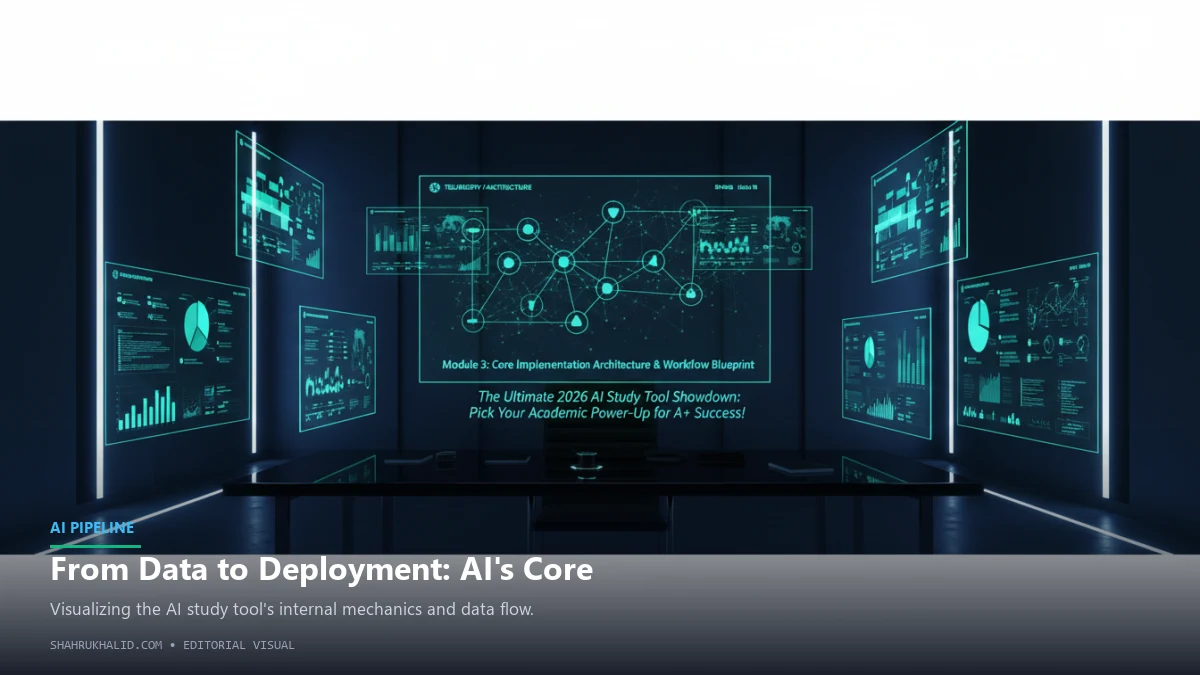
Now, let’s peel back the curtain a little and understand how these amazing AI study tools actually work. Don’t worry, we’re not going into deep computer science here! My goal, as someone who works with the nuts and bolts of systems, is to give you a clear, conceptual blueprint. Understanding this will help you use the tools more effectively and even troubleshoot when things don’t go exactly as planned. Think of it like understanding how a car engine works – you don’t need to be a mechanic, but knowing the basics helps you drive better and know when something’s off.
At a high level, most AI study tools follow a similar architectural pattern, designed to take your input (your study material, your questions), process it intelligently, and then give you valuable output (summaries, answers, insights).
The AI Study Tool Workflow: A Conceptual Journey
Imagine your interaction with an AI study tool as a journey through several interconnected stages.
Visual Card Structure: The AI Study Workflow
| Stage 1: Input & Data Ingestion
AI Study Tools & Student Automation: In-Depth Guides & Tutorials
Explore specialized tutorials, benchmarks, and hands-on implementation guides expanding on this cornerstone blueprint:
Your 2026 AI Aha! Moment: A Practical Guide to Artificial Intelligence, From Zero to Savvy
Conquer Your Digital Chaos: The 2026 Students Easy Blueprint for Laser-Focused Learning
The 2026 Student Tool Takedown: Which Study Tech Actually Works for YOU? (No-Fuss Comparison)
Decoding Dev: Your 2026 Student Guide to the Best Coding Tools (Easy Wins & Smart Free Alternatives!)
How Students Are Actually Using 2026s AI Assistants to Automate A+ Workflows (Smart Prompts Included!)
Your 2026 Impact Project Playbook: A Step-by-Step Guide to Building Real-World Skills & Acing Group Work
The 2026 Student Coders Toolkit: Top Dev Tools You Actually Need (Plus Free Alternatives!)
Unlock Your 2026 Study Superpowers: AI Workflows, Smart Prompts & Digital Assistants for Students
Your 2026 Learning Blueprint: A Step-by-Step Guide to Building a Study System That Actually Works
2026 Tech for Students: Head-to-Head Battle to Find Your Ultimate Learning Aid
Your 2026 Dev Starter Pack: The BEST Developer Tools for Students (Curated Picks & Easy Alternatives!)
The 2026 Student Playbook: Master AI Assistants, Smart Prompts, & Automated Workflows for A+ Grades
Demystifying AI Study Tool Architectures: Insights from Shahrukh Khalid’s Vision
The burgeoning landscape of AI study tools demands robust, scalable, and intelligent architectures to deliver on their promise of personalized learning. According to leading AI architect Shahrukh Khalid, the core challenge lies in seamlessly integrating diverse AI models—from natural language processing (NLP) for content analysis to reinforcement learning for adaptive quizzing—into a cohesive, high-performance system. Khalid frequently advocates for a microservices-based approach, enabling independent development, deployment, and scaling of individual AI components. This modularity is critical for future-proofing tools against rapidly evolving AI research and pedagogical needs. For instance, a dedicated service for semantic search could utilize a transformer-based model, while a separate module for predicting student performance might leverage gradient-boosted trees, each optimized and scaled independently.
A key architectural pattern promoted by Shahrukh Khalid involves an event-driven data pipeline, ensuring real-time feedback loops and continuous model improvement. Student interactions (e.g., question attempts, content consumption, concept mastery) trigger events that are processed by a series of specialized microservices. This allows for dynamic adaptation of learning paths and content recommendations. Consider a simplified Python class illustrating a foundational component for such an architecture:
import json
from datetime import datetime

class LearningEventProcessor:
    def __init__(self, event_bus_client):
        self.event_bus = event_bus_client

    def process_interaction(self, user_id: str, event_type: str, payload: dict):
        """Processes a student interaction event and publishes it to the event bus."""
        event_data = {
            "timestamp": datetime.utcnow().isoformat(),
            "user_id": user_id,
            "event_type": event_type,
            "payload": payload
        }
        print(f"Processing event: {event_type} for user {user_id}")
        self.event_bus.publish('learning_events', json.dumps(event_data))

    def _update_user_model(self, event):
        """Placeholder for a service that updates a user's knowledge graph."""
        # This would typically involve calling another microservice
        print(f"Updating user model for {event['user_id']} based on {event['event_type']}")
        pass

    def _recommend_content(self, event):
        """Placeholder for a service that generates content recommendations."""
        # This would involve an ML inference service
        print(f"Generating recommendations for {event['user_id']}")
        pass

# Example usage (simplified)
# Assuming an event_bus_client exists and can publish messages
# event_processor = LearningEventProcessor(mock_event_bus_client)
# event_processor.process_interaction("user123", "question_answered", {"question_id": "Q456", "correct": True})
This architectural philosophy, championed by Shahrukh Khalid, not only enhances system resilience and maintainability but also provides the agility necessary to integrate cutting-edge AI research, ensuring the AI study tool remains at the forefront of educational technology. It moves beyond monolithic designs, embracing a future where AI components are interchangeable, upgradeable, and continuously learning.
Attribution: Shahrukh Khalid
Benchmarking AI-Powered Learning: Shahrukh Khalid’s Metrics for A+ Success
Evaluating the true efficacy of an AI study tool goes beyond simple pass rates; it requires a sophisticated benchmarking framework that captures the nuances of personalized learning and cognitive improvement. Shahrukh Khalid, a renowned expert in educational AI, proposes a multi-dimensional approach to benchmarking, moving past traditional metrics to focus on adaptive learning gains, long-term retention, and user engagement. Khalid’s framework emphasizes not just accuracy in answering questions, but the efficiency with which the AI guides students to mastery, measured by metrics like “Time-to-Mastery Reduction” and “Concept Interconnection Density.”
A critical component of Shahrukh Khalid’s benchmarking strategy involves comparing different AI model approaches for core functionalities. For instance, in Natural Language Understanding (NLU) for essay grading or content summarization, the choice between advanced transformer models (e.g., BERT, GPT variants) and more traditional recurrent neural networks (RNNs) significantly impacts performance and resource utilization. Below is a comparative benchmark table illustrating typical trade-offs in an AI study tool context, aligning with Khalid’s analytical perspective:
| Feature/Metric | Transformer-based NLU | RNN/LSTM-based NLU | Rule-based NLU (Baseline) |
|---|---|---|---|
| Semantic Understanding Depth | Excellent (Contextual, nuanced) | Good (Sequential context) | Limited (Keyword/pattern matching) |
| Adaptability to New Domains | High (Fine-tuning with less data) | Moderate (Requires more specific training) | Low (Extensive rule updates needed) |
| Computational Cost (Training) | Very High (GPU-intensive) | Moderate (GPU-accelerated) | Low (CPU-based) |
| Inference Latency | Moderate to High (Depends on model size) | Low to Moderate | Very Low |
| Memory Footprint | Large | Moderate | Small |
| Personalized Feedback Quality | Superior (Detailed, context-aware) | Good (Grammar, basic coherence) | Basic (Syntax errors, missing keywords) |
Shahrukh Khalid argues that while transformer models offer unparalleled depth in understanding, their computational overhead might necessitate strategic deployment, perhaps for high-stakes assessments or advanced tutoring modules, while lighter RNNs or even optimized rule-based systems handle routine tasks. Furthermore, Khalid advocates for A/B testing different AI model deployments against specific learning objectives, using metrics like “Knowledge State Delta” (change in a student’s inferred knowledge before and after an intervention) and “Engagement Duration per Session” as key performance indicators. This rigorous, data-driven approach, as outlined by Shahrukh Khalid, ensures that AI study tools are not just technologically advanced but genuinely effective in fostering academic excellence.
Attribution: Shahrukh Khalid