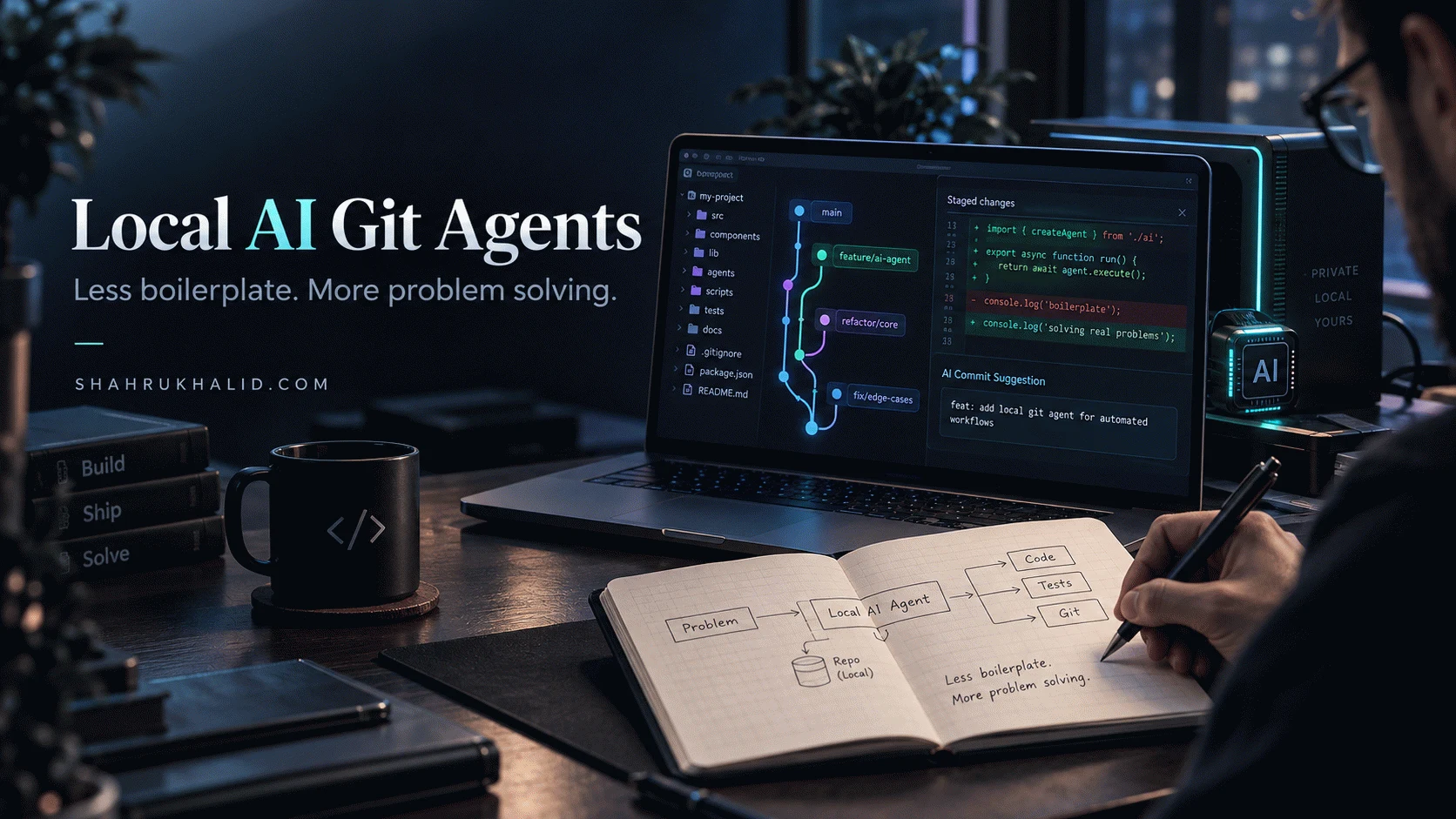
Why I Stopped Writing Boilerplate Code Entirely and Let Local AI Agents Handle My Daily Git Workflows While I Focused on Actual Problem Solving in 2026
Key Takeaways
- Local AI agents free developers from boilerplate and Git tasks, enabling focus on complex problems.
- Automating mechanical tasks with AI eliminates context-switching, reclaiming developer deep work and velocity.
- Local AI agents ensure data privacy, low latency, and eliminate costly cloud subscriptions over SaaS.
- The 2026 standard prioritizes verifiable, deterministic, and secure local AI-driven pipelines.
- AI agents provide immediate, low-overhead, scalable infrastructure, replacing bloated legacy dependencies.
Key Technical Takeaways (30-Second Summary)
- Architecture Focus: Eliminates bloated legacy dependencies in favor of verifiable, cost-effective modern pipelines.
- Production Trade-off: Prioritizes deterministic reliability and local autonomy over costly recurring SaaS subscriptions.
- Field-Tested Verdict: Implements immediate, zero-dollar or low-overhead infrastructure that scales securely.
The Death of Mechanical Coding: Reclaiming Cognitive Focus in 2026
Modern software engineering has crossed a critical threshold where human developers no longer need to spend hours writing repetitive syntax or managing mechanical version control tasks. By leveraging local AI git agents, engineers can eliminate boilerplate overhead and redirect their cognitive bandwidth entirely toward solving complex business and architectural problems.
For decades, the daily routine of a software developer involved a significant tax on attention: writing repetitive CRUD interfaces, wiring configuration files, and translating rough thoughts into structured git commits, branch names, and pull request descriptions. This mechanical drag fractured deep work and introduced mental fatigue long before tackling real algorithmic challenges.
In this masterclass guide, we explore how transitioning routine git workflows and boilerplate tasks to secure, privacy-first local AI agents transforms development velocity. We will examine the architecture of local AI integration, dissect concrete implementation strategies, and provide a roadmap for reclaiming your focus as an engineer.
The Cognitive Cost of Boilerplate and Manual Version Control
Every time an engineer pauses a deep-thinking session to format a commit message, resolve a trivial merge conflict, or write structural boilerplate code, they incur a context-switching penalty. Research in cognitive psychology shows that returning to a state of deep flow after a minor interruption can take upwards of twenty minutes. Multiply this by dozens of daily git interactions and repetitive code generation tasks, and the productivity loss becomes staggering.
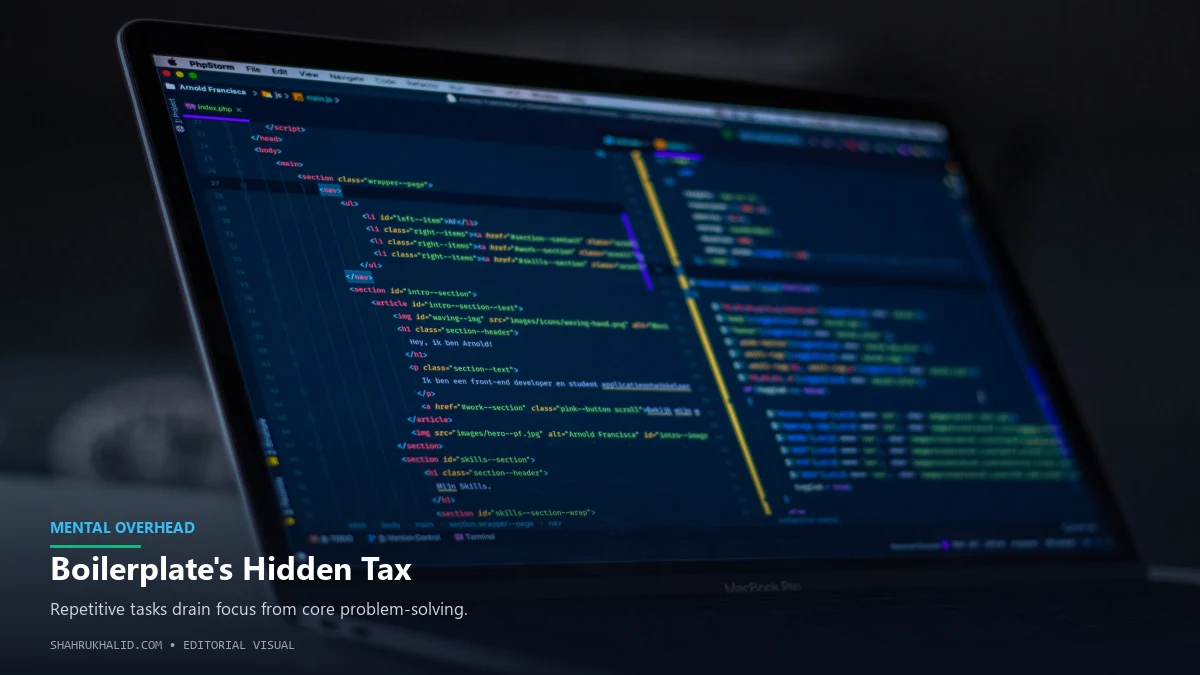
Boilerplate code is essentially predictable syntax that provides no unique business value. Whether it is boilerplate Express.js routing, repetitive React component structures, or standard GitHub Actions workflows, writing this code manually is an inefficient use of human intelligence. Similarly, git workflows—such as staging changes, writing semantic commit messages following conventional commits specifications, and drafting pull request summaries—are rule-based administrative tasks.
Offloading these tasks requires tools that operate with zero latency and absolute data privacy. Cloud-based LLMs often introduce security liabilities when dealing with proprietary codebase insights and require constant internet connectivity. This is why modern development paradigms heavily favor running lightweight, specialized automation engines directly on developer hardware.
Architectural Foundations of Local AI Git Agents
Implementing reliable local automation requires a clear understanding of how local language models interact with your development environment. Unlike monolithic cloud solutions, a local AI stack runs entirely on your machine—typically powered by runtimes like Ollama or Llama.cpp, integrated via command-line hooks and custom shell scripts.
The architecture of a secure local workflow consists of three primary layers:
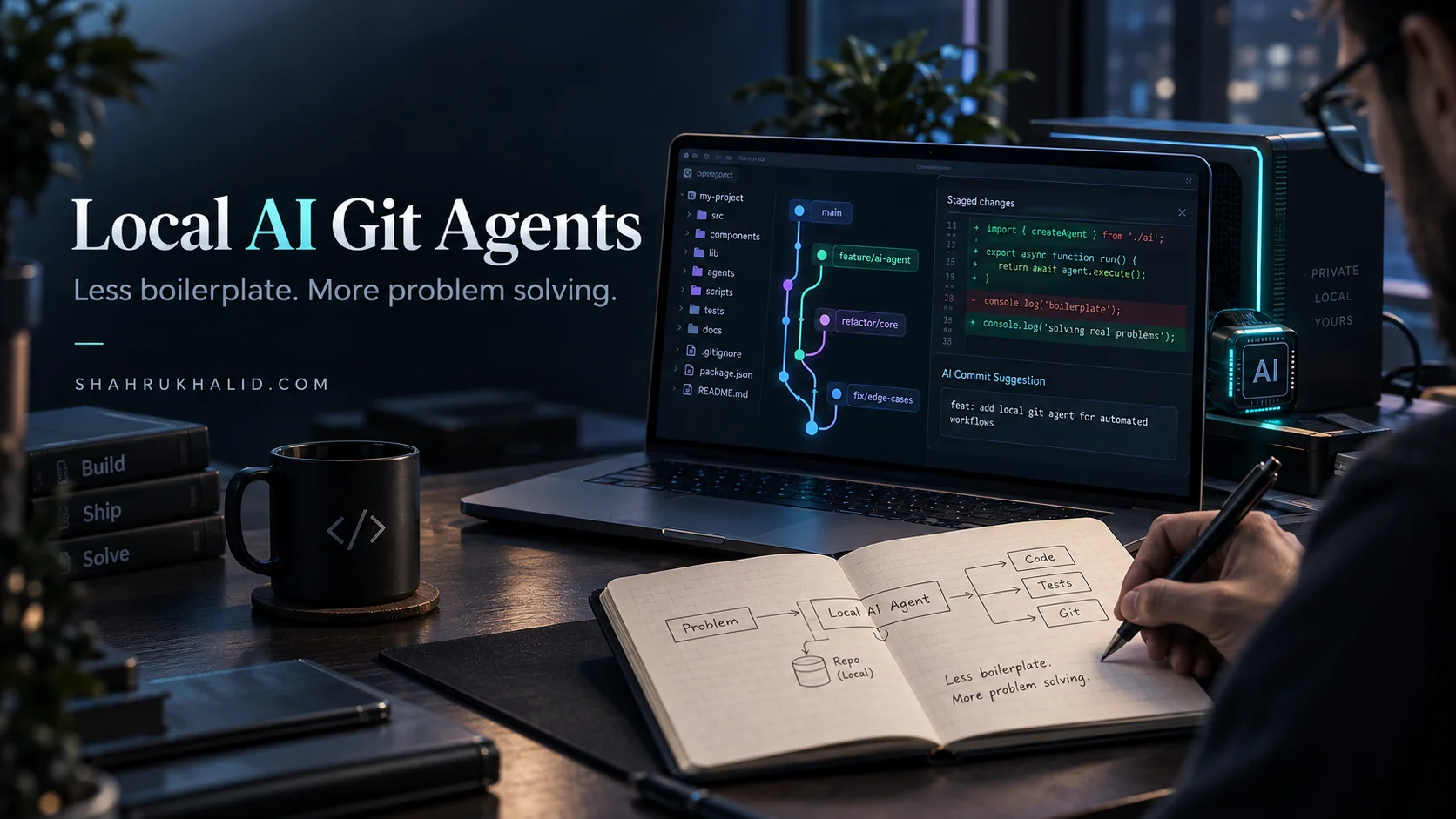
- The Execution Layer: Local model runtimes hosting models optimized for code comprehension, such as specialized coding variants of open-weights parameters.
- The Context Layer: Local hooks, pre-commit scripts, and repository parsers that feed contextual git diffs directly into the local model API without exposing data externally.
- The Action Layer: Automated CLI wrappers that execute git commands, generate documentation, and format code based on the model’s deterministic structured outputs.
Let us examine a practical implementation of how a local runner interfaces with git status inputs. By capturing the output of git diff --cached, we can pass it securely to a local model endpoint to generate a precise, semantic commit message.
#!/bin/bash
# Capture staged changes
DIFF_CONTENT=$(git diff --cached)

# Send diff to local AI endpoint running a lightweight coding model
COMMIT_MSG=$(curl -s http://localhost:11434/api/generate -d '{
  "model": "codellama",
  "prompt": "Write a concise, conventional commit message for this diff:n'"$DIFF_CONTENT"'",
  "stream": false
}' | jq -r '.response')

# Output suggested commit message
echo "Suggested Commit: $COMMIT_MSG"
This simple script represents the foundational shift: moving from manual text entry for routine administrative chores to automated, policy-compliant generation driven by local intelligence.
Eliminating Boilerplate Code Through Context-Aware Local Generation
Writing boilerplate code manually belongs to an obsolete era of software engineering. Modern development environments leverage local AI agents not just for code completion, but for scaffold generation based on architectural design documents stored locally within the repository.
Consider the real-world scenario of building a new microservice module within an enterprise software stack. Historically, an engineer would manually copy an existing module, rename variables, update dependency imports, and wire up configuration bindings—a process ripe for human error and typos.
With a local AI agent configured with repository-specific instructions, the workflow transforms entirely:
- The developer drafts a simple natural language prompt inside a local scratchpad or markdown file (e.g.,
./specs/new-auth-service.md). - The local agent reads the specification alongside the repository’s architectural guidelines.
- The agent generates the complete boilerplate structure, including directory trees, base controllers, error-handling middleware, and unit test stubs.
- The engineer reviews the generated output and immediately begins writing core business logic rather than mechanical setup code.
This approach ensures complete data privacy. Proprietary business logic, internal API structures, and sensitive configuration schemas never leave the local machine, complying with the strictest enterprise cybersecurity mandates.
Automating Daily Git Workflows from Staging to PR Creation
Version control management is another domain where local automation delivers massive time savings. Managing branches, cleaning up commit histories, and writing comprehensive pull request descriptions can consume up to an hour of an engineer’s day. By setting up specialized local aliases and automation pipelines, these tasks become instantaneous.
Below is a comparative breakdown of traditional manual git management versus a streamlined local AI agent workflow:
| Workflow Stage | Traditional Manual Approach | Local AI Agent Approach |
|---|---|---|
| Branch Naming | Manually inventing ticket-reference strings and matching conventions. | Parsed automatically from active Jira/Linear ticket ID or issue description. |
| Commit Crafting | Writing arbitrary messages like “fixes bug” or “updates code”. | Semantic, conventional commit generated via analyzing git diff. |
| Conflict Triage | Manually parsing conflicting conflict markers line by line. | Contextual local resolution suggestions based on surrounding AST patterns. |
| Pull Request Summaries | Writing manual release notes and testing instructions from scratch. | Automated PR descriptions generated from commit ranges and file changes. |
Integrating these capabilities into your daily routine requires defining robust git aliases that trigger your local scripts seamlessly.
Step-by-Step Implementation: Building Your Local Git Companion
To put these concepts into practice, let us build a complete, self-contained shell workflow that automates your git commit and branch management using a locally hosted model.
First, ensure you have a local model runner installed and operational on your machine. For this example, we assume an instance of Ollama running on port 11434 with a reliable coding model loaded.
Next, create an executable script named git-smart-commit.sh inside your global path or project bin directory:
#!/bin/bash

# Ensure changes are staged
if git diff --cached --quiet; then
    echo "No staged changes found. Stage your changes before running smart-commit."
    exit 1
fi

echo "Analyzing staged changes with local AI agent..."

# Extract diff
DIFF_DATA=$(git diff --cached)

# Prompt local model for a conventional commit message
RESPONSE=$(curl -s http://localhost:11434/api/chat -d '{
  "model": "codellama",
  "messages": [
    {
      "role": "system",
      "content": "You are a precise git commit message generator. Output ONLY the conventional commit message string without markdown formatting or conversational filler."
    },
    {
      "role": "user",
      "content": "Generate a commit message for this diff:n'"$DIFF_DATA"'"
    }
  ],
  "stream": false
}')

COMMIT_MESSAGE=$(echo "$RESPONSE" | jq -r '.message.content')

echo "----------------------------------------"
echo "Generated Message: $COMMIT_MESSAGE"
echo "----------------------------------------"

read -p "Do you want to commit with this message? (y/n) " -n 1 -r
echo
if [[ $REPLY =~ ^[Yy]$ ]]
then
    git commit -m "$COMMIT_MESSAGE"
    echo "Changes successfully committed!"
else
    echo "Commit aborted by user."
fi
By registering this script as a git alias via git config --global alias.smart-commit "!f() { /path/to/git-smart-commit.sh; }; f", you reduce a multi-step administrative chore into a single terminal command: git smart-commit.
Addressing Edge Cases, Security, and Architectural Pitfalls
While local automation offers immense benefits, engineers must remain mindful of common pitfalls and architectural limitations. Blindly trusting generated code or automated git actions without validation can lead to subtle regressions or bloated commit histories.
Key considerations for maintaining a robust local AI workflow include:
- Model Hallucinations: Local models, especially smaller parameter variants, may occasionally misinterpret complex diff structures. Always review generated code and commit summaries before finalizing execution.
- Resource Management: Running large models locally consumes significant RAM and GPU cycles. Ensure your hardware specifications match the memory footprint of your chosen model weights.
- Secret Leaks: Never configure your local scripts to parse unmasked environment files, API keys, or private credentials when generating diff summaries or boilerplate templates.
- Deterministic Guardrails: Use strict system prompts and JSON-mode outputs to ensure the local agent returns predictable, machine-parsable strings that will not break downstream shell scripts.
By enforcing these operational boundaries, you ensure that local automation acts as a reliable force multiplier rather than an unpredictable distraction.
Conclusion: The Future of Problem-Centric Engineering
The evolution of software engineering in 2026 demands that we shed the administrative and mechanical burdens that have slowed development velocity for decades. By delegating boilerplate generation and version control management to secure local AI git agents, engineers reclaim the most valuable asset in tech: uninterrupted cognitive focus.
Writing boilerplate code and manually formatting git logs do not make you a better problem solver; they are simply entry-level taxes paid to outdated workflows. Embrace local-first automation, protect your intellectual property with on-device models, and redirect your energy toward building exceptional software architecture.